A Blythe Coach

Care & Actualization of the Self

During my training with Accomplishment Coaching, I read the wonderful book There is Nothing Wrong with You: Going Beyond Self-Hate, a compassionate process for learning to accept yourself exactly as you are, in which spiritual teacher Cheri Huber states: 

“The simplest example is that if self-hate is hating my body, it doesn’t matter what I do or what I look like, I will never meet self-hate’s standard, which is the point.” &

“I’m suggesting that you stop beating yourself. Many spiritual teachers suggest that hatred is not the answer. They say things about love, forgiveness, generosity, and gratitude.”

Wooded scene with green, yellow and red leaves on the trees along a path

This week we have been exploring the theme of developing a strong self-identity and self-care as the underpinning of growth and learning in any area of life, including dance, yoga, relationships, and career. I recorded my 23rd weekly podcast, called “Care & Actualization of the Self,” which is the first in my series on the Elements of Dance, where I’ll be explaining each Element, including The Body/Shape/Systems/Self, Action/Shaping, Space, Time, and Quality/Energy and how I use them in choreography, criticism, teaching, and reflective practice. 

Podcast Audio of “Care & Actualization of the Self,” also accessible from link above

I will be exploring all of the Elements as the palette we work with as performing artists (a broader exploration than my prior series on the 7 basic movements of ballet), and logical starting point, it seems to me is often grouped as part of the Element of the Body, the “Inner Self.” I’ll start to get into the physical side of dance expression next week, and today I am discussing the “inner,” sometimes referred to as “higher” SELF. 

As an ontological coach, I approach all of my work from the perspective of inquiry, reflection, and transformation. Whether teaching dance or yoga, or coaching clients, I am interested in co-creating a shift in how we show up in the world, and support people in coming from Essence, rather than habituated Survival Mechanism. 

My approach to coaching and teaching is to assume (and confirm) that I and those I work with are essentially healthy, whole, and supported. We are each ultimately responsible for our own well-being, and that is the ground we stand on to be able to learn, grow, and accomplish our goals. Mental, emotional, spiritual, psychological, relational, and physical health all must be looked after.

For me, this includes developing self-awareness, self-acceptance, and (increasingly) self-love. One framework we often refer to as educators is Maslow’s Hierarchy of Needs, which includes Physiological Needs, Safety Needs, Love & Belonging, Esteem, Self-Actualization. The theory is that higher needs in the hierarchy can emerge when people have satisfied the previous need, although subsequent research has shown that it’s not a strictly linear or chronological progression.

I also often refer to the Teaching Tolerance Anti-Bias Framework as well as the guidelines detailed in Philosophy for Children. The Teaching Tolerance Anti-Bias Framework of instruction in Social Justice includes four main areas: Identity, Diversity, Justice, and Action. First comes the development of a strong and healthy identity, and particularly relevant here is #4, that “Students will express pride, confidence and healthy self-esteem without denying the value and dignity of other people.” 

Yoga develops awareness and acceptance of our body and mind, while also strengthening the connection between body, mind, and spirit. The Yoga Sutra attributed to Patanjali outlines moral principles (the yamas) and observances (niyamas) that are a part of the yogic path, often called the “Eightfold Path,” and these form a foundation on which the subsequent breath and meditative practices are built:

“The moral principles are nonviolence, truthfulness […] the absence of greed…The observances are bodily purification, contentment, ascetic practice, study of sacred lore, and dedication…” (Sutras 2:30 & 2:32) 

Now there’s a whole LOT to unpack in each of these principles and practices, but the fact that nonviolence came first of all I think is telling. When we talk about ahimsa or nonviolence, that includes violence toward ourselves in word or deed.

In the introduction to There is Nothing Wrong with You, Cheri Huber explains that “The reason spiritual practice is essential in doing this work of going beyond self-hate is that, in order to be free of self-hate, we must find the unconditional.” and “Every spiritual path tells us that what we are seeking is inside us.” 

Yogic philosophy is also instructive when it comes to finding our true identity and following our personal purpose (or dharma), and in the classic text The Bhagavad Gita it states,

“Therefore, always do your duty without attachment. If you do things without desiring results for yourself, you will experience the highest state.” (3:19)  

“When you see the stainless unity of God (Brahman) everywhere, you become established in Brahman and rise above the constant changes of this world.” (5:19)

As a coach and teacher, I love helping clients grow their Self-knowledge, Self-compassion, Self-love, Self-care, and Self-confidence, which leads to breakthroughs in accomplishment, contentment, and fulfillment. We distinguish Essence, Purpose, Survival Mechanism and obstacles and take concrete actions. 

To do this work, we have to be well-resourced, including consulting with any professionals who can help. At various times in my life, through injury and other transitions and challenges I have faced, these have been some of the supportive resources I have called upon:

  • Physical Therapy
  • Therapy & Support Groups
  • Chiropractic Care
  • Naturopathy
  • Acupuncture
  • Yoga
  • Gyrotonic
  • Coaching
  • Social Community (time with friends, asking for help)
  • Spiritual & Creative Community…

Teaching Yoga and Dance, this self-awareness and acceptance means learning about and respecting our body’s abilities and limits, using positivity and patience with achieving our performance goals, and getting good support from teachers, coaches, and other professionals. 

Awareness of my personal strengths and learning preferences as well as which structures of support help me personally helps me continue to address my “weaknesses” and challenges.  I’ll continue to share resources going forward to support our need to be clear and solidly situated in our identity, as well as compassionate with ourselves in facing inevitable challenges.

Introduction to Ballez ballet technique classes, culture of acceptance

I’ve been sharing my favorite classical ballets in my newsletter each week, but for self and identity week I thought it would be fitting to feature the work of my friend Katy Pyle, including the Ballez dance company, and “Ballez Everywhere” class on YouTube. It is such a welcoming, encouraging, creative space!

My explanation of the ballet exercise Rond de Jambe on YouTube, link also below

Getting down to the specifics of the interface between the self and the world in dance technique, this week on my own YouTube Channel I’m breaking down the exercise of rond de jambe a terre, which is a sliding half-circle of the foot and leg. These movements are smooth and develop the muscles of the standing and working leg and foot, with support and control from the center of the body. 

It is all a process! We are responsible for taking care of our well-being first, to be healthy, happy dancers and people.

How do you define your identity and where will you offer yourself some love and care this week? For more, please visit me at ablythecoach.com

Élancer – Swiftly Darting in Ballet + Life

“With care, and skill, and cunning art, 
She parried Time’s malicious dart, 
And kept the years at bay, 
Till passion entered in her heart and aged her in a day!”
– Ella Wheeler Wilcox

Seven Basic Movements of Ballet

This week we have been exploring the theme of darting as part of my series on the 7 Basic Movements of Ballet. Hummingbirds and bees hover, then dart. When we throw a dart, we zero in on our target, take aim, and strive to send it with swift efficiency to the center of the bullseye. Darting movements are required for fencing or tennis, and many other sports.

The feeling of darting is powerful, decisive, assertive, direct, strong, even a bit risky and brave. Stabbing, slicing, bounding, pouncing, snatching–all involve the sharp quickness of darting. 

The Laban Movement Analysis Effort most closely resembling darting is “Punch,” which is direct, strong, and quick. This type of movement has a specific focus or sense of directionality, and moves in that dimension very suddenly.  

Although individual parts of the body may also dart in dancing – they eyes, an arm, a leg, we generally think of darting the whole body through space, as in the jumps of petit and grand allegro, especially speedy ones like glissade, jete, sissonne, and entrelacé. Which is your favorite allegro step, and which do you think best represents the quality of darting?

Don Quixote as exemplar of balletic darting

Barishnikov/Harvey “Don Quixote” 1983

The ballet “Don Quixote” includes some of my favorite examples of darting in classical ballet with virtuosic feats of speed, amplitude, and sheer energy. It’s really such a fun, thrilling performance to participate in as well as to watch. I can’t decide if I prefer the Barishnikov/Harvey version or Acosta/Nunez. Who do you think does it best? 

Acosta/Nunez “Don Quixote” 2013

Eliza Gaynor Minden states in The Ballet Companion:
“In music, allegro means ‘at a brisk tempo’; in Italian it means ‘merry.’ […] allegro is ‘grand’ when it includes big, traveling jumps and turns and ‘petit’ when the steps are smaller and faster. […] those moments when dancers devour space, attain and maintain amazing elevation, change position midair, and land with effortless precision–those grand allegro moments are ballet at its most electrifying.”

New Ballet Technique Podcast & Video

This week I recorded “Élancer – Swiftly Darting,” the last in my podcast series on the seven basic movements of ballet. 

Getting down to the specifics of how to dart in ballet, this week on my YouTube Channel I’m sharing the exercise of battements frappés, which is a beat of the leg, striking the ball of the foot against the floor, triggering the toes to point in a stabbing sort of kick. These movements are explosive and forceful, yet precise and controlled. 

When we use this sort of force to spring into the air and then land on a new foot, it becomes petit jeté, and later we perform our largest leaps in the same way, with the leading foot brushing into grand battement and then coordinating movements through plie and with the arms, head, and entire body throwing into spectacular flying shapes in the air.  

“Frappé & Jeté – Classical Ballet Technique striking, darting, & springing”

Yoga Practice

In yoga, we don’t typically dart through space, but we do practice the focus required to respond appropriately to what is whizzing all around us, to act with discernment and avoid impulsivity. We can move quickly when necessary, but also maintain control. I have been using the tools of yoga and coaching recently to maintain some equanimity in the midst of frenetic energy.

In fact, I experienced a recording malfunction while attempting to capture a full-length practice this week, and I sadly didn’t have time to re-record the whole session. Life happens! I’ll record again next week, but I did want to share a little taste of the practice, so here’s a new little 10-minute breath and meditation about the release of Autumn: 

A seated “Lion’s Breath” pranayama and brief meditation practice

Where do you need to take quick and decisive action right now? What do you need to practice to move powerfully in the direction of your choosing? May you move with swiftness and clarity in the direction of your dreams!

Blythe Stephens, MFA 
she/her or they/them

Glisser – Smoothly Gliding into Autumn

“Beauty, like ice, our footing does betray;
Who can tread sure on the smooth, slippery way:
Pleased with the surface, we glide swiftly on,
And see the dangers that we cannot shun.”
– John Dryden (appointed England’s first Poet Laureate in 1668!)

That exhilarating sensation of gliding

A soaring hawk, riding thermals high above the mountainside, the grace of a dolphin catching a wave, a swan gliding across a mirror-calm lake, an olympic hopeful skimming their way across an ice rink, these are the images that come to mind when I think of gliding.

In order to get that sensation of gliding, there must be a lack of resistance from the surrounding environment, such as moving through the air or across a slick surface such as water or ice.

7 Basic Movements

This week we have been exploring the theme of gliding in yoga, ballet, and coaching sessions. This is part of my series on the 7 Basic Movements of Ballet, and you can explore more about each of the movement ideas in my corresponding YouTube videos and podcasts:

The relevant YouTube videos that I created previously describing the first basic movements of ballet are:

  1. The Seven Basic Movements of Ballet
  2. Powerful Pliés
  3. Plush Paralleleves
  4. Tempting Tendus”
  5. Saucy Prances & Sautes” &
  6. Tourner – to Turn

To start practicing the skill of gliding in dance, I also recommend my

The & Basic Movements podcast episodes are:

  1. #014 “Powerful Plies
  2. #016 “Tendus & What it Means to Stretch
  3. #018 “Relever & Rising
  4. #019 “Tourner – turning, rotation, and creative U-turns” &
  5. #020 “Sauter, Jumping, & Leaps of Faith 

Also, stay tuned for “Élancer – to dart,” the last installment of the series, still to come!

To Glide

Laban Movement Analysis classifies the Effort of “Glide” as direct, light, and sustained. This type of movement has a specific focus or sense of directionality, and continues uninterrupted along its path, flowing weightlessly. 

Anatomically, many of the joints in our bodies are classified as gliding joints, which articulate at flat surfaces between bones, such as those of the fingers and toes, at the clavicle, and the facet joints of the vertebrae in the spine (vs. ball and socket, hinge…) When we suffer from disorders such as arthritis, the movement of our joints is impeded, but in many cases gentle exercise such as walking, yoga, or pilates can help prevent and manage these conditions and help us keep gliding [of course consult your medical professional for advice on your specific situation!]

Yoga and Gliding

In yoga, we may not be sliding, gliding, or floating anywhere, but we cultivate steadiness and ease in our movements, which can create a graceful, smoothly gliding impression. Mentally, we practice detachment, a lack of resistance, skimming past obstacles, letting go of sticking points, and awareness of what serves us and how to let go of what does not. Here is the 40-minute practice I created called “Get Gliding Yoga,” focused on this theme. 

Gliding in Ballet

Moving towards winter, I especially enjoy Frederick Ashton’s ballet “Les Patineurs,” a playfully gliding riff on an ice-skating rink.  But truthfully, in ballet we do like a bit more friction between our feet and the surface beneath us than an ice skater does. The floor still needs to be essentially smooth and free of obstacles for us to produce this quality of seemingly-effortless gliding that is one of the hallmarks of classical ballet technique. 

The appearance of gliding in ballet performance requires supreme control and coordination, cultivated during years of practice, to attain this smooth otherworldliness. Much of our early work as dancers is developing a relationship with the floor as well as with our own bodies, learning to balance and to slide with poised control. Indian actor Salman Khan said, “Have you ever seen a duck gliding smoothly on water? Does it ever look like it is paddling furiously underneath the surface? I don’t have to show that I am working very hard,” to me this encapsulates the hidden effort of ballet.

Glissade

The exercise of battements tendus is a practice in sliding one foot across the floor, and it eventually leads to battements glisses, which fly just off of the floor, and then to glissade, which is a jump that involves sliding the feet across the floor and is performed either low-to-the-ground as a connecting step or with some elevation.

In the book of her Russian ballet technique, Basic Principles of Classical Ballet, Agrippina Vaganova clarifies, “It would seem that the very name of this step [glissade] indicates the gliding characteristic of it. Yet we see that this movement is very seldom distinguished from other movements, and is lost on the stage.” Indeed, it is these small connecting steps that form the glue that creates the smooth whole of our dance performance. 

Eliza Gaynor Minden states in The Ballet Companion: “Done neatly and correctly, connecting steps add elegance to your dancing and provide the preparation you need to launch what comes next; done carelessly they dull your polish and undermine the propulsion needed for elevation and ballon […] The successful timing and coordination of […] any difficult jump depends on the rhythm, the momentum, and especially the final plie of the connecting step that comes first.”

Gliding into Autumn

If you’re reading this blog in real time, we just passed the Autumnal Equinox, which means fall has officially arrived. Here in Cologne, the leaves have just begun to turn, and a few trees have started to release their leaves for the coming season.

Many seize this seasonal transition as an opportunity to let go of their own burdens where they can, allowing them to relax and enjoy the harvest time or move powerfully into the final quarter of the year. 

This week I have been deeply saddened by the passing of Ruth Bader Ginsburg, an phenomenal voice for equality, and I grieve with you if you are feeling similarly crushed. It is appropriate to feel the loss of such an influential and empowering, indeed liberating, leader. Though we know it is inevitable for us all, a death of a loved one or icon can be hard to take. May we mourn this loss, and then use our feelings to fuel our motivation to continue important work.

Speaking of letting go of things which do not serve us, in the US it is about time to cast our votes for the next president, so if you’re a US citizen make sure to register and make your voice heard with your vote: 

I’m also excited to participate in an initiative called “Dance the Vote” to promote voting rights, more about that to come!

So, what is weighing on you, slowing you down, holding you back from the life you dream of? What can you release? May you glide into this spectacular season!

Blythe Stephens, MFA
she/her or they/them
A Blythe Coach: Dance Education & Coaching 
move through life with balance, grace, & power

Jumping in with “Sauter” & Leaps of Faith

“Get ready to jump!” states a creepy voice at the beginning of the “Petit Allegro 2 – Bats in the Cave” track for jumping on the “Musical Gems” Halloween Ballet CD by Craig Wingrove. I love to play this silly, spooky, whimsical recording for my dance classes in October and am already looking forward to fall-themed melodies. 

It’s true that when we are startled or scared, we sometimes spring high into the air, a survival mechanism meant to immediately remove us from a threat. Around Halloween time, it can be hilarious to watch videos of people’s responses to haunted house scares and harmless practical jokes. Some of us love a thrill!

Speaking of leaping, I released my 20th weekly Podcast this week! That endeavor was a big jump outside of my comfort zone, working to distill my ideas into a central theme and then talk about it weekly in an audio recording. I didn’t know how it would go, or whether people would listen, but I decided to take the leap and it’s been a learning adventure so far. 

This particular episode, #020 “Sauter, Jumping, and Leaps of Faith” is about jumping, and is the 5th in a series about the 7 Basic Movements of Ballet. The first four were #014 “Powerful Plies,” #016 “Tendus & What it Means to Stretch,” #018 “Relever & Rising,” and #019 “Tourner – turning, rotation, and creative U-turns.” Stay tuned for “Glisser – to glide” and “Élancer – to dart,” still to come!

The podcast is meant to discuss a key theme of inspiration for each week, in as little time as possible, and in a flexible format that one can listen to while doing chores, errands, or taking a walk. There’s something for you if your interest is in ballet technique, dance artistry, yoga philosophy and practice, coaching, or just living a wonderful life. 

Now I’d like to translate this audio format into a lovely written blog, for those that prefer to read instead of listen. This way I can link my podcasts (free audio content), YouTube videos (free video content), live classes in-person and on Zoom, special workshops and coaching services all in one place. I have a vision of the blog as a place to share my thoughts and resources in a written format, and also a hub for my online dance, yoga, and coaching studio!

I’ve enjoyed exploring the theme of stable and strong legs this week,  jumping, and leaping into the unknown. Right now the birds are migrating, and I’ve seen the Canada Geese organizing themselves by the ponds and riverfront. As humans, the closest we can get to flight, without the help of equipment and additional propulsion,  is jumping and leaping. Ballet is known for this near-flight quality, especially portraying supernatural creatures that float like fairies, willis, and so forth, as well as actual birds- the bluebird, “The Fire Bird,” and that classic human-and-bird ballet, “Swan Lake.” 

Of all the super-hero/superhuman characteristics one might wish for, my favorite is flight. I adore the wind, dream of soaring, and though I have a reasonable amount of fear about falling from a height, I relish a motorcycle ride, a fast roller-coaster, and the thrill of watching and performing the jumps of ballet. I think this is the impulse behind the love of dance for many of us, that sense of soaring. 

Of course, unaided, our flight is more like a controlled fall, and a lot of technique and coordination is required to pull it off. We must thoughtfully build a strong foundation of support, developing coordination and power. We launch ourselves heavenward in the hope that we will be caught again. If you’re interested in working on the physical skills of jumping, I recommend starting with the “Saucy Prances & Sautés” video on my YouTube Channel, as well as the “Legs, Legs, Legs,” “Foot & Ankle Conditioning,”  and “Ballet Barre” playlists. 

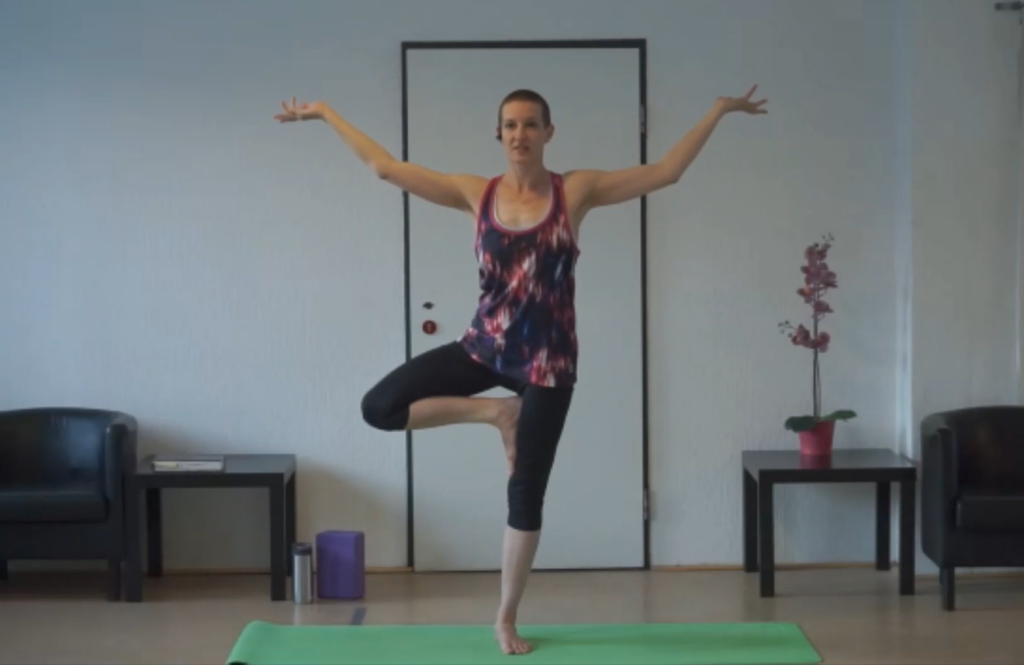
In yoga, we foster a balance between stability and mobility that prepares the body and mind for whatever it may face. Recently, we’ve been practicing stability through the bottoms of the feet for balancing, visualizing planting them into the floor across a “golden triangle” of big toe-little toe-heel, or for those that prefer it, the four corners of the feet, pouring the weight evenly across that surface. Then we build a strong scaffolding of supporting musculature through mindful movement through balancing poses.

This week’s 40-minute practice video, “Happy Knees Stability Yoga”  was focused on developing stability for balancing, everyday activities, and athletic feats. 

Whether we physically jump or leap, all of us face leaps of faith in life. We can’t always clearly see the road ahead, and must do our best to build a strong foundation and then move forward in the hope that we will be met with a soft landing. If you’d like to explore how personal ontological coaching can assist you with the leaps ahead in your life, schedule a free consultation call with me over Zoom at my Calendly link here: calendly.com/ablythecoach

If you’re reading this blog in real time, I wish you a strong foundation and a spring in your step as we move from late summer into early fall, and any time of year, may you find the resources and support you need. I’m so grateful to be a part of your network, a thread in the net (or indeed or indeed a feather in the wings) that you find when you make your brave leap!

Blythe Stephens, MFA Dance

she/her or they/them

A Blythe Coach: Dance Education & Coaching 

move through life with balance, grace, & power

WordPress Cookie Notice by Real Cookie Banner