A Blythe Coach

Embracing Ballet Balancé – Classical Waltzing Theory & Practice

According to Agrippina Vaganova in Basic Principles of Classical Ballet**, Pas Balancé “Is one of the simple pas allegro, which is easily done even by children. In classical dancing it is often used in waltz tempo.” (p.99)

I love to waltz alone or as a pair, in ballet, ballroom and other styles, and find it’s swingy rhythms intoxicating, much as its early fans and critics did! This blog brings weekly insights on dance, yoga, well-being, creativity, and joy and today I’m talking about my love of balletic waltzing and the origins of this elegant dance, and I did in the companion YouTube Video and Podcast:

In podcast Episode 043: Waltzing into Spring with Ballet Balancé I provide an audio version of this discussion about Balancé and the Waltz.

History of the Waltz

Although the Waltz has become a beloved ballroom and social dance as well as inspiration for balletic movement performed in concert dance, at first it caused a scandal. As Wikipedia relates:

“There are many references to a sliding or gliding dance that would evolve into the waltz that date from 16th century Europe, [and] Around 1750, the peasants of Bavaria, Tyrol, and Styria began dancing a dance called Walzer, a dance for couples. The Ländler, also known as the Schleifer, a country dance in 34 time, was popular in Bohemia, Austria, and Bavaria, and spread from the countryside to the suburbs of the city. While the eighteenth century upper classes continued to dance the minuets (such as those by Mozart, Haydn and Handel), bored noblemen slipped away to the balls of their servants.

In the 1771 German novel Geschichte des Fräuleins von Sternheim by Sophie von La Roche, a high-minded character complains about the newly introduced waltz among aristocrats thus: ‘But when he put his arm around her, pressed her to his breast, cavorted with her in the shameless, indecent whirling-dance of the Germans and engaged in a familiarity that broke all the bounds of good breeding—then my silent misery turned into burning rage.'[…]

Shocking many when it was first introduced, the waltz became fashionable in Vienna around the 1780s, spreading to many other countries in the years to follow. […] The waltz, especially its closed position, became the example for the creation of many other ballroom dances. Subsequently, new types of waltz have developed, including many folk and several ballroom dances.”

When Americans got ahold of the waltz, they of course had their way with it, including delightful movie musical versions such as this one with Ginger Rogers and Fred Astaire, “Waltz in Swing Time” from Swing Time (1936):

“Waltz in Swing Time” with Ginger Rogers and Fred Astaire, from “Swing Time” (1936)

Waltzing through the Classical Ballets

There are many famous waltzes in classical ballets, including “Sleeping Beauty” and “Cinderella” as well as more modern pieces such as Balanchine’s “Vienna Waltzes” to music by Richard Strauss. Since it was St. Patrick’s Day this week, I’ve been sharing Irish folk music in dance classes all month, including a lovely Irish Waltz that makes me want to dance!

Waltzing in Classical Ballet Technique

In the Technical Manual and Dictionary of Classical Ballet**,  Gail Grant describes Balancé as a “Rocking step. This step is very much like a pas de valse and is an alternation of balance, shifting the weight from one foot to the other. Balancé may be done crossing the foot either front or back. […] Balancé may also be done en avant or en arrière facing croisé or effacé and en tournant.” (p.11)

Vaganova describes the performance of a basic ballet balancé: “Stand in 5th position, right foot front. From demi-plié, do a light jeté with the right foot to the side, and then draw left foot back (on count one). On count two change to the left foot on half toe, and on three lower yourself again on the right foot in demi-plié, and raise the left one sur le cou-de-pied back. The next balancé will be to the left, i.e. jeté left, etc.” (Basic Principles of Classical Ballet** p.99-100)

I find in describing a balletic waltzing step to dancers of other forms, it compares well with modern dance’s “Triplets,” or “The Pony” of the 1960’s. 

What is a Waltz Rhythm?

In a blog and podcast coming soon, I will discuss musical meter, ¾ time, and so forth, but for now it is helpful to think of counting a waltz step as “one and uh two and uh three and uh four and uh…” or “one two three, two two three, three two three, four two three…” Unlike other even meters such as marching rhythms, you’ll notice is has a distinct up-and-down, lending a swingy feeling. T

he accent or emphasis in a waltz rhythm is usually on the first beat, unlike other rhythms in 3, for example the mazurka, where the accent is on the second beat.

Balancé in Ballet Class

“A balancé in ballet is a step where a dancer moves while alternating balance between their feet.  The rhythm is usually in three counts like a waltz and has the motion of going “down, up, down” with their legs. […] Balancé is often taught to young ages and in beginning ballet classes.  The ease of the step combined with the feeling of movement and ‘dancing’ makes it an enjoyable step at these levels and further into advanced levels.  Like many beginning ballet steps, balancé is used often in advanced classes and through professional levels. Dancers will often be given combinations with balancés in center combinations, such as pirouettes or adagio.  A balancé en tournant is common in pirouette combinations because this has the dancer turning in a waltz-style movement.” (ballethub.com)

Such a versatile rhythmic pattern and dance technique spans many schools and styles of dance, so practicing balancé will pay off in technical gains as well as the pure joy of moving!

More Music for Balancé & Waltzing

For more free-wheeling triplet-ing waltzy musical fun, check out my “Waltzing into Spring” playlist or Spotify’s “Strauss II Waltzes and Polkas” playlists:

Send me a message, or hop over to the A Blythe Coach Facebook Page and tell me about your waltzing experience and favorite steps!

Blythe Stephens, MFA
she/her or they/them
A Blythe Coach:
move through life with balance, grace, & power

** This blog is not sponsored. Amazon Affiliate links potentially give me a percentage of the purchase price.

DISCLAIMER: A Blythe Coach recommends that you consult your physician regarding the applicability of any recommendations and follow all safety instructions before beginning any exercise program. When participating in any exercise or exercise program, there is the possibility of physical injury. If you engage in this exercise or exercise program, you agree that you do so at your own risk, are voluntarily participating in these activities, assume all risk of injury to yourself.
Move Your Body: Minimalist Fitness for Maximal Well-Being

I am realizing that there are two ways to look at my approach to achieving my goals, especially when it comes to today’s topic of physical fitness and training: there is the positive interpretation, or “efficient,” and the negative way, or “lazy.” 

But it doesn’t matter how my behavior is interpreted, as long as it is getting me the results that I seek! In order to achieve my most important goals, I need to prioritize, and along the way I have learned to find the least amount of effort to accomplish what I desire. Even big goals begin with these small steps!

Here I’m sharing my current minimalist workout or cross-training regimen, future fitness goals, and ideas for creating your own custom plan, and you can also check it out in audio format on my Podcast 042: Lazy Minimal Fitness – Cross-training for dance and overall well-being.

What makes you feel good?

That’s right, we’re talking about exercise and working out, and I want to be clear that I am not not necessarily recommending that you exercise like me, or suggesting that the way you appear, function, move your body should in any way resemble the way I do. You are beautiful as you are, there is nothing wrong with you, and I just want to share tools that have helped create better balance and well-being in my life. Body positivity all the way! 

What I want to encourage is your own discovery of what brings you joy in movement, what makes you feel good and capable, and what expands what your body can do, in the ways you want to. 

Taking control of your movement, your yoga practice, and your dancing can be incredibly liberating and can ripple out to the rest of your life. Maybe for you, minimal movement involves doing a favorite stretch each morning, a walk around the block on your break, or another action you will enjoy and that cumulatively, will make you feel good!

For myself, I currently enjoy a combination of daily short yoga sessions, weekly longer practices, short physical therapy and callisthenic/cardio bursts, teaching ballet and yoga, and other leisurely activities to complement, like walks, hikes, bicycle rides, or swimming as well as plenty of rest, massage, and the like.

Squeezing in well-being

Back in my Whitman College Admissions days, I had the least amount of time to exercise in my life so far, and so cherished very occasional visit to the yoga studio, but more often turned to my Crunch Fitness “Pick Your Spot” Pilates workout DVD. With it, I could choose what area to focus on (I believe it was belly, buns, thighs, or full-body), and in only 15 minutes get a decent workout that helped me deal with tons of time spent at the computer, desk, airplane, and car.

Working as a life coach, many of my clients have had physical well-being goals, as well as facing real health challenges, and I have supported them in creating habits that transformed their life experience, such as in the case of one client, whose results including having, “[…] begun a simple exercise routine and have completely changed the way that I eat and cook — I’ve even lost weight without once experiencing hunger.  My pain levels have decreased, I have more energy and I can sleep through the night…” 

Choosing from the cross-training menu

I have collected many exercises over the years from dance, yoga and Pilates classes as well as physical therapy from a variety of practitioners, and have developed a minimal and evolving plan that allows me to do what I need to do (teach ballet and yoga, bicycle, walk, sit to create content, coach, and study on the computer), feel able, minimize my stress, and care for my nervous system. I do have lingering pain from accidents and injuries of the past, so there is a certain amount of maintenance I require to minimize the effects of old whiplash and other injuries.

To my students and dancer friends who struggle to participate in other kinds of activity aside from dancing, I share Eliza Gaynor Minden’s words from The Ballet Companion** section on Cross-Training: 

“It may be that all you want to do is dance, but the well-rounded dancer can benefit from a variety of training tools. Pilates, resistance training, the ancient practice of yoga, along with thoroughly modern forms of exercise such as Gyrotonic and Floor-Barre can improve overall strength and stamina, help overcome specific weaknesses, and generally complement a dancer’s regime. You can become a better, stronger, more capable dancer by doing more than just dancing.”

So how do we get the benefits of a variety of cross-training exercises or workouts, with the least expenditure of time and effort?

Consider starting with short and simple yoga

Yoga makes me feel good, and I finally developed a consistent personal practice starting three years ago with the Yoga with Adriene YouTube Channel 30-Day Challenge and monthly calendars.

I found that doing short, 15-30 minute practices daily, in addition to weekly full-length in-person classes at local studios, made me feel amazing! It manages my pain, balances my strength, and gives me time for self-study and relaxation.  Over time, my own personal practice has grown, and I continue to learn more through teaching others. 

I agree with yoga teacher Georgina Berbari, in the article “How Long Should a Yoga Session Be? A yoga teacher shares some thoughtful insight:” “The beauty of being a yogi who practices at home is that some days, your practice is five minutes long, and others, it’s nearly an hour — and that’s totally cool. When you’re not in an actual studio, and you’re flowing freely without instruction, there’s a lot more flexibility in terms of how long you remain on your mat.”

In the same article, Sara DiVello, a nationally recognized yoga and meditation teacher shares that, “Though there’s no yogic handbook detailing the designated length you should make your practice in order for it to “work” (whatever that means), she’s no stranger to feeling obligated to remain on her mat for a certain amount of time.” But obligation and long duration do not a happy practitioner make.

Indeed, rather than starting with an hour or more of yoga every day, what worked for me was to practice consistently at least 5 minutes a day, focusing on specific areas of the body or themes that are relevant to me that particular day (quick wins, reinforcing the practice with how great it could make me feel in minimal time), and that once I was doing so regularly, it became easier to add in more.  

The “Yogalicious” playlist on YouTube includes practices 5-60 minutes in length

This insight that I was more likely to practice more often if it were for less time per session, I then applied to my meditation, physical therapy and cross-training. 

Minimalist approaches to fitness

Last year, I added a little cardio/full-body workout to my habits, inspired by reading The Minimalists’ book Essential**, of which Joshua Fields Millburn’s essay “18-Minute Minimalist Exercises” was a part. I appreciated his applying a minimalist and enjoyable philosophy to fitness, and the example of committing to only 18 minutes daily of exercises he enjoys, outside in the park, to get great results!

Fields Millburn recommends doing exercises you like, using movement to de-stress, and building in variety. For example, “I do only exercises I enjoy. I don’t enjoy running, so I don’t do it. I attempted it for six months and discovered it wasn’t for me. If you see me running, call the police—someone is chasing me. Instead, I find other ways to do cardio: I walk, I get on the elliptical machine at the gym, I do bodyweight exercises that incorporate cardio.” I laughed at that description, as I feel quite the same way about running, but also need to keep my endurance up in order to be able to demonstrate dance and yoga as well as speak in class. 

Continues Fields Millburn: “Variety keeps exercise fresh. When I first started exercising, I used to hit the gym three times per week, which was certainly better than not exercising at all. Then, as I got more serious, I started going to the gym daily. This routine became time-consuming, and doing the same thing over and over eventually caused me to plateau. These days I mix it up: I walk every day, and I still hit the gym occasionally, but the thing that has made the biggest, most noticeable difference has been the variety of daily eighteen-minute bodyweight exercises.”

I really got jazzed by their podcast “Ep 174 Minimalist Fitness.(with Ben Greenfield),” and subsequently adapting my own minimalist fitness regimen. I learned the details of the “10-Minute Workout” from the Optimal Living Weekly newsletter of the Optimal Living Daily podcast by Justin Malik in February 2020, and it is also featured in the article, “Study Finds 10 Minutes of Exercise is All You Need.”  

The article states, “There is an ongoing debate on the effectiveness of short workouts and whether or not longer is better. We do know that short bursts of high intensity interval training can be more effective than 45 minutes of moderate cardio, but longer workouts can help us build endurance. Ideally, we could do both — a couple of lengthy sweat sessions every week mixed in with a couple of short workouts leads to long-term fitness.”

Sounds like a manageable combination for me- regular, short bursts of activity, whether they be yoga, walking, resistance training, or other cardio, mixed with longer sessions when possible. 

My current “Micro-Workout”

The minimal program described is designed to be simple, minimal, and adaptable, and as the research found, “Not only are 10 minute workouts effective, but in some cases, you don’t need any equipment or room to complete them. Ben Greenfield, fitness and triathlon expert, recommends completing these moves three times:

  • 50 jumping jacks
  • 15 body weight squats
  • 15 push-ups (on your knees is fine)
  • 15 reverse lunges per side
  • 15 tricep dips (using a chair or bench)

Try doing this workout every morning and see if you notice a difference in a couple of weeks. Your results might surprise you.” 

Last year, I chose versions of each of the basic exercises that suited me at that time, and also recorded videos for each element with a variety of fun variations and modifications to try. Maybe you don’t feel up to jumping today (or ever), then consider my side-lying jumping jacks. Or perhaps your aversion to push ups could become delight with the right variation.

Micro-Workout” YouTube Playlist

[Side note: how can it be nearly a year since I created these videos? That was before my website and blog were yet up, and they were among the first I shared on my new A Blythe Coach Channel! I can see in these videos the difference improvements to my camera, microphone, editing, and more have made! But I think the message and variations in each are still worthwhile, keeping in mind that I’ve brought the quality of my videos up a lot since then and seek continual improvement with each one that I make.]

Full disclosure, though I tried to do the workout daily at first, it was certainly correct to say that it yields results! I was super sore after just one round (not the recommended three) in the beginning, and after nearly a year now, I have worked my way up and settled into doing the workout the recommended three times through, but only 2-3 times per week. I saw results right away, particularly in my arm strength, and am much fitter than if I didn’t do it, with a minimal expenditure of time! As I plateau, I’ll keep trying new variations of the movements to add challenge, but not increase the time spent.

On a weekly basis, I also do my mini physical therapy practice (distilled down to two exercises) about twice, and you can see me doing both workouts live from time to time on my Instagram and Facebook Lives as accountability and inspiration 🙂 

More movement motivations

Or maybe none of these exercises is right for you, but the idea of coming up with your own edited capsule or micro-workout inspires you! There are other fun ideas to move your body on my “Wonderful Dance Warmup” playlist, “Ballet Barre” playlist, “Sumptuous Stretching,” and “Concentrated Core Conditioning,” “Arm Artistry,” “Foot & Ankle,” “Legs, Legs, Legs” specific groupings. Or maybe a focus on your breathing through yoga pranayama practices from the “Beautiful Breathing” playlist is something you want to add to the mix.

My “Wonderful Dance Warmup” Playlist contains more favorites for dance conditioning

In the spring/summer/fall I do more bicycle riding and I enjoy long walks and hikes all year round and swimming when I can get it. My next goal is to be able to do a pull-up, and perhaps to work in a minimal jump rope regimen at the park (like Fields Millburn, I hate running, but used to enjoy skipping rope), will keep you posted on my progress! 

Tips to customize your fitness fun

Make it minimal with “atomic” habits

Want to create your own minimal routine to achieve well-being, physical or dance technique goals? I’ve benefited greatly from reading the book Atomic Habits** last year and a couple particularly valuable takeaways for me were to make the habits truly manageable and small (“Atomic”), and to make sure they are relevant to your identity (an enjoyable expression of who you are!), or that which you are wanting to manifest.

Thus, I recommend making your new habit as tiny as possible at first, so light and low-commitment that you can find no excuse to wiggle out of doing it and can build a regular practice to see results.

You could commit to five minutes of yoga or stretching daily, a walk around the block, or take the stairs when you see them…so that it’s downright silly to skip it no matter how busy you are. If you skip a day, you genuinely miss it, and you just might get carried away and want to do more! 

Don’t skip more than one day in a row

I really like Matt D’Avella’s “The Two Day Rule” rule of not skipping more than one day of a habit. This way it’s not perfectionistic 100-percent-ism or failure, rather you can take breaks when needed, but it still creates that consistency and results that will keep you going. 

Habit tracking and giving yourself credit

As I shared in my “Healthy Habit Building” Blog, I learned to track my habits while training with Accomplishment Coaching, and in recent years I have established new habits, stacking them, and tracking them. I’ve become a consistent journaling, gratitude, and meditation, German language learning, a short sequence of Physical Therapy exercises for my knee, a minimal full-body workout, and more. 

For me, it is important to give myself “credit,” preferably colorful, playful, celebratory credit, to track the new habit(s) visually and with analytics over time. It is so satisfying to color in squares or check off boxes, or even use stickers, it makes me want to leave no empty boxes in the row!

I have enjoyed the Atiliay.com Monthly Mindset + Goals Sheet and monthly Habit Tracker as well as creating a similar setup in a notebook or bullet journal, and electronically on apps like the Today Habit Tracker App which lives on my phone’s home screen. I have also enjoyed working with an accountability partner and briefly reporting to each other daily on our performing our promised habits and actions. What appeals to you?

What will your own minimal cross-training plan look like?

Is it irresistible and in small enough increments where I can find no good excuse to skip it?

Does it feel good, make you feel stronger (or more flexible or more relaxed…) and encourage you to keep going?

What structures of support and accountability do you need in place to guarantee consistent practice for guaranteed results?

Go ahead and tell me at the A Blythe Coach Facebook Page or on my website, ablythecoach.com

Blythe Stephens, MFA
she/her or they/them
A Blythe Coach:
move through life with balance, grace, & power

My Minimalism Memoir

“Whatever you stockpile–be it diamonds, big houses, fame, money, proficiency at advanced yoga poses, or less flashy things, you will inevitably encounter two certainties. First […], all will be lost. Second, these things, in and of themselves, will never satisfy your cravings, which are expressions of your fear and emptiness.” -Judith Lasater in Living Your Yoga** (p.107)

Hiking from West Virginia to Maine on the Appalachian Trail with just a daypack of gear

I’m pretty excited to talk about minimalism in the blog today, as it’s an important principle of my ideal life, to be unburdened by excess things and free to move through the world with, as I say, balance, grace, and power!

Just as I was never a “perfect” vegan, so too am I also a very imperfect minimalist, but what is important to me is the process and the results that I have seen in my life, not appearing a certain way or having some specific number of belongings. I want to critically edit and focus on what is most important, but not live with nothing.

You can also hear my “Minimalism Memoir” in Podcast form, and just scroll to the bottom of this blog for more of my favorite resources on the topic. 

I have always enjoyed an elegant, minimal aesthetic, and making things happen in my life in the simplest way possible. Though the pursuit of a materially minimal lifestyle is ongoing (it will never be complete and finished, and that’s the practice!), further it has become a mindset and approach to all that I do, asking myself, “how can I make progress on this with the minimum of time, effort, and materials?”  

This is concordant with yoga philosophy and the sacred texts of yoga which I have read, according to which nothing really belongs to us anyway, and detachment and lack of greed are key tenets. Other world philosophies and religions also share this ethic, including Biblical humility, faith in being provided for, and priorities. As Jesus stated, “ For where your treasure is, there your heart will be also.” (Matthew 6:21)

My Simplicity Story

But more on the theory and practice as we go along, I’d like to share my personal path with minimalism with you (and hear yours!), the challenges I face with it, and resources that have provided inspiration.

Aspiring to be Organized as a Child

Always a fan of life-optimization and effectiveness and wanting to make the most out of my time on earth, as a child I read Don Aslett’s engaging books on de-cluttering such as Clutter’s Last Stand** and proceeded to organize my room.

In elementary and middle school, I was a little nonconformist and my minimal tendencies sprung from valuing anti-consumer bohemian creativity. I loved animals, and was a vegan, too, striving and advocating for a small environmental footprint. I sought items that were high quality over quantity, keeping with basic needs and timeless pieces rather than following trends of the moment, and keeping focused on my interests of reading, study, the performing arts, and the environment. 

This all served me well when I left home to pursue pre-professional training in ballet at UNCSA, when I moved clear across the country from Hawai’i to North Carolina, and arrived to share a dorm room with two roommates (that’s right! 15 years old and living in a “triple” with two other dancers!). It was a good thing that I only had two suitcases and two small trunks in tow, as there wasn’t a lot of room for things in the midst of the bunked and lofted beds and ballet gear. 

Low-Impact as a Teen

I maintained this low-impact lifestyle through my teens (except the jet fuel of going home twice per year, ahem), keeping with a minimal aesthetic in ballet/dance and a focus on my art, a low budget and little space in my room or my life for material things.

I prioritized my education, a love of biology and value of preserving biodiversity, and also mobility, allowing me to move cross-country yet again, this time to Washington State to attend Whitman College.

Everything that Jamey and I brought with us ultralight backpacking on the Appalachian Trail in the summer of 2002

Traveling Lightly into Early Adulthood

Preparing to backpack on the Appalachian Trail for the entire summer of 2002, my then-boyfriend (future husband and ex-husband), Jamey and I eagerly studied Beyond Backpacking: Ray Jardine’s Guide to Lightweight Hiking**, collected the lightest gear we could find, and were ruthless with our minimal packing. 

Ultralight travel was a shared value as well as a necessity, as we would be completing the nearly 1,000-mile trek without having actually trained for it. We made sure to carry no more than 20 pounds of gear (as I recall), since food and water weight can also really add up (this I remember all too well) and we didn’t want to pack more than we could handle. It was a beautiful and challenging experience that I will always remember!

This is a great metaphor for all of life, as the less I owned, the easier it was moving from state-to-state, school-to-school, room-to-room, house-to-house, even country-to-country. Not that I ever feel that moving is “easy,” but there is certainly a spectrum of difficulty, and knowing how to only carry what I need made it easier to study abroad in Italy in 2000, to tramp around New Zealand for three months in 2005, Peru in 2011, and to relocate my life where and when I felt called to do so.

Though I did accumulate things while in college (hello, textbooks!!!), I still needed and wanted to keep my possessions minimal, and was reinforced by what I was learning in my Philosophy major, specializing in ancient philosophy including Aristotle’s ethics of moderation, environmental studies, reading of the transcendentalists Emerson and Thoreau, and self-improvement literature pleasure-reading, such as Three Black Skirts: all you need to survive** 

Related to focusing on what is most essential (and perhaps this should be part of a future blog, as it is related to how I paid all my undergraduate student debt off in two years), Jamey also introduced me to the book Your Money or Your Life**, which helped me to get clear on my own financial and life priorities, essentials, or minimal requirements for satisfaction in the same way I did in minimizing my belongings.

I enjoy making the most of compact spaces, from living on campus as a student, Sorority Member, and Resident Assistant, then as partner of a Resident Director, with frequently-changing living arrangements. After I graduated from college, I loved my tiny rooftop studio loft while working in Admissions, and it only required a very small U-Haul to lug our junk to California with Jamey’s family while we decided where to land next, which after time in New Zealand and with my family in Hawai’i, wound up being Portland, Oregon. 

Coaching Myself in Portland…and back to Hawai’i for my MFA

We found a wonderful, central little one-bedroom apartment in Portland, which is also where I discovered a new career of Life Coaching with InsideTrack and Accomplishment Coaching and continued on my path of discovering what is most meaningful to me, simplicity, travel, community, and artistic expression. I supported other people in achieving their educational and life dreams as I unfolded my own.

During this time, I saw the emergence of a new magazine about simple living, called Real Simple and grew addicted to a blog called Zen Habits by Leo Babauta and a sadly now-defunct YouTube Channel called Light by Coco. These discussed a materially minimal lifestyle as well as cutting back on tasks and activities that lack meaning in order to use our energy toward what is most meaningful.

I weathered many changes in Portland, including a divorce and falling in love again, which led to moving back to Hawaii and pursuing my MFA. What a life! My new flame, Nicole (future wife/ex-wife) and I made the move without a shipping container, but weren’t certain just how long we would stay, so put things not urgently needed into storage (gratefully, in a friend’s garage free of charge). Ultimately we decided to remain longer than a couple of years, so returned to Portland for a visit and and to give most of our things away to friends. What was most important, we mailed (mostly books, no surprise!).

Living in Honolulu was even more expensive than Portland, and we were a student and a teacher, so we lived in shared houses in Pearl City, had our own studio in Waikiki for a time, then ran an Airbnb at our “compound” shared with friends in Kalihi. We had shared values of minimal spending on nonessentials, focus on experiences, the arts and the outdoors, and using community resources to minimize spending and environmental impact through the sharing economy.

While earning my MFA and dancing and teaching all over, I also learned about The Minimalists and Matt D’Avella through their first documentary and books (both of which have multiplied, and they have a great blog and podcast), and became even more obsessed with small capsule wardrobes through Courtney Carver‘s Project 333, (and later her blog, newsletter and Soul + Wit Podcast), as well as the YouTube Channels of Use Less‘ Signe and Justine Leconte. A low-maintenance stance suits my academic and artistic lifestyle so well!

At this point, Minimalism was a full-on cultural phenomenon, and I rode the Konmari/Marie Kondo Life Changing Magic of Tidying Up** wave with enthusiasm, keeping only what sparks joy (except for those last couple areas in which I’m still working to soften my grip). The Minimalists also introduced me to the idea of the Minsgame, which really came in handy when my second marriage abruptly ended and I underwent subsequent drastic changes.

Rufio helping me sort schoolwork during my pre-move Minsgame in 2019

That is, events unfolded to present the opportunity to move abroad and I took it, so I had to pare back again, after eight years on O’ahu! I spent a month playing the game (eliminating one thing the first day, two the second, and so on, to release hundreds of belongings), and then continued to purge down to a few bags to store at my family home, and a few to take with me, plus media rate boxes to follow. You can check out the results of my first trip through the Minsgame in spring of 2019 on my personal IG 🙂

Minimal Move to Germany in 2019

Everything that flew with me from Hawai’i to Germany 20 months ago

A minimalist approach freed me to move to Germany, to live in an urban apartment while teaching and creating here. I do have certain collections that have stayed with me, but they are very specific: books, keepsakes/nostalgia/correspondence. And I’m keeping my accumulation of physical books to a minimum with a Kindle, ever an avid reader. 

Since the move, I had the chance to complete a yoga teacher training, learn German, and continue to teach, coach, and study my passions of dance, pedagogy, and spirituality. 

Yoga Philosophy & Current Spiritual Growth

Reading classical texts of yogic philosophy while in my training program and since, I found much that resonated with my minimal mindset. In the Yoga Sutra**, Patanjali counsels practitioners to follow aparigraha, greedlessness or non-covetousness, a relevant Yama or avoidance, and also a relevant Niyama or observance called santosha or contentment (which is also the theme I have personally declared for 2021).    

Lasater explains, “When we seek contentment, or what Patanjali calls samtosha, we are closer to experiencing our own wholeness. In book two, verse forty-two, he writes […] ‘Through contentment unexcelled joy is gained.’” (Living Your Yoga** p.108)

The Bhagavad Gita** also admonishes against attachment to the material world, for example in 5:22 it states, “Pleasures that come from sense contacts, Arjuna, actually are the womb of pain. A wise person does not delight in pleasure that comes and goes.” (The Living Gita** p.76) So the path to wisdom is indeed a simple one.

Additionally, Lasater shares wisdom from Zen Buddhism regarding The Five Remembrances of Shakyamuni Buddha (presented by Thich Nhat Hahn, a Vietnamese Zen Buddhist monk, in The Plum Village Chanting Book), of which I find the fifth most relevant to this minimalist meditation: “My actions are my only true belongings. I cannot escape the consequences of my actions. My actions are the ground on which I stand.” (Living Your Yoga** p.97)

However, as I said at the start, I am human and as such, do tend to cling to certain things! I always struggle to let go, as I have emotional attachment to so many things, but I also always find it worth while to eliminate as much as I can.

Paperwork and Nostalgia – my “last bastion” of clutter

My achilles heel of minimalism is all things nostalgic- photos, albums, schoolwork and proof of my accomplishments, as well as other paper records. I am working to digitize and minimize in these areas to enjoy maximum freedom in my current lifestyle in Germany. 

My journey to simplicity is ongoing, and this month I’m tackling one of the last bastions of hoarding, playing the Minsgame again, this time focused on my paper clutter, including assignments from my MFA, notes from teaching and coaching over the last ten years, financial documents, and more. You’re invited to join me in a Spring Cleaning minimization fest! Let me know what you’re working to remove from your life to live more lightly here or at the A Blythe Coach Facebook Page

Two of the ten boxes of books, papers, and gear that followed me to Germany

Minimalist & Simplicity Resources

Living Your Yoga** by Judith Lasater 
Clutter’s Last Stand** by Don Aslett
Beyond Backpacking: Ray Jardine’s Guide to Lightweight Hiking**
Your Money or Your Life** by Vicki Robin & Joe Dominguez
Transcendentalists Collection** Thoreau & Emerson 
Three Black Skirts: all you need to survive** by Anna Johnson
Real Simple Magazine
Zen Habits by Leo Babauta
The Minimalists: Joshua Fields-Milburn & Ryan Nicodemus
Matt D’Avella: Minimalists’ Documentaries, YouTube Channel
Courtney Carver: Be More with Less, Project 333, Newsletter & Podcast
Use Less YouTube Channel by Signe (capsule wardrobes)
Justine Leconte YouTube Channel (capsule wardrobes)
Life Changing Magic of Tidying Up** by Marie Kondo
The Yoga Sutra** 
The Bhagavad Gita**
Never too Small YouTube Channel
Living Big in a Tiny House YouTube Channel
Exploring Alternatives YouTube Channel
Simplify Magazine

“When you allow yourself to see things as they really are, then–and only then–can you love yourself and others without hidden expectations. Detachment is the greatest act of love.” (Living Your Yoga** p.19-20)

Blythe Stephens, MFA
she/her or they/them

** This blog is not sponsored. Amazon Affiliate links potentially give me a percentage of the purchase price if you decide to buy a book.

Go Bananas for the Splits, Leap like Yoga Mythology’s Monkey God Hanuman (and a review of the basics of stretching technique)

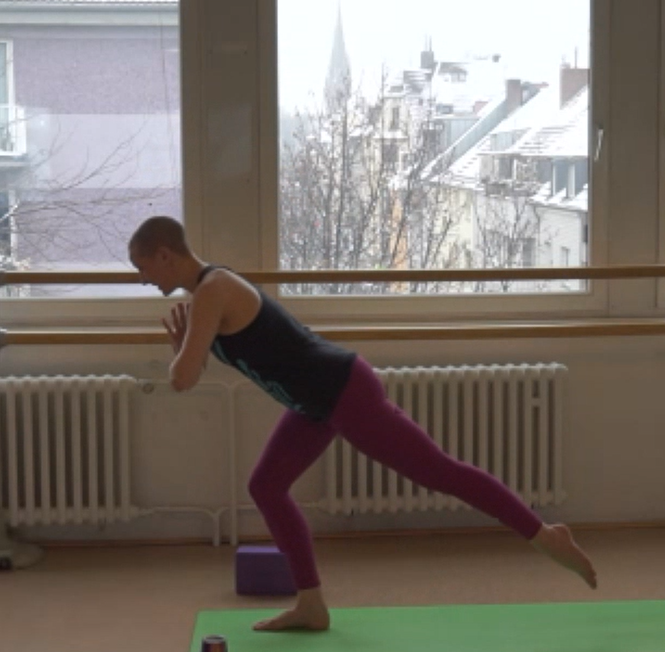
Screenshot of video of how I get into a yummy lunge en route to the splits/Hanumanasana

This article explores the classic splitting shape of Hanumanasana in yoga or “The Splits,” which becomes leaps like Grand Jete in Ballet dancing technique and others, in mythology, proper stretching practices, and performance.

Hanuman’s Journey

In the book Myths of the Asanas**, which details the stories behind the names of yoga’s poses, Alanna Kaivalya and Arjuna van der Kooij tell the tale of the monkey god Hanuman, who inspired the iconic forward-splitting yoga pose:

“Hanuman’s journey, as recounted in the Ramayama (the epic tale of Rama), is one of faith, fearlessness, and complete devotion. Hanuman is said to embody all of the qualities of the yogi, and his story reflects our own in many ways. How many times have we forgotten our own divinity only to fall back into the same self-defeating way of thinking over and over? Who hasn’t had a crisis of faith and wondered if some burden wasn’t too great to bear, or whether some task wasn’t impossible to complete? Hanuman teaches us that there is one thing that allows us to override all of our doubts and fears. That one thing is love.”  (p.75)

Along the lines of February’s theme of self-love, here we’re leaping into the benefits of a stretching practice for body and mind. I’ll include resources for preparing to stretch and going deeper with the practice as well, but let’s start with inspiration from Hanuman’s story:

“As son of the wind, Hanuman could do anything. He could grow very large or very small, move mountains, and even change his shape altogether. But he was constantly forgetting his divinity, and so he turned to his faith–which in Sanskrit we call shraddha–to give him the confidence to do what he knew he must accomplish.” (Myths of the Asanas** p.72) 

This faith allowed him to perform one of his most miraculous acts, to help save Sita, the wife of Ram, which was to spring over the ocean with a flying leap: “As he flew over the ocean toward his destiny, one of Hanuman’s feet reached forward and one foot reached back, like the famous split pose, hanumanasana, that yogis know today. Despite encountering numerous obstacles, including a demon that rose from the water to try to gobble him up, Hanuman landed confidently on the island of Lanka [to] let her know that Ram would be coming to save her.” (Myths of the Asanas** p.73)

Benefits of Hanumanasana and Splits practice

Both Hanumanasana, the full forward-facing split, and Anjaneyasana, a deep kneeling lunge that is its prerequisite,

“stretch the psoas muscle, which runs from the middle of the spine to the inner thigh. […] This very deep core muscle initiates all of our movements, and it is pivotal in the fight-or-flight response that is built into our bodies. For many people, the fight-or-flight response is almost continuously stimulated by a low-grade application of stress, which is so much a part of Western lifestyles, and results in a chronically locked psoas. The effects of stress are augmented by our daily habit of sitting for long periods of time on chairs, which also shortens and tightens this long, rope-like muscle.” (p.68-9)

Indeed, since renewing my focus on practicing this pose, I have noticed greater relaxation in the affected areas of the stretch as well as in my psyche. In fact, as Kaivalya and van der Kooij continue, “Because of its relation to the fight-or-flight response, which typically engages when fearful, the psoas is where we generally hide fear. The process of opening the psoas and encouraging its release through these […] related poses give us an opportunity to physically shed our fears and move into a state of fearlessness.” (p.69) This makes these stretches ideal medicine for our current pandemic-lockdown lifestyles, fraught with fear and an overabundance of sitting!

Anatomy/Kinesiology of Muscle Tissue

Exciting inspiration, yes? Now let’s take a couple steps back and discuss how stretching the muscles works in general and outline some safety precautions before we leap in. If you’re already familiar with this theory, feel free to skip ahead to the technical instructions 🙂 

Rory Foster breaks it down in Ballet Pedagogy**: “Muscles move, control, and stabilize our skeleton. They propel our body into movement as well as slow it down and stop it. They also stabilize the body, in both stasis posture and dynamic movement and balances. Muscles have three basic characteristics: they stretch, they contract, and they are elastic–they will return to their original length after being stretched. Muscle tissue turns into tendons toward the end of the muscles, and these strong semi-elastic tendons attack the muscles to the bones.” (p.67) 

Strive for balance between strength/stability and flexibility/mobility

In order for our training to serve a practical purpose, and advance our ability to perform techniques with mastery and artistry, we need to build our self-awareness and create a balanced regiment of strength and stretching or stability and mobility training. As Foster explains, “Teachers and students should remember that strength and flexibility must have a balanced relationship. Having a loosey-goosey body may be great for high leg extensions, but it requires a good deal of muscular strength to control such hyperflexibility.” (Ballet Pedagogy** p.67)

Flexibility affects not only the shapes that we make, but also how we enter into them and transition out of them, and create a whole-body effect. Especially the spine is involved in every stretch and movement, as foster points out, “Nearly all of the stretching that is done in ballet either directly or indirectly involves the spine by arching side or back (cambre), bending forward, or rotating. Therefore, the act of lifting or lengthening the torso, especially the upper back, prior to entering into the movement will elongate the spine, giving a fuller stretch with a greater range of movement and a more aesthetic look.” (Ballet Pedagogy** p.67)

Warm Up First!

Stretching when insufficiently warm will impede, rather than support your progress, so don’t skip a good warm-up before attempting any deep stretch, and go carefully.

Any dance, yoga, or movement instructor worth their salt will implore you to warm up, as “Doing proper stretches that involve a maximum range of motion and, therefore, a definite feeling of resistance reflex in the muscles should always be done after the body is warmed up.” (Ballet Pedagogy** p.67) 

Why? Because, as Foster elaborates:

“Muscles are made up of bundles of fibrous tissue encased in connective tissue called fascia. Some of the fascia fibers are gelatinous. When the body is cold, these gelatinous fascia fibers are also cold, making the muscles feel tight or stiff. Once the body warms up, the gelatinous fibers soften and flow, thereby allowing a greater and safer range of motion while stretching.” (Ballet Pedagogy** p.67) 

I also find Eliza Gaynor Minden’s words of advice on stretching in The Ballet Companion** very practical:

“Only when you feel warm is it appropriate to begin stretching. Once warm, be guided by the idea of ‘gently dynamic.’ Small, controlled movements are safer than either big, ballistic movements or no movement at all. Resist the urge to hang out in a static stretch position, especially in a big straddle stretch such as à la seconde on the floor. The other extreme–sudden, forceful movement–can cause tears, sometimes the ‘uh-oh’ kind you notice immediately, sometimes the more subtle and insidious kind that heal by forming scar tissue that creates a permanently vulnerable area prone to reinjury. Before class is not the time to test your full range of motion; a low, slow, mini battement cloche before class is ok, but whacking your leg up to a full extension might pull a muscle.” (p.109)

How shall we go about getting warm, then? If you’re looking for inspiration, I’ve got ideas, in the form of free videos on my YouTube Channel!

A sampling from my Wonderful Dance Warm-up Playlist:

Warming Yoga Flows from my Yogalicious Playlist:

Types of stretches and further words of warning

Gaynor Minden shares an important distinction between static, dynamic, and ballistic stretching: “The two types of stretches that dancers do regularly are static stretching and dynamic stretching. In static stretching, a position is held for 20-30 seconds, such as remaining in a split or straddle on the floor. Dynamic stretching is done while moving, such as doing a forward bend, an arched stretch to the side, a backbend, or a penche. It is never a good idea to do ballistic stretching […] when one bounces while in the stretch. It risks tearing muscle or fascia tissue.” (Ballet Pedagogy** p.67)

Listen to Your Body and don’t over-stretch

Gaynor Minden goes on to warn that, “Ambition, discipline, and zeal–all admirable traits–can get in the way of listening to the body. Put them aside for long enough to tune in and take an inventory of what feels tight. Try to distinguish between the salutary discomfort that indicates productive effort and the pain that warns of injury. If a movement feels ‘pinchy’ in the joints or causes residual pain, don’t do it. It’s not self-indulgent to heed your body’s messages. It’s prudent.” (The Ballet Companion** p.109)

It can be helpful to get visual feedback to check on your body’s alignment and where you can adjust the positioning, as Gaynor Minden reminds us, “Finally, the mirror is not just for primping. Try to find a spot where you can see yourself to check for symmetry and alignment.” (The Ballet Companion** p.109)

Foster reinforces the individual nature of our bodies and personal needs: “Increasing or maintaining flexibility through stretching is important, and how much and what type of stretch will depend on the individual needs of each dancer. Too much stretching, particularly if it involves ligaments, can result in hypermobile or loose joints, which will increase the risk of injury. Unlike muscles, ligaments are not elastic, and once they are stretched, they will not return to their original length.” (Ballet Pedagogy** p.67)

Be mindful getting into and out of stretching positions

This is true in both ballet dancing and also in the practice of yoga and mindful stretching, “How you arrive at and how you leave a position are as important as the position itself; this is just as true for stretching as it is in the rest of ballet. Your transitions into and out of a stretch should be slow, controlled, and graceful.” (The Ballet Companion** p.109) Each stage of the process is important, and contributes to our results.

Use your breathing to support the stretch

In the book Ballet Pedagogy**, Rory Foster explains the importance of breath support to all stretching practices, whether they be yoga as such, or more generally in dance and athletics: “Incorporating the use of breath is an important element to the mechanics of stretching, use of port de bras, and balletic movement in general. Unfortunately, teaching students to be aware of how they breathe and knowing how important breathing is in dance has diminished over the years. As the science of Yoga has become more mainstream in the West along with its teaching on the use of breath in stretching, more and more dancers are now learning and benefiting from it. Generally, we should use inhalation to elongate the spine and begin the movement, and we should use the exhalation to move further into the stretch or to increase and deepen the stretch once we are there, thereby helping to relax the reflex in response in the muscles. We use the inhalation again to bring us out of the stretch.” (p.67)

Yes, this is why I created Yummy Gentle Yoga for Dancers (and those who wish to be more dancerly), to bring out the connections between yoga and artistic movement!

I was fascinated to read the reminder that, “Movement of the legs into extension stretches the iliopsoas muscles from their insertions on the lesser trochanter of the femoral heads up through the pelvis and to their origin on the lumbar vertebrae and twelfth thoracic vertebra. This is the same place where the diaphragm attaches at the central tendon.” (Teaching Yoga** Loc 4677) Therefore we can sense in this stretch, the connection between freedom in the psoas and lower body, as well as in the flow of the breath. 

Step-by-step instructions also available in “Stretchy Banana Splits and Lunges” here on my YouTube Channel

Getting into Hanumanasana / training for “the Splits”

Start with a good warm-up, of course, either in the form of flowing through other simple yoga poses such as sun salutations or with another gentle but vigorous exercise such as those suggested above under “Warm Up First!”. Then start with getting familiar with some lickety luscious high and low lunges and gentle stretches of the major muscle groups of the legs and torso.

Leg and Hip Stretches:

Once your lunging shapes are well-established, you can move from a low lung into Hanumanasana in this way, as Mark Stephens details in the book Teaching Yoga** : “Place the hands on the floor and shift the hips back above the rear knee while straightening the front leg. Stay here for one to two minutes. Keeping the hips even with the front of the mat, slowly slide the heel of the front leg forward while extending the rear leg.”

It is very useful to use props such as yoga blocks or similarly-sized books to bring the floor to you and help get into the pose and enjoy its benefits. Stephens explains: “Since most students are unable to release fully into this asana, offer blocks to place (1) under the sitting bone of the front leg and/or (2) on both sides of the hips for hand support. It is important to position the hips even with the front of the mat while the sitting bone of the front leg is firmly grounded, thereby creating a symmetrical foundation for spinal extension and reducing the risk of lower-back strain.” (Loc 4340-4344)

Only after getting set up in this stable architecture, do we descend further into the stretch: “Once stably positioned with the spine upright, increasingly flex the front foot, engaging the quadriceps muscles and releasing the hamstrings. To the extent that the hips are even with the font of the mat, the back leg will more easily extend straight back from the hip. Emphasize internal rotation of the back leg, especially if exploring the backbend variation.” (Teaching Yoga** Loc 4344-4348)

As you breathe into the shape, consider how you have already overcome fear and resistance to the practice, regardless of what your shape may look like from the outside. Remember that gaining flexibility and range of motion is a long-term process, and we can only improve once we have gotten started. Be gentle and patient with yourself, and remember that, “We easily forget that there is a part of us that is also divine and can accomplish the impossible.” (Myths of the Asanas** p.72) 

Maybe we think accomplishing the splits, or some other advanced yoga or dance position is impossible now, but consider what a steady practice combined with faith in yourself might do!

What is your splits and flexibility story? Leap over to ablythcoach.com, the A Blythe Coach Facebook Page or Instagram and tell me about your successes and frustrations with positions such as these!

Blythe Stephens, MFA
she/her or they/them

** This blog is not sponsored. Amazon Affiliate links potentially give me a percentage of the purchase price.

DISCLAIMER: A Blythe Coach recommends that you consult your physician regarding the applicability of any recommendations and follow all safety instructions before beginning any exercise program. When participating in any exercise or exercise program, there is the possibility of physical injury. If you engage in this exercise or exercise program, you agree that you do so at your own risk, are voluntarily participating in these activities, assume all risk of injury to yourself.
Roses Have Thorns: Time, Love, & Mortality in “Sleeping Beauty,” “Hamilton,” Poetry, & Life

CONTENT WARNING: Death, Mortality, Tribulations [but with the intent to create greater meaning and motivation in life!]

To Free the Heart by Francis C. Anderson, Jr. 

Through dreary sodden days
The field sponged up
The greying skies.

And now the sun
Lies soft as birth again
As if the earth had just begun. 

And blossoms on the vines
Designed in spring
Come out to sing again.

And everywhere the ripening 
Pushes falling leaves apart
To free the heart
For freshening.

As through the seasons
Of our years

Becoming
Often waits the nourishment
Of tears.

Indeed! Becoming is a plant fed with tears, it requires great strength, and it can be scary to face the changes that time inevitably brings. This time of year, late winter just flirting with spring (depending on your locale), is bittersweet, loaded with possibility and waiting and patience. 

Winery with rose garden in Ruedesheim am Rhein, Germany

Our becoming depends on time, which, along with space, provides the fleeting field in which we live. In a future blog, I’ll cover more about time as an Element of Dance, and music, too, but today, I’m meditating on our relationship to time and our human mortality, and how the blink of an eye that is our lifespan is reflected in performance and poetry and how we can respond to our awareness of this fact. 

Sometimes, time seems to pass slowly, sometimes a season is gone in the blink of an eye. Some of us feel as if we can never get enough time to live the life we desire, and some feel as if they must endlessly wait for life to begin. Some times are filled with trials, some produce great masterpieces.

Hamilton’s non-stop approach to time

Why don’t you write like you’re running out of time,” goes the title of a “Hamilton-”inspired blog on Medium, responding to Alexander Hamilton’s drive to write and their own difficulties in doing so. Truth be told, I relate somewhat to Hamilton’s endless desire to express! In the musical, Alexander Hamilton is seen tirelessly, incessantly writing his ideas in letters and pamphlets and manuscripts, and those around him struggling to catch up. Unfortunately, his relationships suffer, but his lasting impact can’t be denied.

What is your relationship to time and to your own mortality?

I seek to fill each day with actions that I believe will make a difference in my life and in the world. My legacy, if you will, though that sounds a bit grandiose. Not that I bother to hope that my specific name will somehow endure or my particular story remembered. I have no illusions about that, as I don’t believe any one history can truly be remembered “for all of time.” Rather, it is my wish that the joyful, healing energy that I send out will, in effect, continue to radiate forever, having come from before and beyond myself in the first place.  

This mortality/death/rebirth idea has been hovering, amorphous, on the edges of my mind. It’s a little like a hummingbird- I can hear it and vaguely sense it’s movements before I can spot the bird itself. It’s doubtful that I can scratch the surface in one essay, one blog post, or ever quite capture what it is that is niggling at me to say. But I might as well get started, as a way to reflect on the loss and grieving I experience (we all do, and are) and connect about this universal experience and ways we may respond.

Synchronicity and pulling the Death Card in Tarot

While I’ve been ruminating on time, death and mourning, mortality, gratitude, blessings, “Sleeping Beauty,” “Hamilton,” and the fleeting nature of my own life, what with my 40th birthday approaching and the recent loss of two people in my circle (a best friend who we visited with often and is my age, and my girlfriend’s 105 year-old grandma), I was considering when I want to try to formulate some of these ideas into writing. I considered focusing on the dance technique topic of flexibility and working towards the splits first, but that is now planned for next week, as I then pulled the Death Card as my Tarot card of the week. So that was decided 🙂

This means big change (planned or unplanned), including loss and grieving, but ultimately light at the end of the tunnel. There’s no way out but through, but it’s helpful to have supportive resources on the way! By the way, I use Tarot Cards as a way to understand timeless archetype, access my own intuition and awareness, get perspective, and problem-solve, not to somehow predict my future from an external source. And it works nicely for my purposes!

According to Michelle Tea’s guide, Modern Tarot**, “Though the Death card, a difficult, almost uniformly painful card to draw, deals primarily with change, transitions, and transformations, it is largely the primal fear of death at our core that makes these and so many other endings excruciating for humans.” (p.96) Rather than being about physical, corporeal death, it can be helpful to think of it as some type of symbolic bereavement.

As Tea writes, “Sometimes I think the Death card would benefit from being renamed Grief, or Mourning, for that is the real heart of the card. There has been a profound loss, and whether you are grateful for the loss or devastated, a time of processing is upon you, of consciously letting go. It’s a time of feeling your feelings, your anxiety, or raging and making peace.” Modern Tarot** (p.96) 

It is a time to come to grips with fear, and put in place helpful coping mechanisms, while realizing that we can’t bypass our current situation, painful though it may be: “You’re not going to be able to pray-meditate-chant-yoga-cleanse-crossfit your way out of this one. While those pursuits are killer support systems, tools to help you through this moment, sitting down to meditate in the hope that you’ll be lifted away from your pain is (always) incorrect. Meditate in order to bring yourself closer to the razor’s edge of fear. Look it in the face. Accept it and make peace with it. If the fear of death underlies all fear, and fear is what stops us from acceptance and letting go, then getting into a practice of accepting that you’re going to die will have the ripple effect of assisting you with all loss.” (p.97)

I didn’t expect to find an explication of meditation in a book on reading the Tarot, but I think that’s as good an explanation as any! Meditation is facing exactly what is and learning to deal with it calmly. It can be very uncomfortable, and these are not necessarily easy truths to accept, but they can be paths to wisdom.

Memento Mori with Socrates, the Stoics, and Ryan Holliday

In Modern Tarot**, Michelle Tea summarizes: “No one outwits death, and no one outwits change.” (p.96) This sentiment echoes the practice if Memento Mori, or reflecting on the inevitability of our death. 

As Ryan Holliday of The Daily Stoic explains: “Most often, our ego runs away from anything that reminds us of the reality that sits at odds with the comfortable narrative we have build [sic] for ourselves. Or, we are simply petrified to look at life’s facts as they are. And there is one simple fact that most of us are utterly scared to meditate, reflect on and face head on: We are going to die. Everyone around us is going to die. Such reminders and exercises take part of Memento Mori—the ancient practice of reflection on mortality that goes back to Socrates, who said that the proper practice of philosophy is ‘about nothing else but dying and being dead.’ In early Buddhist texts, a prominent term is maraṇasati, which translates as ‘remember death.’ Some Sufis have been called the ‘people of the graves,’ because of their practice of frequenting graveyards to ponder on death and one’s mortality.” 

This awareness has the potential to give a sense of urgency to our actions, as we don’t know how long we “have,” and no one can! Sometimes I myself feel fearful about it, sometimes sad, sometimes in simple wonder. The ego doesn’t want to imagine it’s non-existence. I’m really quite attached to this life of mine, which I love! I find the experience of living glorious, precious, worthy of celebration, moving beyond words, as well absurd. But one thing I’m sure of is that I want to live my life the best that I can. 

Making the most of the time we (hope to) have

We all have much to contribute to the world in our time. I have heard the tragedy often cited of “going to the grave with our music still inside of us.” Who said that? I had to look it up, and according to Poynter.org: “While Henry David Thoreau is often credited with variations of the aphorism ‘Most men lead lives of quiet desperation and die with their song still inside them,’ that is not what he wrote in ‘Walden.’ He merely said, ‘The mass of men lead lives of quiet desperation.’ So it’s not clear who pointed out the tragedy of passing before we have given the gift we are meant to give to the world, but presumably they made their mark as the motivating idea resonates still. 

I can’t find the video I originally found around the idea, but this one is similar

A few years ago, I learned of the idea of estimating (based on average life span for your demographic) the total number of days of your life you might hope to see, then calculating where you are now to determine how many may be left. You also consider how much time goes into everyday activities and how much you’re spending on your important priorities, the idea being to be present to the finite nature of this life and need to appreciate and make the most of the present. It’s a little bit of a horrifying, yet enlightening exercise. 

I do not think this means that we need to be “Non-Stop” like Alexander Hamilton, nor is it healthy to work without ceasing, as breaks are necessary to avoid burnout and maintain a healthy, balanced life. For example, taking 20 minutes per day to meditate and do “nothing” could be a step on the way to enlightenment and the ultimate. Who knows? Do you value balance and calm in your life, or do you prefer a go-go-go productivity fest?

“Say Yes” like Andrea Gibson

If it inspires you, then by all means run with the idea to write, create, find your voice, your expression, what you are here to do or say or teach or be–go for it, during whatever time you may have! Whatever you dream of, live into it in the present moment.

Consider, as poet Andrea Gibson demonstrates, saying yes and playing your music:

YouTube Video of Andrea Gibson reciting the poem “Say Yes”
Sleeping Beauty’s Love Through Tribulations

Speaking of fear of death/being forgotten/left out, love, waiting, blessings and curses and other intertwined themes, in Podcast “039: What is the Moral of Sleeping Beauty?I talk about what the classical ballet “Sleeping Beauty” means, from the point-of-view of choreographer George Balanchine and Francis Mason in Balanchine’s Complete Stories of the Great Ballets** and my own perspective on productions, literature, and teaching.

For more about how I teach this particular ballet with children and adults, I also created a video on my YouTube Channel, below, and Playlist with example tracks on Spotify

Of course, many ballets feature death of characters, death and loss as a theme, or even as a character of it’s own, but at this time of looking ahead to spring while going through the dark time of Lent and also continuing to face global pandemic and personal loss, I’m fascinated with the connection of all these themes with The Sleeping Beauty. As Balanchine and Mason point out, it can be a little tricky to suss out a meaningful or uplifting moral:

“Most of the fairy tales that adults go to the theater to see again and again–Swan Lake, Cinderella, Hansel and Gretel, the Ring–symbolically enshrine truths about human experience and human behavior to make their pleasures more than incidental. Swan Lake, for example, is a drama involving conflict and character; it gives scope for dramatic expression, for acting, and for diverse striking interpretations. By comparison with Prince Siegfried in Swan Lake, Prince Florimund in The Sleeping Beauty is a cipher. What does he do to deserve his princess? The briar thicket surrounding his bride is no dangerous Magic Fire through which only the dauntless can pass. And similarly, by comparison with the brave, pathetic Odette and the formidable temptress Odile, Princess Aurora is a passive heroine played upon by circumstance. Can we find a moral in The Sleeping Beauty beyond that guest lists should be kept up-to-date lest awkwardness result?” (Balanchine’s Complete Stories of the Great Ballets**  p.553)

Charles Perrault, author of the fairy tale on which the ballet is based, explicitly spelled out his own moral for the story in poetry:

“Many a girl has waited long
For a husband brave or strong;
But I’m sure I never met
Any sort of woman yet
Who could wait a hundred years,
Free from fretting, free from fears.
Now, our story seems to show
That a century or so,
Late or early, matters not;
True love comes by fairy-lot.
Some old folk will even say
It grows better by delay.
Yet this good advice, I fear,
Helps us neither there nor here.
Though philosophers may prate
How much wiser ’tis to wait,
Maids will be a-sighing still —
Young blood must when young blood will!”

[https://www.pitt.edu/~dash/perrault01.html Source: Perrault’s Fairy Tales (New York: Dover Publications, Inc., 1969), pp. 3-21, translation from Old-Time Stories told by Master Charles Perrault, translated by A. E. Johnson (Dodd Mead and Company, 1921), translations of the verse morals are from Perrault’s Fairy Tales, translated by S. R. Littlewood (London: Herbert and Daniel, 1912).]

Sleeping Beauty Story & Music YouTube Video about how I teach the ballet to all ages

As I mentioned in the video, I personally enjoy the symbolism of sleeping and awakening again in relation to our travel through the seasons of the year, but “In a preface to the Penguin edition of Perrault, Geoffrey Brereton remarks that it is ‘tempting to adopt the nature-myth interpretation and see the tale as an allegory of the long winter sleep of the earth’–but adds that ‘the allegory, if it is one, is obscure.’” (Balanchine’s Complete Stories of the Great Ballets**  p.553) This is alright with me, as we can enjoy any interpretation of these works of art that makes sense, and make any creative connections we like!

Balanchine and Mason continue by describing the composer of the ballet’s score’s, take on the meaning of the tale: “Tchaikovsky’s interpretation was simpler. His Sleeping Beauty is a struggle  between good and evil, between forces of light and forces of darkness, represented by the benevolent Lilac Fairy and the wicked fairy Carabosse. The prelude, a straightforward exposition of the music associated with the two characters, suggests it; the consistent employment of melodies related to or derived from these themes, –The Lilac Fairy’s transformation of the Carabosse music at the close of Act I, the Carabosse figuration that propels Aurora’s dance with the spindle, the opposition of the two themes in the symphonic entr’acte that precedes the Awakening–makes it clear. These two forces shape Aurora’s destiny, and although she initiates nothing, with just a little stretching of the imagination we can accept the declaration of the Russian composer and critic Boris Asafiev that the heroine’s three adagios (the Rose Adagio, in E flat; the Vision Scene appearance in F, the Grand Pas de Deux, in C) tell ‘the story of a whole life–the growth and development of a playful and carefree child into a young woman who learns, through tribulations, to know great love’.” (Balanchine’s Complete Stories of the Great Ballets**  p.553-4)

Betraying their own perspective on the artform as well as appreciation for the complexity of meaning in balletic performance, Balanchine and Mason point out that “The question ‘Can we find a moral?’ prompts others.” They ask, “Is it right to look for one? Does the ‘meaning’ of The Sleeping Beauty not lie simply in its patterns of movement, as does that of, say, Ballet Imperial, Balanchine’s homage to Petipa and Tchaikovsky? While spectacle, pure dance, expressive dance, narrative, and symbolism must mix in any presentation of the work, what importance should be given to any single ingredient? Different productions have provided different answers.”  (Balanchine’s Complete Stories of the Great Ballets** p.554)

Yes, different productions provide diverse perspectives on the tale, and how rich is the material that has emerged from this surprisingly complex fairy tale! 

Speaking of love, life, roses, and poetry… Emerson and Shakespeare!

In his essay, “Self-Reliance”, Ralph Waldo Emerson wrote: “These roses under my window make no reference to former roses or to better ones; they are for what they are; they exist with God to-day. There is no time to them. There is simply the rose; it is perfect in every moment of its existence. Before a leaf-bud has burst, its whole life acts; in the full-blown flower there is no more; in the leafless root there is no less. Its nature is satisfied, and it satisfies nature, in all moments alike. But man postpones or remembers; he does not live in the present, but with reverted eye laments the past, or, heedless of the riches that surround him, stands on tiptoes to foresee the future. He cannot be happy until he too lives with nature in the present, above time.” (Ralph Waldo Emerson Essays and Lectures** p.270)

All this talk of roses, love, and human mortality is recalling to me Shakespeare’s Sonnet XXXV, which was one of the selections that guided my MFA thesis choreography:

Sonnet 35: No more be grieved at that which thou hast done

No more be grieved at that which thou hast done:
Roses have thorns, and silver fountains mud,
Clouds and eclipses stain both moon and sun,
And loathsome canker lives in sweetest bud.
All men make faults, and even I in this,
Authorizing thy trespass with compare,
Myself corrupting salving thy amiss,
Excusing thy sins more than thy sins are:
For to thy sensual fault I bring in sense—
Thy adverse party is thy advocate—
And ‘gainst myself a lawful plea commence.
Such civil war is in my love and hate,
That I an accessory needs must be
To that sweet thief which sourly robs from me.

Thanks for sticking with me until the end, and I hope these poems, classical ballet, musical, and philosophical distinctions have brought some perspective and inspiration to your life, despite the morbid theme. As Michelle Tea concludes at the end of her chapter on the Death Card: “We can’t leave this card without speaking about the […] chic black flag embossed with an enormous, elaborate rose. What could be more beautiful? And truly, as sure as the sun setting in the background will rise again, there is beauty at the end of this struggle.” (Modern Tarot** p.99)

For now, let’s find motivation to “play our music” in these ideas and interpretations, and in the future I’ll cover related topics of time, phrasing, musicality, how all of this contributes to yoga practice, choreographic inspiration, and more!

Blythe Stephens, MFA
she/her or they/them

** This blog is not sponsored. Amazon Affiliate links potentially give me a percentage of the purchase price.

Powerful Portfolios: Celebrate Your Greatness & Catalyze Action

This month I am celebrating Black History Month, Valentine’s Day, and self-proclaimed “Self-Love Month.” In order to love who we are, we have to first learn about who that is, then accept what we find and make the most of it. I have found that creating a “Powerful Portfolio” of my personal strengths, preferences, and history of success has been a wonderful resource on my path of self-discovery and achievement. It really gives me a boost when I need it!

Powerful Portfolios to Celebrate Your Greatness video on my YouTube Channel

In addition to the video above and this blog, I explored this topic in Podcast 037: Powerful Portfolios & Loving Who You Are.” Each of these media depicts and reinforces the theme a little differently. Which ways do you like learning best: reading, watching videos, or listening to podcasts? I find that I can fit in different media types at different times of day- I can listen to podcasts while moving around, watch videos while taking breaks, and read articles when I’m at my computer.

Resume-writing started relatively early for me as a performing artist, and I always kept mine updated with my latest performances, during my MFA program this was also emphasized, as it is very important in academia to keep a dossier of your accomplishments to help in applying for positions, promotion, tenure, grants, etc. I have long enjoyed seeing joyful milestones accumulate in my CV.

But the idea of a “Powerful Portfolio” that I’m talking about today, goes much deeper than the sorts of outward accomplishments that others will be impressed with, and can include personal talents, strengths, values, passions, goals…anything we find inspiring and want to return to when we need a reminder of who we are. 

As James Flaherty describes in Coaching: Evoking Excellence in Others**, in the coaching relationship, this process of learning about the client is called Assessment, and it is through this process that, “First, the level of the client’s competency is assessed. Second, the coach assesses the structure of interpretation of the client. Finally, the coach takes time to study the array of relationships, projects, and practices that make up the life of the client.” p.43 […] “That is, the coach must have a general sense of the way the client is in and makes sense of the world.” p.44 If this is true of a coaching relationship, it is all the more valuable for our relationship to ourselves, but it can prove challenging to have perspective on our own qualities. 

In his book, Launch Your Life, Morgan Rich explains how we can come to know and appreciate our unique qualities and preferences: “Who you are is a combination of how your brain works and what is in your heart and your body. When you Know Yourself, you understand that you are okay just the way you are. You will always continue to expand who you are and what you know, and you get to decide what is best for you and what you care about.” (p. 139) 

Rich recommends assembling a tool as you learn about your strengths and preferences: “While you build your Know Yourself, it will be helpful to capture the things you learn about yourself in the Powerful Portfolio part of your Play Huge Notebook. This can be a collection of pictures, words, poems, quotes, music, or whatever else will keep you connected to your Know Yourself and on the path of the Real You.” (p.160)

I love how many forms this can take, as it could be a notebook, file, collage, Pinterest board, audio file, jar… Mine is a binder, with articles, notes, goals, statements of purpose, resume and CV, thank-you notes from students and feedback from clients and colleagues, letters of recommendation, current projects, long-term goals, transcripts, certificates, mission and vision statements, inspiring quotes and music, and more as well as an annual digital (Google Doc & Evernote) running list of accomplishments, as shared in my 2020 End-of-Year Reflection blog.  

Rich suggests a few places to start when it comes to learning about your abilities and interests and collecting them in your Powerful Portfolio, including:

  • Learning Styles assessments – Visual, Auditory, Kinesthetic (p.144-6) 
  • Multiple Intelligences theory – Interpersonal, Intrapersonal, Logical/Mathematical, Linguistic, Musical, Bodily/Kinesthetic, Natural, Spatial… (p.147-9) 
  • Brain Dominance Tendency – Left and Right (p.149-50), 
  • Values (p.154, Values Clarification Exercise p.170), and I will link another resource on understanding values below
  • Passions (p.155, 171)
  • Talents (p.155, 171)
  • Rejuvenation or what makes you feel alive (p.156, 171)

I appreciate that Rich acknowledges that there are many many ways to understand ourselves, and helps us prioritize where to start so that we can take action without getting overwhelmed by the options, providing the caveat: “Remember the metrics I have chosen–learning styles, the multiple intelligences, and brain dominance–are ones I have found to be useful and meaningful over my years of working with people. If you have other measures that you find to be congruent with your way of being, then use those […] There are many sophisticated systems that will give you similar, but different, assessments of how you understand the world. I have found that these can be useful at a later stage of the Upward Spiral.” (p.163-4)

The Minimalists’ “How to Understand Your Values” article classifies values into Foundational, Structural, Surface, and Imaginary categories, a distinction I find helpful in understanding their importance to us and role in our lives, as well as for facilitating discussion with loved ones.  The MInimalists also provide a free Values Worksheet download to support you in understanding your personal values. I will probably write again about the distinction between our true values (those deeply-held pillars of our identity) and our apparent values that others can observe from the outside and how these may be aligned or drastically different… 

This is a journey of personal discovery, and ultimately no one else can tell you what is going to be most important and valuable to you: “You will have to figure out which of these ideas work best for you and which don’t work at all. The whole concept of Know Yourself is that you figure out a way you understand the world so you can powerfully create the life you want.” (p.158)

By way of a brainstorm, other places you may find inspiration to add to your Powerful Portfolio might be:

  • Some of those sophisticated tests that Rich mentions include the Meyers-Briggs (MBTI), Strengthsfinder, Enneagram, The Four Tendencies, etc.
  • I highly encourage you to add a “Love File” to your Powerful Portfolio, which is a tool I originally learned from colleague Kate Prael while working for Whitman College Admissions. The idea is to collect thank-yous, positive feedback, and nice notes into a file to look at when you need a pick-me-up, renewed energy, and reinforcement that you’re doing a good job and to keep going
  • I also enjoy an unofficial Accomplishments List to remind me of my hard work, persistence, and past results, to celebrate achieving intended objectives, mark milestones. It’s nice to have a place to go beyond what is listed in “professional” forums and go ahead and include EVERYTHING I’m proud of and would like to remember when I could use a boost
  • It may also be a helpful place to store lists of Needs & Conditions of Satisfaction (for life, relationship, career…)
  • Short-, Medium-, and Long-Term Goals and Projects may find a place within the Powerful Portfolio as we look to the future and reflect on our past
  • Results Tracking towards objectives & habits get down into the nitty-gritty of daily steps towards those big dreams and goals

I keep my Powerful Portfolio handy to remind me of my strengths, attractive qualities, purpose in life, valuable experiences, notes of appreciation, things that bring me joy, sources of inspiration, the ways I have been strong and learned important lessons in the past, and the dreams and visions I hold for the future. At dark or discouraged times, it can make a big difference!

Do you keep something like a “Powerful Portfolio” to celebrate your strengths and accomplishments, or do you plan to start? Send me a message, or hop over to the A Blythe Coach Facebook Page and tell me about it! ablythecoach.com

Blythe Stephens
she/her or they/them
A Blythe Coach: 
move through life with balance, grace, & power

** This blog is not sponsored. Amazon Affiliate links potentially give me a percentage of the purchase price.

Art & Architecture of Arabesque

“These are very charming poses, which doubtless owe their inspiration to antique painting and sculpture. The name arabesque applied to the flowing ornament of Moorish invention is exactly suited to express those graceful lines which are their counterpart in the art of dancing.” – Cyril W. Beaumont and Stanislas Idzikowski in The Cecchetti Method of Classical Ballet** p.31

Pique arabesque from “Blue Green” at UH Manoa

I’m excited to share one of my favorite ballet shapes with you in this blog and accompanying videos, including definitions of arabesque from major schools of ballet, instructions for executing first arabesque, explanation of how the various arabesques differ, as well as suggestions to help strengthen posture, technique, flexibility, and balance to create exquisite classical lines.

Whether you just want to appreciate balletic shapes while watching dance in  performance, you want to try your first arabesque, or you’re looking to improve your execution of this gorgeous shape, I’ve got something for you in this blog and recommended resources for further learning!

My video on Arabesque theory and practice, also called “Architecture of Arabesque”
What is a balletic arabesque?

As Beaumont and Idzikowski intimate above, “Arab-esque” refers to appealing lines, both in terms of architectural flourishes and in said lines coursing through the body of a ballet dancer. 

Technically speaking, they describe the dynamic shape in this way: “An arabesque is made by supporting the body on one leg, which can be straight or demi plié, while the other is extended in a straight line at right angles to it. The arms are disposed in harmony with the lines made by the legs.” (The Cecchetti Method of Classical Ballet** p.31) 

Thus the leg we stand on can be either bent or straight, but the leg stretched behind us is absolutely straight, while the arms and orientations can greatly vary, as Agrippina Vaganova emphasizes in Basic Principles of Classical Ballet**: “The arabesque is one of the basic poses in contemporary classical ballet. If in attitude the leg is bent, or half-bent, in arabesque it must always be fully extended. The forms of the arabesque are varied to infinity.” (p. 56)

The extended rear leg can differ greatly in terms of its height, as Eliza Gaynor Minden describes in The Ballet Companion**: “The working leg–always long and stretched–may range in height from arabesque à terre, in which the working toes touch the floor, to a ‘6 o’clock’ arabesque penchée in which the upper body leans forward to allow the working foot to point straight up to the ceiling.” (p.98)

Supported 2nd arabesque penchee in the studio at NCSA

Beaumont and Idzikowski agree with Vaganova about the unlimited diversity of such a pose, and further explain its use in choreography: “It is obvious that such positions are capable of infinite variation for the slightest displacement of either foot or either arm at once produces a new pose. […] Choreographically considered, arabesques are usually introduced to conclude a phrase of steps, both in the slow movements titled Adage and in the sparkling vivacious movements grouped under Allegro.”  (The Cecchetti Method of Classical Ballet** p.31-2)

Arabesque with arms en haut at home in Kailua-Kona, HI
Technique and alignment of arabesque

So we know that we’re standing on one leg, with the other behind us, but how do we maintain grace and balance in such a shape? Of course the whole ballet class builds support for such shapes, but further we need to keep in mind as Beaumont and Idzikowski remind us, that “The essence of a good arabesque is the correct disposition of the weight of the body, which should be neither too far forwards nor too far backwards.” (The Cecchetti Method of Classical Ballet** p.31)

Gaynor Minden describes how the body must respond as the leg is raised above the ground, while maintaining engagement and control: “The pelvis tips to allow the leg to rise above 45 degrees, and the shoulders must move forward as well, but the back is strong and arched at all times. The working hip resists opening until the height of the working leg requires it. The upper back from the bust up is always upright and slightly arched. Be careful not to let the ribs protrude or the shoulders to hunch forward.” (The Ballet Companion** p.98)

How schools of ballet define arabesques differently

Gaynor Minden describes the varying approaches to theory of naming the various arabesque forms according to school, as well as providing diagrams of the different shapes and their numbers: “The major training systems differentiate between arabesques in different ways. The French school considers orientation: which leg is raised relative to the audience. R.A.D. and Bournonville consider the positions of the arms; Cecchetti does, too, and adds variations facing a corner with a bent supporting leg (4th and 5th arabesques). The Soviet system incorporates both orientation and port de bras.” (The Ballet Companion** p.98)

Here I’m performing first arabesque on a rock in SE Oregon
How to do First Arabesque

Vaganova includes a very specific and helpful description of how the first in the series of arabesques is performed: “The body rests on one leg. The other, extended and straight, is lifted from the ground to an angle of no less than ninety degrees. The feet are in position effacé. The arm opposite to the lifted leg is extended forward, the other one is taken out to the side. The hands are held palms down as if leaning on the air. The body is inclined forward. The head is in profile to the audience, as is the entire figure. The shoulders are level, as in all arabesques. The deciding factor in the arabesque is the back. Only by holding it well can one produce a beautiful line.” (Basic Principles of Classical Ballet** p. 56, bold emphasis mine)

Beaumont and Idzikowski provide further instruction on the use of the upper body and arms: “Note that the shoulders are held square to the line of direction and that the extremity of the hand placed in the fourth position front must always be in a line with the center of the space between the eyes. The arm extended in the fourth position back is disposed in the same line, according to the theory of Port de Bras.” (The Cecchetti Method of Classical Ballet** p.31)

In the book Ballet Pedagogy**, Rory Foster provides a diagram that I often share with my students, which clearly shows “Placement in arabesque, showing the correct counterbalance of the working leg, torso, and arms in relation to the center of gravity and over the base of support. Notice how the arabesque is visually, and aesthetically, balanced.” (p.61)

An early arabesque performance photo, as Clara in “The Nutcracker”
Test your equilibrium

Once you’ve got the basic shape set up, Beaumont and Idzikowski suggest a way to determine if you are holding the body correctly: “A simple method of determining whether the body is correctly placed, is to pass the raised foot forwards and step on it. If the weight is correctly disposed, the body will remain in equilibrium, whereas, if the back is too arched or the chest thrown too far forwards, the body will fall backwards or forwards respectively.” (The Cecchetti Method of Classical Ballet** p.31)

Of course we must learn to gracefully transition in and out of arabesque as well!

Developing flexibility, strength, and balance for arabesque

By now we see that although arabesque is a “basic” ballet position, there is a lot that going into effectively using the shape in our dancing. We require an understanding of the technical and anatomical theory, core and back strength, flexibility in the back and hips, stability and balance, and lots of practice using arabesque in dancing. The following are targeted training for each of these areas, and of course I will continue to offer more in the future.

To learn more about basic ballet body positions theory & spatial ideas:

Planes of Space & the Body” Video
Ballet Orientations of the Body” Video

To practice ballet body positions and creating lines while dancing: 

Ebullient Battement & Passe” Video
Ballet Centre Tendu” Video
Articulate Adage” Video

For developing core and back strength and balance:

Planking Pleasures” Video 
Oh Wow! Cat Cow” Video
Winning at Warrior III” Video, which is NEW this week!
New Year, New Yoga Flow” Video

For developing leg strength and stability:

Happy Knees Stability Yoga” Video
“Luscious Lunges” Video 
“Scrumptious Squats” Video 

For developing Upper-body strength and control:

Ballet First Port de Bras” Video
Ballet Second Port de Bras” Video
“Push It Up!” Video 
Tasty Tricep Dips” Video

For developing hip and lower back flexibility:

Intro to Hip Stretches” Video
…And soon to come, “Splendid Splits,” which will focus on lunges and variations on splits techniques appropriate for different starting flexibility levels 🙂

Send me a message, or hop over to the A Blythe Coach Facebook Page and tell me about your favorite ballet shapes, as well as technical and artistic questions!

Blythe Stephens
she/her or they/them
A Blythe Coach: 
move through life with balance, grace, & power

** This blog is not sponsored. Amazon Affiliate links potentially give me a percentage of the purchase price.

DISCLAIMER: A Blythe Coach recommends that you consult your physician regarding the applicability of any recommendations and follow all safety instructions before beginning any exercise program. When participating in any exercise or exercise program, there is the possibility of physical injury. If you engage in this exercise or exercise program, you agree that you do so at your own risk, are voluntarily participating in these activities, assume all risk of injury to yourself.

Change in the Air: Out of Ruts, Into Action

Ch-ch-ch-ch-changes are happening, from the inauguration of a new president in the US, vaccinations coming out for the deadly pandemic that has swept the planet, a new calendar year, all of us having had to radically change our lives in some way, recently, if not in every way.

The change process is an area I’m glad to have become an expert in, over the course of the inevitable changes in my life as well as specific training I have  sought. Leaving home at 15 for ballet conservatory and a career in the performing arts, higher education and coaching, numerous moves (rooms, houses, states and countries), and many other life experiences have taught me how to navigate, even enjoy, change. 

Snowy train tracks in Cologne, Germany
Ready or not, here it comes

It can be uncomfortable, sometimes even harrowing, but an unavoidable part of life nonetheless. We are all faced with changes, involuntary and chosen. I would argue that unless we can learn to ride the waves of change, we can’t revel in the ups and downs of life.

Often change comes to greet us whether we like it or not, even tragically in the moment, and we have to summon all of our resources to get through. 

Sometimes we crave and need change, because we are stuck in a block of inaction or in a rut of ineffective action.

In either case, I am here to help you find clarity, powerful action, transformation and joy! Today I’m sharing about the process of change from the books Making Connections** by Peggy Hackney and The Creative Habit** by Twyla Tharp, and I also use tools from The Artist’s Way** and Accomplishment Coaching, among other sources. And, I offer coaching sessions with yours truly in order to launch these processes into action.

Achieving Goals is a Process of Change

I am struck by how in expounding on Bartenieff Movement Fundamentals, Hackney connects the process of changing our fundamental movement patterns with the process of change in life, especially in that we need to “Remember that achieving our goals is a process of change,” and there are a number of “Steps in the Change Process:” 

  1. Notice what you are already doing.
  2. Accept what you are doing and how it serves you.
  3. Know what it is that you want to do, your intent.
  4. Clarify your intent even further (use imagery, work from movement principles, let your whole body be involved in the movement, tune-in to your own emotional feelings as you move, work with the space around you)
  5. Give yourself a lot of time and many different situations in which to practice your new pattern.
  6. Know that change is a process. “It will be ongoing. Change may surprise you! Many times the first reaction to a new way of moving or an absence of tension is a kind of shock and a feeling of residual tensions in other body parts (sometimes even pain in the area which had been holding tension). This is often a part of the process. You might want to check with your Fundamentals Practitioner if you are concerned.” (Making Connections** p.24-6)

If you’re interested in the nitty-gritty of clarifying your intent, I go into those details in Podcast 036: Change Your Movement Patterns, Improve Your Technique.

Blocks, Ruts, & Grooves

Twyla Tharp explains the distinction between finding one’s groove and being stuck blocked or in a rut:

“A rut is when you’re spinning your wheels and staying in place; the only progress you make is in digging yourself a deeper rut. A groove is different. The wheels turn and you move forward effortlessly… A rut is not writer’s block (or any other creative block). When you’re in a rut, at least you know your motor is running. Writer’s block means your engine has shut down and the tank is empty. Being blocked is most often a failure of nerves, with only one solution: Do something–anything.” (The Creative Habit** p.185)

Tharp further distinguishes, “Dealing with ruts is a three-step process of seeing, believing, and repairing […] First you have to see the rut […] Second, admit you’re in a rut. This is harder than it sounds. It requires an admission that you’ve made a mistake […] The third step is getting out of the rut. This is the hard part. Knowing and admitting a problem are not the same as solving it. But executing a solution is also the fun part, because the solution saves you and gets you moving again.” (The Creative Habit** p.188-9)

Coaching to Catalyze Positive Change

So in order to create the positive changes we want for our lives, we need to see the reality of what has happened and will happen if we continue on the same course, and change our context and actions to create the change we wish for. This sort of transformation is possible through radical support. 

Coaching is a potent tool when you know you seek change and have some sense of what you want to create, but you would like support in the how of being who you need to be to do what it takes to make it happen. We can coach ourselves to a degree, an accountability buddy and awareness of our other personal resources goes a long way too, and working with a personal coach can also be a game-changer. Schedule a complimentary coaching session using my Calendly Calendar here to identify your powerful Essence, design a Project Plan, or recover from a Breakdown in one of your goals or projects. This can be a one-time session to help you understand coaching and make progress, or you may decide that ongoing coaching could be for you or someone you know. No pressurized sales here, I just want to be here to hear about what you dream of accomplishing and help it become real!

Related Resources
I implement intentional change in my life with the help of my bullet journal, and in this video I set up this year’s spreads and then walk through January

In a related A Blythe Coach Podcast from 2020, 019: Tourner – turning, rotation, & creative U-turns – Classical Ballet Technique in theory & practice, I also quote Julia Cameron, who in The Artist’s Way** explains, “In dealing with our creative U-turns, we must first of all extend ourselves some sympathy. Creativity is scary, and in all careers there are U-turns. Sometimes these U-turns are best viewed as recycling times. We come up to a creative jump, run out from it like a skittish horse, then circle the field a few times before trying the fence again…A successful creative career is always built on successful creative failures.”

Podcasts 009: Resilience, 031: Healthy Habit-Building, 032: Theme, Vision, and Project Planning for 2021, 034: Goal-Setting for Dancers (& Humans) and this week’s, 036: Change Your Movement Patterns, Improve Your Technique, also discuss related themes, as does the Healthy Habit-Building YouTube Video.

For a bit of fun, I also created a “Change in the Air Music” playlist on Spotify, with tracks where the music changes over the course of the song, and others around themes of change, lyrically or rhythmically. More to come on time in an upcoming blog about time as an Element of Dance!

What changes have you made and experienced so far this year? Send me a message or click over to the @ABlytheCoach on Facebook to share the transformation you’re creating.

Blythe Stephens
She/her or they/them
A Blythe Coach: 
move through life with balance, grace, & power

** This blog is not sponsored. Amazon Affiliate links potentially give me a percentage of the purchase price.

Truths About Turnout

Turnout, external rotation from the hips, duck-walking ballet dancers…what does it all mean? Why is this “turnout” so important in classical ballet?

A controversial topic indeed, here I discuss the myths, the function, technique tips from leading pedagogues, and how to build strength and flexibility to optimize this capacity in the body and expand our dance technique and functional movement.

This is the video version of today’s blog, with theory for the first 11 minutes, and experiential exercises following

History

According to dance historians, turnout has been a distinguishing quality of ballet dancing since it’s courtly origins. As I am, in the words of one of my mentors, Betsy Fisher, not a “guru of dance,” I like to rely on a variety of primary and expert sources in my exploration and sharing of ballet. 

In The Ballet Companion**, Eliza Gaynor Minden describes the history of external rotation thus: “Ballet dancers have been turned out since the time of ballet de cour, well before the days of ear-high developpes. Turnout enables the dancer to move easily from side to side, to jump, and to pose without ever turning away from the audience. Dancers have always believed that it looks better that way. Back in the days of court dancing, women wore huge, concealing skirts, but men showed their well-formed legs in elegant silk hose. Turnout displayed those handsome calf muscles to better advantage.” (p.80)

In Ballet Pedagogy**, Rory Foster underscores the essential nature of external rotation to classical ballet and the importance that ballet dancers develop their turnout to the degree they are able:  “The movement vocabulary of classical ballet is designed to be performed utilizing the outward rotation of the legs, or turnout. While certain steps can be accomplished with little turnout, more complex steps cannot. Technically and aesthetically, classical steps will not have the correct and desired look unless they are done with an adequate degree of rotation” (p.73-4)

Dispelling turnout myths

I have seen far too many children and those new to ballet cranking their feet around, twisting their ankles and knees into a grotesquely turned-out and frankly dangerous shape incapable of generating any balletic movement, in an effort to mimic the perceived forms of ballet while grossly ignorant of the function of these forms, so it’s clear that misunderstanding of turnout is widespread.

More Ballet theory, focused on directions of rotation, en dedans and en dehors

Following her discussion of turning and rotation theory (which I also describe in my “Ravishing Rond de Jambe” and “Tourner” videos), Agrippina Vaganova explains that, “The conception of en dehors also defines the turned-out position of the leg accepted in classical ballet. People who know nothing about classical ballet tell all sorts of false and nonsensical things about turnout. Therefore I shall explain the origin of turn-out in detail, borrowing some terms from anatomy.” (Basic Principles of Classical Ballet** p.24) I shall do so below as well, citing Vaganova, Cecchetti Technique, and others as well as my own experience.

Range of Motion

To me, turnout is mainly a means to greater movement possibility, and therefore greater articulation and artistic possibilities. Indeed, Gaynor Minden describes how, “Turnout is what enables a dancer to raise the leg elegantly to the side without displacing the hips or torso. Try to do this without turning out and you’ll find that when your leg reaches waist height, your hips become uneven and your alignment is lost. Turnout facilitates everything you do in ballet, and batterie would be quite impossible without it: absent good turnout the heels get in the way of the beats.” (The Ballet Companion** p.80) 

Vaganova also describes how turnout out the leg allows much greater extension of the working leg skyward to the side: “In the normal position, the movements of the legs are limited by the build of the joint between the pelvis and the hip. As the leg is extended, the hip-neck meets the brim of the acetabulum and further movement is impossible. But if the leg is turned out en dehors, the big trochanter recedes, and the brim of the acetabulum meets the side flat-surface of the hip-neck. This allows the leg to be extended to an angle of 90 degrees and even 135 degrees.” (Basic Principles of Classical Ballet** p.24)

But really, try it! In the Truths About Turnout” Video (starting at 11:27 after the theoretical introduction and literature review also included in this blog), I demonstrate the difference in my range of motion in parallel and using my turnout and even when I’m not warmed up, it’s pretty dramatic! 

The Cecchetti Method of Classical Ballet** agrees that in terms of training the legs of dancing, rotation is critical: “In the management of your legs, your chief concern must be to acquire a facility of turning them well outwards. Therefore your hips must be free so that your thighs move with ease and your knees turn well outwards. By this means the openings of your legs are rendered easy and graceful.” (p.23) 

I think the benefits of turnout are made even more clear in the footnotes: “The turning outwards of the legs from the hips provides the dancer with a wide space-line, develops his stability, and enables him to attempt to do a number of difficult movements otherwise impossible.” (The Cecchetti Method of Classical Ballet** footnote 2 p.23)

Vaganova also describes the spatial effects and vital nature of this facility: “The turn-out enlarges the field of action of the leg to the proportions of the obtuse cone which the leg describes in the grand rond de jambe[…] This is the importance of training the legs of a classical dancer in strict en dehors. It is not an aesthetic conception but a professional necessity. The dancer without turn-out is limited in her movements, while a classical dancer possessing a turn-out is in command of all conceivable richness of dance movement in the legs.” (Basic Principles of Classical Ballet** p.24)

Anatomy of rotation from the hip joint

To better understand how rotation affects the anatomy of the hip joint to create range of movement, I recommend taking a look at a good illustration, such as those in The Anatomy Coloring Book** (p.37+) or Anatomy of Hatha Yoga** (p.139, 146+), or better yet, a video. I found several by other creators on YouTube that might be useful, including a super-quick 20-second “Hip Joint Range of Movement” video, one-minute “Hip Joint 3D Anatomy Tutorial” video, and thorough 6-minute “Hip Muscle Movement” video.

Vaganova explains the significance of turnout: “The turn-out is an anatomical necessity for every theatrical dance, which embraces the entire volume of  movement conceivable for the legs, and which cannot be accomplished without turn-out […] The foot turns outward together with the knee; this is a consequence and, to a certain degree, an auxiliary movement. The aim of the turn-out is to turn out the upper part of the leg, the hip-bone. The result of the turn-out is freedom of movement in the hip joint. The leg can be more easily extended and crossed with the other leg.” (Basic Principles of Classical Ballet** p.24)

Rory Foster warns that some anatomical limitations are absolute and must be respected: “Turnout originates in the hip joint. The angle of the upper thigh (femoral neck) and the directional opening of the hip socket (acetabulum) play a major role in determining the allowable degree of turnout. Some students have a skeletal structure that allows little or no rotation, and no amount of stretching will significantly alter their ability for turnout.” (Ballet Pedagogy** p.73-4)

Technique and alignment

How shall we visualize and execute turnout to properly use our own range of motion? Gaynor-Minden says that we can make the most of what we have: “Proper turnout starts deep in the hip socket and continues all the way down the leg to the knee, ankle, and foot. Led by the inner-thigh muscles, the entire leg rotates. A few lucky dancers have a full 180-degree turnout, but it’s possible to dance well with less. Work fully with what you have–your imperfect turnout properly used looks better than perfect turnout on someone who can’t control it. You can and should stretch gently to help open your hips.” (The Ballet Companion** p.80)

Foster reminds us that “Alignment of turned-out legs, thigh/knee/lower leg/foot, must be maintained in order to avoid injury, particularly to the knee,” but he provides a caveat for young advanced and pre-professional students only: “A 180 degree rotation rarely, if ever, happens completely from the thigh and hip joint, especially in third and fifth positions. Rotation of the front thigh in fifth position is usually 60 degrees to 70 degrees. The remaining rotation happens through the lower leg and rotation in the ankle, completing the look of 180 degrees in both legs.
This remaining rotation of the feet through the lower legs and ankles should not be encouraged with young children; their feet should maintain a straight alignment with the thighs and knees. As the student develops strength and flexibility in the feet and ankles, the fifth position adjustment can gradually be made to complete the correct finish of the turnout. At that time, careful attention should be paid to the fully turned out fifth position, making sure that the front foot does not pronate and roll in and that the knee is not twisted or strained.”   (Ballet Pedagogy** p.74-5)

For beginning and intermediate students of all ages, it is critical to develop proper alignment first, and carefully develop rotation, along with all strength and flexibility, over time.

Developing flexibility and strength for turnout

Foster explains in Ballet Pedagogy** how dancers learn to use the resistance of the floor and gravity to develop equal strength and rotation in both legs:  “Newton’s Third Law of Motion states that ‘for every action there is an equal and opposite reaction.’ Dancers know this, experientially, better than most. Inorder to move, force must be exerted and met by equal resistance. This is constantly in play in all upright stationary and locomotor movement–the pushing force against the floor. Likewise, working the turnout must be done using oppositional fore–both legs simultaneously rotate outward in opposition to each other. Concentrating on the turnout in the working leg without engaging turnout in the supporting leg (emphasizing the top of the inner thigh) will not increase, strengthen, or stabilize the overall turnout.” (p.73-4)

All ballet exercises, starting with those at the barre, are designed to strengthen the ability to use rotation, including those done in all 5 of the basic foot positions such as plie, tendu, and rond de jambe. Check out my Ballet Barre playlist on YouTube for more examples of ways to develop your technique.

We strengthen and stretch the whole body while developing coordination through the dancing exercises, as well as practicing specific stretches before and after dancing to increase and maintain our flexibility. Of course, each dancer’s body is built differently, so we need to respect skeletal and physical realities while developing the greatest range possible. 

Foster underscores the importance of this work to young dancers, and the caution necessary: “Assuming there is no skeletal impediment to one’s turnout, developing as much flexibility in the part of the anatomy of the young dancer is as important as developing strength in the legs, feet, and torso. Ligaments bind bone to bone at the joints. The insertion of the femur into the pelvis is a ball-and-socket joint that is held by these strong ligaments. Unlike muscles, ligaments are tough and do not stretch easily. Care must be taken to gradually stretch them incrementally, not forcibly. Unlike muscle tissue, ligaments that are overly stretched will not return to their original length; therefore, it is important to simultaneously build supporting strength in the muscles (principally the rotators) that stabilize and have a direct relationship to the hip joint. Building strength and flexibility together should be accomplished through a balanced approach.”  (Ballet Pedagogy** p.73-4)

Hip Stretches

So what sorts of hip stretches are useful for ballet dancers and other athletes? Ideally, consult with a physical therapist or other medical professional to identify any risks and then proceed cautiously with your regimen. Self-knowledge and mindfulness, as well as patience, are key to incrementally and safely increasing range.

Here are some possible places to start when it comes to stretching the hips:

Intro to Hip Stretches presents several options, including reclining and seated poses
Pigeon Pose Cool Down makes a nice before or after dance hip-opening yoga practice
6-Minute Hip Stretch for after ballet” Video is a quick post-barre stretch

Warnings

While each of these experts acknowledges the importance of turnout to dancers, they all also offer precautionary warnings to help dancers extend their careers and increase their abilities in a sustainable way. Gaynor Minden stresses: “Turnout should be carefully coaxed, never forced. Working in incorrect, overly turned-out positions can cause injury. Your knees are aligned directly over your toes at all times; position your feet accordingly and do not allow your knees to roll inward, especially when you plie.” (The Ballet Companion** p.80) She also offers the following additional reminders:

  • Turn out both legs equally at all times.
  • Don’t let the pelvis ‘tuck under’ in an effort to increase turnout.
  • It’s a rotation within the hips, not a clenching of the buttocks.
  • Don’t force your feet into a perfect toe-to-heel-heel-to-toe fifth position if it means the slightest compromise of straight knees or a properly placed pelvis.
  • Never force your feet to turn out in a plie and then try to straighten your legs–it could injure your knees. (The Ballet Companion** p.80)

Send me a message, or hop over to the A Blythe Coach Facebook Page to tell me about your experiences with turnout and your goals for range of motion and strength!

Blythe Stephens
She/her or they/them
A Blythe Coach: Dance Education & Coaching
move through life with balance, grace, & power

** This blog is not sponsored. Amazon Affiliate links potentially give me a percentage of the purchase price.

DISCLAIMER: A Blythe Coach recommends that you consult your physician regarding the applicability of any recommendations and follow all safety instructions before beginning any exercise program. When participating in any exercise or exercise program, there is the possibility of physical injury. If you engage in this exercise or exercise program, you agree that you do so at your own risk, are voluntarily participating in these activities, assume all risk of injury to yourself.

Goal-Setting for Dancers

Having worked with hundreds of high school, college, adult and graduate students in ballet and modern dance classes, I have learned to balance the stated objectives of the dance course with the expectations and personal goals of the individual students. 

We all come to dance (or whatever artistic practices we pursue) for diverse reasons, and our intentions and desired results therefore also vary. One thing that we all share is that if we don’t have clearly-defined objectives, we have no chance of achieving them.

So, the first thing to do is for us to articulate what we are seeking in our dancing practice, and strategize how to accomplish that. This is helpful in any dancing context, and applies to other life practices as well.

Why write down our goals?

Research demonstrates a connection between formulating and writing down goals, learning, and accomplishing them. “The process of writing is a continual loop among the the hand (or body), eye, and brain, and ‘it marks a uniquely powerful multi-representational mode for learning’ (Emig 1977, 88).” (Writing about Dance** p.3)

The books Write it Down, Make it Happen** and The 5 Second Rule** both discuss the efficacy of recording our objectives in helping us fulfill them. Robbins states: “According to research by Dominican University of California psychology professor Dr. Gail Matthews, by simply writing down your goals, you are 42% more likely to achieve them. Having them written in my planner means that I’ll see them throughout the day and be reminded to act. Having the ‘why’ statement reminds me of why these goals are important and gives me an added push.” (The 5 Second Rule** p.137)

Pie charts for a former student, evaluating Personal and Physical areas for growth

How can I identify meaningful goals?

Goals with regard to dancing can fall into a couple general categories, including what is important to dancing, or general goals with regard to the topic, and what is important to me as a dancer, or personal goals. Once we have a history of training and performance, we can evaluate our “Glows & Grows” (from one of my mentors, Cheryl Treiber-Kawaoka), or strengths and weaknesses, on an ongoing basis. To get into action when we get stuck, we can ask ourselves: “What happened, what’s missing, what’s next?”

Psychology of Dance** provides pie charts for dancers to complete in order to identify areas of strength and weakness, evaluating them on a scale of 1-10, with 1 being a weak area in need of improvement and 10 indicating an area of strength and existing accomplishment.

Such charts can be used to consider personal attributes (Focus, Imagery, Understanding, Mental Skills, Performance, Communication, Social Support, Adherence, Training, Confidence, Motivation, Intensity), physical indicators (Timing, Flexibility, Agility, Balance, Pain Tolerance, Recovery, Health, Sleep, Diet, Strength, Stamina, Coordination), or specific technical attributes identified by the dancer or teacher. Using this sort of visual model, dancers can clearly see in which areas they are accomplished and which areas are in need of improvement. (p.9-12)

Through this process, dancers identify strengths in weaknesses in the domains of physical (strength, flexibility, stamina), mental (motivation, confidence, concentration), technical (turns, jumps), and lifestyle (sleep, diet, school/work, social) and turn these into long-term, “ultimate dream” goals, performance season/this year goals, and performance goals for specific performance situations, identifying specific methods to attain each.

Some possible areas of dance technique training to look: 

  • Posture & poise
  • Balance & stability
  • Coordination
  • Strength & endurance
  • Personal well-being, sleep, nutrition, stress-management
  • Footwork
  • Port de Bras/Arms
  • Jumping: amplitude, speed, accuracy, energy
  • Turning/Pirouettes: alignment, spotting, accuracy
  • Adagio: control, strength, flexibility/extension
  • Quality, timing and expressiveness
  • Improvisation, choreography, and performance

So, how can I formulate my goals for dance in order to achieve them?

There are endless options for setting dancing and other types of goals, so here are a few proven methods for your consideration. Writing about Dance** provides a variety of prompts for reflective letter-writing and  journaling, such as these submitted by Elizabeth Cooper and Kitty Daniels:

Statement of Course Goals: “In one to two pages, please discuss your dance background and the reasons you are taking this course. Identify your strengths as well as your personal challenges in relation to dance. In particular, explain what you hope to accomplish in this class–your personal goals. Finally, please lay out a strategy for achieving your personal goals.” (Writing about Dance** p.34)

Identification of Alignment and Anatomical Issues: “As we begin the term, please give some thought to identifying alignment or anatomical issues that you wish to focus on. In a one-page paper, discuss these issues and develop a strategy using imagery to help correct the problems. I will ask you to revisit this assignment later in the quarter and to write a follow-up analysis. Teacher’s note: I suggest that students consult Valerie Grieg’s Inside Ballet Technique. I will also bring a skeleton to class to identify particular aspects of the spine, pelvis, hip joint, and scapula.” (Writing about Dance** p.36-7, also includes also follow-up reflection)

Self-Reflection Letters: 

First Letter: “You are a proficient, experienced dancer with a sophisticated knowledge of yourself and your working process. Given that, please do the following:

  1. Describe your technical journey last semester: What were you working on? In what areas did you experience growth? Were there any frustrations?
  2. Identify your priority for this semester–perhaps the technical goal that you think will facilitate your dancing on multiple levels.
  3. How do you plan to work on this priority goal? What learning strategies will you employ?
  4. How can I help you with this process?”

Second Letter: “Reflect on your initial goals and your work during this entire semester:

  1. Reflect on your accomplishments this semester in relation to your initial goals. What growth did you experience? Did you modify your goals as the semester progressed? What were your frustrations? How could you address those frustrations productively?
  2. What do you think you need to work on to continue your growth?
  3. Given your personal learning style and process, what is the best way for you to work toward these goals?
  4. Do you have summer study plans that will help you to progress in these areas?”

As a responsible teen or adult dancer, you can choose what sort of prompts or declaration process you prefer. As a minimalist at heart, I like to consider what is the least I can do and reap the largest benefits in terms of my ballet training and artistry, in the short- and medium-term?

Excellent performance is a goal for many, if not all dancers. Watching UNCSA’s new video version of “The Nutcracker” recently inspired me to go into my archives and dig up this photo of my participation in it – Here I am (top left) ready for “Waltz of the Flowers”

What makes a goal good and achievable?

You are most likely already familiar with the SMART goals framework, and I myself prefer the Futurability for Objectives Checklist from the book Coach Anyone About Anything**, which encourages goal-setters to answer the following questions regarding their desired objective(s):

 “fu-tur-a-bil-i-ty: the ability of an objective to be realized in the future. Futurability  has to do with the formulation and process in achieving an objective or outcome. 

  1. OWNED: Is this objective your own? Are you free from burden, guilt or sacrifice? Do you think you ‘should’ or ‘have to?’ Is it so significant that you’ll be hampered?
  2. RELEVANT: Will achieving this objective improve or forward your business or enhance profitability?Will it help fulfill one or more of your life goals? Is it worth doing? When imagining it completed, do you feel truly satisfied?
  3. MEASURABLE: Is this objective able to be measured? Can you tell when it has been accomplished? Have you set a date when it will be done? Without a date to be achieved, it is not a realizable objective.
  4. ACHIEVABLE: Do you have some sense you can achieve this objective although you may not see precisely how yet? Or is it a hopeful fantasy or pipe dream?
  5. INSPIRED: Are you challenged or inspired by this objective? Is it predictable, i.e. merely an extension of the past?
  6. COMMITTED: Are you fully committed to the outcome, regardless of circumstances that may arise, or is this only a ‘wish’ to be accomplished if things go your way?
  7. SPOKEN: Is your objective in writing and part of your environment to call you to action? Have you communicated this objective to others? Have you made it public? Do you have the support of key people in your environment?
  8. COACHED: Do you have a coach, someone whom you are really willing to have be your coach for this objective? Will you be coachable?” (Coach Anyone About Anything** p.30)

It’s great to set good goals, but we must also consider what sorts of supports we require to accomplish them, whether they be material resources, accountability buddies from our class or elsewhere, a teacher or coach, or other structures.

Remember that achieving goals is a process of change

Lastly, it is important to realize that achieving any goal is a process of change. We can’t remain comfortable where we are and make lasting changes, and so we want to consider the process we face to make our objectives a reality.

In the book Making Connections**, Peggy Hackney describes change-making in fundamental movement patterning and life, outlining “Steps in the Change Process:”

  1. Notice what you are already doing.
  2. Accept what you are doing and how it serves you.
  3. Know what it is that you want to do, your intent.
  4. Clarify your intent even further (use imagery, work from movement principles, let your whole body be involved in the movement, tune-in to your own emotional feelings as you move, work with the space around you)
  5. Give yourself a lot of time and many different situations in which to practice your new pattern.
  6. Know that change is a process. “It will be ongoing. Change may surprise you! Many times the first reaction to a new way of moving or an absence of tension is a kind of shock and a feeling of residual tensions in other body parts (sometimes even pain in the area which had been holding tension). This is often a part of the process. You might want to check with your Fundamentals Practitioner if you are concerned.” (Making Connections** p.24-6)

Change and improvement are processes that require patience and compassion, as Hackney reminds us: “Change may be depressing. Change may be uplifting. You will inevitably fall back into old patterns…and you will go ahead into the new. On the one hand, you will need a firm resolve; on the other hand, you will want to be gentle with yourself. It will be an alive, involving journey.” (Making Connections** p.26)

I’ll be following up this post with more information about how to achieve some of the specific dancing goals we set for ourselves, and in the meantime, send me a message, or hop over to the A Blythe Coach Facebook Page and tell me about your goals for your dancing and other areas of life!

Blythe Stephens
She/her or they/them
A Blythe Coach: 
Dance Education & Coaching to move through life with balance, grace, & power

** This blog is not sponsored. Amazon Affiliate links potentially give me a percentage of the purchase price.

DISCLAIMER: A Blythe Coach recommends that you consult your physician regarding the applicability of any recommendations and follow all safety instructions before beginning any exercise program. When participating in any exercise or exercise program, there is the possibility of physical injury. If you engage in this exercise or exercise program, you agree that you do so at your own risk, are voluntarily participating in these activities, assume all risk of injury to yourself.

WordPress Cookie Notice by Real Cookie Banner