How I do love to travel! Sadly due to the global pandemic, I am not able to travel as far afield at present as I ordinarily like to do regularly. Thankfully, I am still able to walk around the city of Cologne, and also dance!
Walking, strutting, marching, sliding, under-curves, over-curves, crawling, turning, rolling, grapevines, triplets, gallops, skips, and many more movements take us from one place to another in dance. As Mary Joyce succinctly states in her book Dance Technique for Children: “‘Locomotor’ simply means going from one place to another as opposed to axial or ‘on the spot’ movement.” (p.155)
In dance, we use both axial and locomotor movements, with technique classes generally progressing from more in-place body-half, rising and lowering movements, and movements of the upper and/or lower body in-place which then expand to include traveling or locomotor movements which increase in size as the body is warmed and as skill advances.
Last week I outlined various categories of allegro or jumps, and those steps and categories are a great way to get from place to place and describe the kind of footwork that we use along the way when it leaves the ground into a jump, which may travel to a new place or return to the same place.
Here we are going into the various forms of walking, running, and combination movements, which I have also done in Episode 48 of the Podcast, and in future videos I will break down each of these specific locomotor movements and provide an opportunity to practice them alone and in combination.
Walking: a highly complex coordinated event
Walking itself is an exceedingly complex activity coordinating movements of the whole body and all of it’s many systems and built on many basic developmental movement patterns.
As Peggy Hackney explains in her book, Making Connections: Total Body Integration through Bartenieff Fundamentals, “Even a simple walk or jog is a cross-lateral phenomenon (i.e., a highly complex coordination event) and requires support of all earlier patterns, including Breath, Core-Distal Connectivity, Head-Tail, Upper-Lower, and Body-Half. For simplicity’s sake, let’s focus on how a basic ability to push into the floor with the foot and sequence that into a reach with the opposite arm into space makes possible walking or running. The propulsion of the body weight through space can be most effectively accomplished through beginning the intent to forward action in the lowest part of the pelvis; supporting that intent with a push through the grounded leg, sequencing through the internal core, letting the arm get the message and providing counterbalance cross-laterally, while at the same time reaching forward with the free leg to accept the weight. (p.23)
Before we learn to walk, first we learn to crawl, as Hackney also details in the chapter on Body-Half Connectivity under Homolateral Yield & Push From the Lower– “Crawling” (p.168-9), developing important movement patterns in support of walking and other future locomotor movements. I’m looking forward to exploring crawling and dance in a future video 🙂
Another key to well-coordinated walking is Upper-Lower Connectivity under Use of the Iliopsoas in Walking (Weight Shift) p.128-9. You will hear references and learn more about the psoas muscle and movement patterning and how these ideas translate to dance in other blogs and videos.
Walk, March, Run, Skip, Gallop, Slide…
Joyce explains the range of locomotor steps clearly: “Locomotor steps are based on the ways we transfer weight on our feet. We transfer weight on the ground and through the air from one foot to the other, from one foot to the same foot, or we land on two feet simultaneously.
Although all steps are built upon the step, hop, and jump, dancers have come to regard the following basic locomotor steps:
Walk, Step, March, Stamp: A transfer of weight from one too the other on the ground Run, Toe Jog, Prance: A transfer of weight from one foot to the other in the air. Leap: A run with more time in the air than on the ground Hop: Taking off and landing on the same foot Jump: Landing on two feet Skip: A step-hop in uneven rhythm Gallop: A step-leap in uneven rhythm, an overcurve Slide: A step-leap in uneven rhythm, an undercurve.” (Dance Technique for Children p.156)
These basic steps can take myriad forms through level changes, different rhythms, sizes, shapes and spatial directions and orientations. I find it so fascinating to see the same basic patterns performed in wildly different ways, such as in ballet and hip hop. Indeed, the music, rhythm, and approach to space with which steps are performed greatly impact the form a step takes and how the audience perceives it.
As examples, take the steps of gallop and slide above, which are both performed to uneven rhythms but which take the form of an over-curving (as in glissade or pas de chat) path and under-curving path (as in chassé) through space respectively. Or look at types of skips or temps levé that take different shapes in the air or are danced to different rhythms, such as those Alwin Nikolais and Murray Louis describe: “Skipping: as opposed to a ¾ undercurve, skipping can be a duple or a ⅜ rhythm with emphasis on the push off to upward instead of low transfer of weight.” (The Nikolais/Louis Dance Technique p.95)
There are endless variations on these basic locomotor movements, such as Grapevine, Pas de Bourrée, Triplet, Balancé, March; 3-Step Turn, Chainée Turn, & Chassé Turn; Tumbling & Rolling, performed in different ways depending on the style or technique of dance and the choreogapher’s intent.
Still to come: March & Prance, Skip & Pas de Chat, Chassé, further jumps such as Changements & Soubresaut, Sissonne and many more.
We may not be able to visit other cities or countries right now, but thank goodness we’re still able to explore different types of movement, develop dance technique, improvise, choreograph, even “travel” through diverse styles and movement qualities! I look forward to exploring these with you in the future!
Blythe Stephens, MFA she/her or they/them A Blythe Coach: move through life with balance, grace, & power
Given that I’ve been thinking and researching about this blog for a while, it’s serendipitous that I also just learned a new German saying: “Gehüpft wie gesprungen.”
It means literally “Hopped as jumped,” or more-or-less “It doesn’t matter if you hop or jump to get there.” Sort of like the English “six of one, half dozen of the other” phrase, or in other words, it’s all the same.
Sure, for your average citizen, the distinction between jumping and hopping may be insignificant, but to a dancer of any style it is indeed critical! Here I am defining various forms of jumping in order to help you more easily learn and brilliantly perform jumping steps and combinations in ballet, modern, jazz, tap… really any technique where we leave the ground!
Video with description and demonstration of basic jump types
In Episode 047 of the Podcast, linked below, we are exploring ways to understand various types of jumps in ballet, modern dance, and other techniques and I seek to synthesize a categorization system to help dancers learn steps and sequences with ease and pleasure.
Classifying Jumps to learn steps & choreography
These classifications are applicable to all dance styles that change feet or leave the floor with a spring regardless of velocity or amplitude with which they do so. Here I’m taking the definition of the categories which I use in live classes from both ballet text and a modern texts, but have been taught these concepts in jazz and tap contexts as well.
Students report it to be a useful tool to analyze and learn new steps as well as elaborate petit allegro choreography, which is also a wonderful training in musicality (check out my rhythm and musicality for dancers blog for more on that)! 🙂
Jumps which fly and those which barely leave the ground
Ballet Pedagogy diva Vaganova begins by grouping jumps into two large categories, those which just leave the ground and those which soar with ballon: “Jumps in classical ballet are highly diversified. In further study we will see that they are divided into two basic groups. In the first group are the aerial jumps. For these jumps the dancer must impart a great force to the movement, must stop in the air. In the second group are the movements which, without a literal jump, cannot be made without tearing oneself away from the ground. These movements, however, are not directed up into the air; they are done close to the ground.” (Basic Principles of Classical Ballet* p.68)
We use all sorts of small jumps as transition steps in ballet, and they form an important glue or connection between our showier feats, be they languidly suspended extensions or powerful expressions of passion.
Such “Jumps which are not directed into the air but are parallel to the floor,” according to Vaganova, include: “pas glissade, pas de basque, and jeté en tournant (in the execution of the first part of the movement).” (Basic Principles of Classical Ballet* p.68) Although not normally featured prominently, if these connecting steps are not performed well, the whole dance will appear disjointed.
Small & Medium Allegro Tempo
In the book Ballet Pedagogy*, Rory Foster provides a helpful introduction to allegro, or jumping, in the context of ballet. The language of classical music is Italian, while the language of ballet is French, and increasingly the international language of dance teaching is English, so these descriptions get delightfully multilingual!
Foster explains: “Allegro steps are divided into three basic categories: petit or small, medium, and grand allegro. Tempo, more than the individual step itself, plays the defining role for small and medium jumps. Petit allegro includes jumps terre à terre where the feet barely leave the ground, along with small quick jumps without a lot of elevation. Medium allegro consists of the same steps as petit allegro, but is done to a slower tempo or a different rhythm or meter, which allows time for more sustained dynamics and elevation.” (p.48)
Finding the Downbeat
The concept of allegro or “jumps” in dancing is relevant to all dancers, including those who do not jump in the sense of leaving the ground entirely, as it pertains to the dancer’s approach to the rhythm or music.
I learned more about this in a recent presentation by the National Dance Education Organization and the dance company Dancing Wheels on the topic of physically integrated dance. In the session the leaders described and demonstrated a variety of types of translations of movement, focusing on the MEANING of movement and evaluating the execution of said intent in sit-down and stand-up dancers.
Such choreographic translations include direct and indirect translation of movements, temporal translation, spatial translation (such as leap + port de bras), rhythmic translation, relevé/rise/wheelie, tendu/stretch/articulate a limb, and jumps as finding and landing on the down beat. In the demonstration of jumping by a sit-down dancer, the dancer rose up into a wheelie, and bounced her wheels down in the rhythm of the jumping sequence.
[I also appreciated how Dancing Wheels started by breathing together and pointing out that this is one way we ALL can move together, regardless of ability.]
Repertoire of Allegro in Ballet Pedagogy
Next I’d like to talk about the repertoire of jumps specifically in ballet pedagogy, and then I’d like to broaden the categories to include modern, jazz, and all dance styles.
Foster describes the range of types of allegro movements in classical ballet like so: “The repertoire of jumps falls into certain descriptive categories depending on the takeoff and landing of the step. The following are the various categories of jumps along with a few examples:
In the air, one might make a variety of shapes and perform beats or switches with the legs, leading to other specific French terms for steps, but generally jumps can be helpfully grouped into these categories. I do think a couple of other distinctions are also useful, indicating whether the “one foot to one foot” (#2 above) is landing on the same foot that was departed from, or the other one, but we’ll get more into that in a minute.
Vaganova’s Aerial Allegro Categories
Vaganova’s groupings are a bit more complicated, but she includes more detail and nuance, and she provides more examples. She instructs that, “Aerial jumps are divided into four kinds:
Jumps from both feet to both feet which are subdivided into: (a) those done directly from 5th position, as changement de pieds, echappé, soubresaut; (b) done with a movement of one foot from 5th position to the side, as assemblé, sissonne fermée, sissonne fondue, sissonne tombée, pas de chat, failli, chassé, cabriole fermée, jeté fermé fondu.
Jumps from both feet to one foot, which have the following subdivisions: (a) when at the beginning the dancer tears himself away from the floor with both feet and finishes the movement on one foot (in a pose), as sissonne ouverte, sissonne soubresaut, ballonné, ballotté, rond de jambe en l’air sauté; (b) when the movement begins with a thrusting out of the leg (a take off) and ends with a stop on the same foot in a pose, as jeté from 5th position, grand jeté from 5th position, jete with a movement in a half-turn, emboîté.
Jumps from one foot to the other, as jeté entrelacé, saut de basque, jeté passé, jeté in attitude (when it is done from a preparation in 4th position croisé).
Combination jumps, the structure of which embodies several elements, such as jeté renversé, sissonne renversée, grand pas de basque, double rond de jambe, pas ciseaux, balancé, jeté en tournant and grand fouetté.” (Basic Principles of Classical Ballet* p.68)
In providing all of these classifications and definitions here, I realize they include considerable complexity. Don’t fret, I have existing tutorials and upcoming lessons on all of this available on YouTube (with suggested places to start listed later in this blog) and live in Balletlicious classes on Zoom.
Repertory of Jumps in Modern Dance
In the section of their book on modern dance technique that covers basic locomotor steps (those which travel from one place to another in contrast to axial movements, which remain in one place), Alwin Nikolais and Murray Louis also describe these movements in terms of weight transfer, using mostly plain English and some musical terminology:
“Walking: transferring weight evenly from leg to leg on a level path. Hopping: locomotion on the same leg, transferring the weight in the air to the same leg. Transferring the weight through an undercurve or overcurve. Jumping: locomotion on two legs. Transferring weight to both legs. Full turns in the air, landing and pushing off from both legs. Leaping: transferring the weight from leg to leg in the air. Creating a long, horizontally level path as opposed to an overcurve. The different leaps vary in their character of traveling through the air.” Skipping: as opposed to a ¾ undercurve, skipping can be a duple or a ⅜ rhythm with emphasis on the push off to upward instead of low transfer of weight.” (The Nikolais/Louis Dance Technique* p.95)
Leaping, or jumping off from one leg and landing on the other, is certainly a different type of jump than a hop from one foot to the same foot. “Hop” can be a confusing term, as in general usage that word can mean a small jump 2:2 feet, or a spring on one foot landing on the same. Using ballet terminology can help clarify, or one may also specify in English when “hop” indicates 1:1 (same) or small 2:2 jumps.
In Dance Technique for Children*, Mary Joyce provides definitions of basic locomotor movements as well, some of which I’ll cite in my future blog/podcast on locomotor basics, but which include allegro of the type we’re discussing today:
“Leap: a run with more time in the air than on the ground. Hop: Taking off and landing on the same foot. Jump: landing on two feet.” (p.156)
I would argue that skipping is a combination or compound step of repeating “step, hop” or “slide, hop” rather than its own type of jump, though the term “skip” is certainly helpful in describing this sort of locomotor travel. As I said, more on common locomotor movements in dance coming soon!
Consolidating Allegro/Jump Categories
So, let’s digest all of those ideas so we can use them in class, shall we?Here I’m integrating Foster, Vaganova, Joyce, and Nikolais/Louis’ categories, thus separating jumps from one foot to one foot (1:1) into hops, or those which do not change from one foot to the other, and leaps, or those which spring off from one foot and land on the other foot. The categories I have found most practical to use in teaching are:
1:1 (other, switch) / leap / jeté, glissade, pas de chat, saut de chat
1:2 (one to both) / assemblé, brisé
2:1 (both to one) / sissonne
Strong Feet and Jumping
Nikolais and Louis note the importance of developing strength, sensitivity, and articulation in the feet to the quality of our jumps and dancing in general: “Stopping and starting need tactile feet that can touch, land on, and grip the floor to move quickly and accurately and hold a movement. Weight is always forward so that there is an immediacy of movement.” (Nikolais/Louis Dance Technique* p.172)
Allegro Technique
Vaganova provides technical pointers on executing sparkling ballet allegro:
“Every jump begins with demi plié. Since the main factor in imparting force at the moment of leaving the floor is the heel, it is necessary, at the development of the jump, to pay special attention to the correctness of demi plie, i.e. one must see to it that the heels are not lifted from the floor in demi plié.
If the jump is done on both legs, the legs must be forcefully extended in the knees, arches and toes at the moment of the jump. If the jump is done on one leg, the other assumes the position required by the pose. […]
After the jump the feet must touch the floor first with the toe, then softly with the heel, then lowered into demi plié. After this the knees should be straightened.” (Basic Principles of Classical Ballet* p.69)
“Saucy Prances & Sautes” video on my YouTube Channel
Expanding Jumping Repertoire
In classical ballet, beats or batterie can be added to all jumps (Vaganova has a whole chapter on beats!), creating virtuosity and greater vocabulary for dancing. As other elements of dance are integrated into allegro in various ways–such as spatial levels, facings & changes of direction, time factors, energy and so forth–further expressive and artistic possibilities emerge.
This is true of all styles of dance including ballet, modern dance, jazz and other styles. In tap, the movements of jumping are also heard!
Jumping & Allegro Resources
To learn more about jumping and practice basic jumping techniques, I’ve created a variety of other resources on the blog, podcast, and on video.
I hope you enjoyed this exploration of jumping categories in ballet and modern dance and find them applicable to other styles of dance you may practice. Keep your eyes peeled for more on locomotion, focus, other elements of dance and life coming soon, and let me know what you’d like to see from me in the future!
Blythe Stephens, MFA she/her or they/them A Blythe Coach: move with balance, grace, & power
** This blog is not sponsored. Amazon Affiliate links potentially give me a percentage of the purchase price.
DISCLAIMER: A Blythe Coach recommends that you consult your physician regarding the applicability of any recommendations and follow all safety instructions before beginning any exercise program. When participating in any exercise or exercise program, there is the possibility of physical injury. If you engage in this exercise or exercise program, you agree that you do so at your own risk, are voluntarily participating in these activities, assume all risk of injury to yourself.
As I mentioned in the “My Minimalism Memoir” Blog and Podcast 041, having first played in 2019 in preparation to move to Cologne, I played the 30-Day Minimalist Game (or “Minsgame”) again this March, in order to curb encroaching clutter so that I have more space for what is most important. Now this round of the Minsgame is done, and I won!!!
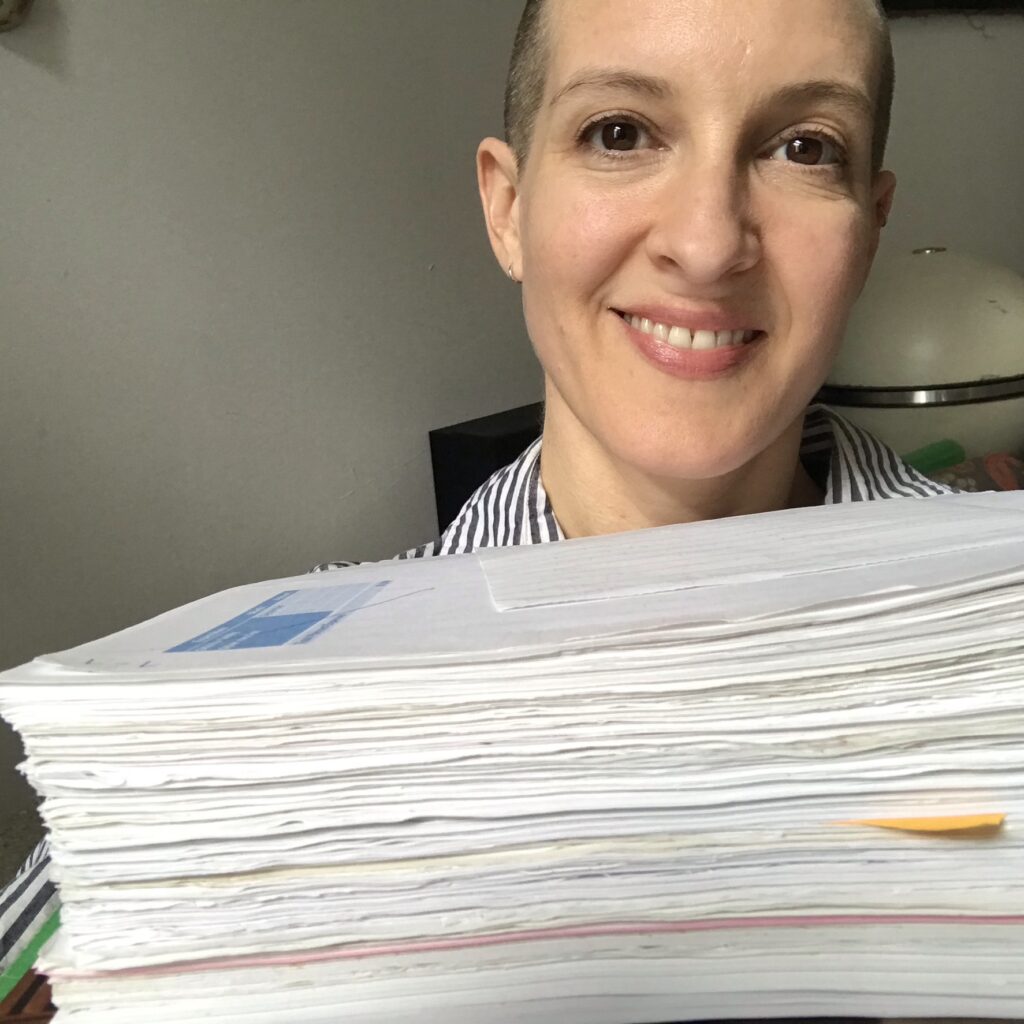
I still have so much paperwork that I want to cull, namely financial documents, old student work samples, client notes, and coaching notes, teaching notes…then finally the sentimental stuff. But, I kept taming my paper tiger all 30 days–totaling 465 pieces of paper!–and also held in there for 14 days clearing bathroom and wardrobe clutter for a total of 105 additional items!
Me and my pile of 465 pieces of paper I let go while playing the Minsgame in March
Reflecting on March 2021 Minimalism Game
I admit it is still very tedious and difficult for me to sort and dispose of items–I do want to keep and be able to use that which is of value, to be able to refer back to my work and favorite resources over time and have a reliable and efficient system for doing so. I am both an aspiring minimalist and honestly a bit of a paper packrat.
I keep playing the Minsgame and making an effort to simplify because I do love feeling unburdened by meaningless or unnecessary clutter that obscures the things I really want to have access to. It’s freeing to let go of what no longer serves me and has gotten caught up in the mix.
Listen to the Podcast version of this blog here
I finished the game with a bunch of research articles and notes from graduate school that I still find interesting, such as theory, ideas about change processes, pedagogy and so forth. I decided although the content is relevant to me still, I do not need to keep hard copies of these documents as they should be accessible in other forms. To make it easier than ever to use the information, I made sure to scan them and put in keywords that will be helpful later when I revisit these topics.
That’s been a good result from the Minsgame last time and this–better organization and easier retrieval of relevant information, as well as letting go of things I won’t need or want to access again.
Clearing clutter, making ideas easily retrievable
I sorted out a lot of good stuff that will be easier to find as it is now organized in binders (for those things which I do need a hard copy for) and into the Evernote App (to back up hard copies of critical documents, and as a replacement to hard copies of things for which I don’t need an original) and therefore searchable.
My work always requires research, and then having the results at my fingertips for inspiration and citation this is a system that is ever-evolving.
Keeping track of your creative ideas
Choreographer Twyla Tharp favors an analog system for storing creative ideas, and shares her system in her book The Creative Habit*: “Everyone has his or her own organizational system. Mine is a box, the kind you can buy at Office Depot for transferring files. I start every dance with a box. I write the project name on the box, and as the piece progresses I fill it up with every item that went into the making of the dance. This means notebooks, news clippings, CDs, videotapes of me working alone in my studio, videos of the dancers rehearsing, books and photographs and pieces of art that may have inspired me. The box documents the active research on every project.” (p.80)
Tharp’s boxes serve psychological as well as pragmatic purposes in support of her creative process: “The box makes me feel organized, that I have my act together even when I don’t know where I’m going yet. It also represents a commitment. The simple act of writing a project name on the box means I’ve started work. The box makes me feel connected to a project. It is my soil. I feel this even when I’ve back-burnered a project: I may have put the box away on a shelf, But I know it’s there. The bold black lettering is a constant reminder that I had an idea once and may come back to it very soon.” (The Creative Habit p.81)
I absolutely resonate with Tharp’s fears of forgetting ideas and memories, as she explains the most important feature of the box system: “The box means I never have to worry about forgetting. One of the biggest fears for a creative person is that some brilliant idea will get lost because you didn’t write it down and put it in a safe place. I don’t have to worry about that because I know where to find it. It’s all in the box.” (The Creative Habit p.81)
The “boxes” don’t have to be literal boxes though, they can take whatever shape best suits you, as Tharp explains: “The more technological among us put it all on a computer. There’s no single correct system. Anything can work, so long as it lets you store and retrieve your ideas–and never lose them.” (The Creative Habit p.82)
The pain of data loss
The loss of a particular notebook is to this day one of the things I am saddest to have misplaced over the years and my many moves. It was my notebook of corrections and choreography notes from NCSA, inspired by the notebooks the modern dancers were required to keep for their composition class. Ballet students didn’t have to keep such notes, but I’ve always tried to record and archive my work and learnings, so I got myself a small blue spiral-bound notebook and glued a postcard from the Kona Village Hotel in my hometown to customize the cover, and kept notes and corrections from my classes and conferences with Fanchon Cordell, Gina Vidal, Gyulia Pandi, Frank Smith, Duncan Noble, etc. in there, as well as scribbles about the choreography that we were learning and creating, from classical ballets to contemporary collaborations with fellow students.
I’m not sure when I misplaced that notebook, but it still breaks my heart. I have also lost plenty of data over the years due to failed computers, drives, and every possible technical malfunction. Although I do what I can to hold on to important information and records, ultimately it’s best that I not be too attached and realize that much of it is available through other sources in the modern age. It’s a good yogic exercise to let go! But it’s not a natural impulse for me.
Evolution of organization systems
The origins of my organization/filing systems started with my family of course. My Mom’s address book is kept scrupulously up-to-date and my Dad keeps a pocket notebook to capture thoughts, lists, project lists, measurements…a whole Captain’s Log. I consulted guides for students to help me succeed in college, and after graduating balanced my working and personal lives with a planner.
After reading Living a Beautiful Life* as a young professional just out of college, I started using a proper paper Filofax, but I had always endeavored to keep a calendar and journal (with mixed consistency and results). Some of my favorite fictional characters kept diaries or notebooks, and I was also inspired by Anne Frank and other famous diarists to record my reflections.
Note-keeping like Beethoven
My academic and creative research will always be a part of my work, so it is important that I maintain a good working archive system and that it evolves with my needs over time. Through trial and error and good advice, I have refined my system over the years. As Tharp points out, a writer or creator can work more efficiently with an organizational system in place:
“A writer with a good storage and retrieval system can write faster. He isn’t spending a lot of time looking things up, scouring his papers, and patrolling other rooms at home wondering where he left the perfect quote. It’s in the box.” (The Creative Habit p.82)
Everyone can benefit from refining their archiving skills, but especially creatives. Tharp explains the system that Beethoven used in developing his works: “A perfect archive also gives you more material to call on, to use as a spark for invention. Beethoven, despite his unruly reputation and wild romantic image, was well organized. He saved everything in a series of notebooks that were organized according to the level of development of the idea. […] He would scribble his rough, unformed ideas in his pocket notebook and then leave them there, unused, in a state of suspension, but at least captured with pencil on paper. A few months later, in a bigger, more permanent notebook, you can find him picking up the idea again, but he’s not just copying the musical idea into another book. You can see him developing it, tormenting it, improving it in the new notebook. […]
The notebooks are remarkable for many reasons. Beethoven was a volatile and restless personality, always demanding a change of scene. In the thirty-two years he lived in and around Vienna, he never bought a home and moved more than forty times. I suspect that’s why he needed the elaborate system of notebooks. With all the turmoil of his personal life, the notebooks anchored the one part of his life that mattered: composing.” (The Creative Habit p.83)
I may not be a Beethoven-caliber genius, but I too work with a similar notebook system to anchor me in the midst of whatever chaos may come in life. No matter how much I digitize, I find for me much creative work must exist, at least at some stages of its development, in analog. So I have a daily diary, a bigger bullet journal of weekly, monthly, and longer-term planning, notes, and brainstorming, and yet another notebook of various ongoing professional projects and notes. At some point, the most important projects then are archived as Evernote notes, with photos, music, articles, and other relevant links attached.
If you want to take a peek at the current state of my idea-recording system, I recorded a video paging through the setup of my 2021 Bullet Journal at the beginning of the year.
Archiving acorns like a poet
Each person must consider what type of system serves their creative process best, and I found Sage Cohen’s ideas in the book Writing the Life Poetic* about storing and accessing ideas very helpful to my poetry practice as well as other areas of creativity, particularly the tips in the chapter called “Save Acorns: Keeping Track of Your Great Ideas.”
Cohen describes how this system of archiving and retrieval works: “What happens when you sit down to write and no bolt of lightning strikes you? When it comes to inspiration, I say there’s no offense like a great defense. Squirrels use their feasts to prepare for the famine, and so can you. When your mind is alert to the acorns of inspiration–and you have a good system for saving those acorns–you can build up a surplus. This secret stash of great ideas can keep the pilot light of inspiration going, and get you through the harshest winters of creative dormancy.” (Writing the Life Poetic p.200)
Cohen shares a variety of strategies for catching these acorns as soon as they arrive:
Post-it notes. “When sitting at my desk doing other work, this is the fastest, easiest way to capture a poetic thought the moment it arrives. By strategically placing Post-it note pads where you’re likely to need them most, you can ensure that every good idea that flits through is assured a safe landing.”
Index cards. “When inspiration strikes, I can get the idea down fast and then move on with whatever I’m doing. Index cards are light, easy to transport, and disposable as soon as I’ve transferred a good idea to one of my idea-saving systems.”
Notebooks. “Kim Stafford, the person who taught me this fabulous acorn metaphor, carries a beautiful, handmade (by him) notebook in his pocket at all times; he records his acorns there. A notebook or notepad can be a receptacle in which to capture, save, and admire acorns over a period of time. Each collection becomes its own masterpiece of possibility–so you can see what you were thinking during that period of time.”
Recording devices. “Not everyone enjoys or has the time to capture his moments of fleeting genius in writing. Also, for people who are more verbal than visual, speaking poetry might feel like a better fit than writing it down. Sometimes it is best to have both options. I have had contexts where writing was preferable, and others where voice recordings worked better, depending on my mode of transportation, ability to have hands free, etc.” (Writing the Life Poetic p.200-1)
“Once you’ve scribbled down the fragment of overheard dialogue or captured the moment of grace before it melted away like a snowflake, what do you do with it next?” (Writing the Life Poetic p.201) First the acorns are caught, and then like Tharp’s boxes and Beethoven’s notebooks, they need to be organized, with Cohen offering multiple possible solutions:
Tubs, baskets, and bins. “Create an acorn holding bin where you can deposit your Post-it notes, index cards, cassettes, and notebooks until you’re ready to use them. […] The next time you decide to write a poem and don’t know how to begin, you can cull through your acorn bin as though you’re on a treasure hunt.”
Bulletin boards and whiteboards. “Sometimes it helps to have your ideas right in front of you, in your line of sight, to keep you on track, or to see how a concept is developing. Post them on a bulletin board or write them on dry-erase whiteboards. I like to collect quotes and inspiration on my bulletin board; on a whiteboard I write my latest goals and aspirations.”
Paper file folders. “If you have a file drawer or metal stand, paper files can be a simple solution for collecting loose acorn scraps in a way that’s easy to access.”
Computer files. “I have a single document in my computer titled ‘Acorns’ into which I enter in consecutive order all of my scribbled-on-paper ideas. After a handful of index cards and sticky notes collects on my desk, I transcribe these into the acorn document, date each entry, and then recycle the paper. I like having this ever-expanding record of my creative process at my fingertips when my inspiration well is running dry. At the very least, it reminds me at one time in recent history I did have an interesting idea!” (Writing the Life Poetic p.201-2)
Developing your own system for creative productivity
“Once you start experimenting with acorns, you’ll find a system of recording and retrieving your ideas that works for you. You may be surprised at how much inspiration your mind serves up once it knows that you’re paying attention.” (Writing the Life Poetic p.202) It is true that when we create space in our lives, as well as a readiness to receive and process ideas as they occur, it opens a rich path of possibility.
For now, I’m super satisfied to have a big stack of paper that is officially cleared, and to support you in playing the Minsgame and whatever simple and creative living projects you’re up to. Next I will turn my focus to a new game: April is Letter-Writing Month for me, and I’m continuing to write poetry as well as create choreography, so I’m excited to use the fresh space I have made for more creativity!
In her introduction to the book Hip Hop Speaks to Children: a celebration of poetry with a beat*, Nikki Giovanni explains the genesis of rhythm in language, music, and ultimately hip hop: “When humans were beginning to develop our own language, separate from the growls and howls, separate from the buzz and the birdsongs, we used rhythms: a sound and a silence. With no silence, the sound is cacophonous. With no sound, the silence is a lonely owl flapping her wings against the midnight sun seeking a careless mouse.”
In my last installment of the blog, we explored Attitudes to Time from the perspectives of yogic philosophy, as a coaching concept and as an element of dance. Today we’re getting into more detail about rhythmic and musical expressions of the element of time in dance, which you can also enjoy in Podcast form here:
Musicality
In the book Ballet Pedagogy, Rory Foster defines the relationship we call “musicality” like this: “Musicality in dance means that an integral relationship exists between music and movement. It can be simple and literal or, in the case of certain choreographic performances, sophisticated and abstract. By utilizing the subtlety of nuance in phrasing and counterpoint, this partnership offers many possibilities in movement qualities and textures. This applies not just to the creator (choreographer) but also to the dancer who executes and interprets the choreography.” (p.80)
Although not always performed with, or to, music, choosing to dance with music is a critical choreographic decision that fundamentally impacts our experience of the dance as dancers and how the audience experiences and interprets our composition as well. Being “on-time” and “musical” are key skills for dancers, but what does that mean, and how can we develop our relationship to and facility with music?
The Nikolais/Louis Dance Technique describes how “In dance, the most experience one has with time is musical time: pulse, rhythm, syncopation, rest in place, diminuendo, accelerando, and so on. […] How fast, how slow, when to do the next movement, how long to wait, how long to continue. All of these sensed decisions, plus their combination with musical time, give performance and composition a compelling range of play.” (p.171)
Stack of books and notes from my education and teaching, for researching this blog
I’m no expert: my musical education
First, let’s disavow ourselves of two ideas: one, that this, or any of my writings or teaching on the topic can be exhaustive, and second, that I am “expert” in the area of music.
My hope is that what I share here inspires people’s interest and encourages you to explore the concepts and bring greater awareness to listening and dancing to music.
I took, as I recall, less than a year of piano lessons as a kid (my teacher was nice, but I found practicing awful and of course, later I wished I had stuck it out long enough to become adept at reading music and plunking out a few tunes). I did perform in a bunch of musicals at the Aloha Theatre before going off to ballet school, where I was lucky to enjoy lots of live music for free and consort with musician friends at UNCSA.
At Whitman College, too, I continued to enjoy experiences listening to live music, expanded my musical tastes as I met new people and enjoyed concerts and collaborated with musicians in improvisation and performance.
In Portland, I was fortunate to sing in a choir with the First Unitarian Church and also take my first sight-reading course, which was helpful, if a bit over my head, as well as continue to expand my musical experiences and tastes.
During my MFA, I received specific training in Music Theory for Dancers and Dance Improvisation and Composition classes with an emphasis on music. Study of ballet and modern dance pedagogy as well as study Okinawan Dance, work with the Kenny Endo Taiko Ensemble and exposure to other world dance and music forms, as well as collaborating with live accompanists as a teacher and performer and having musicians explain music and how best to work with them to me have all been most instructive.
That said, there is a LOT to know about music, and I have much yet to learn. I can only hope to point the way for further exploration. Luckily, it’s a joyful pursuit, and I am so grateful for how music enriches my daily life.
The value of music in storytelling and daily life
Music helps me feel and process emotion. In fact, while in therapy during my divorce, my therapist encouraged me to use music for the healing tool that it is in my life. It moves me, provides catharsis and connection, and recalls memories. It builds anticipation and aids storytelling. I can sing the scores of ballets I have performed from start to finish!
My daily life resembles a constant musical theatre production, punctuated with outbursts of song and dance. I use music to set the mood for yoga or work or dance brainstorming; I create ever-evolving playlists for the dance classes I teach and just for fun to suit every mood; I seek to hear new music and different styles, continue to learn its history and theory, and recently took up the harmonica to enhance my understanding of music.
I admire conductor and musician friends who have a deeper knowledge and intelligence in the area of music. But as with the other practices I engage with, it’s mostly about experiencing the process of learning and how my horizons of growth expand from there. Our appreciation and enjoyment of various artforms is enhanced by study.
Importance of Musicality for Dancers
As dancers, we are well-served by learning to hear and analyze music at a basic level, and to develop a close relationship to the music we dance with. Choreographers must have a bird’s-eye view of the music and dancing and also an intimate familiarity with and ability to interpret the fine details. As Katherine Teck states in Ear Training for the Body: A Dancer’s Guide to Music*, “The most obvious reasons for dancers to develop a keen awareness of specific musical events is so that they can recognize aural cues during onstage performances. To put it bluntly: If performers cannot quickly sense and remember what they should be doing in relation to the music, they will have a rough time making it in the dance world.” (p.3)
Teck continues on to describe the difficulty and importance of musical calibration and responsiveness: “It is not something that can be measured precisely, like the angle of turnout or the height of a jump. But it is there to various degrees, or else is conspicuously lacking, in all dancing.” (Ear Training for the Body p.3-4)
Further underscoring the potential complexity of interpreting music as dancers, Teck clarifies: “It is not enough for people to say, ‘Dance with the music,’ or, ‘You are not with the music.’ If you are supposed to be with the music, you might ask, ‘To which aspect am I relating? Is it the timing, the melody, the articulations, the patterns of the underlying accompaniment texture, the structure, the nuances, or the expressive nature? And how am I to be with it? Or what if my movement is supposed to be a contrast to the music?’” (Ear Training for the Body p.5)
There is so much to think about when it comes to musicality. So let’s start by discussing what dance teachers and choreographers do to understand the music they work with better.
Rhythm & Musical Time
Although not all dance is performed with music, and they argue for a distinct definition of “dancer’s time,” Murray Louis and Alwin Nikolais do concede that, “Generally the time that is taught and used in class is musical time, with all the strict disciplines of music such as beats and their organization in twos and threes, fast and slow. This is the major use of time in dance, and as a result should be mastered first. Most choreography is set to this organization of time.” (The Nikolais/Louis Dance Technique p.172)
Nikolais and Louis describe rhythm this way: “Long ago, musical tradition and the use of musical notation set a system of time analysis and writing, on which dance relied heavily. This became firmly embedded in dance because of the interrelationship between the two arts. […] In musical terms, rhythm implies the regular recurrence of an emphasis during a succession of pulses or beats.” (The Nikolais/Louis Dance Technique p.178)
The Western Classical Music Tradition
I want to be clear that we are talking here primarily about concert dance (ballet, modern dance, etc.) performed on the proscenium stage to music from the Western classical music tradition. Most of my discussion today on rhythm, meter, and the Tempo of music comes from this specific musical lineage. Since my primary training is in classical ballet and modern dance, this is the music I have worked with the most, and for today it’s where we will focus, but I would like in the future to talk more about world music, hip hop, and other fascinating musical and cultural topics.
Fundamental Concepts of Musical Form & Structure
In Ballet Pedagogy: The Art of Teaching* Rory Foster outlines some music essentials for teachers of dance work with: “It is not imperative for a ballet teacher to have formal training in music, but it is reasonable to assume that any understanding of music fundamentals, its form and structure, will broaden and enrich one’s teaching capabilities and effectiveness. Ballet is performed to music, and its kinesis and aesthetics work with many of the same components of music such as meter, tempo, rhythm, accent, phrasing, and dynamics.” (p.79)
Foster says of choreographers, “A choreographer chooses music that fits his concept or simply chooses to use a piece of music that inspires him to create movement that will interpret the score. The chosen music will often influence or even dictate how movements are constructed based on the various qualities and characteristics of the musical structure: rhythm, tempo, dynamics, mood, and melody. Linking and integrating the continuous musical and movement phrases establishes musicality in dance.” (Ballet Pedagogy p.81) We can see that awareness of musical structure is a very important skill for dancers to learn, so let’s dig into some of the basic concepts.
Music Essentials from Ballet & Modern Dance Pedagogy
The fundamental musical time distinctions dancers need to learn first include the concept of beat, meter, tempo, and phrasing.
Beat & Meter
According to Foster, “The beat is the feeling of pulse in the music. Musical notes and silent rests are each given a beat, or partial beat, with a specified time value and organized into bars. The total number of whole beats within a bar is called the meter. Beats are normally grouped into the following: 2’s (duple meter–2/4), 3’s (triple meter–3/4), or 4’s (quadruple meter–4/4) with a certain beat being given the primary accent (usually the first beat) and sometimes secondary accents.” (Ballet Pedagogy p.82)
Meter, Tempo & Time Signatures in Music
As Foster explains, “Meter is the timing of music; it is the particular grouping together of beats. Tempo is the speed at which the music moves. Meter and tempo are an integral part of every ballet combination and exercise. It takes knowledge, experience, practice, and rhythmic sensitivity to know which meter and tempo will work best for each exercise. These elements, more than any other, will affect the dynamics and accurate technical execution of a ballet combination.” (Ballet Pedagogy p.79-80) In this way, teachers can help students better learn dance technique through their choice of music.
We can identify the meter and tempo of a piece of music by looking at how it is notated on sheet music. Foster explains: “Time signatures identify the meter. The time signature is stated at the beginning of the measure. Most recorded music for ballet class will specify the meter for each piece of music on the CD or its back cover and will often identify the rhythm, such as a waltz, polka, tango, adage, etc. The top number of a time signature denotes the number of beats in the measure. The bottom number denotes which note in each measure gets one full beat. The bottom number, however, is not something that we are immediately concerned with in working with class music. It does have relevance, though, once we become more sophisticated in using music.” (Ballet Pedagogy p.82)
Phrasing in Music and Dance
Foster explains the concept of musical phrasing as follows: “We express ideas through our speech and writing by combining words, forming phrases, and creating sentences. Sentences are linked together into paragraphs, which collectively communicate a story, concept, or emotion. It can be literal or abstract. Music and dance do that same thing through sound and visual expressions.” (Ballet Pedagogy p. 80) Now, I will say that when comparing music to language in this way, I have had musicians take issue, so while I think this metaphor can be helpful for dancers, it isn’t meant to precisely describe how form works in music.
That said, Foster continues to describe how phrasing is recorded as musical notes organized into bars or measures: “Musical notes having various time values are grouped together with a given rhythmical pattern and are divided into sections called bars or measures. A measure or groups of measures create a musical phrase. A complete musical movement or composition features sections consisting of many connected phrases. The defining characteristic of a phrase is the brief rest or sense of resolution at the end, which is called cadence. It is similar to the pauses we hear when someone speaks. Cadence enables us to hear phrasing easily.” (Ballet Pedagogy p.81)
Identifying phrasing in movement
Phrasing may be easy to hear in musical compositions, but a little trickier to pick out in dance. As Foster explains, “A movement phrase, like a musical one, will have cadence–a pause, rest, or resolution–before beginning the next phrase. Movement phrases are not as easily identifiable as musical cadences because they are often visually quite subtle, with their execution dynamically internal. However, since they are integrated with the musical structure, they usually coincide with musical phrasing that is quite literal, particularly with studio teaching combinations.” (Ballet Pedagogy p.81)
In a studio or educational environment, we are trying to make these concepts very clear to help students become more aware of the music and how they are moving in relationship to it, so it is helpful if the phrasing is quite literal and simple to begin with.
We can also think of movement phrasing in terms of how movement patterns occur in the body, as Peggy Hackney describes in Making Connections*: “Movement happens in phrases. The preparation and initiation determine the entire course of action for the phrase. Kinetic chains of muscular action are set up in the moment of the initiation which sequence and follow-through to complete the phrase.” (p.47)
As dancers, I think these meaningful units of movement are interesting to look at from the perspective of both music and movement!
Responding to Musical Form in Choreography
As choreographers we apply both definitions of phrasing, musical and physical, in our creations. As Foster describes: “When choreographing, we are creating movement phrases. Classical steps, stylized choreographic movements, and gestures are arranged with connecting steps to form combinations, or movement phrases that integrate in various ways with the music. And, as in music, many connecting phrases make up a complete dance.” (Ballet Pedagogy p.81)
Choreographer Twyla Tharp describes her work with music in her book The Creative Habit*: “Sometimes the spine of a piece comes from the music I’ve chosen. For example, I love to create dances in the form of theme and variations. In many ways, this genre is a perfect blueprint for organizing a dance: Each new variation is my cue to change dancers or groupings or steps. It makes my job a lot easier if the music tells me where to end one section and begin another. (Can you blame me for picking a form that gives me one less variable to worry about?) As a result, I have gladly tackled the behemoths of form: Brahms’s Handel Variations, and his Haydn Variations and Paganini Variations, too, and the most intimidating set of all, Beethoven’s Diabelli Variations.” (p.149)
Music Analysis for Dancers
Foster provides a helpful step-by-step description of how dancers can begin to analyze musical structure to improve their musicality in performance: “Dancers first listen for the pulses in music and assign a count to some or all of those beats. They then identify where the cadence is so that phrasing can be recognized. Accents are also identified as part of the dynamics, for example, a 3/4 waltz has the first beat accented–1 2 3/ 1 2 3; in most mazurkas the end of the second beat has the accent: 1 2 3/ 1 2 3. Dancers also listen for the mood of the music through its feelings of texture along with dynamics: lyrical, percussive, syncopated, crescendo, rubato, etc.” (Ballet Pedagogy p.82)
Coming soon…
In the future I will discuss other forms of music outside the classical western tradition such as world music and the liberating tradition of hip hop, and more exercises and resources to develop your own musical sensitivity and dancing musicality, and we’ll practice rhythm through walking, jumping, and manipulating our focus soon.
What are your struggles and triumphs in working with music as a dancer, or in understanding it as a musician or audience member? Send me a message to let me know, or to join my email newsletter and receive my handout of “Music Basics for Dancers” for free!
Blythe Stephens, MFA Dance she/her or they/them A Blythe Coach: Dance Education & Coaching move through life with balance, grace, & power
* This is not sponsored. Amazon Affiliate links potentially give me a percentage of the purchase price.
In “real time,” we have just had St. Patrick’s Day, are looking ahead at the end of March and Lent, and here in Cologne it is very much spring. Daylight savings has already sprung forward in North America, and shortly will here in Germany as well.
All manner of friends report that quarantining during a global pandemic has done weird things to their sense of time, and the topic is very much on our minds. How can we alter our perception of time in dance and life?
In Podcast episode 44 and below, I discuss Time’s potential expansiveness, abundance, and richness, from the perspectives of yogic philosophy, as a coaching concept and as an element of dance. Next time we’ll get into more detail about musical concepts around time.
Attitudes toward Time Podcast
Time is an immensely important topic for growth, yoga, and dance, so it’s a theme I’ll return to again and again.
In awe to witness time in all its manifestations
Contrary to how we sometimes try to define time, our experience of it is NOT really linear. Some describe it as spiralic, others as only existing in this present moment. Scientists use the term “spacetime” due to the inseparability of these linked concepts.
The Nikolais/Louis Dance Technique* book, a wonderful resource of philosophy and technique for modern dance, says: “Time is much more abstract than shape or motion. Time in its essence is invisible until it is related to something. Examples: one speed against another, repetition against sudden pauses, slow motion against fast, pendulum action in time versus out of time. Time can be absurd, surreal, and rhythmic; it can accelerate and decelerate. […] Time is closely related to space (but we don’t know how); time is like space in that it doesn’t exist until you put boundaries on it.” (p.174-175)
It’s fun to let the mind be boggled a little bit with awe at the enormity of the universe(s), to marvel at the incomprehensible complexity and beauty of nature and the nature(s) of reality through different perspectives.
Neon green sprays of early-spring willow leaves in Cologne, Germany
The “Myths, Mirages, and Measuring Time” podcast by Rev Dr. Carl Gregg of the Unitarian Universalist Congregation of Frederick blew my mind by introducing me to the idea that time passes at different speeds, measurable by modern technology, depending on one’s elevation/relative distance from the center of the earth (affecting the speed of our rotation).
What? My minutes pass faster on mountaintops or in an airplane than they do at sea level? Then how do clocks work exactly and how can we agree on what time it “is?” I remember learning about how measures of weight/mass are similarly problematic to standardize and having difficulty wrapping my head around those ideas too…and am glad that there are people who better understand these areas expertise to serve as engineers and the like!
Meanwhile I get to play in creative and spiritual ideas of time, such as:
Time in Yogic Philosophy
Writings on yogic philosophy have much to contribute to the conversation about time. As just one example, in his translation of the Bhagavad Gita*, Satchidanana explains how time is a matter of perspective, and that the lived experience of time helps us better see certain elements of reality: “Past, present and future are just relative. It all depends on where you stand and how you see. Space and time are unlimited. Thus, you more readily see God’s manifestation, in space and time.” (The Living Gita* p.159)
Chapter 10 of the Gita in particular contains insights on the nature of time that echo in other sources I share below: 10:30 “Of all that measures, I am time itself.” (The Living Gita* p.157) 10:33 “I am the first letter: A. I am the combining word: “and” (dvandva). Actually I am time eternal. Thus I am the one facing all directions (Brahma). I sustain everyone as I dispense the fruits of all actions.” (The Living Gita* p.158)
“Although we say A (rhyming with bay) in English,” Satchidananda explains, “the most natural sound of the letter is ah. All you need is to open your mouth: ah, the very first letter. This is how sound begins.” (The Living Gita* p.158)
Satchidananda elaborates on the infinite nature of consciousness, and therefore also time: “Of course, words and sounds have beginnings, but there is no beginning for consciousness. Consciousness is eternal: no beginning, no end, always there. Just as the audible ah sound has a beginning. Beneath the audible is the inaudible ah sound, which you didn’t create. It’s already there. But you brought it out. […] Time also never ends or begins. Time itself is timeless and comes from the timeless one. We create so-called sections of time and call those the present, past or future. But strictly speaking there’s no past, present, or future. They are our conceptions.” (The Living Gita* p.158)
We can learn to distinguish our conceptions about time from universal truths.
Using Time to Accomplish Our Aims
James Flaherty reflects on time in Coaching: Evoking Excellence in Others*: “It’s always the case that we are fulfilling what was begun in the past by taking action in the present to bring about an outcome in the future. In a way, this may be unique to human beings; we exist simultaneously in these three openings in time.” (p.26)
On a practical level, coaching resources offer to shift our relationship to time and create a more empowering relationship with the distinction. In the ontological coaching that I do, examining and transforming our relationship to time (and all the relevant contexts we operate within) is key.
Flaherty describes the supportive structures of a time frame and network of support for coaching: “A time frame puts sufficient structure and rigor in your program so that you can have a sense of forward movement. At the outset of your program give your best estimation of how long it will take. If necessary, correct your time frame by speaking to your network of support: people who have committed themselves to your success in the program. These people will make it more difficult for you to fool yourself or endlessly postpone.” (Coaching: Evoking Excellence in Others*, emphasis mine)
There is always a time frame associated with intended outcomes in coaching, as well as the coaching relationship itself, stated in the contract.
Indeed, in the book Coach Anyone About Anything*, the authors speak of time as the duration of play or time frame during which the payers act: “Measurable outcomes (results) to be produced by the player and by what specific dates they are to be accomplished […] Timeframe for the coaching engagement.” (p.24)
They also provide useful tools for coaches and “players” or clients, including the “Futurability for Objectives Checklist” (p.30, and which I will share more about in the future) and guidance for “When Players Aren’t Taking Action” (p.70), in which they describe the “Top five reasons why players don’t take action,” which, “You may want to share this with your players because we’ve found even players themselves need to know and understand why they’re not motivated to move.” (p.70) The reasons which pertain to time are: “a. Player has no time available, b. or not enough time, c. or something isn’t worth the time investment required.” (Coach Anyone About Anything* p.71)
Coach Yourself to Success* by Talane Miedaner has a whole chapter on finding time to accomplish what is important to you, “IV. Make Time When There Isn’t Any,” and she has some great ideas for places to look to get integrity with your time, including reflective practice, time tracking, and priority-setting, such as “Take twenty minutes every morning to plan the day and reflect (Tip 35). And make a firm rule to arrive at every appointment ten minutes early.” (p.82)
Another key insight that I took away was: “Everyone complains that there isn’t enough time. We act as though time were a fixed quantity, and it isn’t. Time expands and contracts depending on what we are doing. The irony is that being overly busy makes time seem to go even faster. If you want to feel like you have more time, do less.” (Coach Yourself to Success* p.81)
Ontological Coaching Tools on Time
Of course I have a whole slew of tools about time from my training with Accomplishment Coaching. Some key distinctions that I work with in my coaching work include that time is a conversation (and as such, wedecide what we want to make up about time) and that time management as an attempt to control every moment is a fallacy. What we can control is our energy and focus.
If time is defined as every moment that has ever been, is or ever will be, we see that there is plenty of time, but as with other resources available to us, we may operate in a context of abundance or scarcity. We do best to remember that satisfaction and fulfillment live in the present moment and that it is empowering to deal with time as an integrity item.
There are a variety of specific tools that I use to support clients in empowering their relationship to time and getting in integrity in this area, such as the “Context Exercise,” “Time Generator Checklist,””Top Six Checklist” and many others. I’d be happy to share these time tools with you and help you get new perspective on your time in a free 60-minute coaching session, which you can schedule by following the link here.
This concept of our being able to relate to time in different ways is connected with the topic of focus, another topic for a future blog 🙂
Describing Time in Movement and Dance
Now let’s look at how time is portrayed and described in movement. In A Primer for Movement Description*, Cecily Dell clarifies how we can describe the experience of time in dance, or “The Time Factor,” as “Changes in the quality of time in movement, becoming either sustained or quick.” Dell compares the two attitudes to time coexisting in one scene:
“Scene: gangster movie. Rich industrialist whose daughter has been kidnapped confronting mobster he knows is responsible. Where is his daughter — he wants to know now. Well . . . mobster isn’t quite sure, is stalling for time to make sure his plans have been carried out. Industrialist’s movements are punctuated with quick, nervous jerks and starts. Mobster smokes his cigar with long sustained gestures, stretching out every second as much as he can.
The dynamic in this scene consists of two opposing attitudes toward time. The two men share the same duration in their exchange; they exist and interact with the same amount of time. But the one acts from a sense of urgency, of wanting to hurry time, which the other indulges in time, as if prolonging its passage. The quality of prolonging or stretching time out, we call sustainment the quality of urgency or quickening in time we call quick. Sustained and quick are the elements or qualities of the time factor.
The qualities of sustainment and quickness differ from quantitative speed as measured by a clock, or pace or tempo as marked by a metronome. In ballet, or more extremely in Spanish dance, the legs and feet may be moving in response to very fast-paced music, while in the arms and upper body, the quality of sustainment in time may appear.” (A Primer for Movement Description Using Effort Shape and Supplementary Concepts p.24-5)
Such a vivid portrayal of these varied and relative attitudes to time!
The Nikolais-Louis approach, dancer’s time
Alwin Nikolais and Murray Louis have many relevant points regarding time in dance, so I did my best to pull out just a couple passages relevant to today’s topic. One point is time’s inseparability from other ideas: “We cannot attach time exclusively to sound or motion or space; rather, it is an integral component of all of them. Its presence cannot be eliminated. Time flows continuously, and because it has no substance we cannot alter its speed or presence. Time is relentless. It cannot be stopped. The only way to deal with time is to go with it.” (The Nikolais/Louis Dance Technique* p.178)
However we may try to box in the concept, they assert that, “There is no precise definition of time. We understand time mainly through a recurrent pattern of happenings. Natural and artificial structures exist for its measurement. In artifice, we have the clock and yard-stick. In nature, we have the rising and the setting of the sun. We have our own recurrent breath and heart-beat and the live presence of the body experiencing its existence.” (The Nikolais/Louis Dance Technique* p.178)
We move through different experiences of time, including artificially measured, sensed, and musical/rhythmic, as well as lack-of-awareness:
“Without a clock or some equivalent timepiece, time can also be determined by attention. One senses or feels the presence of time–moving fast, slow, or standing still. In dance, this awareness is abetted by musical pulse and rhythm, In addition to this awareness, the dancer can also step out of time consciousness and into a pedestrian state of unawareness.” (The Nikolais/Louis Dance Technique* p.173) So we see that time and perception are inextricably linked, such that:
“Time, for the artist, is basically a sense and perception of change. When there are no sensations or realizations of change, there is a sense of monotony and the feeling that time is passing too slowly. At the opposite pole, perception of quick change can also alter our perception of time.” (The Nikolais/Louis Dance Technique* p.178) I am so fascinated by how yogic, philosophical, pragmatic, and creative ideas about time intersect!
Coming Soon: Time & Music in Dance
I plan in my next installment to delve further into the nitty gritty of Time as an Element of Dance as it relates to music theory and ways to play with time and music in technique and choreography. In live classes we will explore manipulating time, as well as recorded classes online, so we can relate theory to practical experiences in movement.
Stay tuned on my YouTube Channel and Blog for more about the Element of Time and many more related topics!
What is the conversation that you have with time?
Blythe Stephens, MFA she/her or they/them A Blythe Coach: Dance Education & Coaching move through life with balance, grace, & power
*This blog is not sponsored. Amazon Affiliate links potentially give me a percentage of the purchase price.
According to Agrippina Vaganova in Basic Principles of Classical Ballet**, Pas Balancé “Is one of the simple pas allegro, which is easily done even by children. In classical dancing it is often used in waltz tempo.” (p.99)
I love to waltz alone or as a pair, in ballet, ballroom and other styles, and find it’s swingy rhythms intoxicating, much as its early fans and critics did! This blog brings weekly insights on dance, yoga, well-being, creativity, and joy and today I’m talking about my love of balletic waltzing and the origins of this elegant dance, and I did in the companion YouTube Video and Podcast:
Although the Waltz has become a beloved ballroom and social dance as well as inspiration for balletic movement performed in concert dance, at first it caused a scandal. As Wikipedia relates:
“There are many references to a sliding or gliding dance that would evolve into the waltz that date from 16th century Europe, [and] Around 1750, the peasants of Bavaria, Tyrol, and Styria began dancing a dance called Walzer, a dance for couples. The Ländler, also known as the Schleifer, a country dance in 34 time, was popular in Bohemia, Austria, and Bavaria, and spread from the countryside to the suburbs of the city. While the eighteenth century upper classes continued to dance the minuets (such as those by Mozart, Haydn and Handel), bored noblemen slipped away to the balls of their servants.
In the 1771 German novel Geschichte des Fräuleins von Sternheim by Sophie von La Roche, a high-minded character complains about the newly introduced waltz among aristocrats thus: ‘But when he put his arm around her, pressed her to his breast, cavorted with her in the shameless, indecent whirling-dance of the Germans and engaged in a familiarity that broke all the bounds of good breeding—then my silent misery turned into burning rage.'[…]
Shocking many when it was first introduced, the waltz became fashionable in Vienna around the 1780s, spreading to many other countries in the years to follow. […] The waltz, especially its closed position, became the example for the creation of many other ballroom dances. Subsequently, new types of waltz have developed, including many folk and several ballroom dances.”
When Americans got ahold of the waltz, they of course had their way with it, including delightful movie musical versions such as this one with Ginger Rogers and Fred Astaire, “Waltz in Swing Time” from Swing Time (1936):
“Waltz in Swing Time” with Ginger Rogers and Fred Astaire, from “Swing Time” (1936)
Waltzing through the Classical Ballets
There are many famous waltzes in classical ballets, including “Sleeping Beauty” and “Cinderella” as well as more modern pieces such as Balanchine’s “Vienna Waltzes” to music by Richard Strauss. Since it was St. Patrick’s Day this week, I’ve been sharing Irish folk music in dance classes all month, including a lovely Irish Waltz that makes me want to dance!
Waltzing in Classical Ballet Technique
In the Technical Manual and Dictionary of Classical Ballet**, Gail Grant describes Balancé as a “Rocking step. This step is very much like a pas de valse and is an alternation of balance, shifting the weight from one foot to the other. Balancé may be done crossing the foot either front or back. […] Balancé may also be done en avant or en arrière facing croisé or effacé and en tournant.” (p.11)
Vaganova describes the performance of a basic ballet balancé: “Stand in 5th position, right foot front. From demi-plié, do a light jeté with the right foot to the side, and then draw left foot back (on count one). On count two change to the left foot on half toe, and on three lower yourself again on the right foot in demi-plié, and raise the left one sur le cou-de-pied back. The next balancé will be to the left, i.e. jeté left, etc.” (Basic Principles of Classical Ballet** p.99-100)
I find in describing a balletic waltzing step to dancers of other forms, it compares well with modern dance’s “Triplets,” or “The Pony” of the 1960’s.
What is a Waltz Rhythm?
In a blog and podcast coming soon, I will discuss musical meter, ¾ time, and so forth, but for now it is helpful to think of counting a waltz step as “one and uh two and uh three and uh four and uh…” or “one two three, two two three, three two three, four two three…” Unlike other even meters such as marching rhythms, you’ll notice is has a distinct up-and-down, lending a swingy feeling. T
he accent or emphasis in a waltz rhythm is usually on the first beat, unlike other rhythms in 3, for example the mazurka, where the accent is on the second beat.
Balancé in Ballet Class
“A balancé in ballet is a step where a dancer moves while alternating balance between their feet. The rhythm is usually in three counts like a waltz and has the motion of going “down, up, down” with their legs. […] Balancé is often taught to young ages and in beginning ballet classes. The ease of the step combined with the feeling of movement and ‘dancing’ makes it an enjoyable step at these levels and further into advanced levels. Like many beginning ballet steps, balancé is used often in advanced classes and through professional levels. Dancers will often be given combinations with balancés in center combinations, such as pirouettes or adagio. A balancé en tournant is common in pirouette combinations because this has the dancer turning in a waltz-style movement.” (ballethub.com)
Such a versatile rhythmic pattern and dance technique spans many schools and styles of dance, so practicing balancé will pay off in technical gains as well as the pure joy of moving!
Send me a message, or hop over to the A Blythe Coach Facebook Page and tell me about your waltzing experience and favorite steps!
Blythe Stephens, MFA she/her or they/them A Blythe Coach: move through life with balance, grace, & power
** This blog is not sponsored. Amazon Affiliate links potentially give me a percentage of the purchase price.
DISCLAIMER: A Blythe Coach recommends that you consult your physician regarding the applicability of any recommendations and follow all safety instructions before beginning any exercise program. When participating in any exercise or exercise program, there is the possibility of physical injury. If you engage in this exercise or exercise program, you agree that you do so at your own risk, are voluntarily participating in these activities, assume all risk of injury to yourself.
I am realizing that there are two ways to look at my approach to achieving my goals, especially when it comes to today’s topic of physical fitness and training: there is the positive interpretation, or “efficient,” and the negative way, or “lazy.”
But it doesn’t matter how my behavior is interpreted, as long as it is getting me the results that I seek! In order to achieve my most important goals, I need to prioritize, and along the way I have learned to find the least amount of effort to accomplish what I desire. Even big goals begin with these small steps!
That’s right, we’re talking about exercise and working out, and I want to be clear that I am not not necessarily recommending that you exercise like me, or suggesting that the way you appear, function, move your body should in any way resemble the way I do. You are beautiful as you are, there is nothing wrong with you, and I just want to share tools that have helped create better balance and well-being in my life. Body positivity all the way!
What I want to encourage is your own discovery of what brings you joy in movement, what makes you feel good and capable, and what expands what your body can do, in the ways you want to.
Taking control of your movement, your yoga practice, and your dancing can be incredibly liberating and can ripple out to the rest of your life. Maybe for you, minimal movement involves doing a favorite stretch each morning, a walk around the block on your break, or another action you will enjoy and that cumulatively, will make you feel good!
For myself, I currently enjoy a combination of daily short yoga sessions, weekly longer practices, short physical therapy and callisthenic/cardio bursts, teaching ballet and yoga, and other leisurely activities to complement, like walks, hikes, bicycle rides, or swimming as well as plenty of rest, massage, and the like.
Squeezing in well-being
Back in my Whitman College Admissions days, I had the least amount of time to exercise in my life so far, and so cherished very occasional visit to the yoga studio, but more often turned to my Crunch Fitness “Pick Your Spot” Pilates workout DVD. With it, I could choose what area to focus on (I believe it was belly, buns, thighs, or full-body), and in only 15 minutes get a decent workout that helped me deal with tons of time spent at the computer, desk, airplane, and car.
Working as a life coach, many of my clients have had physical well-being goals, as well as facing real health challenges, and I have supported them in creating habits that transformed their life experience, such as in the case of one client, whose results including having, “[…] begun a simple exercise routine and have completely changed the way that I eat and cook — I’ve even lost weight without once experiencing hunger. My pain levels have decreased, I have more energy and I can sleep through the night…”
Choosing from the cross-training menu
I have collected many exercises over the years from dance, yoga and Pilates classes as well as physical therapy from a variety of practitioners, and have developed a minimal and evolving plan that allows me to do what I need to do (teach ballet and yoga, bicycle, walk, sit to create content, coach, and study on the computer), feel able, minimize my stress, and care for my nervous system. I do have lingering pain from accidents and injuries of the past, so there is a certain amount of maintenance I require to minimize the effects of old whiplash and other injuries.
To my students and dancer friends who struggle to participate in other kinds of activity aside from dancing, I share Eliza Gaynor Minden’s words from The Ballet Companion** section on Cross-Training:
“It may be that all you want to do is dance, but the well-rounded dancer can benefit from a variety of training tools. Pilates, resistance training, the ancient practice of yoga, along with thoroughly modern forms of exercise such as Gyrotonic and Floor-Barre can improve overall strength and stamina, help overcome specific weaknesses, and generally complement a dancer’s regime. You can become a better, stronger, more capable dancer by doing more than just dancing.”
So how do we get the benefits of a variety of cross-training exercises or workouts, with the least expenditure of time and effort?
Consider starting with short and simple yoga
Yoga makes me feel good, and I finally developed a consistent personal practice starting three years ago with the Yoga with Adriene YouTube Channel 30-Day Challenge and monthly calendars.
I found that doing short, 15-30 minute practices daily, in addition to weekly full-length in-person classes at local studios, made me feel amazing! It manages my pain, balances my strength, and gives me time for self-study and relaxation. Over time, my own personal practice has grown, and I continue to learn more through teaching others.
I agree with yoga teacher Georgina Berbari, in the article “How Long Should a Yoga Session Be? A yoga teacher shares some thoughtful insight:” “The beauty of being a yogi who practices at home is that some days, your practice is five minutes long, and others, it’s nearly an hour — and that’s totally cool. When you’re not in an actual studio, and you’re flowing freely without instruction, there’s a lot more flexibility in terms of how long you remain on your mat.”
In the same article, Sara DiVello, a nationally recognized yoga and meditation teacher shares that, “Though there’s no yogic handbook detailing the designated length you should make your practice in order for it to “work” (whatever that means), she’s no stranger to feeling obligated to remain on her mat for a certain amount of time.” But obligation and long duration do not a happy practitioner make.
Indeed, rather than starting with an hour or more of yoga every day, what worked for me was to practice consistently at least 5 minutes a day, focusing on specific areas of the body or themes that are relevant to me that particular day (quick wins, reinforcing the practice with how great it could make me feel in minimal time), and that once I was doing so regularly, it became easier to add in more.
The “Yogalicious” playlist on YouTube includes practices 5-60 minutes in length
This insight that I was more likely to practice more often if it were for less time per session, I then applied to my meditation, physical therapy and cross-training.
Minimalist approaches to fitness
Last year, I added a little cardio/full-body workout to my habits, inspired by reading The Minimalists’ book Essential**, of which Joshua Fields Millburn’s essay “18-Minute Minimalist Exercises” was a part. I appreciated his applying a minimalist and enjoyable philosophy to fitness, and the example of committing to only 18 minutes daily of exercises he enjoys, outside in the park, to get great results!
Fields Millburn recommends doing exercises you like, using movement to de-stress, and building in variety. For example, “I do only exercises I enjoy. I don’t enjoy running, so I don’t do it. I attempted it for six months and discovered it wasn’t for me. If you see me running, call the police—someone is chasing me. Instead, I find other ways to do cardio: I walk, I get on the elliptical machine at the gym, I do bodyweight exercises that incorporate cardio.” I laughed at that description, as I feel quite the same way about running, but also need to keep my endurance up in order to be able to demonstrate dance and yoga as well as speak in class.
Continues Fields Millburn: “Variety keeps exercise fresh. When I first started exercising, I used to hit the gym three times per week, which was certainly better than not exercising at all. Then, as I got more serious, I started going to the gym daily. This routine became time-consuming, and doing the same thing over and over eventually caused me to plateau. These days I mix it up: I walk every day, and I still hit the gym occasionally, but the thing that has made the biggest, most noticeable difference has been the variety of daily eighteen-minute bodyweight exercises.”
I really got jazzed by their podcast “Ep 174 Minimalist Fitness.(with Ben Greenfield),” and subsequently adapting my own minimalist fitness regimen. I learned the details of the “10-Minute Workout” from the Optimal Living Weekly newsletter of the Optimal Living Daily podcast by Justin Malik in February 2020, and it is also featured in the article, “Study Finds 10 Minutes of Exercise is All You Need.”
The article states, “There is an ongoing debate on the effectiveness of short workouts and whether or not longer is better. We do know that short bursts of high intensity interval training can be more effective than 45 minutes of moderate cardio, but longer workouts can help us build endurance. Ideally, we could do both — a couple of lengthy sweat sessions every week mixed in with a couple of short workouts leads to long-term fitness.”
Sounds like a manageable combination for me- regular, short bursts of activity, whether they be yoga, walking, resistance training, or other cardio, mixed with longer sessions when possible.
My current “Micro-Workout”
The minimal program described is designed to be simple, minimal, and adaptable, and as the research found, “Not only are 10 minute workouts effective, but in some cases, you don’t need any equipment or room to complete them. Ben Greenfield, fitness and triathlon expert, recommends completing these moves three times:
50 jumping jacks
15 body weight squats
15 push-ups (on your knees is fine)
15 reverse lunges per side
15 tricep dips (using a chair or bench)
Try doing this workout every morning and see if you notice a difference in a couple of weeks. Your results might surprise you.”
Last year, I chose versions of each of the basic exercises that suited me at that time, and also recorded videos for each element with a variety of fun variations and modifications to try. Maybe you don’t feel up to jumping today (or ever), then consider my side-lying jumping jacks. Or perhaps your aversion to push ups could become delight with the right variation.
[Side note: how can it be nearly a year since I created these videos? That was before my website and blog were yet up, and they were among the first I shared on my new A Blythe Coach Channel! I can see in these videos the difference improvements to my camera, microphone, editing, and more have made! But I think the message and variations in each are still worthwhile, keeping in mind that I’ve brought the quality of my videos up a lot since then and seek continual improvement with each one that I make.]
Full disclosure, though I tried to do the workout daily at first, it was certainly correct to say that it yields results! I was super sore after just one round (not the recommended three) in the beginning, and after nearly a year now, I have worked my way up and settled into doing the workout the recommended three times through, but only 2-3 times per week. I saw results right away, particularly in my arm strength, and am much fitter than if I didn’t do it, with a minimal expenditure of time! As I plateau, I’ll keep trying new variations of the movements to add challenge, but not increase the time spent.
On a weekly basis, I also do my mini physical therapy practice (distilled down to two exercises) about twice, and you can see me doing both workouts live from time to time on my Instagram and Facebook Lives as accountability and inspiration 🙂
More movement motivations
Or maybe none of these exercises is right for you, but the idea of coming up with your own edited capsule or micro-workout inspires you! There are other fun ideas to move your body on my “Wonderful Dance Warmup” playlist, “Ballet Barre” playlist, “Sumptuous Stretching,” and “Concentrated Core Conditioning,” “Arm Artistry,” “Foot & Ankle,” “Legs, Legs, Legs” specific groupings. Or maybe a focus on your breathing through yoga pranayama practices from the “Beautiful Breathing” playlist is something you want to add to the mix.
My “Wonderful Dance Warmup” Playlist contains more favorites for dance conditioning
In the spring/summer/fall I do more bicycle riding and I enjoy long walks and hikes all year round and swimming when I can get it. My next goal is to be able to do a pull-up, and perhaps to work in a minimal jump rope regimen at the park (like Fields Millburn, I hate running, but used to enjoy skipping rope), will keep you posted on my progress!
Tips to customize your fitness fun
Make it minimal with “atomic” habits
Want to create your own minimal routine to achieve well-being, physical or dance technique goals? I’ve benefited greatly from reading the book Atomic Habits** last year and a couple particularly valuable takeaways for me were to make the habits truly manageable and small (“Atomic”), and to make sure they are relevant to your identity (an enjoyable expression of who you are!), or that which you are wanting to manifest.
Thus, I recommend making your new habit as tiny as possible at first, so light and low-commitment that you can find no excuse to wiggle out of doing it and can build a regular practice to see results.
You could commit to five minutes of yoga or stretching daily, a walk around the block, or take the stairs when you see them…so that it’s downright silly to skip it no matter how busy you are. If you skip a day, you genuinely miss it, and you just might get carried away and want to do more!
Don’t skip more than one day in a row
I really like Matt D’Avella’s “The Two Day Rule” rule of not skipping more than one day of a habit. This way it’s not perfectionistic 100-percent-ism or failure, rather you can take breaks when needed, but it still creates that consistency and results that will keep you going.
Habit tracking and giving yourself credit
As I shared in my “Healthy Habit Building” Blog, I learned to track my habits while training with Accomplishment Coaching, and in recent years I have established new habits, stacking them, and tracking them. I’ve become a consistent journaling, gratitude, and meditation, German language learning, a short sequence of Physical Therapy exercises for my knee, a minimal full-body workout, and more.
For me, it is important to give myself “credit,” preferably colorful, playful, celebratory credit, to track the new habit(s) visually and with analytics over time. It is so satisfying to color in squares or check off boxes, or even use stickers, it makes me want to leave no empty boxes in the row!
I have enjoyed the Atiliay.com Monthly Mindset + Goals Sheet and monthly Habit Tracker as well as creating a similar setup in a notebook or bullet journal, and electronically on apps like the Today Habit Tracker App which lives on my phone’s home screen. I have also enjoyed working with an accountability partner and briefly reporting to each other daily on our performing our promised habits and actions. What appeals to you?
What will your own minimal cross-training plan look like?
Is it irresistible andin small enough increments where I can find no good excuse to skip it?
Does it feel good, make you feel stronger (or more flexible or more relaxed…) and encourage you to keep going?
What structures of support and accountability do you need in place to guarantee consistent practice for guaranteed results?
“Whatever you stockpile–be it diamonds, big houses, fame, money, proficiency at advanced yoga poses, or less flashy things, you will inevitably encounter two certainties. First […], all will be lost. Second, these things, in and of themselves, will never satisfy your cravings, which are expressions of your fear and emptiness.” -Judith Lasater in Living Your Yoga** (p.107)
Hiking from West Virginia to Maine on the Appalachian Trail with just a daypack of gear
I’m pretty excited to talk about minimalism in the blog today, as it’s an important principle of my ideal life, to be unburdened by excess things and free to move through the world with, as I say, balance, grace, and power!
Just as I was never a “perfect” vegan, so too am I also a very imperfect minimalist, but what is important to me is the process and the results that I have seen in my life, not appearing a certain way or having some specific number of belongings. I want to critically edit and focus on what is most important, but not live with nothing.
You can also hear my “Minimalism Memoir” in Podcast form, and just scroll to the bottom of this blog for more of my favorite resources on the topic.
I have always enjoyed an elegant, minimal aesthetic, and making things happen in my life in the simplest way possible. Though the pursuit of a materially minimal lifestyle is ongoing (it will never be complete and finished, and that’s the practice!), further it has become a mindset and approach to all that I do, asking myself, “how can I make progress on this with the minimum of time, effort, and materials?”
This is concordant with yoga philosophy and the sacred texts of yoga which I have read, according to which nothing really belongs to us anyway, and detachment and lack of greed are key tenets. Other world philosophies and religions also share this ethic, including Biblical humility, faith in being provided for, and priorities. As Jesus stated, “For where your treasure is, there your heart will be also.” (Matthew 6:21)
My Simplicity Story
But more on the theory and practice as we go along, I’d like to share my personal path with minimalism with you (and hear yours!), the challenges I face with it, and resources that have provided inspiration.
Aspiring to be Organized as a Child
Always a fan of life-optimization and effectiveness and wanting to make the most out of my time on earth, as a child I read Don Aslett’s engaging books on de-cluttering such as Clutter’s Last Stand** and proceeded to organize my room.
In elementary and middle school, I was a little nonconformist and my minimal tendencies sprung from valuing anti-consumer bohemian creativity. I loved animals, and was a vegan, too, striving and advocating for a small environmental footprint. I sought items that were high quality over quantity, keeping with basic needs and timeless pieces rather than following trends of the moment, and keeping focused on my interests of reading, study, the performing arts, and the environment.
This all served me well when I left home to pursue pre-professional training in ballet at UNCSA, when I moved clear across the country from Hawai’i to North Carolina, and arrived to share a dorm room with two roommates (that’s right! 15 years old and living in a “triple” with two other dancers!). It was a good thing that I only had two suitcases and two small trunks in tow, as there wasn’t a lot of room for things in the midst of the bunked and lofted beds and ballet gear.
Low-Impact as a Teen
I maintained this low-impact lifestyle through my teens (except the jet fuel of going home twice per year, ahem), keeping with a minimal aesthetic in ballet/dance and a focus on my art, a low budget and little space in my room or my life for material things.
I prioritized my education, a love of biology and value of preserving biodiversity, and also mobility, allowing me to move cross-country yet again, this time to Washington State to attend Whitman College.
Everything that Jamey and I brought with us ultralight backpacking on the Appalachian Trail in the summer of 2002
Traveling Lightly into Early Adulthood
Preparing to backpack on the Appalachian Trail for the entire summer of 2002, my then-boyfriend (future husband and ex-husband), Jamey and I eagerly studied Beyond Backpacking: Ray Jardine’s Guide to Lightweight Hiking**, collected the lightest gear we could find, and were ruthless with our minimal packing.
Ultralight travel was a shared value as well as a necessity, as we would be completing the nearly 1,000-mile trek without having actually trained for it. We made sure to carry no more than 20 pounds of gear (as I recall), since food and water weight can also really add up (this I remember all too well) and we didn’t want to pack more than we could handle. It was a beautiful and challenging experience that I will always remember!
This is a great metaphor for all of life, as the less I owned, the easier it was moving from state-to-state, school-to-school, room-to-room, house-to-house, even country-to-country. Not that I ever feel that moving is “easy,” but there is certainly a spectrum of difficulty, and knowing how to only carry what I need made it easier to study abroad in Italy in 2000, to tramp around New Zealand for three months in 2005, Peru in 2011, and to relocate my life where and when I felt called to do so.
Though I did accumulate things while in college (hello, textbooks!!!), I still needed and wanted to keep my possessions minimal, and was reinforced by what I was learning in my Philosophy major, specializing in ancient philosophy including Aristotle’s ethics of moderation, environmental studies, reading of the transcendentalists Emerson and Thoreau, and self-improvement literature pleasure-reading, such as Three Black Skirts: all you need to survive**
Related to focusing on what is most essential (and perhaps this should be part of a future blog, as it is related to how I paid all my undergraduate student debt off in two years), Jamey also introduced me to the book Your Money or Your Life**, which helped me to get clear on my own financial and life priorities, essentials, or minimal requirements for satisfaction in the same way I did in minimizing my belongings.
I enjoy making the most of compact spaces, from living on campus as a student, Sorority Member, and Resident Assistant, then as partner of a Resident Director, with frequently-changing living arrangements. After I graduated from college, I loved my tiny rooftop studio loft while working in Admissions, and it only required a very small U-Haul to lug our junk to California with Jamey’s family while we decided where to land next, which after time in New Zealand and with my family in Hawai’i, wound up being Portland, Oregon.
Coaching Myself in Portland…and back to Hawai’i for my MFA
We found a wonderful, central little one-bedroom apartment in Portland, which is also where I discovered a new career of Life Coaching with InsideTrack and Accomplishment Coaching and continued on my path of discovering what is most meaningful to me, simplicity, travel, community, and artistic expression. I supported other people in achieving their educational and life dreams as I unfolded my own.
During this time, I saw the emergence of a new magazine about simple living, called Real Simple and grew addicted to a blog called Zen Habits by Leo Babauta and a sadly now-defunct YouTube Channel called Light by Coco. These discussed a materially minimal lifestyle as well as cutting back on tasks and activities that lack meaning in order to use our energy toward what is most meaningful.
I weathered many changes in Portland, including a divorce and falling in love again, which led to moving back to Hawaii and pursuing my MFA. What a life! My new flame, Nicole (future wife/ex-wife) and I made the move without a shipping container, but weren’t certain just how long we would stay, so put things not urgently needed into storage (gratefully, in a friend’s garage free of charge). Ultimately we decided to remain longer than a couple of years, so returned to Portland for a visit and and to give most of our things away to friends. What was most important, we mailed (mostly books, no surprise!).
Living in Honolulu was even more expensive than Portland, and we were a student and a teacher, so we lived in shared houses in Pearl City, had our own studio in Waikiki for a time, then ran an Airbnb at our “compound” shared with friends in Kalihi. We had shared values of minimal spending on nonessentials, focus on experiences, the arts and the outdoors, and using community resources to minimize spending and environmental impact through the sharing economy.
While earning my MFA and dancing and teaching all over, I also learned about The Minimalists and Matt D’Avella through their first documentary and books (both of which have multiplied, and they have a great blog and podcast), and became even more obsessed with small capsule wardrobes through Courtney Carver‘s Project 333, (and later her blog, newsletter and Soul + Wit Podcast), as well as the YouTube Channels of Use Less‘ Signe and Justine Leconte. A low-maintenance stance suits my academic and artistic lifestyle so well!
At this point, Minimalism was a full-on cultural phenomenon, and I rode the Konmari/Marie Kondo Life Changing Magic of Tidying Up** wave with enthusiasm, keeping only what sparks joy (except for those last couple areas in which I’m still working to soften my grip). The Minimalists also introduced me to the idea of the Minsgame, which really came in handy when my second marriage abruptly ended and I underwent subsequent drastic changes.
Rufio helping me sort schoolwork during my pre-move Minsgame in 2019
That is, events unfolded to present the opportunity to move abroad and I took it, so I had to pare back again, after eight years on O’ahu! I spent a month playing the game (eliminating one thing the first day, two the second, and so on, to release hundreds of belongings), and then continued to purge down to a few bags to store at my family home, and a few to take with me, plus media rate boxes to follow. You can check out the results of my first trip through the Minsgame in spring of 2019 on my personal IG 🙂
Minimal Move to Germany in 2019
Everything that flew with me from Hawai’i to Germany 20 months ago
A minimalist approach freed me to move to Germany, to live in an urban apartment while teaching and creating here. I do have certain collections that have stayed with me, but they are very specific: books, keepsakes/nostalgia/correspondence. And I’m keeping my accumulation of physical books to a minimum with a Kindle, ever an avid reader.
Since the move, I had the chance to complete a yoga teacher training, learn German, and continue to teach, coach, and study my passions of dance, pedagogy, and spirituality.
Yoga Philosophy & Current Spiritual Growth
Reading classical texts of yogic philosophy while in my training program and since, I found much that resonated with my minimal mindset. In the Yoga Sutra**, Patanjali counsels practitioners to follow aparigraha, greedlessness or non-covetousness, a relevant Yama or avoidance, and also a relevant Niyama or observance called santosha or contentment (which is also the theme I have personally declared for 2021).
Lasater explains, “When we seek contentment, or what Patanjali calls samtosha, we are closer to experiencing our own wholeness. In book two, verse forty-two, he writes […] ‘Through contentment unexcelled joy is gained.’” (Living Your Yoga** p.108)
The Bhagavad Gita** also admonishes against attachment to the material world, for example in 5:22 it states, “Pleasures that come from sense contacts, Arjuna, actually are the womb of pain. A wise person does not delight in pleasure that comes and goes.” (The Living Gita** p.76) So the path to wisdom is indeed a simple one.
Additionally, Lasater shares wisdom from Zen Buddhism regarding The Five Remembrances of Shakyamuni Buddha (presented by Thich Nhat Hahn, a Vietnamese Zen Buddhist monk, in The Plum Village Chanting Book), of which I find the fifth most relevant to this minimalist meditation: “My actions are my only true belongings. I cannot escape the consequences of my actions. My actions are the ground on which I stand.” (Living Your Yoga** p.97)
However, as I said at the start, I am human and as such, do tend to cling to certain things! I always struggle to let go, as I have emotional attachment to so many things, but I also always find it worth while to eliminate as much as I can.
Paperwork and Nostalgia – my “last bastion” of clutter
My achilles heel of minimalism is all things nostalgic- photos, albums, schoolwork and proof of my accomplishments, as well as other paper records. I am working to digitize and minimize in these areas to enjoy maximum freedom in my current lifestyle in Germany.
My journey to simplicity is ongoing, and this month I’m tackling one of the last bastions of hoarding, playing the Minsgame again, this time focused on my paper clutter, including assignments from my MFA, notes from teaching and coaching over the last ten years, financial documents, and more. You’re invited to join me in a Spring Cleaning minimization fest! Let me know what you’re working to remove from your life to live more lightly here or at the A Blythe Coach Facebook Page.
Two of the ten boxes of books, papers, and gear that followed me to Germany
“When you allow yourself to see things as they really are, then–and only then–can you love yourself and others without hidden expectations. Detachment is the greatest act of love.” (Living Your Yoga** p.19-20)
Blythe Stephens, MFA she/her or they/them
** This blog is not sponsored. Amazon Affiliate links potentially give me a percentage of the purchase price if you decide to buy a book.
Screenshot of video of how I get into a yummy lunge en route to the splits/Hanumanasana
This article explores the classic splitting shape of Hanumanasana in yoga or “The Splits,” which becomes leaps like Grand Jete in Ballet dancing technique and others, in mythology, proper stretching practices, and performance.
Hanuman’s Journey
In the book Myths of the Asanas**, which details the stories behind the names of yoga’s poses, Alanna Kaivalya and Arjuna van der Kooij tell the tale of the monkey god Hanuman, who inspired the iconic forward-splitting yoga pose:
“Hanuman’s journey, as recounted in the Ramayama (the epic tale of Rama), is one of faith, fearlessness, and complete devotion. Hanuman is said to embody all of the qualities of the yogi, and his story reflects our own in many ways. How many times have we forgotten our own divinity only to fall back into the same self-defeating way of thinking over and over? Who hasn’t had a crisis of faith and wondered if some burden wasn’t too great to bear, or whether some task wasn’t impossible to complete? Hanuman teaches us that there is one thing that allows us to override all of our doubts and fears. That one thing is love.” (p.75)
Along the lines of February’s theme of self-love, here we’re leaping into the benefits of a stretching practice for body and mind. I’ll include resources for preparing to stretch and going deeper with the practice as well, but let’s start with inspiration from Hanuman’s story:
“As son of the wind, Hanuman could do anything. He could grow very large or very small, move mountains, and even change his shape altogether. But he was constantly forgetting his divinity, and so he turned to his faith–which in Sanskrit we call shraddha–to give him the confidence to do what he knew he must accomplish.” (Myths of the Asanas** p.72)
This faith allowed him to perform one of his most miraculous acts, to help save Sita, the wife of Ram, which was to spring over the ocean with a flying leap: “As he flew over the ocean toward his destiny, one of Hanuman’s feet reached forward and one foot reached back, like the famous split pose, hanumanasana, that yogis know today. Despite encountering numerous obstacles, including a demon that rose from the water to try to gobble him up, Hanuman landed confidently on the island of Lanka [to] let her know that Ram would be coming to save her.” (Myths of the Asanas** p.73)
Benefits of Hanumanasana and Splits practice
Both Hanumanasana, the full forward-facing split, and Anjaneyasana, a deep kneeling lunge that is its prerequisite,
“stretch the psoas muscle, which runs from the middle of the spine to the inner thigh. […] This very deep core muscle initiates all of our movements, and it is pivotal in the fight-or-flight response that is built into our bodies. For many people, the fight-or-flight response is almost continuously stimulated by a low-grade application of stress, which is so much a part of Western lifestyles, and results in a chronically locked psoas. The effects of stress are augmented by our daily habit of sitting for long periods of time on chairs, which also shortens and tightens this long, rope-like muscle.” (p.68-9)
Indeed, since renewing my focus on practicing this pose, I have noticed greater relaxation in the affected areas of the stretch as well as in my psyche. In fact, as Kaivalya and van der Kooij continue, “Because of its relation to the fight-or-flight response, which typically engages when fearful, the psoas is where we generally hide fear. The process of opening the psoas and encouraging its release through these […] related poses give us an opportunity to physically shed our fears and move into a state of fearlessness.” (p.69) This makes these stretches ideal medicine for our current pandemic-lockdown lifestyles, fraught with fear and an overabundance of sitting!
Anatomy/Kinesiology of Muscle Tissue
Exciting inspiration, yes? Now let’s take a couple steps back and discuss how stretching the muscles works in general and outline some safety precautions before we leap in. If you’re already familiar with this theory, feel free to skip ahead to the technical instructions 🙂
Rory Foster breaks it down in Ballet Pedagogy**: “Muscles move, control, and stabilize our skeleton. They propel our body into movement as well as slow it down and stop it. They also stabilize the body, in both stasis posture and dynamic movement and balances. Muscles have three basic characteristics: they stretch, they contract, and they are elastic–they will return to their original length after being stretched. Muscle tissue turns into tendons toward the end of the muscles, and these strong semi-elastic tendons attack the muscles to the bones.” (p.67)
Strive for balance between strength/stability and flexibility/mobility
In order for our training to serve a practical purpose, and advance our ability to perform techniques with mastery and artistry, we need to build our self-awareness and create a balanced regiment of strength and stretching or stability and mobility training. As Foster explains, “Teachers and students should remember that strength and flexibility must have a balanced relationship. Having a loosey-goosey body may be great for high leg extensions, but it requires a good deal of muscular strength to control such hyperflexibility.” (Ballet Pedagogy** p.67)
Flexibility affects not only the shapes that we make, but also how we enter into them and transition out of them, and create a whole-body effect. Especially the spine is involved in every stretch and movement, as foster points out, “Nearly all of the stretching that is done in ballet either directly or indirectly involves the spine by arching side or back (cambre), bending forward, or rotating. Therefore, the act of lifting or lengthening the torso, especially the upper back, prior to entering into the movement will elongate the spine, giving a fuller stretch with a greater range of movement and a more aesthetic look.” (Ballet Pedagogy** p.67)
Warm Up First!
Stretching when insufficiently warm will impede, rather than support your progress, so don’t skip a good warm-up before attempting any deep stretch, and go carefully.
Any dance, yoga, or movement instructor worth their salt will implore you to warm up, as “Doing proper stretches that involve a maximum range of motion and, therefore, a definite feeling of resistance reflex in the muscles should always be done after the body is warmed up.” (Ballet Pedagogy** p.67)
Why? Because, as Foster elaborates:
“Muscles are made up of bundles of fibrous tissue encased in connective tissue called fascia. Some of the fascia fibers are gelatinous. When the body is cold, these gelatinous fascia fibers are also cold, making the muscles feel tight or stiff. Once the body warms up, the gelatinous fibers soften and flow, thereby allowing a greater and safer range of motion while stretching.” (Ballet Pedagogy** p.67)
I also find Eliza Gaynor Minden’s words of advice on stretching in The Ballet Companion** very practical:
“Only when you feel warm is it appropriate to begin stretching. Once warm, be guided by the idea of ‘gently dynamic.’ Small, controlled movements are safer than either big, ballistic movements or no movement at all. Resist the urge to hang out in a static stretch position, especially in a big straddle stretch such as à la seconde on the floor. The other extreme–sudden, forceful movement–can cause tears, sometimes the ‘uh-oh’ kind you notice immediately, sometimes the more subtle and insidious kind that heal by forming scar tissue that creates a permanently vulnerable area prone to reinjury. Before class is not the time to test your full range of motion; a low, slow, mini battement cloche before class is ok, but whacking your leg up to a full extension might pull a muscle.” (p.109)
How shall we go about getting warm, then? If you’re looking for inspiration, I’ve got ideas, in the form of free videos on my YouTube Channel!
Gaynor Minden shares an important distinction between static, dynamic, and ballistic stretching: “The two types of stretches that dancers do regularly are static stretching and dynamic stretching. In static stretching, a position is held for 20-30 seconds, such as remaining in a split or straddle on the floor. Dynamic stretching is done while moving, such as doing a forward bend, an arched stretch to the side, a backbend, or a penche. It is never a good idea to do ballistic stretching […] when one bounces while in the stretch. It risks tearing muscle or fascia tissue.” (Ballet Pedagogy** p.67)
Listen to Your Body and don’t over-stretch
Gaynor Minden goes on to warn that, “Ambition, discipline, and zeal–all admirable traits–can get in the way of listening to the body. Put them aside for long enough to tune in and take an inventory of what feels tight. Try to distinguish between the salutary discomfort that indicates productive effort and the pain that warns of injury. If a movement feels ‘pinchy’ in the joints or causes residual pain, don’t do it. It’s not self-indulgent to heed your body’s messages. It’s prudent.” (The Ballet Companion** p.109)
It can be helpful to get visual feedback to check on your body’s alignment and where you can adjust the positioning, as Gaynor Minden reminds us, “Finally, the mirror is not just for primping. Try to find a spot where you can see yourself to check for symmetry and alignment.” (The Ballet Companion** p.109)
Foster reinforces the individual nature of our bodies and personal needs: “Increasing or maintaining flexibility through stretching is important, and how much and what type of stretch will depend on the individual needs of each dancer. Too much stretching, particularly if it involves ligaments, can result in hypermobile or loose joints, which will increase the risk of injury. Unlike muscles, ligaments are not elastic, and once they are stretched, they will not return to their original length.” (Ballet Pedagogy** p.67)
Be mindful getting into and out of stretching positions
This is true in both ballet dancing and also in the practice of yoga and mindful stretching, “How you arrive at and how you leave a position are as important as the position itself; this is just as true for stretching as it is in the rest of ballet. Your transitions into and out of a stretch should be slow, controlled, and graceful.” (The Ballet Companion** p.109) Each stage of the process is important, and contributes to our results.
Use your breathing to support the stretch
In the book Ballet Pedagogy**, Rory Foster explains the importance of breath support to all stretching practices, whether they be yoga as such, or more generally in dance and athletics: “Incorporating the use of breath is an important element to the mechanics of stretching, use of port de bras, and balletic movement in general. Unfortunately, teaching students to be aware of how they breathe and knowing how important breathing is in dance has diminished over the years. As the science of Yoga has become more mainstream in the West along with its teaching on the use of breath in stretching, more and more dancers are now learning and benefiting from it. Generally, we should use inhalation to elongate the spine and begin the movement, and we should use the exhalation to move further into the stretch or to increase and deepen the stretch once we are there, thereby helping to relax the reflex in response in the muscles. We use the inhalation again to bring us out of the stretch.” (p.67)
Yes, this is why I created Yummy Gentle Yoga for Dancers (and those who wish to be more dancerly), to bring out the connections between yoga and artistic movement!
I was fascinated to read the reminder that, “Movement of the legs into extension stretches the iliopsoas muscles from their insertions on the lesser trochanter of the femoral heads up through the pelvis and to their origin on the lumbar vertebrae and twelfth thoracic vertebra. This is the same place where the diaphragm attaches at the central tendon.” (Teaching Yoga** Loc 4677) Therefore we can sense in this stretch, the connection between freedom in the psoas and lower body, as well as in the flow of the breath.
Getting into Hanumanasana / training for “the Splits”
Start with a good warm-up, of course, either in the form of flowing through other simple yoga poses such as sun salutations or with another gentle but vigorous exercise such as those suggested above under “Warm Up First!”. Then start with getting familiar with some lickety luscious high and low lunges and gentle stretches of the major muscle groups of the legs and torso.
Once your lunging shapes are well-established, you can move from a low lung into Hanumanasana in this way, as Mark Stephens details in the book Teaching Yoga** : “Place the hands on the floor and shift the hips back above the rear knee while straightening the front leg. Stay here for one to two minutes. Keeping the hips even with the front of the mat, slowly slide the heel of the front leg forward while extending the rear leg.”
It is very useful to use props such as yoga blocks or similarly-sized books to bring the floor to you and help get into the pose and enjoy its benefits. Stephens explains: “Since most students are unable to release fully into this asana, offer blocks to place (1) under the sitting bone of the front leg and/or (2) on both sides of the hips for hand support. It is important to position the hips even with the front of the mat while the sitting bone of the front leg is firmly grounded, thereby creating a symmetrical foundation for spinal extension and reducing the risk of lower-back strain.” (Loc 4340-4344)
Only after getting set up in this stable architecture, do we descend further into the stretch: “Once stably positioned with the spine upright, increasingly flex the front foot, engaging the quadriceps muscles and releasing the hamstrings. To the extent that the hips are even with the font of the mat, the back leg will more easily extend straight back from the hip. Emphasize internal rotation of the back leg, especially if exploring the backbend variation.” (Teaching Yoga** Loc 4344-4348)
As you breathe into the shape, consider how you have already overcome fear and resistance to the practice, regardless of what your shape may look like from the outside. Remember that gaining flexibility and range of motion is a long-term process, and we can only improve once we have gotten started. Be gentle and patient with yourself, and remember that, “We easily forget that there is a part of us that is also divine and can accomplish the impossible.” (Myths of the Asanas** p.72)
Maybe we think accomplishing the splits, or some other advanced yoga or dance position is impossible now, but consider what a steady practice combined with faith in yourself might do!
** This blog is not sponsored. Amazon Affiliate links potentially give me a percentage of the purchase price.
DISCLAIMER: A Blythe Coach recommends that you consult your physician regarding the applicability of any recommendations and follow all safety instructions before beginning any exercise program. When participating in any exercise or exercise program, there is the possibility of physical injury. If you engage in this exercise or exercise program, you agree that you do so at your own risk, are voluntarily participating in these activities, assume all risk of injury to yourself.
Through dreary sodden days The field sponged up The greying skies.
And now the sun Lies soft as birth again As if the earth had just begun.
And blossoms on the vines Designed in spring Come out to sing again.
And everywhere the ripening Pushes falling leaves apart To free the heart For freshening.
As through the seasons Of our years
Becoming Often waits the nourishment Of tears.
Indeed! Becoming is a plant fed with tears, it requires great strength, and it can be scary to face the changes that time inevitably brings. This time of year, late winter just flirting with spring (depending on your locale), is bittersweet, loaded with possibility and waiting and patience.
Winery with rose garden in Ruedesheim am Rhein, Germany
Our becoming depends on time, which, along with space, provides the fleeting field in which we live. In a future blog, I’ll cover more about time as an Element of Dance, and music, too, but today, I’m meditating on our relationship to time and our human mortality, and how the blink of an eye that is our lifespan is reflected in performance and poetry and how we can respond to our awareness of this fact.
Sometimes, time seems to pass slowly, sometimes a season is gone in the blink of an eye. Some of us feel as if we can never get enough time to live the life we desire, and some feel as if they must endlessly wait for life to begin. Some times are filled with trials, some produce great masterpieces.
Hamilton’s non-stop approach to time
“Why don’t you write like you’re running out of time,” goes the title of a “Hamilton-”inspired blog on Medium, responding to Alexander Hamilton’s drive to write and their own difficulties in doing so. Truth be told, I relate somewhat to Hamilton’s endless desire to express! In the musical, Alexander Hamilton is seen tirelessly, incessantly writing his ideas in letters and pamphlets and manuscripts, and those around him struggling to catch up. Unfortunately, his relationships suffer, but his lasting impact can’t be denied.
What is your relationship to time and to your own mortality?
I seek to fill each day with actions that I believe will make a difference in my life and in the world. My legacy, if you will, though that sounds a bit grandiose. Not that I bother to hope that my specific name will somehow endure or my particular story remembered. I have no illusions about that, as I don’t believe any one history can truly be remembered “for all of time.” Rather, it is my wish that the joyful, healing energy that I send out will, in effect, continue to radiate forever, having come from before and beyond myself in the first place.
This mortality/death/rebirth idea has been hovering, amorphous, on the edges of my mind. It’s a little like a hummingbird- I can hear it and vaguely sense it’s movements before I can spot the bird itself. It’s doubtful that I can scratch the surface in one essay, one blog post, or ever quite capture what it is that is niggling at me to say. But I might as well get started, as a way to reflect on the loss and grieving I experience (we all do, and are) and connect about this universal experience and ways we may respond.
Synchronicity and pulling the Death Card in Tarot
While I’ve been ruminating on time, death and mourning, mortality, gratitude, blessings, “Sleeping Beauty,” “Hamilton,” and the fleeting nature of my own life, what with my 40th birthday approaching and the recent loss of two people in my circle (a best friend who we visited with often and is my age, and my girlfriend’s 105 year-old grandma), I was considering when I want to try to formulate some of these ideas into writing. I considered focusing on the dance technique topic of flexibility and working towards the splits first, but that is now planned for next week, as I then pulled the Death Card as my Tarot card of the week. So that was decided 🙂
This means big change (planned or unplanned), including loss and grieving, but ultimately light at the end of the tunnel. There’s no way out but through, but it’s helpful to have supportive resources on the way! By the way, I use Tarot Cards as a way to understand timeless archetype, access my own intuition and awareness, get perspective, and problem-solve, not to somehow predict my future from an external source. And it works nicely for my purposes!
According to Michelle Tea’s guide, Modern Tarot**, “Though the Death card, a difficult, almost uniformly painful card to draw, deals primarily with change, transitions, and transformations, it is largely the primal fear of death at our core that makes these and so many other endings excruciating for humans.” (p.96) Rather than being about physical, corporeal death, it can be helpful to think of it as some type of symbolic bereavement.
As Tea writes, “Sometimes I think the Death card would benefit from being renamed Grief, or Mourning, for that is the real heart of the card. There has been a profound loss, and whether you are grateful for the loss or devastated, a time of processing is upon you, of consciously letting go. It’s a time of feeling your feelings, your anxiety, or raging and making peace.” Modern Tarot** (p.96)
It is a time to come to grips with fear, and put in place helpful coping mechanisms, while realizing that we can’t bypass our current situation, painful though it may be: “You’re not going to be able to pray-meditate-chant-yoga-cleanse-crossfit your way out of this one. While those pursuits are killer support systems, tools to help you through this moment, sitting down to meditate in the hope that you’ll be lifted away from your pain is (always) incorrect. Meditate in order to bring yourself closer to the razor’s edge of fear. Look it in the face. Accept it and make peace with it. If the fear of death underlies all fear, and fear is what stops us from acceptance and letting go, then getting into a practice of accepting that you’re going to die will have the ripple effect of assisting you with all loss.” (p.97)
I didn’t expect to find an explication of meditation in a book on reading the Tarot, but I think that’s as good an explanation as any! Meditation is facing exactly what is and learning to deal with it calmly. It can be very uncomfortable, and these are not necessarily easy truths to accept, but they can be paths to wisdom.
Memento Mori with Socrates, the Stoics, and Ryan Holliday
In Modern Tarot**, Michelle Tea summarizes: “No one outwits death, and no one outwits change.” (p.96) This sentiment echoes the practice if Memento Mori, or reflecting on the inevitability of our death.
As Ryan Holliday of The Daily Stoic explains: “Most often, our ego runs away from anything that reminds us of the reality that sits at odds with the comfortable narrative we have build [sic] for ourselves. Or, we are simply petrified to look at life’s facts as they are. And there is one simple fact that most of us are utterly scared to meditate, reflect on and face head on: We are going to die. Everyone around us is going to die. Such reminders and exercises take part of Memento Mori—the ancient practice of reflection on mortality that goes back to Socrates, who said that the proper practice of philosophy is ‘about nothing else but dying and being dead.’ In early Buddhist texts, a prominent term is maraṇasati, which translates as ‘remember death.’ Some Sufis have been called the ‘people of the graves,’ because of their practice of frequenting graveyards to ponder on death and one’s mortality.”
This awareness has the potential to give a sense of urgency to our actions, as we don’t know how long we “have,” and no one can! Sometimes I myself feel fearful about it, sometimes sad, sometimes in simple wonder. The ego doesn’t want to imagine it’s non-existence. I’m really quite attached to this life of mine, which I love! I find the experience of living glorious, precious, worthy of celebration, moving beyond words, as well absurd. But one thing I’m sure of is that I want to live my life the best that I can.
Making the most of the time we (hope to) have
We all have much to contribute to the world in our time. I have heard the tragedy often cited of “going to the grave with our music still inside of us.” Who said that? I had to look it up, and according to Poynter.org: “While Henry David Thoreau is often credited with variations of the aphorism ‘Most men lead lives of quiet desperation and die with their song still inside them,’ that is not what he wrote in ‘Walden.’ He merely said, ‘The mass of men lead lives of quiet desperation.’ So it’s not clear who pointed out the tragedy of passing before we have given the gift we are meant to give to the world, but presumably they made their mark as the motivating idea resonates still.
I can’t find the video I originally found around the idea, but this one is similar
A few years ago, I learned of the idea of estimating (based on average life span for your demographic) the total number of days of your life you might hope to see, then calculating where you are now to determine how many may be left. You also consider how much time goes into everyday activities and how much you’re spending on your important priorities, the idea being to be present to the finite nature of this life and need to appreciate and make the most of the present. It’s a little bit of a horrifying, yet enlightening exercise.
I do not think this means that we need to be “Non-Stop” like Alexander Hamilton, nor is it healthy to work without ceasing, as breaks are necessary to avoid burnout and maintain a healthy, balanced life. For example, taking 20 minutes per day to meditate and do “nothing” could be a step on the way to enlightenment and the ultimate. Who knows? Do you value balance and calm in your life, or do you prefer a go-go-go productivity fest?
“Say Yes” like Andrea Gibson
If it inspires you, then by all means run with the idea to write, create, find your voice, your expression, what you are here to do or say or teach or be–go for it, during whatever time you may have! Whatever you dream of, live into it in the present moment.
Consider, as poet Andrea Gibson demonstrates, saying yes and playing your music:
YouTube Video of Andrea Gibson reciting the poem “Say Yes”
Sleeping Beauty’s Love Through Tribulations
Speaking of fear of death/being forgotten/left out, love, waiting, blessings and curses and other intertwined themes, in Podcast “039: What is the Moral of Sleeping Beauty?” I talk about what the classical ballet “Sleeping Beauty” means, from the point-of-view of choreographer George Balanchine and Francis Mason in Balanchine’s Complete Stories of the Great Ballets** and my own perspective on productions, literature, and teaching.
For more about how I teach this particular ballet with children and adults, I also created a video on my YouTube Channel, below, and Playlist with example tracks on Spotify.
Of course, many ballets feature death of characters, death and loss as a theme, or even as a character of it’s own, but at this time of looking ahead to spring while going through the dark time of Lent and also continuing to face global pandemic and personal loss, I’m fascinated with the connection of all these themes with The Sleeping Beauty. As Balanchine and Mason point out, it can be a little tricky to suss out a meaningful or uplifting moral:
“Most of the fairy tales that adults go to the theater to see again and again–Swan Lake, Cinderella, Hansel and Gretel, the Ring–symbolically enshrine truths about human experience and human behavior to make their pleasures more than incidental. Swan Lake, for example, is a drama involving conflict and character; it gives scope for dramatic expression, for acting, and for diverse striking interpretations. By comparison with Prince Siegfried in Swan Lake, Prince Florimund in The Sleeping Beauty is a cipher. What does he do to deserve his princess? The briar thicket surrounding his bride is no dangerous Magic Fire through which only the dauntless can pass. And similarly, by comparison with the brave, pathetic Odette and the formidable temptress Odile, Princess Aurora is a passive heroine played upon by circumstance. Can we find a moral in The Sleeping Beauty beyond that guest lists should be kept up-to-date lest awkwardness result?” (Balanchine’s Complete Stories of the Great Ballets** p.553)
Charles Perrault, author of the fairy tale on which the ballet is based, explicitly spelled out his own moral for the story in poetry:
“Many a girl has waited long For a husband brave or strong; But I’m sure I never met Any sort of woman yet Who could wait a hundred years, Free from fretting, free from fears. Now, our story seems to show That a century or so, Late or early, matters not; True love comes by fairy-lot. Some old folk will even say It grows better by delay. Yet this good advice, I fear, Helps us neither there nor here. Though philosophers may prate How much wiser ’tis to wait, Maids will be a-sighing still — Young blood must when young blood will!”
[https://www.pitt.edu/~dash/perrault01.html Source: Perrault’s Fairy Tales (New York: Dover Publications, Inc., 1969), pp. 3-21, translation from Old-Time Stories told by Master Charles Perrault, translated by A. E. Johnson (Dodd Mead and Company, 1921), translations of the verse morals are from Perrault’s Fairy Tales, translated by S. R. Littlewood (London: Herbert and Daniel, 1912).]
As I mentioned in the video, I personally enjoy the symbolism of sleeping and awakening again in relation to our travel through the seasons of the year, but “In a preface to the Penguin edition of Perrault, Geoffrey Brereton remarks that it is ‘tempting to adopt the nature-myth interpretation and see the tale as an allegory of the long winter sleep of the earth’–but adds that ‘the allegory, if it is one, is obscure.’” (Balanchine’s Complete Stories of the Great Ballets** p.553) This is alright with me, as we can enjoy any interpretation of these works of art that makes sense, and make any creative connections we like!
Balanchine and Mason continue by describing the composer of the ballet’s score’s, take on the meaning of the tale: “Tchaikovsky’s interpretation was simpler. His Sleeping Beauty is a struggle between good and evil, between forces of light and forces of darkness, represented by the benevolent Lilac Fairy and the wicked fairy Carabosse. The prelude, a straightforward exposition of the music associated with the two characters, suggests it; the consistent employment of melodies related to or derived from these themes, –The Lilac Fairy’s transformation of the Carabosse music at the close of Act I, the Carabosse figuration that propels Aurora’s dance with the spindle, the opposition of the two themes in the symphonic entr’acte that precedes the Awakening–makes it clear. These two forces shape Aurora’s destiny, and although she initiates nothing, with just a little stretching of the imagination we can accept the declaration of the Russian composer and critic Boris Asafiev that the heroine’s three adagios (the Rose Adagio, in E flat; the Vision Scene appearance in F, the Grand Pas de Deux, in C) tell ‘the story of a whole life–the growth and development of a playful and carefree child into a young woman who learns, through tribulations, to know great love’.” (Balanchine’s Complete Stories of the Great Ballets** p.553-4)
Betraying their own perspective on the artform as well as appreciation for the complexity of meaning in balletic performance, Balanchine and Mason point out that “The question ‘Can we find a moral?’ prompts others.” They ask, “Is it right to look for one? Does the ‘meaning’ of The Sleeping Beauty not lie simply in its patterns of movement, as does that of, say, Ballet Imperial, Balanchine’s homage to Petipa and Tchaikovsky? While spectacle, pure dance, expressive dance, narrative, and symbolism must mix in any presentation of the work, what importance should be given to any single ingredient? Different productions have provided different answers.” (Balanchine’s Complete Stories of the Great Ballets** p.554)
Yes, different productions provide diverse perspectives on the tale, and how rich is the material that has emerged from this surprisingly complex fairy tale!
Speaking of love, life, roses, and poetry… Emerson and Shakespeare!
In his essay, “Self-Reliance”, Ralph Waldo Emerson wrote: “These roses under my window make no reference to former roses or to better ones; they are for what they are; they exist with God to-day. There is no time to them. There is simply the rose; it is perfect in every moment of its existence. Before a leaf-bud has burst, its whole life acts; in the full-blown flower there is no more; in the leafless root there is no less. Its nature is satisfied, and it satisfies nature, in all moments alike. But man postpones or remembers; he does not live in the present, but with reverted eye laments the past, or, heedless of the riches that surround him, stands on tiptoes to foresee the future. He cannot be happy until he too lives with nature in the present, above time.” (Ralph Waldo Emerson Essays and Lectures** p.270)
All this talk of roses, love, and human mortality is recalling to me Shakespeare’s Sonnet XXXV, which was one of the selections that guided my MFA thesis choreography:
No more be grieved at that which thou hast done: Roses have thorns, and silver fountains mud, Clouds and eclipses stain both moon and sun, And loathsome canker lives in sweetest bud. All men make faults, and even I in this, Authorizing thy trespass with compare, Myself corrupting salving thy amiss, Excusing thy sins more than thy sins are: For to thy sensual fault I bring in sense— Thy adverse party is thy advocate— And ‘gainst myself a lawful plea commence. Such civil war is in my love and hate, That I an accessory needs must be To that sweet thief which sourly robs from me.
Thanks for sticking with me until the end, and I hope these poems, classical ballet, musical, and philosophical distinctions have brought some perspective and inspiration to your life, despite the morbid theme. As Michelle Tea concludes at the end of her chapter on the Death Card: “We can’t leave this card without speaking about the […] chic black flag embossed with an enormous, elaborate rose. What could be more beautiful? And truly, as sure as the sun setting in the background will rise again, there is beauty at the end of this struggle.” (Modern Tarot** p.99)
For now, let’s find motivation to “play our music” in these ideas and interpretations, and in the future I’ll cover related topics of time, phrasing, musicality, how all of this contributes to yoga practice, choreographic inspiration, and more!
Blythe Stephens, MFA she/her or they/them
** This blog is not sponsored. Amazon Affiliate links potentially give me a percentage of the purchase price.