The time is ripe for a new creative challenge, and one crossed my path just recently that I’m excited to jump into, Struthless’ “Alphabet Superset” Challenge!
Encompassing 26 weeks of letter inspiration plus breaks, and lots of structures of support for all artists and creators regardless of medium or experience level, it’s shaping up to be an inspirational and rampantly productive time.
All are welcome to the burgeoning supportive community and participation is free.
Here is Struthless’ original invitation video to introduce the project:
In the words of Struthless, “You probably want to know what you’re getting yourself into! For a summary of the project, check out this Overview.
For a breakdown of what you’ll be doing, have a read of How it Works.
This will let you know what to do next.”
A-Week begins on Monday the 4th of September, and making art together in real time is going to be powerful, but you can also jump in anytime.
Create whatever sort of alphabet challenge you like and Struthless will provide helpful resources to narrow your focus and generate juicy parameters for prolific creativity.
This challenge is a fairly big commitment, so if it is for you I look forward to seeing what you get up to, but if you’d prefer a shorter-term but still concentrated creative challenge, there are a few ideas below under Resources for further Exploration.
The variety of projects I’ve seen folks taking on so far is astounding! That said, it’s good for each project to have a tight focus to create lots of ideas and ultimately a cohesive body of work. A range of examples is also provided in the worksheets provided when you join the challenge.
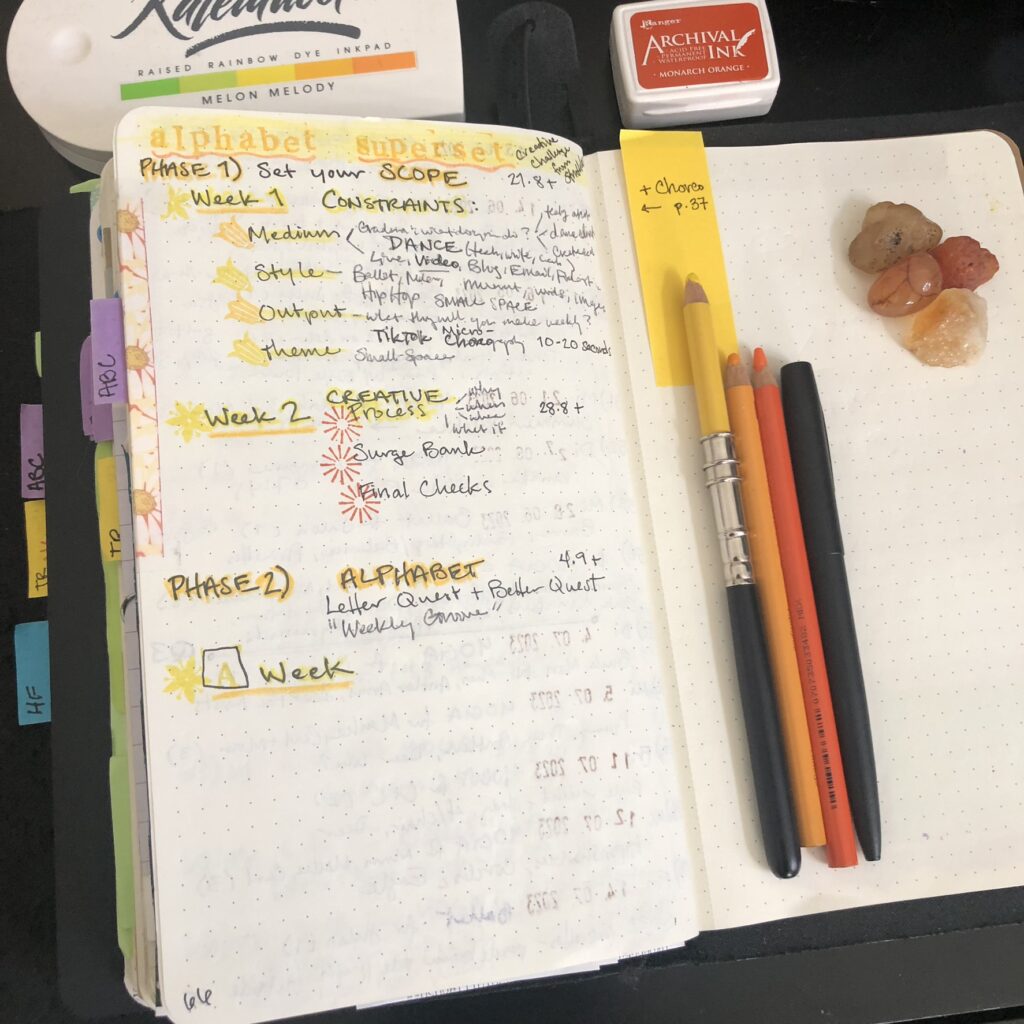
Here’s what the details are shaping up to look like for me, with the assistance of the worksheets in the program and my current curiosity:
10-20 Second Weekly Small Space Video Micro-Choreographies
Shared to TikTok (@blythelydancing), IG and/or Facebook, YouTube (all @ablythecoach)
Sharing to social media for the purposes of the Alphabet Superset challenge, I have no expectations or intention of trying to go “viral.” This goal is not concerned with metrics of social media performance or external “success”, but in order to have a playful form of accountability and build community with other creators within the project.
It’s going to be me, movement, my iPhone, music, & TikTok/IG in my personal project
Purpose of Participation
Although dance is my specialty, this format is outside of my comfort zone, so I wanted to use the motivation and shared risk-taking joie de vivre to propel me to continue to be a learner in the form, along with my students. Full disclosure: I’ve avoided participating in TikTok until now, so this will be my first contribution to the platform!
I intend to explore what’s possible with the vertical/portrait smart phone video orientation, as well as size-, location-, and viewpoint-specific choreography, and popular music. Also here to encourage others to dance, move, and create in their own way!
The whole challenge will help keep my knowledge of today’s dances and dance students up-to-date, while also refining my own artistic voice.
Created a collection in my Bullet Journal to plot, plan, brainstorm, celebrate
Structures for Success
Here’s where participating in a structured creative challenge is full of juicy potential! Struthless has provided some really fun and helpful worksheets for those who join the free challenge, so I definitely recommend signing up and using those if it piques your interest.
In addition, I am also using:
A Bullet Journal and Dry-Erase Board, a Morning Pages Notebook, stationery supplies
A variety of settings to inspire movement
Real-Life Community
Online Community (IG, TT, Email Newsletter subscribers)
Questions for Reflection
In what media do you create or wish to?
Will you join me in giving the Alphabet Superset or another creative challenge a go?
What structures of support do you need to help you succeed at the challenge?
“When we really listen to people talk about themselves, we get to learn about ourselves and it’s beautiful and it’s interesting and it wouldn’t happen in any other way.”
Hello again! In my last blog article, “Let’s Write! Camp NaNoWriMo & Creative Structure,” I declared my participation in the writing challenge Camp NaNoWriMo this July, focusing on developing real-life personal memoir-type stories. In the past I’ve done tons of academic writing, dabbled in fiction and poetry, and I’ve been working through my blog and email newsletter to refine my voice further, but had yet to dig in and develop any of my true stories that I’ve journaled about over the years.
Yes, it was emotional to take the memoir route, looking at my own personal history, diving into true experiences of growth and personal transformation, large and small. I wanted to use the challenge as an opportunity to both study and practice storytelling techniques, so I set a few goals for the focused month, developing habits I can carry forward to enrich my creative practice and life.
Here I’m sharing my results, what I learned from participating in Camp NaNoWriMo this year, and benefits you too might glean from such a personal writing practice.
Goals and Results
My goals and outcomes for Camp NaNo / Memoir July 2023 were:
Finish ReadingStoryworthy book by Matthew Dicks (I did, they also have a great YouTube Channel, and I found a lot of other great memoir resources online as well!)
Daily Story Ideas (generated 38/31)
Weekly Story rough drafts (wrote 5/4)
Continue to practice the new writing strategies I learned
Create a second draft/polish one story (in-progress, see below)
Blog about it
Tracking Writing Progress
Creating spreads in my Bullet Journal makes keeping track of my efforts more fun, so I set up a handy place to measure my progress towards my goals:
The Bullet Journal spread I created to set goals, track progress, motivate, acknowledge and celebrate
Writing Stories Improves Your Life
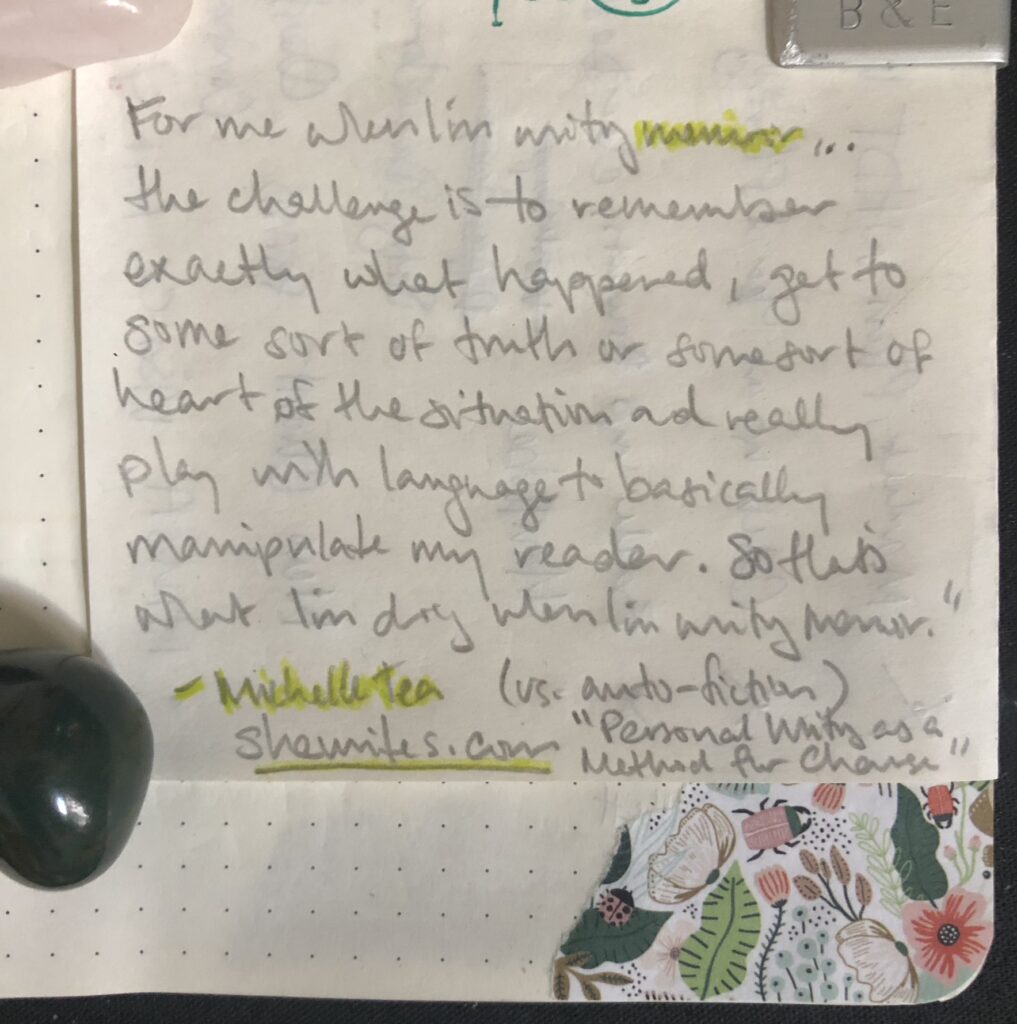
In the “Personal Writing as a Method for Change, featuring Michelle Tea“ podcast on shewrites.com, writer Michelle Tea: “The challenge is to remember exactly what happened, get to some sort of truth or some sort of heart of the situation and really play with language to basically manipulate my reader. So that’s what I’m doing when I’m writing memoir.” (about 7:30) Both Tea and Dicks express the importance of getting at the gems of truth, value, and learning from our personal experiences in processing them to share. It can take time to heal from some
In the book I chose to guide my storytelling growth, Storyworthy, author Matthew Dicks talks about how writing, such as his daily exercise called “Homework for Life,” and his “Crash and Burn” freewriting session that resembles Morning Pages, provides an opportunity for reflection, growth in understanding, and can even stretch our and our audience’s perception of time.
Here’s how you do Homework for Life: “Five minutes a day is all I’m asking. At the end of every day, take a moment and sit down. Reflect upon your day. Find your most storyworthy moment, even if it doesn’t feel very storyworthy. Write it down. Not the whole story, but a few sentences at most. As you start to see importance and meaning in each day, you suddenly understand your importance to this world.” (Storyworthy p.58)
Yes, each of our stories matter!
Writing Stories Stretches Time
Dicks claims, and I have experienced to be true, at least at moments: “As you begin to take stock of your days, find those moments — see them and record them — time will begin to slow down for you. The pace of your life will relax.” (Storyworthy p.53-4) Just as sketching can deepen how we see the world, what we witness and perceive, so can crafting stories from our lives.
Storytelling Time Travels Your Audience
Storytelling can create a sense of time travel for listeners/readers, as Dicks explains: “If I am doing my job well and telling an excellent story, you may, for just a moment, forget that you exist in the present time and space and travel back to the year and location that I am describing. My goal as a storyteller is to make my audience forget that the present moment exists. I want them to forget that I exist.” (Storyworthy p.291)
I decided to take Matthew Dicks’ advice to focus on small moments, and underdog experiences in storytelling–not necessarily the big life-changing or success stories we might first think of.
That in mind, I wrote out a few of the ideas I came up with as free-writes, then typed them up and began the editing process. None are yet refined, but I thought I’d share one of the stories-in-progress here just for giggles:
Biscotti at the Bridal Expo
It’s 2019 and my girlfriend Ela and I attend the Cologne Bridal Expo at Koeln Messe (the trade fair), having received tickets from her ex, who wanted to show her appreciation for Ela and another friend’s helping her prepare the graphics for her Grillmaster Hang Vietnamese street food booth. I have been working very hard to integrate myself into a new country and culture, cried through German language intensive courses, toiled to be sensitive and understood in my teaching, in applying for my work visa, in the grocery store, learning the customs and showing respect to the best of my ability, but I am still new to Germany, far from fluent.
We take the subway across the river, walk through the entryway, festooned with a massive multicolored balloon arch, several other dazzling examples of which are also on display, the competing concepts jostling for attention. We make our way to the booth, which looks awesome with slick yet distinct ambiance evocative of a fantasy Eastern street scene I have yet to experience in real life, with colors of wood, bamboo, green plants, and eye-catching graphics. We all embrace, congratulate the team on getting everything together for the expo, and sample Hang’s delicious appetizers. Her summer rolls are to die for, and we toast with tea. Definitely recommend!
We then drift around all manner of booths to the stage area where our eyes are treated to fashion shows, we listen to live music from harp to Schlager (German hits), peep at diamonds and decorations, view and taste everything Germany’s wedding market has to offer. I reflect that though I’ve been married twice, I have yet to attend such a grand exhibition of wedding wares, and what a funny perspective that is from which to view the festivities.
After much serpentine wandering, I’m wending my way to the back left corner of the huge hall. I pull up to a biscotti booth, where the crispy oblong cookies are appealingly arranged, the array of flavors shining through polished glass jars.
A few people are currently gathered talking to the lady in an apron inside the booth, her hair drawn back into a smart chignon. Taking it all in, I consider which variety to try, and draw one out. I bite into its gratifying expected crunch and wish I had a coffee to go with it as well.
The booth person turns to me, a silver tray of tiny cut-up pieces of biscotti in one hand, tongs with to distribute them in the other, her eyes widening, her face transforming to one of horror, her mouth uttering, all too late, “NEIN!”
But the time to stop me has passed. I’m caught red-handed, the dry texture aleady sucking the moisture from my mouth. Instantly, heat rises to flush my cheeks and chest, turning fully red as I chew and swallow my biscotti bite in shame. All eyes in the group are on me, and only then does my party find their way back to my side.
Deeply embarrassed by my faux pas, indignant at my confusion, and hysterically tickled at the absurdity of the whole situation, I erupt into laughter, scarfing the rest of the biscotti as I round the corner, explaining the shameful debacle that just ensued.
Despite my efforts to blend, I still can’t fully escape coming across as inconsiderate or entitled, even rude. My fear come true, I still, and apparently always will, manage to fulfill many people’s expectations of a “rude American”!
I’m grateful there is no penalty, no long-term consequences for such minor foreigner foibles. However, I am left with the knowledge that try as I might, however experienced or sophisticated I work to become, I will always experience embarrassingly human slip-ups! Learning a new language and moving to a new country as an adult is proving terrifying, humbling, and hilarious.
Next Steps after NaNo
Going forward, I’d like to continue to generate story ideas by doing my Homework for Life, to develop stories to eventually share, and to apply the storytelling tactics I’ve been learning. I’ll share some of my stories on the blog, and hope to eventually publish them in other contexts as well as publish a memoir. The daily habits and storyteller’s ear will continue to be my focus, the enhancement of my quality of life and observation, with lofty goals to inspire.
Considering if I want to participate in NaNoWriMo in November, the next Camp NaNo in April, and what other structures I’d like to support my writing in the future.
Questions for Reflection
Do you have an existing “Homework for Life” practice or will you take it on?
Which of your stories are waiting to be told?
What stories do you find most engaging to hear told or to read?
Which practices help you slow down time when life gets frenetic?
What support do you need to take your next creative plunge?
Back in the year 2019, having freshly moved from Honolulu, Hawai’i to Cologne, Germany, I began integrating into a new country, learning the language, and teaching. It was still prior to global pandemic, before I started publishing this blog in 2020, and with I wanted to do something to inspire my creativity as well as take steps toward a few long-held goals, such as a full-length ballet idea and the desire to publish books.
Knowing that due to years of higher education, I’m much more practiced with writing essays and dry academic writing (regardless of how scintillating I may find the topics) than more creative compositions, I decided to jump into fiction writing for a change. Thanks to social media, I learned of National Novel Writing Month and took on the challenge to write a novel in a month.
Although I didn’t “win” the challenge that November according to the standard 50,000-word goal, I came closer than ever before with a 18,600-word partial novella and the experience spurred me on to participate in and host further creative challenges, ultimately nurturing lasting habits, inspiration, and a growing body of work.
In 2021 I went on to write a Haiku poem every single day, this year I doodled my way through an Inktober adventure which I also discuss in my Charming Chosen Challenges article, and this July I’m excited to join Camp NaNoWriMo, a more casual writing challenge that takes place in April and July.
What is Camp NaNoWriMo?
According to nanowrimo.org, a rich resource for writing, both novels and other genres:
“Camp NaNoWriMo is your next, great writing adventure. Each April and July, tackle your own creative goal in the company of our global writing community.”
You can create your own online profile for free, set and track your goal, connect with other writers, and receive motivation and accountability on your journey as an author. NaNoWriMo also have a very informative YouTube channel.
My Camp Goals
For Camp NaNoWriMo I’ve landed on a new challenge to develop true stories from my life that could form the beginning of a memoir. I started by announcing my intention to participate on Instagram (@ablythecoach), opening up a new Evernote document and Bullet Journal spread dedicated to brainstorming for the challenge, and will continue to update my social media and email newsletter subscribers on my progress.
This time around, on the official website, I set my project up as a 1,000 Words goal. What that really means on a daily basis, is that I plan to develop the skill and habit of nonfiction storytelling through the following habits:
Keep reading and working exercises from Storyworthy book by Matthew Dicks, for story ideas and crafting techniques
Collect Daily Acorns / story ideas (31+ in July) using Homework for Life (noticing story moments in everyday life, in memories), Crash and Burn (which is a freewriting exercise a lot like Morning Pages from The Artist’s Way that I already do weekdays but can always use more effectively), and First Last Best Worst from Storyworthy
Craft weekly Short Story Drafts (4 in July)
May our creative efforts be as fruitful as these Lychee from Ka’u, Hawai’i Island
Notes from NaNoWriMo 2019
As I mentioned in the introduction, in 2019 I participated in National Novel Writing Month and began to write my first novella! At the end of the month I still felt that it’s far from complete, but I did write fiction every single day and produced the bones of my first longer work of fiction. I wrote this reflection at the time, in December 2019, but didn’t get around to sharing it here on the blog until now:
“The plotline and characters in their current form are already serving as a libretto for a ballet that I’m choreographing, and I also will go back and edit and add on to the story to flesh it out as a standalone work once I’ve had a break to get perspective on it.
I took on the NaNoWriMo challenge in order to fuel my daily writing habit and to stretch myself creatively in a new way. It worked splendidly! With all I had going on last month, I committed to working on my book for one hour per day, every day, and not to the full official word count of at least 50,000 words. Maybe next year… It was thrilling to go around imagining characters and settings, key scenes, and dialogue. Getting inside the heads of different people and their relationships, what’s important to them and the events of their lives was a magical way to spend any spare thinking moments I had, and to produce work on this project consistently.
In the end, I came up to about 18,600 words, which is a whole lot more than any other fiction I have written in the past, and to be honest I haven’t written a creative story since I was a child. Academic papers? By the boxful (I can prove it). Books and books of personal journaling, plus some scattered poetry, sure. But to pursue a work of fiction this deep, this fast, was all new to me. It was a huge challenge to show up to write every single day, and I did miss a couple of sessions due to illness, the hours for which I subsequently made up.
I got Chris Baty’s (one of the NaNoWriMo founders) book, No Plot? No Problem! A Low-Stress, High-Velocity Guide to Writing a Novel in 30 Days for my Kindle and it was a fun and inspiring read. Next time I take on NaNoWriMo, I’ll follow the his suggested schedule for preparing in October to jumpstart my month. As it was, I just did a tiny bit of research and thought about characters and point-of-view and then jumped right in. I also indulged in Elizabeth Gilbert’s Big Magic: Creative Living Beyond Fear and it is providing ongoing encouragement to realize my creative imagination. I love books about writing and making art, as well as nonfiction on all the topics that interest me, and of course novels, fine and performing arts. I’m great at taking in inputs and information, consolidating, organizing, and cross-referencing, the challenge is to then create my own output. There’s a balance to strike between the two, always learning from written and live sources and also sharing my own ideas and impressions.
I definitely needed a bit of a break after my intensive stint of writing, and now I will direct my writing time to reflecting on 2019, brainstorming for the new year and decade ahead, this blog, my German writing skills, and poetry. 2020 excites me greatly and I believe there are wonderful things awaiting all of us. As a sort of teaser for the novel I started, which will be born once it’s good and ready, I thought I’d share one of the poems I wrote to accompany the text, perhaps at the beginning of each chapter. It’s a pirate story, and I don’t want to share too many details yet, so here is just a hint:
_ Let’s light this wretched world on fire, Flaming out against the dark.
Not yet sure when or two what extent I may share the stories I write during Camp, we shall see where the practice takes me. Would you be interested in true stories from my life?
You’re always more than welcome to reach out to me via email or on Instagram @ablythecoach, I’d love to hear what you’re creating, and I’m grateful we’re connected.
Blythe Stephens, MFA & Bliss Catalyst she/her or they/them A Blythe Coach: ablythecoach.com @ablythecoach
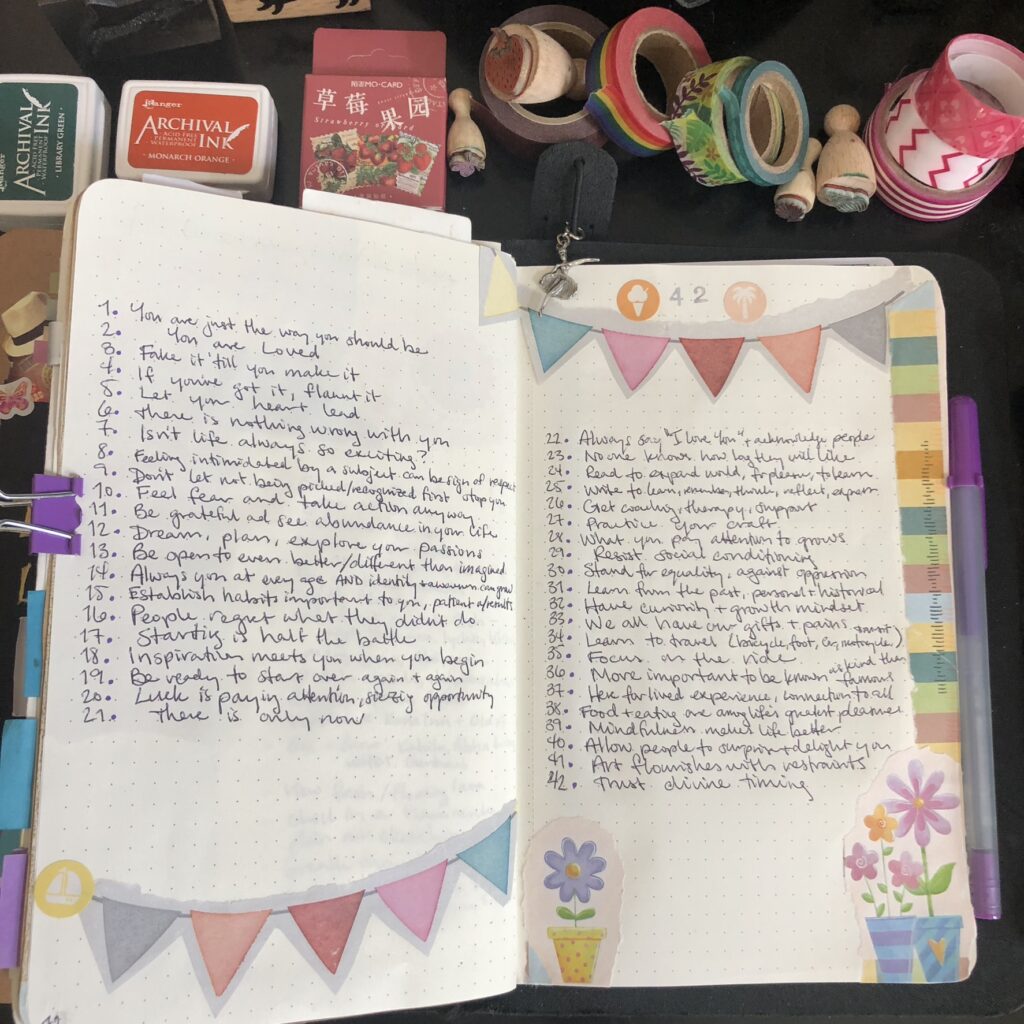
As part of my birthday celebration this year I decided to indulge in sharing, in no particular order, this collection of incomplete, unjustified, and unsolicited pieces of advice!
The bite-sized nuggets come from a wide variety of influences from family and mentors to thinkers and celebrities and my own observations and beliefs.
42 Life Lessons spread in my Bullet Journal
Lessons & Advice, Meaning of Life
I’ve been thinking about the meaning of life, a la The Hitchhiker’s Guide to the Galaxy, which I am reminded that I really would like to re-read.
Usually careful to cite sources, provide context and justification, as well as practical applications, in this case I’ve cast all that aside. Instead, I’ve just compiled, willy-nilly, some of what I consider to be the most important lessons I’ve learned so far. Some might be thought trite, some are redundant, and there are certainly important lessons I’ve failed to include. However all have provided meaning and motivation to me at some point.
Concepts I’ve listed here are also included in my work here in my articles, in my classes and coaching, online on YouTube and social media. Some will bear elaboration in future offerings and I’d love to know what piques your interest.
Want to make creativity a daily ritual and see your self-realization soar?
Regular artistic explorations can help build a habit of joyful creative expression, and each activity can help grow your ability to feel inspired and produce abundant work.
According to “Making Art is Good for Your Health” on npr.org, “‘The act of creation can reduce stress and anxiety and improve your mood,’ says Girija Kaimal, a professor at Drexel University and a leading researcher in art therapy. ‘And flexing our creative side can give us a stronger sense of agency — the ability to solve problems by imagining possible solutions.'”
The bite-sized artistic practices to follow were originally presented as my “Ignite the Spark of Your Creativity” Challenge on Instagram in celebration of International Coaching Week.
Use the six prompts that follow to ignite your creative spark and be amazed by the cumulative and far-reaching impacts such regular practices can have in your life.
Freewriting is the first creative prompt, and is valuable regardless of your preferred artistic medium. One way to free write is called Morning Pages and comes from Julia Cameron’s _The Artist’s Way_ book and program. Cameron writes:
“Every morning, set your clock one-half hour early; get up and write three pages of longhand, stream-of-consciousness morning writing. do not reread these pages or allow anyone else to read them. Ideally, stick these pages in a large manila envelope, or hide them somewhere. Welcome to the morning pages. They will change you.” (_The Artist’s Way_ p.96)
You could also respond to specific prompts, such as recording observations from your five senses, or trying out these Writing Exercises for Poets from Reedsy. The main thing is to get words flowing onto paper, and save any editing for another time.
Morning Pages are one way to ignite the spark of your creativity
The second prompt is to move through an Egg Improvisation–or several–as described in _The Creative Habit_ by Twyla Tharp: “The exercise I call Egg is a great way to start a creative session. It couldn’t be simpler: I sit on the floor, bring my knees to my chest, curl my head down to my knees, and try to make myself as small as I can. In this minimalized shrunken state, I have nowhere else to go; I cannot become smaller, I can only expand and grow. And so it becomes a ritual of discovery for me. If I lift my head and straighten my back I become Tall Egg. If I stretch out my legs and point my toes, forming an L-shape, I become Jackknife Egg. I stick with it as long as it remains interesting, sometimes going through as many as a hundred positions. I’ve been doing this daily for years and I usually find something new in the process.” (_The Creative Habit_ p.112) Tharp herself emphasizes, as with each of the prompts I suggest in this article, that this improvisation does not require specialized skills or ability and can be fruitful for all sorts of creative folks: “I like the Egg routine because it is so basic. You don’t need to know anything or be in particularly good shape to do it (although some stretching is a definite help). The only requirement is a commitment to the process. The starting Egg position is your home base and you are setting out to see see how far you can travel from home.” (_The Creative Habit_ p.113)
Screenshot of a shape from one of my Egg Improvs in the video, on the lanai at home
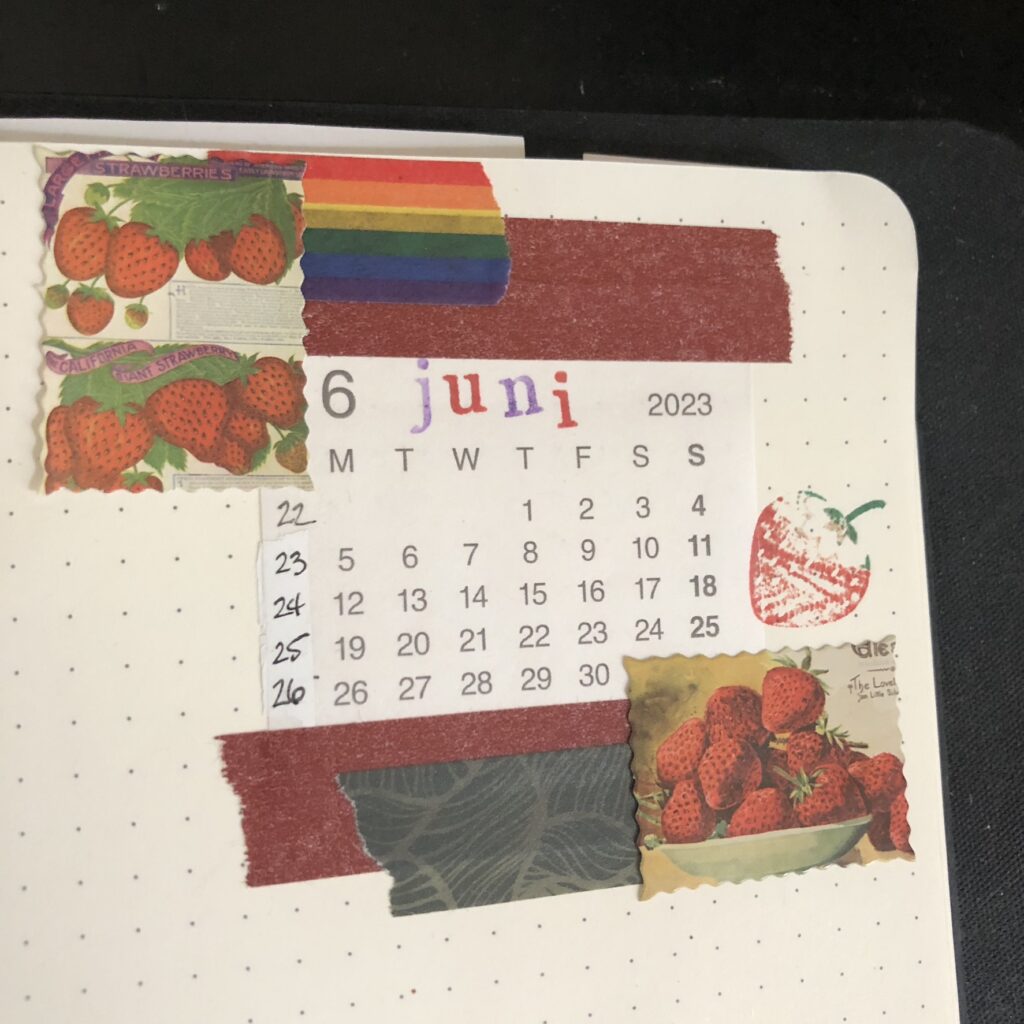
Next is to get crafty, assembling scrap papers, ephemera (gift wrap, cards, tickets, maps, stamps, stickers…), a glue stick or other adhesive and arrange a mixed media collage. Collage using found images, textures, and text, which could take the shape of a mood or vision board, a multi-media mosaic, decorations in a journal, or whatever you want. Cut out your favorite bits using scissors or tear with your hands, try out different configurations, consider color and texture, allow the product to be perfectly imperfect.
A little collage for June in my Bullet Journal, also shared on Instagram
It could be a joyful noise or reflect any kind of mood your feeling, prompt four is to sing, play body percussion or an instrument. Devise a rhythm, write a song, make a beat or a playlist.
My RISE Up in Love Playlist has some favorite feel-good tracks and I find pieces of music and playlists can amplify inspiration to dance and create with other media.
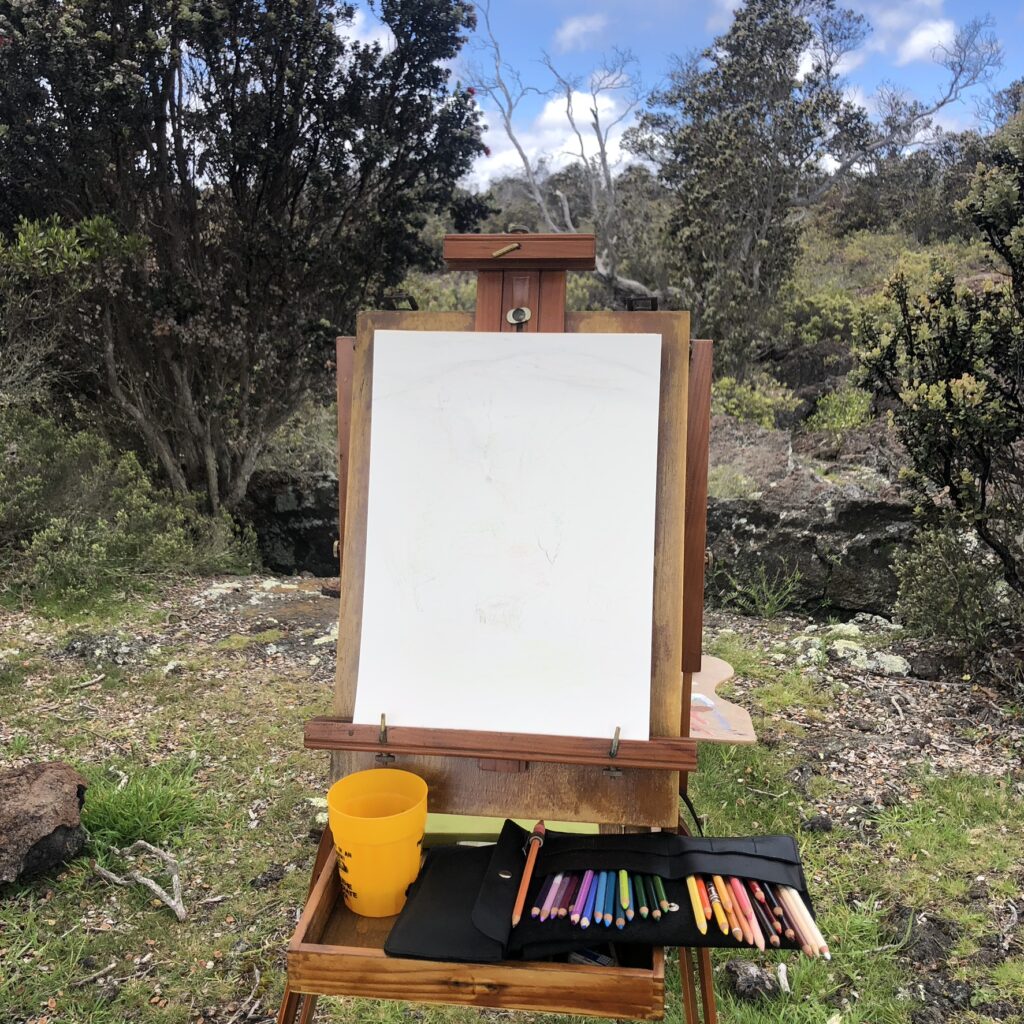
The fifth prompt has us getting sketchy and drawing on paper with pencil or ink, in the form of a landscape, still life, cartoon, caricature, dance shapes and movements, abstract, or doodle.
Regardless of the artistic merits of your creation, there is evidence that Drawing helps you think, and it engages us visually and kinesthetically. So dash out a little sketch and get familiar with exercising your brain in this way.
My view for one day’s sketching session on Mauna Loa on the Big Island of Hawai’i
A further way to ignite your creativity is seek out human sources of creative inspiration and community. You could seek out collaborators in your local community or online, such as on social media or the HITRECORD App, which is loaded with stimulating prompts and ideas for a range of media and genres.
Next Steps
Once ignited, keep the fire of your inspiration burning with daily practice.
Fuel the fire by showing up for your creative rituals regularly, reflecting with the questions below, digging into the resources for further exploration, joining me on my email newsletter, in upcoming workshops and live classes in-studio and online!
Questions for Reflection
What lights you up?
Which media did your inner Artist Child particularly enjoy?
Which practices will you continue to fuel the fire if your creativity?
With whom will you creatively collaborate?
How can I support you in making your artistic mark?
So when Judith “Sympatexter” Peters issued a #BlogYourPurpose challenge, I had to see what it was all about. Luckily I now speak and read German, because that’s the language of the challenge, though she uses a lot of English phrases as well, as seen in it’s title. How fun is it that Germans enjoy peppering their speech with my mother tongue?
Although I’ve been blogging for a bit now, I am always keen to learn and found Peters’ challenge informative and motivating.
Purposeful Creative Living
The upshot is, it is valuable and impactful to express and live out our life’s purpose. We CAN create content, and ultimately a thriving life, that pours forth from our life’s Purpose.
Peters discussed the Japanese concept of Ikigai in relationship with Purpose, Lebenssinn or Bestimmung and offered valuable tips for new bloggers and folks who want to leave a legacy. These concepts are also related to Dharma in yoga philosophy, which I discussed in my Coming from Your Powerful Core blog.
Living my purpose while visiting WHDT during time at home in Kailua-Kona, Hawai’i
Coaching to Distinguish Personal Purpose
In order to identify my Purpose, I worked with a coach and participated in Accomplishment Coaching’s ontological Coaches Training Program. Since then it has provided clarity in times of tumult and change, a lighthouse guiding my way, providing meaning and motivation. It’s been an honor to work with clients to unearth their own purpose and transform their lives.
I would be delighted to guide you through the process as well, please don’t hesitate to reach out for support in your pursuit of a meaningful life.
Blythe’s Purpose, Essence, Mission, & Vision
So what is my personal Purpose?
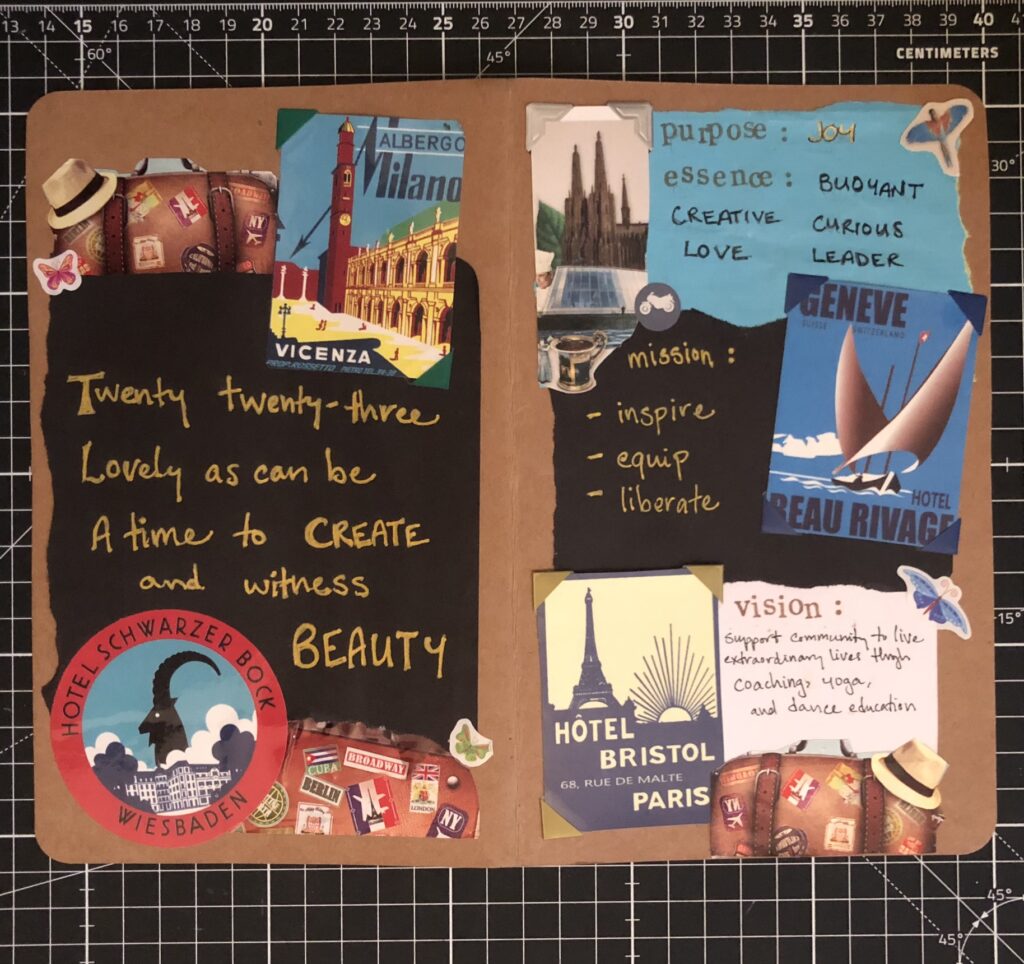
Purpose: Joy
Essence: Buoyant, Creative, Curious, Love, Leader
Mission: Inspire, equip, and liberate dancers, creatives, & global citizens.
Vision: Support my community to live extraordinary lives and reach their potential through coaching, yoga, & dance education.
Visuals and other aids help me remember to stand in my Purpose daily, such as this dashboard/vision board that I created for my 2023 Bullet Journal and which I also shared on Instagram @ablythecoach:
My 2023 Stand / Word of the Year, Purpose, Essence, Mission, & Vision BuJo visual
Leaving a Legacy
Through various processes of distinguishment such as coaching, journaling, and articulating my professional aims, I have sought to encapsulate in powerful and inspiring words, the positive impact I hope to create in the world.
I can live this in real time every day by being my Purpose and Essence in the world, by acting as a catalyst for others’ transformation through coaching, mindful movement, and by other means.
A combination of timeless, circumstance-independent Purpose and Essence with my personal passions and curiosities such as ballet, dance, yoga, and coaching combine to enact my influence in the world.
May the North Star of my purpose lead all that I do, and ripple out through clients, students, collaborators and community across this beautiful earth and into the future. And may you be empowered by your own purpose to be and do what you are here for!
Questions for Reflection
What is your Purpose?
How do you stay present to your Purpose in challenging times?
What are the next steps to live our your Purpose in the world and leave your legacy?
Blythe Stephens, MFA, Bliss Catalyst they/them or she/her Creator of A Blythe Coach: dance through your difficulties and take leaps of faith into a joyful, fulfilling life
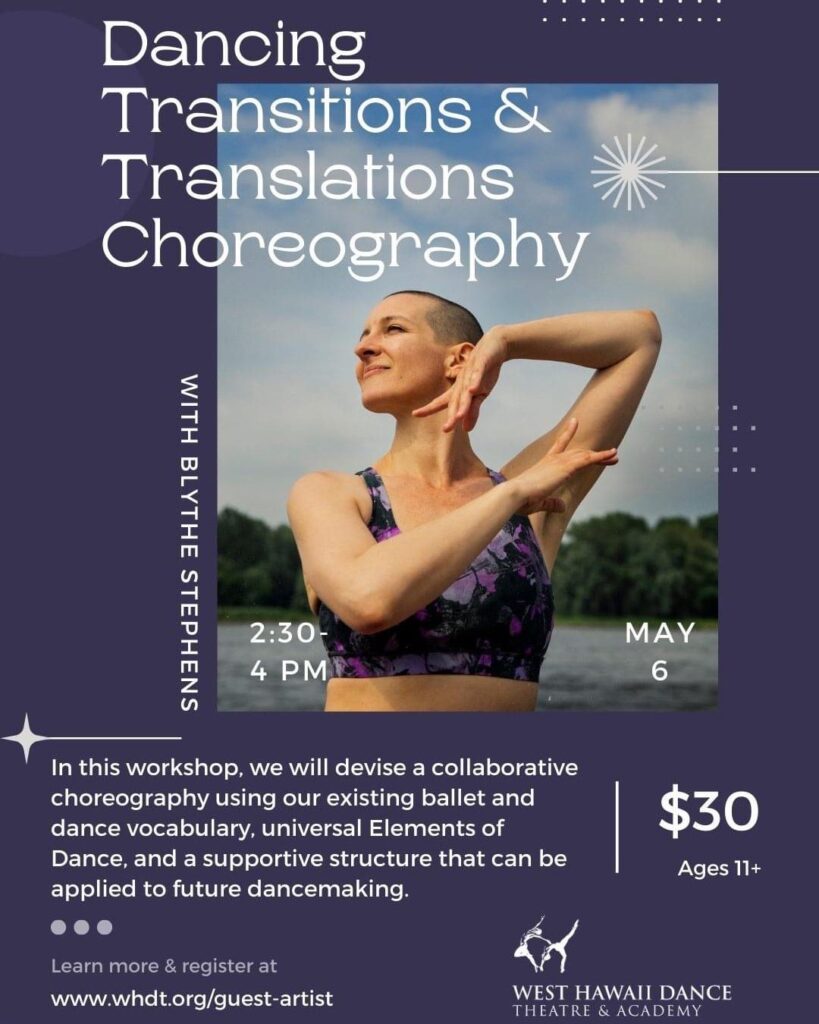
Following on the heels of my Get Down Daily Dance Challenge for National Dance Week, I am pleased to announce a special choreography workshop at West Hawai’i Dance Theatre in Kailua-Kona, Hawai’i on Saturday, May 6th!
Living in intercultural and international locations such as Hawai’i and Germany, we encounter a rich variety of languages and perspectives. Linguistic translation, both in verbal communication and the vocabulary of dance movement, provides an exciting challenge in which we can discover our voice and encounter ourselves anew, articulating ideas in innovative ways. Such adaptations applied to dance choreography can also provide greater accessibility for ourselves in different times of life, for our dancers and collaborators, and for audiences.
Workshop Structure
In this workshop, we will devise a collaborative choreography using our existing ballet and dance vocabulary, universal Elements of Dance, and a supportive structure that can be applied to future dancemaking.
We will begin with a simple dance phrase, developing varied interpretations, integrating our individual viewpoints, and emerging with a new work-in-progress.
The process will generate more nuanced transitions and fuller expression in technique and performance practice, choreographic exploration, and bridging dance tradition and contemporary issues.
Let’s keep in touch, keep dancing, and never hesitate to let me know if I can be of service!
Blythe Stephens, MFA, Bliss Catalyst they/them or she/her Creator of A Blythe Coach: dance through your difficulties and take leaps of faith into a joyful, fulfilling life
Want to make mindful movement and creativity a daily ritual?
This is a recap of my 5-Day “Get Down Daily” Dance Challenge on Instagram (hence the portrait video format).
The following bite-sized movement explorations can help build a habit of joyful exploratory movement and creative expression. Originally created in celebration of National Dance Week, you may use these five prompts and responses to inspire your own improvisation and choreographic research anytime!
We will develop a joyful daily creative dance practice that is accessible to a variety of abilities and experience levels and achievable in minutes a day. Be amazed at the far-reaching impacts such a practice can have in your life.
Prompt No.1 [01:10] – Choose 1 Body Part or segment, explore for 1 Minute. Can isolate that part only or initiate movement with that part that impacts other areas as well. If you’ve got time, repeat the process with other parts!
2. Musical Improvisation
Prompt No.2 [03:08] – Musical Improvisation. Pick a piece of music, old or new, that moves you and boogie.
3. Site-Specific Exploration
Prompt No.3 [06:29] – Site-Specific Exploration. Use whatever space you have or seek one out that you have access to. Small or large works, video is a space too. Notice how my move in this environment, respond to what you see and sense.
4. Costume/Character
Prompt No.4 [07:15]- Costume/Character Embodiment. Try different clothing or accessories, could be a skirt, shirt, hat, shoes, or a whole outfit or costume. Take on a disguise, be a different version of yourself or someone else entirely.
5. Eyes Closed
Prompt No.5 [08:45] – Eyes Closed Somatic Sensing. Carefully and slowly notice your movements with your eyes closed or softly focused. How are shapes and shaping, movements and relationship to your surroundings without a visual representation?
Continue Your Creative Habit
These prompts are truly just an appetizer though, and I have many more tools, existing and future workshops on designing your own creative practices and making dances.
I hope you have found responding to these movement prompts insightful and fun, and that your artistic adventure is ongoing!
Resources for Further Exploration
Keep your eyes peeled here or subscribe to my email newsletter to learn more about my upcoming Spark of Creativity Challenge in May
How could a mindful movement or creative dance enhance your life?
What do you dream of creating?
Let’s keep in touch, keep dancing, and never hesitate to let me know if I can be of service!
Blythe Stephens, MFA, Bliss Catalyst they/them or she/her Creator of A Blythe Coach: dance through your difficulties and take leaps of faith into a joyful, fulfilling life
I know, a whole list-icle featuring none other than my own creations and services, right? But hey, you’ve come this far, so you must jive with something in my offerings and approach.
Heartfelt thanks if you already support my work in any way, currently or in the past. Just showing up means a lot.
Perhaps you already enjoy my offerings in-studio or online and would like to know in what ways we might further collaborate, or you are interested in supporting me in expanding what I can provide for your befit and that of others.
Whether your interests lie in mindful movement, dance, coaching, education, or personal growth, I’ve got something for you, and you’ve also got oodles of potential ways to support me in return 🙂
Podcast 099 is the audio version of this article, links to resources mentioned below
Who am I?
If you’ve learned about me through someone else or stumbled across my work online and we’re not yet properly acquainted, hello! I am Blythe C. Stephens (they/she), a Hawai’i-raised and Cologne, Germany-based bliss-catalyzing coach, dance & yoga educator and creator of A Blythe Coach, helping multi-passionate creatives dance through their difficulties and take leaps of faith!
It would be a delight to connect with you on Instagram, where I regularly post and go live @ablythecoach and you can also learn more about my work here on my blog as well as on the A Blythe Coach podcast and YouTube channel (more about each of those avenues shortly).
My first major interests were ballet and theatre (along with reading, marine biology, visual art…) and I pursued conservatory training in dance on the East Coast at UNC School of the Arts, going on to pursue liberal arts education in philosophy at Whitman College and life coaching certification at Accomplishment Coaching, both on the West Coast, continuing to dance throughout. My MFA in Dance and teaching credential in secondary education I completed at the University of Hawai’i, with further yoga teacher training most recently in Cologne Germany.
A multi-passionate creator myself, it is a balancing act to integrate my many interests and pursuits, educational programs, romantic relationships, and adventures. Having studied and worked in student success, ontological, and life coaching, higher education, dance choreography, performance, production, and education, my current projects and offerings reflect my passions for dance, mindful movement, and joyful living.
Glad that you are here with me to savor any and all of these ways to create and connect! What follows are ten ways for us to work together or support my work, from completely free and low-commitment offerings, to higher-cost, -commitment, and -value contributions.
Blythe looking to the right in a field of flowers, buzz cut blowing in the breeze PC: Marina Weigl
Consult to Determine Fit
My approach is holistic, rigorous, and truly unique, but you don’t have to take my word for it. You can experience the difference firsthand in a complimentary discovery call, available regardless of which of my services piques your interest.
Take the guesswork out of determining which of my offerings is best for you or how we might work together synergistically. Let’s connect or catch up!
Free / Low-Commitment
Gifts of Time & Energy
Let’s say you are digging all the value I offer my free offerings such as YouTube videos, blog articles, challenges, and email newsletter. You would like to help me continue to produce and improve my content, but you’re not in a position to contribute financially. No worries.
Or you are a student or client who is such a fan of my approach that you’d like to know what further ways you could support the work with a minimal monetary cost. Awesome!
In these cases, I suggest the following methods through which you may promote my creations so that they can benefit others as well, at no cost.
1. Subscribe and/or Leave a Review
Subscribing to my various channels, engaging with my posts, and leaving a positive review where available (LinkedIn, Social Media, directly to me to share…), are all great ways to get the information out to more folks who would enjoy it.
Following any of my channels and interacting with the content you like is a great start. Even more effective is to recommend specific videos, articles, or other media to particular people who might enjoy them, or share them with relevant groups you are a part of or your own social media channels. It’s fun when you tag me as well 🙂
Here is where I am showing up and you can follow/subscribe/review and so forth:
A Blythe Coach YouTube Channel – where I publish approximately-weekly videos on topics of mindful movement–ballet, dance, & yoga–, coaching, personal development, & growth.
Weekly Email Newsletter – the best place to hear from me on a regular basis and be the first to hear about my newest creations and offerings, as well as favorite recommendations from other creators.
A Blythe Coach Podcast – available wherever and whenever you like to listen to podcasts.
Creative and mutually-beneficial collaborations could take place live in special events or workshops, working together virtually through videos, audio, written, or social media (above), or in other settings.
If it’s a match, I’d love to introduce my audience to your audience, provide professional and personal insights, participate in interviews (maybe you’d like to be a guest on my podcast or have me as a guest on yours?), and expand our mutual network of inspiring people.
What ideas would you like to bring to fruition and how might we link arms to make that happen?
Low-Cost/ Commitment
If you’d be interested in making a financial contribution, small or large, here are some ways to do that currently. Your donations and payments for classes and coaching directly support my daily operations and I deeply appreciate your support!
3. Make a Donation through Tip Jar
You might have enjoyed a free offering such as my YouTube videos, blog articles, or podcast and wish to support me in continuing to provide these resources to all. How generous and thoughtful of you, please know that your contribution will go to continuing to improve my offerings and therefore the value I deliver back to you.
Here’s a great way to make a one-time donation, which will be greatly appreciated and support the sustainability of the work you enjoy:
It feels so good to move mindfully together, whether in-studio in Germany where I am currently based, while guest teaching at home in Hawai’i, at locations in-between, or online in my virtual studio on Zoom.
Those on my email list are the first to know where I am currently offering classes and coaching, both in-studio and virtually.
If you are in the neighborhood, take advantage of adult & teen ballet, yoga, or other courses with me live in-person at Tanzschule Tanzraum in Cologne, Germany, West Hawai’i Dance Theatre in Kailua-Kona, or elsewhere TBA.
Blythe in grand plie in first position by industrial docks in Cologne PC: Marina Weigl
5. Live Group Mindful Movement Courses Online
If you’ve enjoyed dancing along with my YouTube videos and want to take the next step, or would like to prepare for or supplement work together in-studio, joining my online studio might be for you.
Participate in mindful movement together–dance &/or yoga– with me live in-person on Zoom in a group or private study environment.
Consult with me 1:1 on a discovery call and try a free class to determine if these courses might be for you.
My clients typically come to me for support around massive career shifts and tricky health challenges, as well as working through nasty breakups and other cataclysmic shifts. In short, folks dealing with radical change, whether it is chosen and wanted or totally unexpected, seek out coaching for effectively navigating thrilling and terrifying transitions.
Some individuals prefer to work in a one-on-one environment to receive personalized feedback, intensive attention and support in a more private setting. This can help overcome obstacles and generate unprecedented momentum and power.
I have supported clients through transformations such as career transition, going back to school, taking on leadership positions, radical changes of medium, specialty and/or geography, coping with injury, disability, and diagnosis.
I’m here to help multi-passionate creatives to dance through their difficulties and take leaps of faith into purposeful and fulfilling lives.
Again, the best way to discuss how private coaching or classes would work is to sign up for a no-obligation discovery call.
7. Signature Coaching Program
My signature program, Dilemma to Delight, walks you through my framework step-by-step within a 1:1 coaching container.
In this structured yet individualized coaching program, you will accelerate your results and catalyze the changes that lead to joy and satisfaction.
The season of coaching moves through five stages, which comprise the essential elements of change, catalyzing your growth and transformation. We partner together to reveal your amazing essence, design clear action steps, provide accountability and inspiration in the projects and topics of focus, and deftly dance through obstacles.
More details and further testimonials also available on my coaching page.
8. Special Workshops, Speaking, Events
Got your own company or in a position where you would like to work together to present or teach in a corporate or educational setting? Let’s talk about your topics of interest and how to work together on such a project!
You do not have to be able to strike Firefly pose, pictured above to get the benefits of mindful movement PC: Marina Weigl
9. Positions in Secondary & Higher Education
A lifelong learner, I will always be studying, reflecting, and growing. It’s possible that working with colleges or universities could be a part of that, as I have greatly enjoyed my previous work in academic settings.
Working with teens and adults is of particular interest, as well as ballet and coaching for dancers of other styles and creatives of all stripes.
Please do pass along any positions or opportunities that sound like they may be of interest, and I’ll look forward to also sharing them to folks who could also be a fit.
10. What I haven’t yet imagined…
I’ve found it best to remain open to the unexpected, as surprising twists and turns have been a regular feature of my life experience so far. This leads to a lot of exciting adventures, fuels my creativity, and builds fun connections.
What possible opportunities have I not yet thought of? Your presence, ideas and input are highly valued.
Questions for Reflection
What ways to work together resonate most with you?
What is the next step?
How did you hear about my work or in what capacity have we worked together?
Have we danced or practiced mindful movement together, or would you like to try it out?
Have you been coached?
What area of your life would you like to transform?
Who do you know who could benefit from my offerings?
Thank you for taking the time to consider creative ways we might support one another. Let’s keep in touch, and never hesitate to let me know if I can be of service!
Blythe Stephens, MFA, Bliss Catalyst they/them or she/her Creator of A Blythe Coach: dance through your difficulties and take leaps of faith into a joyful, fulfilling life
Last October I tried out my first Inktober Drawing Challenge, and in January I’ve kept sketching going on a weekly basis. Drawing and visual arts is really a whole other way of being creative than my usual dancing and also very relevant to the enterprise of shape, shaping and space in my dance practice as well.
I got a lot of value out of the challenge of producing 31 drawing studies in in as many days. It was also super inspiring to see the works of, and connect on social media with, “real” illustrators and other visual artists. Great to be influenced by new works and creators!
As November passed, I witnessed those who participated in the latest round of NaNoWriMo at work on their books, some ultimately “winning” the 50,000-words-in-30-days challenge. In 2019 I took on the challenge to write a novel in a month myself, not “winning” the challenge, but coming closer than ever before with a 18,600-word partial novella.
In 2021 I went on to write a Haiku poem every single day and like my Inktober adventure, I continue to seek out fun new creative challenges.
What follows are a sampling of challenges I have enjoyed in the past which have led to valuable insights and in some cases lasting change.
Last weekend’s challenge was climbing the steps at the mining museum in Bochum, Germany
Past Challenges Undertaken
Here are a few of the other challenges I’ve partaken in recent years:
Yoga with Adriene 30-day Yoga Journey in January, which I took my time working through the first few years as I was able, eventually helped me build my daily yoga ritual. I then branched out to participate in yoga challenges with Schuyler Grant and others. I am grateful to Adriene Michler as well as all my other in-person and online yoga teachers for helping me establish a daily practice which I have since made all my own and which I hope to continue for life!
Deepak Chopra and Sharon Salzberg’s Meditation Challenges and other such guided meditation practices have also been instrumental in making what was more sporadic practice a consistent feature in my life. Starting with these brief 2-4 week challenges, I again expanded slowly into longer sessions daily. It was inspiring to practice in daily bite-sized pieces and led to my 2021 Daily Meditation Practice Challenge and ongoing daily ritual.
A few rounds of the MinsGame 30-day Decluttering Minimalism Challenge, for example before moving or as a spring refresh, have done me good, and I’ve also used Marie Kondo’s method. I spill the details in my Minimalism Memoir article.
Since buying my Kindle and reading my friend Claire Willett’s incredible debut novel The Rewind Files, I was inspired to dive back into reading for pleasure and have have since participated in Reading Challenges for the last few years on Goodreads. I don’t plan to continue to set higher and higher goals for books read each year, but am glad to continue to read consistently and with relish.
Language Sprints on Duolingo and Lingoda support me to practice my German. I have over a 3-year streak on the former app!
The Artist’s Wayby Julia Cameron is a 12-week in-depth creativity program/challenge full of valuable practices, including writing Daily Morning Pages for freewriting/braindumping/creative flow which I continue benefit from.
For Music, I’ve played with a minimal daily Harmonica practice, and then read the book a Year of Wonder andlistened to the accompanying classical music selections daily last year (2022). This was a huge boon to my dance improvisation and choreography practices and my creative inspiration in general.
This year I am having fun with A Year of Planning, which is a weekly Bullet Journaling Challenge, and am considering other challenges to participate in and lead.
…And I’ve done assorted other challenges, such as Letter Writing (my weekly-correspondence goal last year, inspired by the book I Want to Thank You), Cold Showers a la Wim Hof for stress-reduction and immunity, and surely others I’m not recalling in the moment.
Cultivate Ongoing Habits
Some challenges, like yoga, meditation, journaling, gratitude and abundance, reading, writing, languages, and music have proven to provide ongoing value to my life.
In these cases, a challenge can provide a sort of “kickstart” for something you intend to make a habit or practice. After the official challenge is complete, these may continue in some form indefinitely. These type of challenges have supported me in creating daily rituals and repeating traditions.
Personally, I’m always on the lookout for fun and motivating challenges in different areas where I’d like to learn and grow.
One-Time Challenges
Challenges don’t have to become a lifelong habit in order to have value. While some may indeed lead to lasting change, others provide insight and inspiration for a time or can be revisited intermittently as desired.
Maybe it turns out that you require the practices in your chosen challenge only intermittently, or they provide a connection to something that proves to be more meaningful for you, or you realize it’s not really a fit at all. Take the learning forward with you, but feel free to leave the challenge behind if it has served its purpose and you don’t wish to continue.
Always feel free to take or leave any “official” rules or make your own entirely, based on your true objectives.
Challenges to Avoid
There are some common challenges that I certainly don’t plan to participate in in the foreseeable future, such as any kind of food or eating restriction or dieting.
I DO want to continue to make a habit of body acceptance, self-care, and joyful intuitive eating as well as rampant creativity and joy.
Challenges I Have Led
In the past, I have offered mindful movement and coaching challenges, and going forward I foresee providing further ballet, dance, yoga, meditation, creative living, and coaching challenges for my community. It is such a blast to come together in a focused way to see growth and results in a short time!
Let’s connect by email or on Instagram @ablythecoach, I would love to hear your perspective!
Blythe Stephens, MFA, Bliss Catalyst they/them or she/her Creator of A Blythe Coach: dance through your difficulties and take leaps of faith into a joyful, fulfilling life