A Blythe Coach

Learning from Mistakes & Failure

“Do not fear mistakes–there are none.” – Miles Davis (quoted in The Artist’s Way p.343)

“Success is not final. Failure is not fatal: it is the courage to continue that counts. Success is stumbling from failure to failure with no loss of enthusiasm.” – Winston Churchill

“Finish every day and be done with it. You have done what you could; some blunders and absurdities no doubt crept in; forget them as soon as you can. Tomorrow is a new day; you shall begin it well and serenely, and with too high a spirit to be cumbered with your old nonsense.” –Ralph Waldo Emerson (quoted in Austin Kleon’s Keep Going)

Me “failing” by falling out of an arm-balancing yoga pose onto the rocks by the Rhine [Photo Credit: Marina Weigl]

Let’s talk about failure, yay! Myself, I have faced many situations that could be treated as failures in my life: jobs I wanted and didn’t get, unsuccessful business endeavors, and two divorces! There have definitely been discouraging times and big obstacles, mistakes and accidents. Just the other week I fell in ballet class (thankfully this time, it didn’t hurt at all)! 

Of course, I’ve had lots of successes, brilliant triumphs, and have experienced tons of love and support and abundance in my life, too, but that’s not what we’re talking about today.

No, here I want to get into how to deal with making mistakes, facing failure, embarrassment, and discouragement, then finding the courage to keep on with our dancing, learning and growing, creative practice, professional dreams, and quest for a happy, fulfilled life!

What follows in this blog post and in Episode 67 of the Podcast can’t possibly be exhaustive, but comprises some of the best resources I know to help with frustration at our all-too-human mistakes and imperfections:

Podcast 067: Learning from Mistakes & Failure in Dance, Creativity, & Life

Mistakes and dancing

Learning to dance and performing live are both absolutely loaded with opportunities for mistakes, failures, and rejection. We can’t learn to dance without first being bad at dancing and working hard to learn how to control our bodies and develop technique through tons of practice, study, and training.

As ballet dancers, we are striving for an impossible “perfect” ideal technique and artistry, so there are always opportunities for further failures and learning.

We are going to fall, forget, yes even fail! But from the very first lesson, it’s important to learn to jump back up, brush ourselves off, assess for damage, try to identify what went wrong, then start again!

I’ve read a couple articles from Pointe Magazine lately on the topic, one from Pro Dancers on recovering from onstage fails which normalizes our performing catastrophies saying, “As live theater returns, we’re reminded again that anything can happen onstage. Be it falling, puking or losing your costume mid-performance, mishaps are a reality of the industry. It’s what you do with the disaster that matters.” Another article deals with How to Let Go of Past Mistakes and Focus on the Future with great tips for dancers of all ages.

Learning to Fail, importance of mistakes to learning

Failure isn’t just built into learning dancing of course, it also applies to all learning! In fact, the research-based book on learning, Make it Stick, blew my mind a bit during my teacher credential program, especially finding out that the difficulty of recalling new information correctly correlates to the depth of the learning.

That means the more I struggle to remember German words, as long as I try hard, keep practicing, and get corrections when I can, the more permanent and retrievable that information will be in the future. Roedinger, McDaniel, and Brown are clear: “The harder it is for you to recall new learning from memory, the greater the benefit of doing so. Making errors will not set you back, so long as you check your answers and correct your mistakes.” (Make It Stick p.202)

This reminds me of a song that continues to echo through my mind, “At Home in the Dark” which includes the quote, “An error doesn’t become a mistake until you refuse to correct it.” I’ve seen this quote attributed to both Orlando A. Battista and JFK (wonder whose mistake was it to credit one in error? Ha.) The point is that the real “wrong” is continuing to be willfully ignorant closed to the truth, growth, and improvement.

So we need to embrace the difficulty we experience in learning, because “People who are taught that learning is a struggle that involves making errors will go on to exhibit greater propensity to tackle tough challenges and will tend to see mistakes not as failures but as lessons and turning points along the path to mastery.” (Make It Stick p.91)

I have had the opportunity to see this in action in various areas of learning in my life, but language learning has been a biggie for about the last three years especially. Tell you what, learning the German language as an adult has been every bit as maddening and hilarious and excruciating and rewarding and embarrassing as promised.

Make It Stick stresses that we hold the power to expand our intellect: “The elements that shape your intellectual abilities lie to a surprising extent within your own control. Understanding that this is so enables you to see failure as a badge of effort and a source of useful information–the need to dig deeper or try a different strategy. The need to understand that when learning is hard, you’re doing important work. To understand that striving and setbacks, as in any action video game or new BMX bike stunt, are essential if you are to surpass your current level of performance toward true expertise. Making mistakes and correcting them builds the bridges to advanced learning.” (p.7)

Mistakes, failure, and creativity

Mistakes are critical for learning, and they are also essential to any creative pursuit. Julia Cameron asserts: “All creative success requires creative failure.” (The Artist’s Way p.384) In the book Succulent Wild Woman, Sark explains how our resistance to this failure can inhibit creativity, and how to move forward:

“Creativity is filled with making ‘mistakes.’ Women are often preoccupied with perfection and miss out on the mistake-making process. We start with a vision in our imagination–then we try to translate it into paint, clay, crayon, pastel, dance or song. The paint leaps off the brush and a big dot appears on the paper. Is it a mistake? Or a messenger of color, sent to invite us to explore?” (p.137) Don’t miss out on this joyful process!

Sark relates her own person experience with this struggle against judgement: “So often, I scribble or color and then judge the result too quickly. I decide it is inferior, or a mistake, or not worthy in some way. Yet the process is a glory if I can detach from the result.”  (Succulent Wild Woman p.137)

While doing the Artist’s Way in 2020, I came across a refreshing approach to supposed creative failures, as Julia Cameron reassures artists: “Because the Artist’s Way focuses on process rather than product, you will learn to value your ‘mistakes’ as part of your learning.” (The Artist’s Way p.367)

Sark relates experiencing negative judgment when creating art and writing books, but has come up with a clever visualization to help: “Sometimes while writing a book, I imagine an audience of critics looking scornfully at what I am writing. I call in my creative and spiritual mentors to ‘scatter the crowd’ and restore some balance.” (Succulent Wild Woman p.137)

Unwaveringly emphatic about the need for mistake-making, Sark cheers: “We need to make more mistakes! As women, and people, and especially creatively. Start more projects! Start more than you can ever finish. Fill yourself overly full so that your imagination spills out. Watch children. So much of what they do is a ‘mistake’ by our narrow adult standards. Women can step boldly forward as working creative people–not just hobbyists, dabblers, and only dreamers.” (Succulent Wild Woman p.137)

Fear of mistakes and failure

It breaks my heart when students of mine come to class already saying that they “can’t.” Of course they can’t yet, they haven’t studied or practiced or anything! It takes a TON of failure to be a ballet dancer and it starts on day one and continues for the rest of your life!

Make It Stick drives home how debilitating this fear can be: “A fear of failure can poison learning by creating aversions to the kinds of experimentation and risk taking that characterize striving, or by diminishing performance under pressure, as in a test setting. In the latter instance, students who have a high fear of making errors when taking tests may actually do worse on the test because of their anxiety.” (p.91)

This is tragic because many highly-intelligent individuals who study hard may perform poorly in examinations due to this paralyzing fear of making mistakes or getting answers wrong. In the book There is Nothing Wrong With You, Buddhist teacher Cheri Huber concurs: “If you are afraid of making a mistake, you’ve already made it. You’re already in as bad a place as you can be. Everything after that is getting out.” (p.162)

One of the historical personalities I found cited again and again for his persistence in the face of apparent failure is Thomas Edison, and Make It Stick points out that the inventor actually “called failure the source of inspiration, and is said to have remarked, ‘I’ve not failed. I’ve just found 10,000 ways that don’t work.’ He argued that perseverance in the face of failure is the key to success.” (p.93)

Letting go of judgement

How can we deal on a practical level when a fear of mistakes and failure stops us or others we love from pursuing what they dream of?

We must find a way to let go of negative judgements of our attempts. As Judith Lasater distinguishes in the book Living Your Yoga, “To view yourself as bad or a failure because you did not accomplish what you set out to do is judgement. To state clearly and simply that you did not accomplish your plan is taking responsibility.” (Living Your Yoga p.24)

This has been a big part of my work as a life coach, helping clients differentiate between disempowering judgements and inspiring/empowering interpretations of the facts of their situation. It’s funny when I bump up against the notion that coaches (or teachers, for that matter) have it all figured out or somehow don’t face failure. Quite the contrary, they are experts at navigating mistakes, challenges, failures due to their intimate experiences with all of these!

If we get stuck in the quagmire of failure and self-loathing, we can miss the opportunity to be responsible for our actions, learn from our experiences, strategize, and stay in action toward what we want to create with our lives. This skill in re-framing failure also gets stronger with practice.

Facing mistakes with compassion

A classic reminder of the importance of determining where we can learn and improve and what we can let go of, The Serenity Prayer states,
“Grant me the serenity to accept the things I cannot change,
The courage to change the things I can,
And the wisdom to know the difference.”
Dealing with mistakes and failures requires acceptance, courage, and wise discernment, not harsh judgment, beating ourselves up, or despair.

My research on resources for cultivating compassion to help us move past our failures included some mindful advice from the Harvard Business Review in the article Recover from Failure with Self-Compassion: “What does it take to rescue yourself and begin to address the situation effectively? You need to treat yourself with the same kindness and support that you’d provide for a friend.”

Cultivating the Courage to Create

In The Artist’s Way Julia Cameron explains how we can cultivate the courage to create: “Let our gardening hands be gentle ones. Let us not root up one another’s ideas before they have time to bloom. Let us bear with the process of growth, dormancy, cyclicality, fruition, and reseeding. Let us never be hasty to judge, reckless in our urgency to force unnatural growth. Let there be, always, a place for the artist toddler to try, to falter, to fail, to try again. Let us remember that in nature’s world every loss has meaning. The same is true for us. Turned to good use, a creative failure may be compost that nourishes next season’s creative success. Remember, we are in this for the long haul, the ripening and harvest, not the quick fix.” (p.378)

Cheri Huber underscores the value of mindfulness to our learning in There is Nothing Wrong With You: “Whatever it is I’m doing, if I pay attention to it, I’m going to benefit. I’m going to learn something.” (p.160)

Responding to a student who struggled to accept their failures, Huber advises, “Look at your son, Evan, learning to walk. At what point should he have considered himself a failure and given up? All of the times he pitched over on his head or fell back on his bottom? Those were not successful from the definition of walking, yet  they were not unsuccessful, either. They were just part of the process of learning to walk.” (There is Nothing Wrong With You p.160)

Huber explains that mindfulness and acceptance are key: “If you were to see clearly all your conditioned beliefs about getting what you want, control, wrong, blame, should, and trying, you would have a level of clarity that would make your life simple and enjoyable in a way that you cannot now even imagine. You would have a level of freedom available to you that you would never find if everything went the way you want it to for the rest of your life.” (There is Nothing Wrong With You p.161)

It’s funny to imagine that our outcomes can turn out even better when things don’t go as we hoped and planned for than if they did, but looking at my life, I can see evidence of this as well. Sure, we want what we want and should go for it, but need to face our results with equanimity.

Yoga to Practice Compassion 

Judith Lasater suggests the following Compassion Practice to help us develop understanding and acceptance of our selves and others. If you are struggling to find compassion for others, Lasater recommends: “To increase your ability to extend compassion to others, begin by allowing compassion for yourself to grow.”(Living Your Yoga p.54)

The first step of the Compassion Practice is to start in a comfortable position such as savasana, spend a few minutes to close your eyes, relax, and breathe. Then Lasater directs:

“When you are ready, recall a past experience in which you wish that you had acted differently or in which your actions were not freely chosen. As you recall your experience, first pay attention to your bodily sensations. What do you notice? Perhaps you feel a tightness in your throat, or a heaviness in your belly, or a restriction in your breathing. Whatever you feel, be present, with kindness.

Next, imagining that your experience is on a video-cassette, rewind and rerun it from the beginning. This time, see yourself through the perspective of time and compassion. Acknowledge that the choices you made were the best that you could do at that time. Allow your actions to be understood from your new perspective.

Then slowly begin to bring your concentration back to the here and now. Breathe quietly for a few minutes. Slowly roll over onto your side, open your eyes, and use your arms to help you get up.” (Living Your Yoga p.54-5)

Importance of Support

It is very difficult to face these challenges and failures on our own. Whether that support takes the form of friends, family members, creative community, or trusted professionals, go get it! Julia Cameron has seen many examples: “I have had ample opportunity to experience firsthand what it means to lack creative support and what it means to find it. Often, it is the difference between success and failure, between hope and despair.” (The Artist’s Way p.379)

Daily Artistic Practice

Austin Kleon describes how artists and people can succeed through designing supportive artistic practices in his book Keep Going:

“Even after you have achieved greatness,” writes musician Ian Svenonius, “the infinitesimal cadre who even noticed will ask, ‘What next?’” In response, Kleon shares: “The truly prolific artists I know always have that question answered, because they have figured out a daily practice—a repeatable way of working that insulates them from success, failure, and the chaos of the outside world. They have all identified what they want to spend their time on, and they work at it every day, no matter what.” (Location: 59-62)  

Structures to overcome fear of failure and mistakes:

Looking for more from me on related topics? Listen to Podcasts 009: Resilience and 008: Persistence or the following blogs:

Questions for Reflection

What mistakes do you regret? What is there to learn from them?
How have you failed lately?
What failure do you fear?
What resources and structures do you need to call upon to face your fear?
What do you want to create?

I hope you’ve gotten value from this exploration of overcoming mistakes and failures to keep going with dancing, learning, and creative practices! Let me know how you fuel your creativity and what practices keep your dancing and artistry alive!

Blythe C. Stephens, MFA
she/her or they/them
A Blythe Coach: Dance Education & Coaching 
move through life with balance, grace, & power

Falling for Momentum, Swinging for the Stars

“How do you like to go up in a swing,
Up in the air so blue?
Oh I do think it the pleasantest thing
Ever a child can do!

Up in the air and over the wall,
Till I can see so wide,
Rivers and trees and cattle and all
Over the countryside–

Till I look down on the garden green,
Down on the roof so brown–
Up in the air I go flying again, 
Up in the air and down!” – Robert Louis Stevenson

“There are swings that are released down into gravity and swings that are released outward into centripetal and centrifugal trajectories. Gravity is a natural force, as is one of its outcomes: momentum. Gravity is in constant operation. The dancer must practice restraint rather than effort when he deals with this principle. In swings he sends the effort downward by releasing it. Gravity creates the downward pull. The resulting energy is the momentum derived from the release. One releases into gravity and one rides the momentum.” (The Nikolais/Louis Dance Technique p.144)

Imagery, Physical Forces, and Dance Movement Techniques of SWINGING, that’s what I’m writing about today and discussing on Episode 66 of the podcast:

Podcast Episode 066: Falling for Gravity, Gaining Momentum, Swinging to the Stars

Safety Warning

As Alwin Nikolais and Murray Louis caution in their book The Nikolais/Louis Dance Technique, “These can be powerful forces, and if one is inept or careless in complying with the natural laws of these centrifugal and centripetal powers, injuries can result. In executing centrifugal and centripetal movements, one must take care to realize the location of the pivot point. The careful study of where the legs begin in the hip sockets and where the arms begin in the shoulder joints is basic and essential.” (p.149 emphasis mine)

As always, before attempting any new movement technique or practice, consult with your physician or healthcare professional. Then, listen to your body’s signals, go slowly and mindfully.

Poetic Imagery for Swinging

In the book Dance and Grow, Betty Rowen describes imagery that can help inspire swinging movements: “There are many dramatic images that come to mind involving swinging. Some of them are elephants’ trunks, bears, the man on the flying trapeze, pendulums, and swings. Of course, the obvious image is of a swing on the playground.
Various parts of the body can swing, as the teacher suggests, Make your arms swing…make your whole body swing. And finally, Swing any way you want to–make up your own kind of swing. Some lovely movements may result from these improvisations. The teacher may select one or two swinging patterns demonstrated and the class may try different ones.” (p.18)

Poetry and imagery resonate for students young and old to accompany improvisation and dance technique exercises. Educators, families and caregivers of children can learn many different creative dance activities in the book Dance and Grow by Betty Rowen. This is where I first learned how to use Robert Louis Stevenson’s “The Swing” poem to inspire movement.

Rowen explains how to integrate movement explorations to the poem into dance class: “The rhythm of the poem follows exactly the swinging rhythm of the movements. A simple structure can be given to group improvisations by setting different types of swings to different parts of the poem.” (Dance and Grow p.18-9)

Swinging in Dance Technique

Swinging movements and imagery are important to dance technique, performance, and improvisation. Dance educators Betty Rowen and Mary Joyce write about using swinging movements in children’s dance classes, and choreographers Alwin Nikolais and Murray Louis apply the concepts to working with adults.

Rowen explains the importance of swinging to mastering dance movements and suggests music to help produce different movement qualities: “Coordinating body parts in a swinging movement calls forth a sense of balance when the weight shifts, as in a side-to-side swing. Swinging movements can change in quality, creating dances that are soft and lyrical (perhaps to Chopin waltzes) or vigorous and percussive (as in fighting movements). It would be hard to find a piece of choreography that does not use swinging movements in some parts of the composition.” (Dance and Grow p.19)

Joyce describes several foundational swinging exercises in the book Dance Technique for Children, including Parallel Swings (p.82), Side Swings and Slides (p.85), used in Perception of Rhythm (p.101), Leg Swings (p.121), and Swings and Extensions (p.142). (Dance Technique for Children)

As a dance technique class exercise, Nikolais-Louis explain that “Swings can be introduced in the post-plié series, as a forward and back, side and side series with arms or legs:
Releasing of weight to gravity.
The swing outcome.
Arrival.” (The Nikolais/Louis Dance Technique p.146)

One way to play with arm swings is my “Wonderful Whirligig Walks” video
Gravity Swings (Arms, Torso)

Nikolais-Louis teach that the most basic type of swinging action to practice is a high-to low vertical gravity swing: “The simplest swings are made with the arms and legs because they are attached at one end, while the outer tip is released into peripheral action. High-to-low vertical swings are basic. The arm held in high suspension without any flexion can swing into gravity. If left completely free to do so, it will pass the gravity point, and its momentum will carry it to the end of its path of weight release and then return in the direction from which it came, repeating the swing until the energy is expended.” (The Nikolais/Louis Dance Technique  p.149)

Joyce’s Parallel Swings involve swinging the arms and upper body from a standing position and can be elaborated into hip-lifting (rising in the lower body) and jumping versions, as well as later double-bounces and upper body articulations:

“1. Arm swings, knee bends: In parallel position, feet under hips, back long, arms high, swing the arms down and back, then forward and up. As the arms swing, the knees bend. Pattern: down two three and up two three.

What do you know about the alignment of the legs and feet? Knees must be over toes. The knees are your signposts. Watch them carefully. Your toes are apart. Where then should your knees be as they bend and straighten? Apart. Think about it, especially as they bend. They will want to get close together.’ Repeat swing until all have it.

2. Torso: Bend torso forward, sweep floor with hands on the backward swing, and straighten legs. Sweeping the floor again on the forward swing, come up. ‘Bend the whole torso, and sweep the floor with your hands, both back and forward.’ Knees bend deeply, but heels stay on the floor.

Combine the arm swings and the torso swings:
Swing backward and forward (arm swings)
Sweep down and up (torso swings)

The count will be
Swing down & swing up &
a 1 & a 2 &
Sweep down & sweep up &
a 3 & a 4 &

Or: 
swing down two three up two three
sweep down two three up two three” (Dance Technique for Children p.82-4)

As with stability in both the legs when swinging the arms and torso, in teaching Leg Swings, Joyce also emphasizes the importance of developing stability in the standing leg (using turnout as support and the hip girdle muscles active) to support the action. This is critical for all dancers and the delicate balance we strike in swings of this sort between standing strong and going with the forces created.

Sizzling Standing Leg Swings Dance Technique video on YouTube
Leg Swings

Nikolais-Louis discuss the importance of mastering both freedom and control in movement and suggest developing swinging skills through both improvisation and class exercises. We need many experiences of swinging and momentum to understand how to create and manipulate the forces involved for choreographic purposes: “What distinguishes the artist from the commonplace dancer is his ability to choose from among the multiple possible variations the most effective sentient designs to control momentum.” (The Nikolais/Louis Dance Technique  p.148)

One exercise for practicing legs swings in the Nikolais-Louis Technique which I’ve also seen variations of in many other modern and jazz classes:
“Swing free leg, forward-back-forward, step-step-step. Change legs.
Swings are in three-quarter time. Make the three parts of the swing visibly clear.” (The Nikolais/Louis Dance Technique p.145)

Joyce’s exploration of Leg Swings looks like this:
1. Leg swings: Review wrap-around (page 117) and broom handle (page 119). First position, girdle muscles supporting the lift, torso stretching upward, weight forward. Repeat, balancing first on one leg and then on the other.
Your right hip joint is now going to be firm as a rock. When the wind blows, does a rock move? No! Hold firmly in your right hip, no movement is allowed. Let your left leg swing easily in the breeze backward and forward. Keep the right hip vertical and lifted‘…
2. Pattern (Have the children start as far back as possible, as the pattern moves forward): ‘Standing on the right leg, begin swinging the left leg forward and continue for seven counts. Step forward on the left on count eight and hold your balance. As you step, find your lift and placement on your left side.’ The children stand on the right leg; the left leg swings:
forward back forward back forward back forward step on the left
1 2 3 4 5 6 7 8
Repeat, standing on the left leg and swinging the right leg.
Next put these two phrases together, sixteen counts in all.
Then, shorten each phrase to four counts, stepping on count four: ‘Swing forward, back, forward, and step.’
Shorten it again, this time to two counts, stepping on count two. Here the count will be
swing & step & swing & step & swing & step & swing & step
1 2 3 4 5 6 7 8
Swing only as hard as you can without moving the rock.’
Next, have them do the whole sequence: two 8’s, two 4’s, and four 2’s.
Repeat, adding a hop after each step. Later you can add arms in opposition to this pattern.
3. Across the floor: Have the children do the same pattern across the floor, using the step-hop to propel the body forward. To stretch the supporting leg and foot in the hop, have them think of pressing the leg forward, splitting the legs.” (p.121-2)

Improvising to get chummy with Momentum

In addition to formal exercises, Nikolais-Louis recommend experimentation through improvisation: “To experience momentum, my suggestion is to propel the body randomly, to get a better sense of momentum on its own terms, rather than using it as a device to achieve a specific end. From a standing position, propel the body percussively into random directions to feel what actually happens during momentum. Practice percussive propelling in different parts of the body so that you can realize the great variety of possibilities and feel the experience of being thrust from one body shape to another.” (The Nikolais/Louis Dance Technique p.148)

Strategic practice and mindful improvisation both play important roles in mastery of movement.

Swings in Laban Movement Analysis

A movement description and analysis standpoint is useful for choreographers, dancers, dance notators, and critics. In describing and analyzing swing movement, both shaping and directional movement are present. Directional movements could include rising/sinking, advancing/retreating, spreading & enclosing gestures (related to gathering and scattering) and qualities. In a swing context, each of these are initiations and resolutions of momentum, using gravity, centripetal and/or centrifugal forces.

According to Cecily Dell, “Spreading and enclosing occur in the horizontal cycle, where shaping that is mainly sideward across or out away from the body also has a forward-backward component, as in an embrace. Advancing and retreating occur in the sagittal cycle where shaping that is mainly forward and backward also has an upward-downward component. Although Lamb stresses the use of the torso in shaping, these symbols may also be used to describe limb movement. In a pirouette, for example, where torso movement is minimal, one arm spreads and the other encloses during the turn.” (A Primer for Movement Description p.57-8)

I find effort action concepts such as “flick,” “punch,” and “slash” inspire different, helpful qualities in swings and use of momentum in dance choreography. Dell explains: “Gathering and Scattering – When a movement can be said to be shaping, but emphasizes either coming toward the body or going away from the body, rather than any particular directions in space, the terms gathering (shaping towards the body) and scattering (shaping away from the body) may be used to describe the movement. Gathering and scattering are terms as traditionally; associated with Laban theory as are basic effort actions such as ‘punch’ and ‘float.’ They can be very helpful, evocative terms for directors and movement teachers, who may be looking for general terms for orienting actors and dancers. They are perhaps less useful in detailed notation and research, since gathering and scattering can be broken down into more basic concepts.” (A Primer for Movement Description p.56)

I have previously written about shape and shaping in the blog Shapeshifting Dancers: Forms & How We Get There. For more on spatial ideas in movement description and analysis, you can view my video on Planes of Space & the Body.  

Physical Forces in Dance

Gravity

According to Peggy Hackney, in the excellent book on Movement Fundamentals Making Connections, “Our ability to sense our weighted mass which makes possible our assertion of strength and lightness is possible only because of earth’s gravity.” (p.41)

One example of a Movement Fundamentals exercise that teaches the use of gravity, momentum, and sequencing through deep muscle groups is the “Diagonal Knee Reach (Irmgard’s Exercise No. 5A “Knee Drop”), a version of which I incorporated into my “Sweet Leg Swings” video. (Making Connections p.182)

Practice Knee-Drop movements, use of gravity and momentum with reclining leg swings
Momentum

Murray Louis and Alwin Nikolais argue that to dance is to manipulate momentum: “Momentum is the consequence of the force caused by the act of propulsion. It is the going, the movement itself. Therefore, it is the basic substance of dance because it defines the kinetic condition occurring between the beginning propulsion and the ending outcome.” (The Nikolais/Louis Dance Technique  p.148)

Swinging involves creating and controlling momentum. Nikolais-Louis define the physical act of swinging in dance: “A swing is a three-part action: A beginning force that is released into space. A path of going. A suspension at arrival point. […] During the second part, through the force of momentum, variations of the swing occur: turns, air work, and so on, which use the resultant force to operate. The dancer must determine the necessary force during the first step to allow the second, complexity of the outcome, to complete itself. He must accomplish the third, the suspension at the arrival stage, to start the upbeat of force for a new swing. (The Nikolais/Louis Dance Technique p.144)

Further, Nikolias-Louis distinguish swings from another familiar dance movement, undercurves: “Although swings resemble the undercurve, their definition and execution have different purposes. The technique involved in the undercurve is to define and depict specifically the undercurve of a circle, whereas the swing defines a release of weight to the forces of momentum and gravity.” (The Nikolais/Louis Dance Technique p.144)

For more about undercurves, consult my blog on undercurves and overcurves or “amazing undercurves” dance warmup video.

Centrifugal and Centripetal Forces

When throwing or swinging limbs and body into space, there are two more forces to define, “Centripetal: inward throw. Centrifugal: outward throw.” (The Nikolais/Louis Dance Technique p.146) Nikolais-Louis elaborate:

Here’s how these types of swings work, from Nikolais-Louis: “With centrifugal and centripetal swings [compared to basic gravity swings which release into earth’s pull from suspension], the force is now the body, which throws the attached body part into space like a weight attached to a string. This creates the momentum to the point of arrival.” (The Nikolais/Louis Dance Technique p.144)

Factors Affecting of Physical Forces

It’s clear that generating and manipulating the physical forces of gravity and momentum are important to dance expression: “One of the fine points of aesthetic technical control that must be mastered is the judgment of how much energy is needed to bring the impulse to a point of termination.” (The Nikolais/Louis Dance Technique p.148) However, gravity, momentum, centripetal and centrifugal forces are not the only influences acting on or created by the body in motion.

Nikolais-Louis remind us: “There are other causes of change in velocity; for example, the friction of the floor can slow momentum, whereas the slipperiness of a polished floor surface may increase its velocity.” (The Nikolais/Louis Dance Technique  p.148) Indeed, human movement is extremely complex.

In fact, harnessing these powers is a never-ending pursuit: “The sensitivity and control of momentum should occupy the dancer’s technical exercises for as long as he continues to study dance. In further study, you will realize that the velocity of momentum is not constant, that motion starts at a high speed and diminishes as it proceeds, either until it is brought to the destined outcome or until, en route, it is recharged by additional forces.” (The Nikolais/Louis Dance Technique p.148)

The arms, legs, and torso can all swing, and these movements in concert with the coordination of the whole body allow dancers to accomplish their choreographic and expressive objectives. Nikolais-Louis tell how the arms contribute: “Dancers often use additional thrusts to increase the height of elevation. The arms make a considerable number of peripheral paths of action possible.” (The Nikolais/Louis Dance Technique  p.149)

With a combination of natural physical forces as well as propulsion from coordinated muscular action of the limbs and body, endless movement possibilities result: “When the dancer adds the motional abilities of the legs, movement variations are multiplied. Then, too, he can add torso peripheries. The weight of the torso swinging in the air can lift the body into extraordinary acrobatic feats.” (The Nikolais/Louis Dance Technique  p.149)

For more on using physical forces to produce Locomotor Movements and Types of Jumps in dance, follow the links provided here. To learn about swings and movements that use momentum in ballet, I recommend my videos on “Tantalizing Tendu, Pas de Cheval, & Undercurves,” “Delectable Dégagé, Pas de Cheval, & Overcurves,” “Ebullient Battement & Passé,” “Embracing Ballet Balance” and “Tourner – Basic Ballet Turning Technique

Rhythm & Musicality

Music can also take a swinging quality, such as in the waltz that Betty Rowen mentioned, Swing Music (and we didn’t even talk about the style of social dancing called “Swing!”). Finding the downbeat and getting a feel for the rhythm of music and movement are related skills. Check out my blog on Developing Rhythm and Musicality for Dance for some more ideas on this topic.

Conclusion

I just had to include one more quote from Nikolais-Louis that made me laugh: “The indulgent dancer delights in centrifugal and centripetal forces. It’s the ‘Viennese Waltz Syndrome.’ Yet these are two of the most significant natural forces to be controlled and used with disciplined discretion. Both are by-products of momentum when it involves circular action and within them rests all forms of swings, turns, circles, and some elevations. Both relate to a central point of anchorage and to the forces that pull both powers toward and away from this central point.” (The Nikolais/Louis Dance Technique p.148)

This provides a good summary of the technical aspects we’ve discussed today, which in my own practice sometimes takes a discretely disciplined form, but admittedly goes in the direction of indulgence from time to time! I say move how you want to, delight in the physical forces that you create and respond to, and dance your way! I’m here to help you play and understand some of the ideas behind dance expression, not to inhibit your exploration and enjoyment 🙂

  • Do you like to go up in a swing and play with momentum?
  • What is your favorite variation of leg, arm, or torso swings?
  • What dancing or movement technique skills are you currently working to improve?

Let me know on social media @ablythecoach or by email, I love hearing from you! 

Blythe Stephens, MFA & Bliss Catalyst
she/her or they/them
A Blythe Coach
move through life with balance, grace, & power

Cinderella’s Courage & Kindness: teaching the classic fairytale ballet

Cinderella be
courageous and kind always
winning the kingdom

While I’ve been immersing myself in this ballet story, I wrote the above haiku as part of my 2021 haiku challenge.

One of the world’s most classic, iconic and ubiquitous tales, the “Cinderella” ballet can provide an entrée to universal themes and concepts useful in life and interdisciplinary topics within and beyond dance.

Teaching fairytales in ballet classes with all ages teaches virtues, storytelling and expression, musicality, technique, movement skills, and choreographic repertory, ballet history, appreciation, and criticism. They are a rich source of exploration and learning!

I especially enjoy teaching and revisiting “Cinderella” in the fall, what with the theme of harvesting the fruits of her actions, the supernatural elements, and the presence of pumpkins for the fairy godmother to transform into a magical coach in some versions of the story. 

Podcast 065: Cinderella’ Courage and Kindness – teaching the classic fairytale ballet

I use the “Cinderella” ballet (and popular fairytales in general) in my teaching in so many ways, depending on the age of the group I am working with, what we are learning at that time of year and in the students’ cycle of learning.

“Cinderella” can be used to teach values and virtues, storytelling and expression, music appreciation and musicality, specific dance technique and movement skills, choreography and repertory, traditional dances, dance composition, ballet history, appreciation, and criticism.  

Last spring I did a blog, podcast, and video about how I teach the ballet “Sleeping Beauty” which is now included in my “Ballet Stories” playlist on YouTube. I will continue to add further ballets as I research and write about them, so let me know what classical and contemporary ballets you’d like to learn more about in the future!

Teaching Virtues & Dance Ground Rules

“Have courage and be kind,” one interpretation of Cinderella’s lesson from her mother, is one of the best morals I can imagine for a fairytale. Knowing that life and success are going to require bravery and leaving one’s comfort zone, and that learning requires courage, I believe it is an important characteristic to develop in young people. As for kindness, or the activity of loving one another, it is the most important, life- and world-changing quality a person can have.

Cinderella is a person of character, demonstrating virtues of forbearance and compassion toward others, including family members, her stepsisters (who are unkind, even cruel to her), even strangers whom others may hold in fear, and other creatures like the birds or fairies who come to her aid.   

These virtues are related to the ground rules that I share for dancing with students from 3 years old through adults, of course gaining in sophistication with age and experience. I originally learned these simple rules from Jonathan Sypert, with whom I worked as teachers of several educational organizations, including Steps to Success, Kaiser High School, and The Movement Center in Honolulu, Hawai’i. Especially TMC has a mission of creating good people through excellent education in the performing arts, so as we develop skills, character is always important.

The three ground rules are:

  1. Be Safe
  2. Be Respectful
  3. Have Fun! 

What does being careful and safe have to do with courage? It is being wise and discerning in taking necessary, calculated risks. It is being observant and aware, remaining calm and responding appropriately to changing circumstances. It is also taking care of ourselves and others.

Respect and kindness also go hand-in-hand. Grace, friendliness, understanding, acceptance, compassion, honesty, and generosity of spirit all fall under this concept. Open-mindedness and embracing diversity, thinking creatively, solving problems, connecting, building relationships and community can all result from kindness and mutual respect. These shared values help create a safe environment for learning.

Cinderella maintains a hopeful and fanciful, with a wonderful life of the mind, dreaming and dancing, keeping a sense of possibility even in what appears to be an oppressive, abusive, toxic, cruel situation. We see her sometimes dancing alone with a broom, she keeps her fantasy alive, she hopes that maybe she can still attend the ball, even when it looks unlikely to come to pass due to many obstacles in her way.

Kind and brave Cinderella gives bread to the elderly lady who comes begging. It is portrayed in different ways in different versions of the story, but there is a common theme of others shrinking away in fear or distaste at the appearance of the ragged beggar woman, while Cinderella is the only one willing to engage with her. Cinderella is generous, having very little to give, she still finds a bit of bread to give to the needy woman.

Patient and compassionate Cinderella cultivates relationships with those she can, including the beggar, her father and stepsisters, even the birds. Ultimately, her generosity is rewarded, since the old woman turns out to be her fairy godmother in disguise, able to grant her wish to attend the Prince’s ball. 

YouTube Video of Podcast 065: Teaching the “Cinderella” Ballet Story – Courage, Kindness, Dance & Music Appreciation

Teaching Balletic History & Appreciation

The classic Balanchine’s Complete Stories of the Great Ballets by George Balanchine and Francis Mason, though the language and ideas can be dated and in some cases downright sexist and offensive, is a wonderfully comprehensive resource on ballet history.

[Note: though there are many problematic ideas in Balanchine’s writing as well as in the fairytale and ballet itself, but I won’t go into great detail about them here, instead focusing on positive, learning-supporting ways to use a story that students are bound to encounter. I’m happy to engage about any of these critiques with you in the future, and critical thinking is key to my teaching, so let me know what gets your goat!]

Balanchine describes four major productions of the “Cinderella” ballet:

Version 1: “Cinderella” Ballet, Music by Sergei Prokofiev, Choreography by Rotislav Zakharov, Libretto by Nikolai Volkov. First presented by the Bolshoi Ballet at the Bolshoi Theatre, Moscow, November 15, 1945. (p.107)

Version 2, 2a: Presented in a new version with choreography by Konstantin Serveyev at the Kirov State Theatre of Opera and Ballet, Leningrad, April 8, 1946. A new production, revised by Sergeyev, was presented at the Kirov Theatre, July 13, 1964. This production was first presented in the United States by the Kirov ballet at the Metropolitan Opera House, New York, September 11, 1964.

Version 3: Choreography by Frederick Ashton. First presented by the Sadlers Wells Ballet of the Royal Opera House, Covent Garden, London, December 23, 1948. (p.110)

Of this production, Balanchine states: “Cinderella is a story everybody knows and in the past it has attracted a great number of choreographers–French, Russian, and English. This particular ballet on the story, however, is important for a special reason: it is the first classic English ballet in three acts, the first full-length English work in the style and manner of the great nineteenth-century classics. But Cinderella is entertaining as well as important. Here the familiar tale is embellished with dramatic and comic differences, with divertissements, and with the grace and warmth of the grand academic style.” (p.110)

Version 4: Staged and choreographed by Ben Stevenson. First presented by the National Ballet at the Lisner Auditorium, Washington, D.C., April 24, 1970. (Balanchine’s Complete Stories of the Great Ballets p.115)

According to Balanchine, in reviewing this production of Cinderella in the British magazine, Ballet Today, Kay Rinfrette wrote: “Ashton’s Cinderella for the Royal Ballet influenced Stevenson’s ballet in several aspects. Like Ashton, Stevenson employs the English pantomime tradition by having the stepsisters played en travesti, and he excludes the stepmother who usually appears in Russian productions. Also, Stevenson omits the prince’s search around the world. Unlike Ashton, Stevenson changes the sequence of musical numbers in the ballroom scene to give the grand pas de deux, a traditional, formal structure (The adagio is followed by the man’s, then the ballerina’s variation.” (p.117)

“The adagio in the last act is less involved with fantasy, closer to a real-life love relationship. This meaning is understood by the choreography which includes thematic elements but in different combinations: there are fewer lifts, more terra a terre work […] Structurally, this adagio is the climax of the ballet, combining and reconciling the literary themes of fantasy versus reality and the choreographic motifs of floating lightness versus heaviness or a sense of weight.”  (p.117-8) 

“A beggarwoman appears, asking for alms. While the stepmother and the two sisters want to chase the woman away, and the father is too frightened to do anything, Cinderella turns and gives her a piece of bread.

Now preparations begin for the gala ball to which the family–all except Cinderella–have been invited. Dressmaker, hairdresser, dancing master, and musicians come to prepare the ladies. When everything is ready, they all depart for the castle, and Cinderella is alone.

Wishing to also be at the ball, Cinderella lets herself be carried away by unattainable dreams. She curtsies, as if before the prince himself. Suddenly the old beggarwoman appears again, but this time as Cinderella’s fairy godmother. She promises to make the girl’s dreams come true in gratitude for Cinderella’s kindness. The fairy presents the girl with a pair of crystal slippers and orders four fairies representing the seasons of the year to prepare and dress Cinderella for the ball.” (Balanchine’s Complete Stories of the Great Ballets p.

The Ballet Companion: A Dancer’s Guide to the Technique, Traditions, and Joys of Ballet by Eliza Gaynor Minden includes several mentions of Cinderella, including the original ballet: “1893 Pierina Legnani, wearing special reinforced Italian-made shoes, and able to spot her turns, performs thirty-two fouettés on full pointe in Cinderella. Audiences are thrilled.”(The Ballet Companion p.294) and the Ashton production:“Cinderella (1948), Ashton’s first full-length original work, was made on Moira Shearer of The Red Shoes fame (Fonteyn was sidelined by an injury), and Ashton himself was perhaps the most hilarious Ugly Stepsister ever.” (The Ballet Companion p.259)

Favorite Resources for Teaching Cinderella to Children

The Favorite Ballets Coloring Book by Brenda Sneathen Mattox, describes a version of the ballet from 1893 from choreographers Marius Petipa, E. Cecchetti, and L.I. Ivanov with music by Composer: B. Shell. One picture depicts Cinderella holding a pumpkin while her fairy godmother conjures a magical coach:

“This ballet elegantly portrays the classic Perrault fairy tale of the gentle girl and her cruel stepsisters. Cinderella must stay behind when her stepsisters attend the King’s ball. However, Cinderella’s fairy godmother provides the girl with a coach to ride in, as well as a ball gown. (Favorite Ballets Coloring Book p.15)

There is a scene of the transformed Cinderella and prince dancing at the ball: “At the ball, Cinderella meets the Prince, who dances with her eagerly, charmed by her grace and beauty. But Cinderella must leave before her fairy godmother’s spell is broken. In her haste, she leaves behind one of her slippers.” (Favorite Ballets Coloring Book p.16)

And finally, a humorous picture of one of the evil stepsisters trying to force her foot into Cinderella’s slipper: “The Prince declares that he will marry the girl whose foot fits into the slipper. Many come to try it on, including Cinderella’s stepsisters. OF course, her stepsisters’ large feet don’t fit the slipper. When Cinderella tries it on, it does fit, and the Prince is delighted to ask for her hand in marriage.” (Favorite Ballets Coloring Book p.17)

A Child’s Introduction to Ballet: The stories, music, and magic of classical dance by Laura Lee describes the version with original choreography by Rostislav Zakharov and music by Sergei Prokofiev which was first performed in Moscow in 1945: “It has been a favorite fairy tale for hundreds of years, and for more than two hundred years choreographers have been making ballets based on it. This is the most famous one.” (A Child’s Introduction to Ballet p.75)

Lee summarizes the plot: “Cinderella sits by the fire as her ugly stepsisters get ready for the prince’s ball. It will be the finest party in the land, but poor Cinderella has not been invited. When a strange old woman comes to the door, the stepsisters are rude to her, but kind Cinderella offers her some bread. It isn’t until the stepsisters have left for the ball that the old woman reveals herself to be a fairy godmother. With a wave of her magic wand, the fairy godmother changes a pumpkin into a luxurious coach, and Cinderella’s rags into a beautiful gown. She waves to Cinderella as she leaves for the ball, but warns her that the magic spell will last only until midnight.” (A Child’s Introduction to Ballet p.75)

Lee also explains the use of performance en travesti to portray the stepsisters: “Ugly indeed! In England and America the ugly stepsisters are often danced by men in women’s dresses so they will look comical and physically ugly. In Russia, they are played by real ballerinas and only their behavior is ugly–not their faces.” (A Child’s Introduction to Ballet p.77)

How to…Ballet: A step-by-step guide to the secrets of ballet by Jane Hackett describes a version of Cinderella with music by Serge Prokofiev:

“When Cinderella’s nasty stepmother and stepsisters go to the prince’s ball, she’s left alone in the cold house. A fairy godmother gives Cinderella a beautiful dress and a carriage so she can go to the ball, too, but warns her that she must be home by midnight, when the magic spell will be broken. Cinderella dances with the prince, but as the clock strikes 12, she runs away, leaving her shoe behind. The prince searches for the beautiful girl who fits the shoe. He finds Cinderella, and they are married.” (How to…Ballet p.55)

Grimm versus Perrault Versions of the Cinderella Tale

Although the Perrault version more heavily influences both the ballet and Disney telling of the Cinderella tale, the Grimm version is another variant popular in many parts of the world. I am learning the German version, based on the Brothers Grimm, in Mein Buch der Schoensten Maerchen, which calls Cinderella “Aschenputtel.”

I do more of a comparison between the two major versions on the podcast and video, but I found a handy chart comparing plot points here.

Teaching Technique/Movement Skills, Storytelling & Expression 

Creative Movement Fairytale Storytelling

When first learning to teach young children and students of all ages about Cinderella, I benefited greatly from guidance from the book Dance and Grow: Developmental Dance Activities for Three- Through Eight-Year-Olds by Betty Rowen.

I have created a playlist of tracks to accompany these and a couple other possible scenes including Cinderella’s waltz and the clock striking midnight: “Cinderella” Fairytale Ballet Story for Children / Creative Movement on Spotify here.

Rowen explains that, “The Prokofiev ballet music has some fine sections for dance accompaniment. The following scenes are good for improvisation.

Step 1: The ugly stepsisters argue and give orders to Cinderella. The suggested music is percussive and encourages children to do sharp, angular movements. The class might be divided into trios, two sisters and Cinderella, as they enlarge the pantomime of bickering into dance.

Step 2: When Cinderella is alone, the Fairy Godmother appears. A duet between Cinderella and the Fairy Godmother can be developed. Pairs of children can improvise to an appropriate section of the ballet music, which is lyrical. At the end of the duet, Cinderella is transformed from her ugly appearance to beauty. The pair dance together.

Step 3: Everyone rejoices at the wedding. A more formal dance, in promenade formation, might be introduced here for older groups.

Although many parts of the story need to be narrated, the selected sections offer opportunities to develop dances through improvisation and/or simple choreography.” (Dance and Grow p.84)

Teaching Classical Ballet Repertory & Choreography

With older ballet students, it is fun to teach specific variations and choreography, either full original or modified versions, such as the Fairies of the Seasons Variations, the Clock Scene, or Cinderella’s Waltz. They can also watch different versions of the ballet to compare and critique, and work on their own choreographic adaptations.

Spring Fairy

Summer Fairy

Grasshoppers & Dragonflies

Autumn Fairy

Winter Fairy

Clock Scene

Cinderella’s Grand Waltz

Teaching Musicality / Music Appreciation

If you want to listen to the Prokofiev Cinderella Ballet in full, that is linked here on Spotify or also available on YouTube or in other forms.

We return to Balanchine’s commentary for insight on the music from the composer himself, Prokofiev, as well as thoughts on the music accompanying several key scenes.

Quotes Balanchine, “Prokofiev wrote that he conceived of Cinderella as ‘a classical ballet with variations, adagios, pas de deux, etc. I see Cinderella not only as a fairy-tale character but also a real person, feeling, experiencing, and moving among us.’ The Russian composer began work on the score in 1940, but because of other commitments during World War II did not finish the orchestration until 1944.” (Balanchine’s Complete Stories of the Great Ballets p.108)

Balanchine describes the first introduction of the theme for Cinderella’s Fairy Godmother: “The orchestra sounds a new, magical melody. The stepsisters hear it, too. Cinderella looks up expectantly, and into the room hobbles a hunchbacked woman in rags. […] Cinderella seems to welcome her. The old hag begs for money, and the two stepsisters go into a tizzy of silly fear, running away to the other side of the room.” (Balanchine’s Complete Stories of the Great Ballets p.111)

Balanchine’s take on the dreamy transformation from grubby beggar to magical Fairy: “The harp is plucked gently, and again the eerie high, piercing cry that heralded the arrival of the old beggarwoman causes Cinderella to look up and smile. The music is magical, like the loveliness of a dream, it grows in volume as the lower strings sound a full, promising melody […] In a flash, the old hag is transformed into a lovely, kind fairy […] a beautiful creature dressed in a shimmering gown.” (Balanchine’s Complete Stories of the Great Ballets p.112)

For the prince’s ball and once the spell is broken, Balanchine explains: “Cinderella and the prince lead the court in an ensemble dance. The music is a bright, sparkling waltz that gradually gains in sonorous force, and all the guests are caught up in the spirit of romance. Suddenly–as the walz gains relentless force, cymbals shimmer, and we hear the loud ticking of a clock–a flourish of trumpets announces the approach of midnight.” (Balanchine’s Complete Stories of the Great Ballets p.114)

Other versions of the Cinderella Ballet

As previously mentioned, there are tons of classic as well as fresh and contemporary versions of the “Cinderella” ballet to explore. I look forward to hearing about what you discover.

One of my favorites that I saw for the first time on Arte TV here in Germany is Paris Opera Ballet’s “Cendrillon,” with choreography by Rudolf Nureyev and a golden age of Hollywood/1920s flappers-and-filmmaking twist on the classic “Cinderella” ballet where she is trying to get into show business rather than a prince’s ball at a castle. I talked about it a little bit in my blog for the final week of the Adaptive Adult Summer Dance Intensive, Week 4. For more about the full program that you can participate in anytime, check out the introduction and first-week overview.

Questions for Reflection

  • What about the “Cinderella” story resonates for you? What rubs you the wrong way?
  • What version of the story, ballet, or music is your favorite?
  • What variation or choreography from the “Cinderella” ballet do you want to learn or create?
  • What stories do you teach or revisit in the fall or seasonally?
  • How are you celebrating the transition to Autumn?

Blythe Stephens, MFA & Bliss Catalyst
she/her or they/them
A Blythe Coach: Dance Education & Coaching 
move through life with balance, grace, & power
DISCLAIMER: A Blythe Coach recommends that you consult your physician regarding the applicability of any recommendations and follow all safety instructions before beginning any exercise program. When participating in any exercise or exercise program, there is the possibility of physical injury. If you engage in this exercise or exercise program, you agree that you do so at your own risk, are voluntarily participating in these activities, assume all risk of injury to yourself.

Daring Yoga Dancer Pose: the story, strategy & benefits of Natarajasana

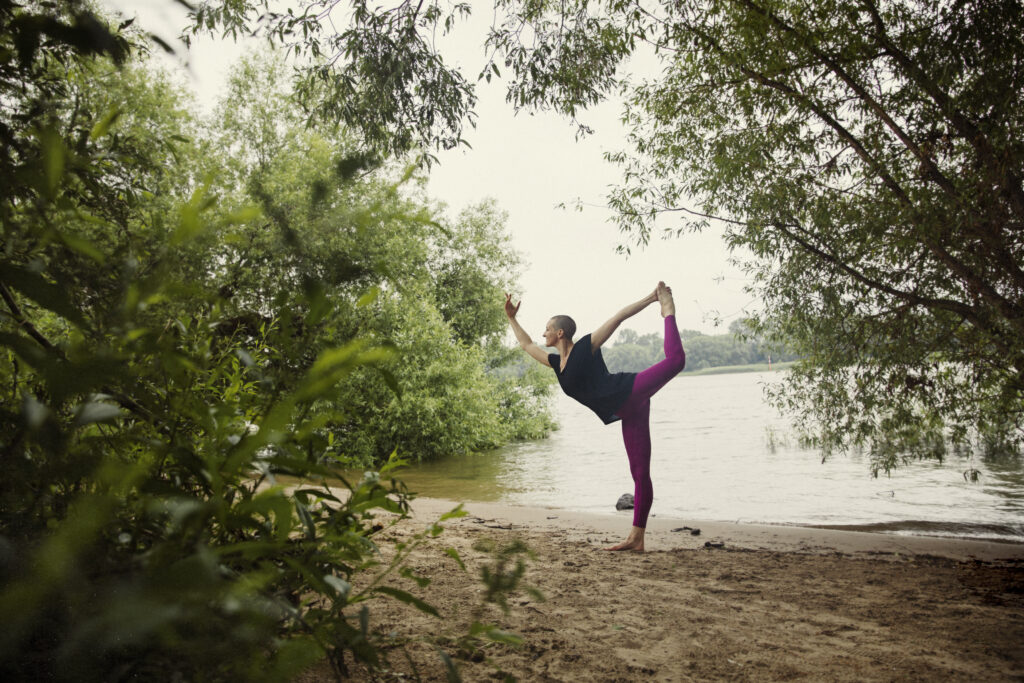
I strike dancer pose on the bank of the Rhine River in Cologne, Germany

Natarajana / King Dancer / Lord of the Dance Pose, more commonly referred to simply as “Dancer,” is an iconic and challenging yoga pose that invites us to discover our own courage and compassion. 

Shiva-as-Nataraj is classically depicted standing atop a mischievous gnome as he dances and plays a drum. A cobra winds around Shiva’s neck, his dreadlocks swirl around his head, a ring of fire encircles him, a flame also burns in the palm of his hand.

Dancer Pose is a standing one-legged balancing shape, where one foot is lifted behind us, grasped by the hand as we tip forward and reach the other to the front. It can be a very confronting but rewarding pose and today on the podcast, on the blog, and in the accompanying YouTube video I provide some variations and modifications to help you find dancer pose that allows you to experience all of its benefits.

Podcast 064: Daring Dancer Pose – story, strategy, & benefits of Natarajasana

Use Caution, Be Aware

Please use caution when attempting any version of Dancer Pose. I am not a medical professional, just sharing what works for me and recommendations from other trusted experts. Definitely consult with a physician to treat any symptoms you may experience and determine if practicing yoga is appropriate for you. 

According to Mark Stephens in the book Teaching Yoga, the main physical risks involved with Natarajasana are the “Lower back, hamstrings and knee of the standing leg, shoulders if unstable or impinging.” (Teaching Yoga Location 4,091)

Always go slowly and with awareness, listen to and respect your body’s signals. 

How to Get into Natarajasana

According to Jessamyn Stanley in the book Every Body Yoga: Let Go of Fear, Get On the Mat, Love Your Body, both supported and unsupported versions of Natarajasana are possible. Stanley provides a modification using a prop: “Optional Prop: 1 strap (make a loop with your strap that’s big enough to hold your foot)” (Every Body Yoga Location 1,092) I would add that if you don’t have a yoga strap, you can try using a long belt, dog leash, or towel to loop around your foot. Additionally, you can use the support of a wall or strong chair or table beside you to help with balance if you feel unsteady.

Stanley continues to describe getting into Dancer Pose:

  • “Starting in Mountain Pose, place your right hand on your hip for balance and bend your left knee.
  • Clasp the inside or outside of your left foot with your left hand and, using the power of your leg muscles, begin lifting your thigh.
  • If using a strap, hold the strap in your left hand. With your right hand on your hip for balance, bend your left knee and place your foot into the strap. Hold the strap as close to your foot as you comfortably can.
  • Keep squaring your hips forward and lifting your thigh away from the floor, actively flexing your foot into the hand or strap.
  • Sweep your right arm forward and up, reaching through your fingers and still continuing to lift your thigh.
  • Draw your standing thigh back and soften your heart forward. Stay for a few breaths, then switch sides.” (Every Body Yoga Location: 1,094-1,102)

Stanley provides helpful modifications and suggestions for a variety of poses, and when it comes to Dancer, shares these additional tips along with photos depicting the pose with and without a strap: “Keep your hips even and neutral,” “actively press your foot into your hand or strap,” “keep a bend in your standing knee if necessary,” “press your tailbone to the floor while actively lifting your pubic bone toward your navel,” and “if you are holding on to a strap, if you have the flexibility, rotate your shoulder so that your bent elbow points to the ceiling.”

In the book Teaching Yoga: Essential Foundations and Techniques, Mark Stephens provides slightly different instructions to guide students into the asana: “From Tadasana, flex the right knee to draw the right foot up toward the right hip. Clasping the right foot with the right hand, rotate the right elbow in and up while extending the right leg back and up from the hip. Lift the left arm overhead, bend the left elbow, and clasp the right foot.” (Teaching Yoga Location 4,093-5)

As teachers and students of yoga, he reminds us to look For and emphasize the following points: “Maintain pada bandha [meaning connection of the sole of the foot to the floor] in the standing foot to help stabilize the foot and ankle joint. Keep the standing leg straight and strong while aware of the tendency to lock the standing knee. Try to keep the pelvis level to create a symmetrical foundation for the full extension of the spine. Pressing the tailbone back and down, expand the chest, pressing the lower tips of the shoulder blades forward and up to open the heart center. If stable and at ease, release the crown of the head toward the arch of the foot and draw the elbows together. Breathe!” (Teaching Yoga Location 4,096-9)

Variations + Modifications of Dancer Pose

Here is my new 35-minute yoga flow, available free on YouTube, that takes you through a few variations and modifications of Dancer Pose:

Daring Dancer Pose Variations YouTube Video

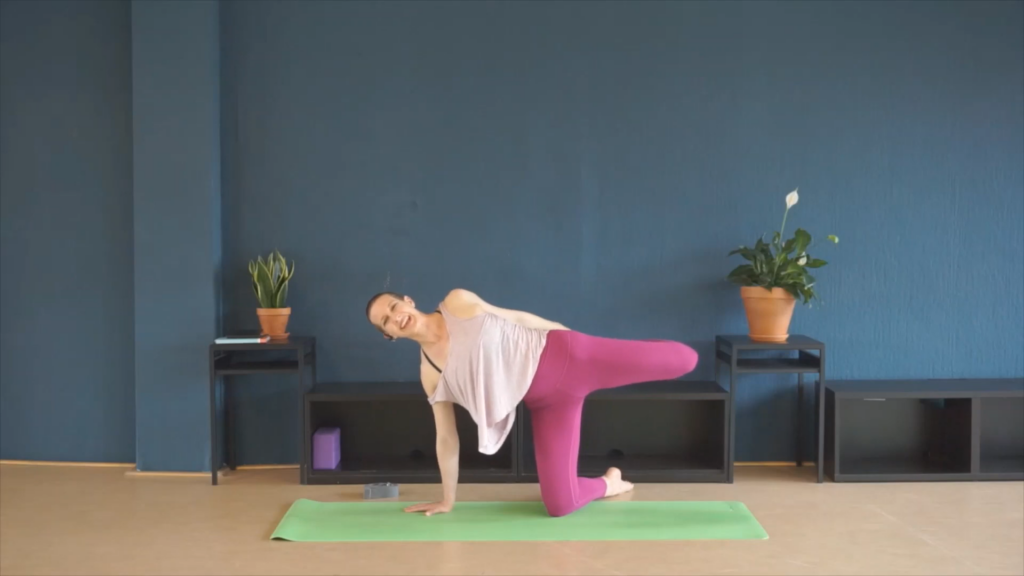
I include a couple of low-level variations of Dancer, that allow balancing on two points (one arm and one leg/knee), on one side and twisted:

This variation I call “Low Side Dancer” and it provides a similar stretch and balance to classic standing Natarajasana with a different perspective, you can use a strap for this version as well
This I call “Low Twisted Dancer” and it provides a similar but a bit of a different stretch and balance challenge as the others, a strap can also be used
This position can be used along the way to standing Dancer Pose, or as a modification of it’s own, developing balance on one leg, lifting the heart, stretching and slightly backbending, a strap and/or wall can also be used
Here I am practicing standing Dancer Pose with support from a Yoga Strap

Remember that you may position yourself in front of or next to a wall for additional support, and consider your gaze/eye focus and shape through the front-reaching hand as well. A variety of hand positions or mudras may be used. There are truly endless variations and modifications possible to make your Dancer Pose your own!

The Story Behind Natarajasana

I find it inspiring when tackling this challenging pose, to consider its origins and potential benefits. In the book Myths of the Asanas: The Stories at the Heart of the Yoga Tradition, by Alanna Kaivalya, Shiva Rea, and Manorama, they explain that Nataraj represents one of the many guises of Shiva, that of the Master Dancer, destroyer of age after age, timelessly dancing to the beat of his drum, ultimately providing a fertile ground for Brahma to create again.

There are a few aspects of this story that I want to emphasize, that of Shiva as King Dancer, the Cycle of Samsara, and the Illusion of Avidya. Kaivalya and Rea explain that, “As one of the Hindu trinity, Shiva has many different personae that illuminate his essence. The most well known is his role as the King Dancer, or in Sanskrit, Nataraja. In this guise he is commonly portrayed with snakes around his neck, dreadlocks standing on end, balancing atop a tiny dwarf, and encircled by a ring of fire.” (Myths of the Asanas Location: 537-539)

Kaivalya and Rea explain what the ring of fire around Nataraj represents, how symbolically, “Shiva dances to his own music within a circle of flame known as samsara. Samsara is the cyclical pattern in which we are all stuck—the constant repetition of birth, life, and death.” (Myths of the Asanas Location: 544-5) 

Like all aspects of this arresting image, the snakes coiled around Nataraj’s neck bring an additional layer of meaning: “The poison the cobra carries symbolizes the toxic nature of avidya, the misunderstanding of ourselves as something other than divine. He has found the remedy to that affliction, which is enlightened knowledge, and he carries its symbolic flame in one of his palms.” (Myths of the Asanas  Location: 550-1 emphasis mine) 

What Dancer Pose Teaches Us

What might we gain from Dancer Pose, as dancers and as human beings?

Kaivalya and Rea provide some insights into how the physical challenges of Dancer bring us into conversation with our psychological limits as well: “Natarajasana allows us to experience a couple of physical elements that can bring about fear in our bodies. Backbending and balancing both elicit fear because of the openness and bravery they require. We tend to store fear in our heart (according to the chakra system), and when we open the heart, we give ourselves an opportunity to let go of fear. Likewise, balancing gives us an opportunity to overcome our natural fear of falling and to be brave and free.” (Myths of the Asanas  Location: 576-8)

So the yoga pose itself involves two elements that bring us into conversation with our fear- balancing and backbending. In my yoga classes, we typically work on each of these skills and facing each fear individually, then in combination, sequentially enlarging our comfort zone. We develop stability, balance, as well as flexibility in key muscle groups (hips, back, shoulders). We practice balancing on one leg (i.e. tree), on the arms (crow, handstand), and backbends in different orientations (i.e. camel, bow, wheel).

We might assume dancers ourselves are automatically bendy and able to easily get into and hold Dancer Pose. Not so, it poses its own challenges for each individual. For example, my lower back is not as supple as it used to be, not sure if that is use or age or the several accidents I’ve been involved in, so I have to be very mindful of preparing for and practicing Dancer. I face the same fear in balancing and backbending that most practitioners do! Rest assured that everyone has their own assortment of difficulties (and strengths) that they become more familiar with and better at navigating through the practice of yoga.

Dancers and athletes can benefit from the physical and mental challenges of Dancer Pose. Given the internal and external challenges it presents, I’m so proud and impressed with the courage of my students in trying Dancer for the first time! 

Both Nataraj’s myth and the experience of practicing the pose itself teaches us to face our fears, embrace change, to release attachment, liberating and embracing our true nature and that of the universe.

Spiritual Benefits of the Practice

On a spiritual level, we encounter avidya and a companion concept, abhinivesha, while practicing Dancer and other confronting poses. As Kaivaly and Rea describe: “In the Yoga Sutra, Patanjali outlines five obstacles that prevent us from true freedom, which are called the kleshas. The first is avidya, and the fifth and most powerful obstacle is the fear of death, or abhinivesha. Death is the ultimate change and takes many forms in our lives, until the greatest death of all, which comes at the end.  As the lord of death and destruction, Shiva understands that change, even one as great as death, is really the only constant in the universe.” (Myths of the Asanas  Location: 566-7)  

In my experience, this is one of the most applicable skills that yoga teaches us for taking into our greater lives: how to navigate change! A big part of this is self-awareness and self-knowledge, fueled by compassionate self-study through reflective practice and meditation. In Yoga Where You Are, Dianne Bondy and Kat Heagberg include an entire chapter on such practices, proclaiming that “Compassionate self-study offers a path to meet yourself without judgement, just where you are and just how you are.” (p.212)

Compassionate self-study takes place in contemplative practices such as meditation and journaling, but also right in the moment when we practice yoga poses with mindful awareness. If you’d like to learn more about written reflection, you may enjoy my article on Reflective Practice through Journaling in Dance, Yoga & Life, or if you want to start a meditation practice, you will find more in my 2021 Meditation Practice Challenge blog.

Ultimately, we are looking for greater freedom: freedom of movement, courage to face what is to come, and compassion for ourselves and others.

“In order to dance like Shiva, we must feel free. Freedom comes from knowing there is nothing that binds us permanently. Shiva’s dance is born out of a liberation from the fear of change. He teaches us to ride the wave of change as if we’re on a cosmic surfboard, coasting toward the shore of bliss.” (Myths of the Asanas  Location: 564-5)   

Questions for Reflection

  • What obstacles have you identified for practicing Dancer Pose?
  • What modifications or variations help you access the pose?
  • What yoga poses or movements do you find especially challenging in general?
  • What emotions come up for you in these times of challenge?
  • What modifications or variations can help you access the potential benefits of these poses, movements, or activities?
  • How can I or another trusted teacher support your practice?

Blythe Stephens, MFA & Bliss Catalyst
she/her or they/them
A Blythe Coach: Dance Education & Coaching 
move through life with balance, grace, & power
DISCLAIMER: A Blythe Coach recommends that you consult your physician regarding the applicability of any recommendations and follow all safety instructions before beginning any exercise program. When participating in any exercise or exercise program, there is the possibility of physical injury. If you engage in this exercise or exercise program, you agree that you do so at your own risk, are voluntarily participating in these activities, assume all risk of injury to yourself.

What I hope we remember about 9/11

Forget, may we not, 
how we cared for our fellows
hopeful aftermath

That’s a haiku I wrote this weekend in honor of 20th anniversary of September 11th. The catchphrase since adopted by many is “never forget.” I am considering what it is important that we remember about that horrific day in this blog and episode 63 of the A Blythe Coach Podcast:

Podcast Episode 063: What I hope we remember about 9/11

20 Years Since Tragedy

Last weekend marked 20 years since that tragic day and my social media feeds were flooded with remembrances. 

Many people were more profoundly impacted and have more profound things to say about the infamous events of September 11th, 2001. But you’re here and this is my blog, so I’m sharing what it meant to me then, what I hope we still remember now, and how that has the potential to impact our lives for the good.

In 2001, I was a junior at Whitman College, serving as a Resident Assistant in Prentiss Hall, a residence housing independent and sorority women. I remember hearing the shocking news and us gathering in the TV Lounge to watch the breaking story in an atmosphere of fear and disbelief.

One of my residents desperately hoped to hear that her sister, a flight attendant, was alright. Although we were clear on the other side of the country from New York City and the World Trade Center’s Twin Towers, we all seemed to have an intimate connection to the unfolding events and we held one another close.

The devastation and senseless loss of life was horrific. Sadly many brave souls, firefighters, EMTs and such, lost their lives that day, in addition to the civilians who worked or did business in the towers. In that moment, America (and arguably the world) mourned together, but also rose to the task of helping all the victims, those hurt and those left behind. Let’s remember that! 

In scary times, look for helpers

As Mr. Rogers famously advised, we also “looked for the helpers,” and they indeed showed up, in force. The way that citizens rushed to help in any way they could made an impression never to be forgotten.

“When I was a boy and I would see scary things in the news, my mother would say to me, ‘look for the helpers. You will always find people who are helping.’” – Mr. Rogers

Ultimately for me the message in observing the tireless work of the “helpers” back then and since is that humans CAN be extremely caring, compassionate, generous, and kind. We can rise above our differences and help people in need. There is a path forward with empowerment and positivity even as we remember tragic events.

How can we be the helpers?

What does this have to do with dancing and living our lives now, two decades later?

I believe that we are called to remember the preciousness and uncertainty of our time on Earth. We owe it to ourselves to do purposeful, passionate work (whether that takes the form of paid work in our career or job or the way we serve in our personal lives), to appreciate what we have, move joyfully, love ourselves and one another.

My friend Olivia Mead (@ladyboss_olivia) from NCSA was so profoundly affected that she would go on to found Yoga for First Responders (@yogaforfirstresponders), training thousands of EMTs, firefighters, etc. in skills to help cope with the stress, trauma, and demands of their jobs as well as instructing yoga teachers in how to do the same. In such positions, danger comes with the territory, and unfortunately PTSD is a common result, but there are steps that such professionals as well as we ourselves can take!

I found this article featuring the many ways we can contribute to our communities now during the COVID-19 pandemic particularly inspiring. My personal contribution includes sharing dance and yoga and supporting students and clients in living extraordinary and fulfilled lives.

Questions for Reflection

  • What is it important for you to remember right now?
  • How will you stay present to that awareness?
  • What action(s) are you committed to taking today in alignment with this remembrance?

I hope you are well, and know that I am with you in spirit whether you are currently in grief or celebration (or both at once). Reach out anytime I can be of service, and stay tuned for more about living a luscious life.

Blythe Stephens, MFA, Bliss Catalyzing Dance Educator & Coach
she/her or they/them
Founder of A Blythe Coach: move through life with balance, grace, & power

Wake Up! Yoga for Energy & Enthusiasm

What fosters energy and youthful enthusiasm in your life? What rituals help you wake up and maintain mindful presence? That’s what we’re exploring here and in episode 62 of the A Blythe Coach Podcast:

Podcast Episode 062: Wake Up! Yoga for Energy & Enthusiasm

I am not a medical doctor or expert, just sharing what works for me and recommendations from friends and professionals. Definitely consult with a trusted physician to treat the cause of your symptoms. 

Recently, students of mine shared about their experiences of insomnia, and I researched yoga poses, taught sequences on the theme, and compiled those and other natural approaches into the Seeking Sweet Sleep: Yogic Insomnia Solutions blog and podcast.

Before taking my August content pause, I also wrote about making the most of time off in the Rest & Recovery Rocks My World blog and podcast. Another key topic related to managing our energy is that of focus and priorities, which I discussed last April in the Approaches to Space: Qualities of Focus in Dance & Life blog. Each of these areas of self-care affect our energy levels and enjoyment of life.

Sweet sleep, productive rest and time off, and focusing on our priorities as we move into early fall brought me to my next topic, which is once we’re awake, how to feel energized, inspired, and awesome! In my life, I’ve been fortunate to be blessed with lots of energy, although I do go through periods of higher and lower energy and require quite a bit of sleep.

It helps to have fostered habits that help lift me up on days where I’m not feeling so peppy, like good nutrition, hydration, getting outside for fresh air and sunshine, engaging with my passions such as dancing, teaching, writing, creating and experiencing art, joyfully moving my body, plus remembering quality rest and recovery. Some yogis avoid coffee, but I am not one of them and really enjoy drinking the stuff. It’s an ongoing process!

Towering sunflowers, the energy of harvest & moving into a fruitful fall

Energizing Yoga Poses & Flows

The beauty of yoga as a holistic system is that it is great at balancing energy, whether we need to come down and mellow out in anxious times or need to wake up and rise to the occasion. Exactly what type of practice or which poses are most beneficial to you will depend on your constitution, experiences, needs, and the season of life you’re currently in. 

Practicing yoga has had a positive effect on my energy levels and mood, creating calm and grounding when I feel anxious, scattered, or jittery, and waking and warming me up, improving my sense of flow, enhancing focus and concentration, relieving pain, and radiating joy when I might feel a bit low. The practices of yoga can cultivate happiness, enthusiasm, vigor, and youthful energy. 

My knowledge of Ayurveda is still very basic, but I look forward to learning more in time, optimizing energy and health in the process. Meanwhile, The Woman’s Book of Yoga and Health, with sequences by Patricia Walden, has a specific recommended sequence for energy, which is the second one to be introduced after the “Essential Sequence.” I believe that the same poses and practices have value for people of any gender.

The poses in Walden’s “Woman’s Energizing Sequence” (p.25) include variations of Mountain Pose (Tadasana), Extended Triangle Pose (Utthita Trikonasana), Warrior II Pose (Virabhadrasana II), Extended Side-Angle Pose (Utthita Parsvokonasana), Warrior I Pose (Virabhadrasana I), Intense Side Stretch Pose (Parsvottanasana), Hero Pose with Cow-Face Arms (Virasana with Gomukhasana Arms), Downward-Facing Dog Pose (Adho Mukha Svanasana), Headstand (Sirsasana), Child’s Pose (Adho Mukha Virasana), Inverted Staff Pose (Viparita Dandasana), Camel Pose (Ustrasana), Upward-Facing Dog Pose (Urdhva Mukha Svanasana), Upward-Facing Bow Pose (Urdhva Dhanurasana), variations of Standing Forward Bend (Uttanasana), Shoulderstand (Sarvangasana), Plough Pose (Halasana), Bridge Pose (Setu Bandha Sarvangasana), Legs-Up the Wall Pose (Viparita Karani), and Corpse Pose (Savasana).

In researching yoga practices to promote healthy energy in The Woman’s Book of Yoga and Health, other books in my yoga library, and the practices and videos offered by other yoga teachers, the following themes emerged in terms of types of practices, flows, and poses: Sun Salutations of all kinds, Kundalini Yoga Exercises, Balancing Poses, Backbends & other Heart-Openers, and Inversions. Below I share examples of each type of pose and where available, links to videos where you can practice them with me.

Sun Salutations: Surya Namaskara – Yoga Sun Salutations A & B – 30 minute practice

Kundalini Yoga Exercises: Rib Spirals/Sufi Circles/Coffee Grinders – Yogic Breathing Practice – Pranayama – Nadi Shodhana + Kundalini Spinal Rotation

Balances: Eagle, Warrior III, Half-Moon, Crow, Side Crow – Good Space Yoga, Firefly

Backbends/Heart Openers: Upward-Facing Dog, Camel, BridgeBuoyant Bridges, Wild Thing, Wheel, Fish, Inverted Staff

Gentle Inversions: Legs-Up-the-Wall Cycle (Feet together, apart, crossed)

Refreshing Yoga Sequence Videos

I recently created a 3-practice video mini-series of these selected poses and flows, with the first sequence focused on low-to-the-ground poses, the second consisting of standing poses (no weight-bearing in the arms/upper body), and the last centered around arm balances:

Floor-Based Yoga for Energy – 45 Minute seated/kneeling/reclining

Standing Yoga for Energy – 25 Minute “hands-free”

Arm Balance Yoga for Energy – 30 Minute

In general, The Woman’s Book of Yoga and Health recommends that we “Exercise early in the day–aerobic activity like walking or jogging, energizing yoga sequences, and pranayama practice.” (p.243) Stimulating activities are better to engage in in the morning or midday, not too close to bedtime when they might inhibit sleep, although we can practice relaxing/restorative poses to relax and unwind later in the day.

Looking for more invigorating and tiring practices for your morning hours?Some other short, energetic yoga sequences for early in the day are:

These practices and more can be found on the Yogalicious playlist on the A Blythe Coach YouTube Channel.

Energizing Breathing Practices/Pranayama

Pranayama or yogic breathing exercises can be great for balancing energy, helping it flow through the chakras or energy centers of the body. These practices include Kapalabhati/Breath of Fire/Skull Shining Breath, Nadi Shodhana/Alternate Nostril Breathing, & Yoga for Integration – Bandhas & Kapalabhati.

More energy-balancing pranayama techniques can be found on the Beautiful Breathing – Yoga Pranayama Playlist on the A Blythe Coach YouTube Channel.

Meditation, Yoga Nidra, & Visualization

More free tools in the toolkit of fostering healthy energy are Meditation, Visualization, and Yoga Nidra. Check out my 2021 Meditation Challenge Blog, Daily Meditation Challenge Podcast, and Yoga Nidra – Deep Relaxation Practice Video for some ways to enhance energy through these practices.

Healthy Eating for Energy

Healthy nutritious eating can be a key factor in our energy levels, self-care, and well-being, check out my blog and podcast on the topic for more ideas for energizing foods.

It was a also a delight to be featured this month in Hong Kong Dance Magazine’s “Tutus & Tapas” dancer snacks article that included dancers around the world. Fun sharing my passion for balance, smoothies and cookies there!

Essential Oils & Herbal Teas

I’m privileged to have access to a good environment for sleeping, quality food, water, coffee & tea, herbs & essential oils, crystals, and a plethora of tools to enhance my quality of life. If they are within reach, you may also try Peppermint tea and/or essential oil, Ginger tea and/or essential oil, Grapefruit & Other Citrus & Lemongrass oils, or whatever scents or flavors that give you a lift! If these things are not available, just do what you can, breath and mindful movement are accessible to all.

Citrus essential oils, incense, clear quartz and citrine crystals

Energetic Crystals

Some of my favorites crystals to support energy and clarity are Clear Quartz, Citrine, Red Jasper, Aquamarine, & Tiger’s Eye.

Bracing Cold Showers

A practice I’ve taken up in the last year or so, which is indubitably invigorating, according to some studies helping reduce stress, improve mood, and boost immunity is Wim Hof-style cold showers.

I learned about Wim Hof’s method on Russell Brand’s “Under the Skin” podcast called “Ice Shaman,” Melissa Urban’s “Do the Thing” podcast “Cold Showers with Ed Sheeran” encouraged me to put a soundtrack to it (very helpful!), and Courtney Carver’s Be More with Less blog, “Lessons From 30 Days of Cold Showers (and other uncomfortable challenges)” pointed out a host of other benefits to facing challenge and discomfort.

Carver says of her experience: “I started the cold shower challenge on June 26th because I was curious, but also because I was bored with my quarantine routine. I craved a shift and cold showers delivered. This may not be a life-changing challenge, but it did brighten up my mornings. When I step out of the cold shower, I am wide awake.” Carver continues, “Starting on Friday, June 26th reminded me that I can always choose to change and grow. I don’t have to wait until Monday or January 1st or another special day or time. Now is a great time to start.”

In this way, both the cold shower itself and it’s physical and emotional benefits, and any small way you switch up and refresh your routine or get out of your comfort zone can invigorate your life. I also used the free Wim Hof App to start small with my cold shower habit and work my way up to longer and build a consistent “streak.” Now I spend a couple minutes in a cold rinse at the end of my shower 1-2 times per week and it’s a surefire wake-up!

Energizing Music

What music you find invigorating is going to differ from what I do, but this is to encourage you to figure out what that is for you, and use it as a tool to help you find a state of wakeful presence. Some of my favorite tracks to inspire creativity and energy are on this recent playlists:

Podcasts for Energy and Well-Being

What helps you wake up, feel vibrant, creative and focused?

Stay tuned here and on my YouTube Channel and for more about living a luscious life!! 

Blythe Stephens, MFA, Bliss Catalyzing Dance Educator & Coach
she/her or they/them
Founder of A Blythe Coach: move through life with balance, grace, & power

DISCLAIMER: A Blythe Coach recommends that you consult your physician regarding the applicability of any recommendations and follow all safety instructions before beginning any exercise program. When participating in any exercise or exercise program, there is the possibility of physical injury. If you engage in this exercise or exercise program, you agree that you do so at your own risk, are voluntarily participating in these activities, assume all risk of injury to yourself.

Rest & Recovery Rocks My World

In addition to stressing the importance of making time (and patience) for ballet practice, in her book The Ballet Companion, Eliza Gaynor Minden recommends that aspiring dancers also “make time for rest,” specifically stating that “Professional dancers generally take one day off a week. Allow yourself at least this much rest. Your body needs it.” (The Ballet Companion p.15)

Of course, this recommended minimum applies not only to dancers but to all humans! Life Coach Talane Meidaner insists that, “You need a day to do whatever you want with no plans, no list of things to do, no scheduled brunches, no lunches–a day to be totally free and spontaneous, to rest, to play, to honor your spiritual self.” (Coach Yourself to Success p.216)

Here I am exploring the importance of time off and ways to build it into our lives.  Just sharing what works for me and recommendations from friends and professionals, which is no substitute for the advice of a medical professional if you are injured or unwell.

This links to the Podcast companion to this blog, scroll down for more resources 🙂

How I know I need a break

Let me begin by saying that I don’t agree with the slogan that you should find work that you love so much that you never want to take a vacation. That is not a healthy balance! And, to my great delight, I already do work that makes my heart sing, fulfills me and brings me profound joy. But I STILL need breaks to prevent burnout and stay sane! 

What happens is, when I have been working consistently for a while without a significant vacation/time off, I will notice a loss in my characteristic patience, especially with the little ones at first, and then with seemingly all of humanity.

In times like those when I’m jonesing for a holiday, I become frustrated, overwhelmed, and snippy, but give me some days off (at least 2-3 in a row, and ideally two weeks to one month) and I am cured!

Without adequate time off, I lose perspective and therefore struggle to prioritize, focus, and strategize. Time away from the normal activities of my life, however much I love and enjoy them, as well as physical removal from my ordinary haunts is so refreshing. A mix of visiting friends and family and adventures to new locations is always nice.

These last months and years of pandemic have been a hard time for my wanderlust and thirst for a vacation getaway. I am grateful that we at least got out of town for a weekend on the Ahr Valley for my birthday, especially before the tragic devastation there. Actively scheming our next escapes and greatly wish to visit my parents in the near future!

In the meantime, I am planning to take time off from some of my projects, such as releasing my blog and new podcast episodes, in the month of August. I will still be teaching in-person and online, and will turn my focus to organizing my efforts for the fall. I have so many ideas and exciting upcoming podcast guests and topics, but want to make sure I’m delivering the best quality that I can, as well as make the mental and physical space to enjoy the process.

Rest as injury-prevention

With regard to our physical bodies, preventing undue fatigue by resting adequately helps us to prevent injury. When we do injure ourselves, immediately following the RICE protocol, the first step of which is to rest, is advised.

Becoming aware of and respecting our body’s early warning signals that we need to rest is critical. 

Gaynor Minden speaks about our power to heal ourselves and the need to respect limitations: “The body is quite good at mending itself but only if it’s given a chance to rest thoroughly. Try to rest the moment you feel an injury coming on, not after you’ve been to a doctor. The sooner you rest, the less likely you are to further stress the damaged tissue. Resist the temptation to try using the injured part periodically just to see if it still hurts. A healthcare professional will be able to advise you whether to continue resting it, do isometric exercises, or resume your regular activities.” (The Ballet Companion p.247)

The same is true of our mental and emotional well-being, we need to pay attention for warning signs of psychological stress and behave accordingly to allow time to rest, recover, and consult with a trusted professional. If Simone Biles can do it, so can we!

Self-Care & Sharpening the Saw

So how do we get the rest that we need? In this sense, self-care means identifying and taking care of your needs. It’s not always glamorous to rest or to do other practices that support our foundational well-being, but if we aren’t proactive about it, things have a way of escalating into larger problems.

In Coach Yourself to Success, Meidaner devotes several sections to rest and self-care concerns, such as “Identify Your Needs,” “Design Your Ideal Life,” and “Banish Adrenaline Burnout” (p.110, 130, 215).

“Sharpen the Saw” is Habit 7 of The 7 Habits of Highly Effective People, my favorite version of which is Sean Covey’s 7 Habits of Highly Effective Teens, where he explains:

“Habit 7 is all about keeping your personal self sharp so that you can better deal with life. It means regularly renewing and strengthening the four key dimensions of your life–your body, your brain, your heart, and your soul.” (p.206)

So what is missing in terms of sharpening your own saw? What does your ideal life look like in terms of rest, recovery, and recreation? The following are some ideas of places to look…

8 Hours of Quality Sleep nightly

When it comes to physical rest, the guideline is to shoot for at least 8 hours of deep, regenerative sleep each night. For myself, I find anywhere from 8-10 hours ideal, though on days where I get less and on lazy days off, I like to add a nap as well.

Part of getting good sleep on a regular basis is maintaining a regular sleep schedule, although I find this consistency challenging when my work and creative schedule varies greatly day-to-day.

If you sometimes have trouble sleeping, you might be interested to hear that I devoted another blog to Seeking Sweet Sleep: Yogic Insomnia Solutions as well as Podcast Episode 053: Yogic Approaches to Sweet Sleep & Natural Insomnia Solutions and the Yoga for Sweet Sleep YouTube video as resources and strategies to help.

Naps as needed

In the book Succulent Wild Woman, Sark emphasizes the value of nap-taking and I am totally on board with this! Like my sweet-tooth, my enthusiasm for napping seems to run in my family, and especially in very active and busy times of life, naps help me relax and refresh to keep going on important projects.

Sark claims that, “None of us get enough naps. Naps are essential for mental health. Naps are productive–contrary to what we’ve been taught.” (p.24) Whether it’s a 15-minute power nap in the middle of a long work day or a leisurely Sunday snooze, these periods of rest are something I relish on a regular basis.

Sacred evenings off

Meidaner also advises setting aside “sacred evenings” in Coach Yourself to Success:

“A sacred evening is just that: an evening you reserve for yourself to do exactly as you please, whether that is going for a stroll in the park, taking a bubble bath, getting a massage, reading a book, going to a concert, or just doing nothing at all. It is a time for you to be by yourself, to play, to rest, to relax. You have nothing planned or scheduled. It is sacred because you must hold it as inviolable time. That which is sacred is separate from mundane activity and set apart for a higher purpose. If you don’t take sacred time for yourself, it will get scheduled away like the rest of your life.” (p. 102) 

I can hear busy families protesting that they couldn’t possibly take such time off, and apparently Meidaner did as well, as she doubles down on the necessity for parents and caretakers to take the time to themselves: “If you have kids, it is ten times more important that you give yourself sacred evenings. You need time to engage in adult activities and time to be totally selfish.” (p.102) 

At least one day off per week

As I mentioned at the start, Eliza Gaynor Minden, Talane Meidaner, and many other experts recommend at least one full day off each week. I admit that taking a full day off each week is always in progress for me, as an freelance educator and coach my work often comes piecemeal and is challenging to consolidate.

Nevertheless, I am always striving to have a full unscheduled day each week. Part of this is not setting an alarm to wake up to, at least one day per week and as much as possible on holidays and vacations. Sometimes it means staying in pajamas the whole day. Sometimes it makes space for gentle restorative yoga, soothing music, candles and incense, sometimes baths, often naps, laying on beaches or floating in warm water when possible, pleasure reading and writing, lounging in cafes, sketching, flower-gazing, bird-watching, museum wandering, pondering works of art, and having someone else cook to name a few. These recuperative times can be alone or in peaceful companionship.

Meidaner reminds us, “You will burn out if you aren’t taking at least one day a week completely off. Somewhere, somehow this got lost. We schedule our weekends away. Our bodies, our souls need a day of rest. According to the Bible, even God took a day of rest. What better role model could there be?” (Coach Yourself to Success p.215-6)

Regular vacations

My goal for regular vacation-taking is to include quarterly-or-so mini-breaks or getaways, and approximately twice-annual longer vacations (at least 2 weeks). I appreciate travel, locally and worldwide, for the new sights, smells, tastes, nature, and cultural experiences. I tend to rotate between travel to visit family and friends, and voyages to new places, though it has become more difficult to do the latter and much easier to do the former from Europe.

As Anna Johnson relates in the book Three Black Skirts, retreats can be a nice option for those with the privilege of time and money: “The advantage of a retreat is that all practical needs are taken care of and there are no external distractions: Someone else cooks, someone wakes you at dawn, birds sing, and everyone around you is united by curiosity and a common aim.” (p.218)

Since quarantine, I’ve gotten into the idea of creating a retreat experience for ourselves at home and would be interested to support others in doin the same – would you like to see such an offering?

Whether we can manage an actual retreat or not, we can intentionally design our time off as we please, to meet our needs and current circumstances, keeping in mind our ideal and long-term vision of the role rest and recovery play in our lives.

You better believe Rufio the cat takes her proper time off

Tips for Maximizing your Downtime

Let’s say you’ve managed to schedule time off, how do you keep it available for yourself and make the most of it? Here are some skills we need to develop to do so:

Saying “no”

If we neglect to develop the skill of declining invitations or saying “no” to opportunities, we will not have the spaciousness and free time to ourselves that we need to rejuvenate us for our most important priorities.

Courtney Carver of the blog Be More With Less is a great proponent of saying no, and shares in the article, “10 Simple Ways to Help You Say No” that, “It’s hard to say no. It can feel uncomfortable. You might feel like you are letting people down. Even so, it’s one of the most important ways to create the time you want for what matters most…It takes time to take care of ourselves and when we don’t take that time, it’s hard to take care of anyone else at least not for very long. Continuing to serve everyone but ourselves will leave us completely depleted and there will be consequences.”

In order to make more breathing room in our daily and weekly schedule, as well as long-term, we must develop the skill of saying “no” when our heart is not 100% “yes.” Sometimes we must even refuse opportunities we would like to accept! 

Leave Work at the Office (or workspace)

When you do have time off, whether it be a sacred evening, full day off, or longer vacation, leave your work at the office! Anna Johnson admonishes us: “Carrying the office in a metaphoric lump in your handbag or hauling it with you on vacation or treasured getaway weekends is more about guilt than it is about diligence. Nine times out of ten the work is ignored and serves only as some sort of physical penance for wasted working hours.” (Three Black Skirts p.135)

Productive Uses of Free Time

Be mindful about how you are spending the precious free time you have created for yourself. Perhaps you would like to pursue hobbies and amateur creative outlets, outdoor or athletic activities, travel, fiction, pleasure, or “beach reading,” reflection and writing or meditation.

Consider which activities are truly restful and restorative for you, and which actually drain energy and inspiration from your life. This will look different for each person, but some habits we consider relaxing are more beneficial than others. As Anna Johnson explains it,

“Refine your relaxation. How you choose to unwind affects the way you work. Real downtime means restoring, instead of depleting, your energy supply. Typical escape routes such as television, alcohol, coffee, and the phone leave jangled nerves in their wake instead of soothed ones. Of the four opiates, TV and the phone are the biggest time suckers. Try to spend some of your downtime doing something deeply restful like yoga, meditation, gentle exercise, or inspirational reading. Books unrelated to work have a funny way of filtering back in subtle, positive ways.” (Three Black Skirts p.136)

In these times of seemingly-endless screentime and smartphone use, we may consider “digital sabbaticals” or breaks from social media and/or other electronic connectivity, another topic which I may explore in the future.

If you’d like to learn more about reflection, writing, meditation, and relaxation, you may also enjoy my Reflective Practice Through Journaling and 2021 Meditation Practice Challenge blogs and my Yoga Nidra relaxation video.

Don’t skip Physical Therapy & mindful movement

One thing I (and experts) recommend you do NOT take time away from is your basic physical therapy, training, or conditioning. One of my professors from graduate school, Betsy Fisher, shared wisdom with me about how especially after a certain age, it is not worth it to take a total break from exercise.

Her opinion, which I now share, is that it simply requires too much time to regain the strength and stability lost after a break of, say, a couple weeks or more. It is too great a risk getting taken out by injury when we return to dancing, whether it be performance, teaching, or recreation and ultimately is easier and less painful to maintain than to regain! So do take a break from super-intensive or strenuous training if you like, but keep a certain baseline of conditioning so you don’t put yourself at undue risk from too much time away.

Rest for the weary

We all know that adequate rest is required to feel well and perform our best, but most still are challenged to take the breaks we need. “No rest for the weary” and “I can sleep when I’m dead”  are commonly-expressed sentiments. Workaholism is rampant. 

Stepping away from my projects and aspirations provides me fresh energy, I get perspective, the opportunity to check-in with myself, make sure my priorities are in order, and cultivate my personal relationship with my partner, family, friends, and myself. I get back my optimism, pep, and patience. Challenges are more manageable and I’m resilient to adapt to change. Learning becomes easier and I can appreciate the process of digesting new information, making connections, working with clients and students, and creating.

Although in some times in life it may feel impossible to take a break–when you have a newborn or as you are taking on another kind of new responsibility, for example. But it serves our well-being and performance best to become aware of our needs and plan for them, preventing burnout and keeping us rejuvenated and ready to take on our dreams! 

Relaxing Bedtime + Wind-Down Yoga Practices

Below are some chill yoga practices that you may enjoy:

I also have a few related past podcasts, such as 011: Creating Good Space, 023: Care & Actualization of the Self, 031: Healthy Habit-Building, & 033: Daily Meditation Challenge.

  • What helps you rest, recover, and rejuvenate?
  • Do you take regular sacred evenings off, a full unscheduled day per week, and vacations?
  • What is missing in terms of “sharpening your own saw?” 
  • What does your ideal life look like in terms of rest and recreation?

Send me an email or come on over to the A Blythe Coach Facebook Page to share your experience with time off, saying no, and productive rest! 

Blythe Stephens, MFA & Bliss Catalyst
she/her or they/them
A Blythe Coach: Dance Education & Coaching 
move through life with balance, grace, & power

DISCLAIMER: A Blythe Coach recommends that you consult your physician regarding the applicability of any recommendations and follow all safety instructions before beginning any exercise program. When participating in any exercise or exercise program, there is the possibility of physical injury. If you engage in this exercise or exercise program, you agree that you do so at your own risk, are voluntarily participating in these activities, assume all risk of injury to yourself.

Adult Adaptive Summer Dance Intensive Week 4: Completion & Continuation

Have you been dancing along with me through the Summer Dance Intensive? If so, are you a bit sore yet? 🙂 I hope you’re having fun and experiencing growth and transformation! Please remember that this program is meant to be taken in your own time, at your own pace.

Speaking for myself, I have definitely been feeling the effects of my personal “Adaptive Adult Summer Dance Intensive: since week one! I’ve got a rotation of tired and stiff muscles (which I love, because it means I’m getting stronger!) and am feeling noticeably more stable, secure, and fit to dance. 

It’s amazing how minimal effort each day can yield noticeable gains in strength and stability, flexibility and range of motion, and general well-being. 

This and the last three blogs (Adaptive Adult Summer Dance Intensive Weeks One, Two, & Three) have presented weekly suggested programs to develop body and mind, providing a complement or bridge to online or in-studio practice. 

You can tailor the program to your needs, with anywhere from 5 minutes to 5 hours per day, choosing to participate in the recommended YouTube videos for specific exercises (great for cross-training and preventing injury alone or in combination with classes at your local studio), recorded classes and combinations, Live Online group classes and/or Live Online Private Lessons and Coaching or even join live in-person classes with me in Cologne, Germany! 

Podcast episode 060 is the audio for this blog, scroll down for links to exercises

Week Four Overview

Week four is all about continuing the work we’ve started, finishing strong, and getting complete on our efforts so far. We are fostering a Creative State of Being and connecting with the Element of Air. 

We are practicing exercises to continue to condition the body for dance, expand dancing movement vocabulary, compose dances, describe & critique choreography. 

This final week, we are setting up to keep your practice going after the “Intensive” is complete. The idea is to have a well-rounded conditioning and cross-training routine that requires a very small commitment of time. You can continue to add different movements slowly as well as take full-length classes with me online or through other teachers and live studios. 

Recommended Viewing: Paris Opera Ballet’s “Cendrillon,” with choreography by Rudolf Nureyev and a golden age of Hollywood twist on the classic “Cinderella” ballet (link is to a trailer, I sadly can’t find a full-length version currently- happened to catch it on television via Arte).  

Criticism: Use the Be a Dance Critic tool, which is a framework for dance criticism with questions to help write reviews of choreography and performance. Through this you will describe, analyze, and interpret your viewing of “Cendrillon” (above) or another dance work you’ve been looking forward to seeing.

Listening: Finding a Creative State of Being and Finding a Related State of Being, and Acknowledgement, Révérence, & Namaste (if you didn’t listen to it in week 3) podcasts.

Repertory: we will continue to learn the “Queen of the Dryads” variation from “Don Quixote:” I will share variations on this short choreography, and you can also create your own translation as a composition exercise.

Improvisation: “Egg” exercise from Twyla Tharp (below), dance freely to “Pluma” or your other favorite music of the moment, or do a study of what movements you associate with the dreamy character of the “Queen of the Dryads” (above) experimenting with your new dance vocabulary, or whatever freestyle movement floats your boat.  

Tharp’s “Egg” Improvisation Instructions:

“I sit on the floor, bring my knees to my chest, curl my head down to my knees, and try to make myself as small as I can. In this minimalized shrunken state, I have nowhere else to go; I cannot become smaller, I can only expand and grow. And so it becomes a ritual of discovery for me. If I lift my head and straighten my back I become Tall Egg. If I stretch out my legs and point my toes, forming an L-shape, I become Jackknife Egg. I stick with it as long as it remains interesting, sometimes going through as many as a hundred positions. I’ve been doing this daily for years and I usually find something new in the process… I like the Egg routine because it is so basic. You don’t need to know anything or be in particularly good shape to do it (although some stretching is a definite help). The only requirement is a commitment to the process. The starting Egg position is your home base and you are setting out to see see how far you can travel from home…Egg is an exercise that teaches you how to accomplish the most difficult task in any creative endeavor: begin.” (The Creative Habit p.112-3)

Composition: translations of  “Queen of the Dryads” variation (i.e. simplification, modifying elements of dance such as use of time, space, or use of the body, music…), or other classical variation or other theme of your choosing.

Reflection: since it is the final week of the Adaptive Adult Summer Dance Intensive and I want to support you in moving powerfully forward, it will serve us to reflect on the learning of the last four weeks and determine how to proceed from here, to free us of any could have/would have/should have or disempowering energy. To that end, you are invited to respond to the following prompts:

  • What have you accomplished and what do you declare complete from this month-long intensive program? 
  • What is missing or incomplete? 
  • What is next to grow your dancing practice?
  • What would you like to be acknowledged for?
Still image from the new “Tantalizing Tendu, Pas de Cheval, & Undercurve Combination

Daily “Menu” for Week 4 +

For your daily program in Week Four and continuing, pick:

Days 22-26

Choose an foot/ankle conditioner + core activator + axial movement or step**
and/or dance warmup/class, yoga practice, or stretching session
and/or improv, composition, repertory, collaboration, or criticism

** Arms: any of the excercises from weeks 1-3 or
Ballet Second Port de Bras – Cecchetti technique (4:26)
Port de Bras Story: 1st-4th Cecchetti Technique arm exercises (9:21)

** Leg work at the barre: any of the exercises from weeks 1-3 or
Plucky Petit Battements (12:29)
Frothy Frappé & Jeté (10:29) 
Types of Jumps – Ballet & Modern Dance Allegro Categories (5:26)
Ebullient Battement & Passé (6:36)
Balletlicious Barre Leg Stretch (12:20)

** Centre work from weeks 1-3 or
Amazing Undercurves (8:52)
New Tantalizing Tendu, Pas de Cheval, & Undercurve Combination (9:47)
Embracing Ballet Balancé (11:03) 
Tourner (6:26)
Articulate Adage – Ballet Centre Développé & Body Positions (14:04)
Glissade + Assemblé Jumps (7:01)
Chasing Chassé (8:17)
Ballet Révérence for all ages (4:58)

Day 27

Yoga Cool-Down – Pigeon, Seated Stretch + Savasana (14:42),
6-Minute Hip Stretch for after ballet or sports, or your favorite relaxing/restorative practice.

Day 28

Winning at Warrior III (41:11), Acknowledgement + Namaste 1-Hour Yoga Practice, or take a break outside!

Week Five On: Continuing Practice

After the “official” 4-week program is done at the end of July, you are encouraged to keep practicing into week 5 and beyond, to work with others to generate a Related State of Being through Partnering, Collaborative Choreography, Repertory, sharing and critiquing Choreography, or ongoing Technique development, and connect to the Element of Ether.

Resources for Your Personal Dance “Intensive

The Ballet Movement Vocabulary Hyperdoc is an interactive syllabus of ballet steps, techniques, and concepts. The Student Profile & Intended Results form can be a reflective tool for you to formulate your objectives, as well as help me tailor content to fit your needs. For more information on designing training to achieve your dancing dreams, check out the Goal Setting for Dancers blog as well.

You can follow some or all of the daily plan above, or sample à la carte steps and exercises from the playlists below:

Practice Video Playlists

Body-Part Specific Conditioning & Cross-Training Video Playlists

Yoga & Pranayama Video Playlists

Theory Video Playlists

Opportunities to Move Together Live

Sunday morning hybrid Yoga class online and in-studio at Tanzschule Tanzraum Zentrum in Cologne Germany @11:00 CEST, Tuesday morning online Yoga class @6:15 CEST, and Tuesday morning online Ballet class @8:00 CEST on Zoom (Tuesday morning German time is Monday evening in HI, late night on the US mainland).

Further group classes or private lessons available by request, schedule a consultation to discuss. I am also continuing to go “Live” every weekday on social media to practice the day’s movements together, talk about improv, repertory, and choreography practices and answer your questions, so join me there for more fun and support! 

Acknowledgment & Completion Celebration

I want to acknowledge you for taking the time to read my blog, and those who watch and move along with my YouTube videos, subscribe to my email newsletter, listen to my podcast, or are live students and clients for your efforts, growth, commitment to learning, increased knowledge, skill, and confidence.

I hope you celebrate your personal efforts and progress, too! Your participation, support, feedback, love, and community are so needed at this difficult time for us all! Live it up, and contact me if you’d like a personal acknowledgment for the glorious being you are in the world!

What’s Next Post-Intensive?

There’s lots more to come on the topics of completion, rest & recovery, dealing with mistakes and failure, elements of dance, specific ballet movements, yoga flows, and more! Come on over and subscribe to the YouTube Channel and join my email newsletter to receive my latest free offerings, favorite resources from myself and others, joy, and inspiration 🙂

Blythe C. Stephens, MFA, Bliss Catalyst
A Blythe Coach: Dance Education & Coaching 
move through life with balance, grace, & power
A Blythe Coach on Facebook & Instagram
Convertkit Commerce Unlimited Online Ballet & Yoga
Tanzschule Tanzraum Cologne, Germany 

DISCLAIMER: A Blythe Coach recommends that you consult your physician regarding the applicability of any recommendations and follow all safety instructions before beginning any exercise program. When participating in any exercise or exercise program, there is the possibility of physical injury. If you engage in this exercise or exercise program, you agree that you do so at your own risk, are voluntarily participating in these activities, assume all risk of injury to yourself.

Adaptive Adult Summer Dance Intensive, Week 3

During July, each week I am sharing a fully adaptable “Summer Dance Intensive” program to develop body and mind for those who would like to be immersed in dance or yoga and don’t have the chance to attend such a workshop in-person. The suggested free sequences can provide a complement or bridge to online or in-studio practice. You can tailor the program to your needs, with anywhere from 5 minutes to 5 hours per day and any level of experience!

Have fun customizing your program for your current condition, skills, and lifestyle, and please let me know what questions you have and how I can best serve you! I would be delighted to work with you individually to help design and execute your ideal training program- just email me at blythe@ablythecoach.com to book a consultation

If you’re just joining me for the Summer Dance Intensive, be sure to get the scoop on Week One and Week Two first.

Week Three Overview

Week 3 expands on our foundation and centering from the first two weeks, building an Oriented State of Being and connecting with the Element of Water. We will flow into some improvisation which will later lead to composition, and continue to develop movement vocabulary and skill through dance exercises and appreciation.

This week you can choose to dive deeper into viewing and reflecting on choreographic works, yoga, breathing, and meditation practices, modern dance, or ballet. If jumping is appropriate for you, in ballet/dance we begin to practice becoming airborne as well as continuing work with the Elements of Dance of the Body, Shape, and Space. 

Recommended Viewing: Post:ballet’s “Swan Lake” for dance appreciation (use the Dance Appreciation Observation Tool can help with note-taking), and my “Planes of Space & the Body”  & “Ballet Orientations of the Body” videos for theoretical framework.

Recommended Reading: Dance Criticism Model Tool, Spatial Dimensions and Planes blog.

Recommended Listening: Podcasts 003: Finding an Oriented State of Being & 012: Acknowledgement, Révérence, & Namaste.

Having laid a solid foundation, if we’re up for it, this week we launch into the air (with stretched feet!) as in this photo of me performing royale at the barre

Week 3 Basic Daily Practices

Day 15: Planking Pleasures (@2:38-5:34), Kicky Floor Kicks (@6:02-8:14), Powerful Pliés (@12:53-16:55), Tempting Tendus (@5:57-9:05), Saucy Prances & Sautés (10:37) [10-25 minutes]

Day 16: Ankle Alphabets (@00:47-2:30), Sweet Leg Swings [13:20], Sensational Caterpillar Walks (@5:48-6:56), Centre Tendu, Temps Lié & Body Directions (11:09) [25 minutes]

Day 17: Towel Toes (@2:05-5:01), Planking Pleasures (@2:38-5:34), Powerful Pliés (@12:53-16:55), Saucy Prances & Sautés (7:05-10:18), Ballet 1st Port de Bras (5:51) [15-20 minutes]

Day 18: Beatific Boats (5:07-5:46), Plush Paralleleves (3:17-5:28), Powerful Pliés (@12:53-16:55), Tempting Tendus (@5:57-9:05), Ravishing Rond de Jambe (15:36) [15-25 minutes]

Day 19: Ankle Alphabets (@00:47-2:30), Buoyant Bridges (5:44-8:09), Saucy Prances & Sautés (7:05-10:18), Rollicking Pas de Bourrée (8:21) [15-20 minutes]

Day 20: Intro to Hip Stretches (14:49) 

Day 21: Slow Your Roll – Gentle Circles Yoga (21:47)

Resources for Your Personal Dance Intensive

The Ballet Movement Vocabulary Hyperdoc is an interactive syllabus of ballet steps, techniques, and concepts. The Student Profile & Intended Results form can be a reflective tool for you to formulate your objectives, as well as help me tailor content to fit your needs. For more information on designing training to achieve your dancing dreams, check out the Goal Setting for Dancers blog as well.

You can follow some or all of the daily plan above, or sample à la carte steps and exercises from the playlists below:

Dance Practice Video playlists

Body-Part Specific Conditioning & Cross-Training video playlists

Yoga & Pranayama Practice playlists

Theory Video playlists

Opportunities to Move Together Live

I am teaching Sunday morning hybrid Yoga class (online and in-studio at Tanzschule Tanzraum Zentrum in Cologne Germany) @11:00 CEST, Tuesday morning online Yoga class @6:15 CEST, and Tuesday morning online Ballet class @8:00 CEST on Zoom (Tuesday morning German time is Monday evening in HI, late night on the US mainland).

Delighted to offer further group or private lessons by request, just schedule a consultation to discuss.

I am also continuing to go “Live” every weekday on social media to practice the day’s movements together and answer your questions, so join me there for more fun and support! 

A Blythe Coach: Dance Education & Coaching 
move through life with balance, grace, & power
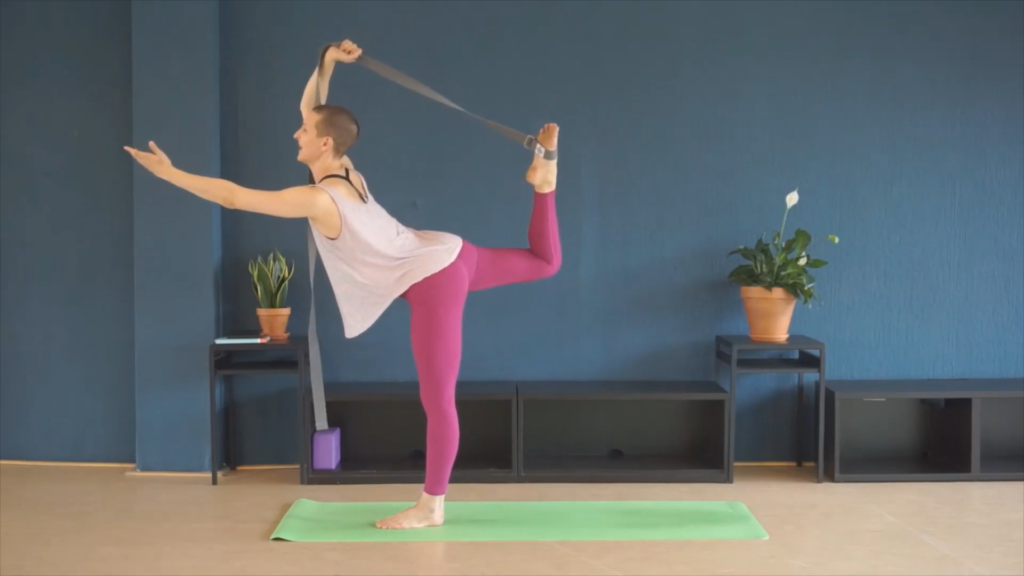
A Blythe Coach on Facebook & Instagram
Convertkit Commerce Unlimited Online Monthly Ballet & Yoga Classes 

DISCLAIMER: A Blythe Coach recommends that you consult your physician regarding the applicability of any recommendations and follow all safety instructions before beginning any exercise program. When participating in any exercise or exercise program, there is the possibility of physical injury. If you engage in this exercise or exercise program, you agree that you do so at your own risk, are voluntarily participating in these activities, assume all risk of injury to yourself.

Adult Adaptive Summer Dance Intensive, Week 2

Welcome to week two of my first offering of the Adult Adaptive Summer Dance Intensive! If you have not yet read or participated in Week 1, please go back to this blog and podcast for the full scoop on the suggested program and ways to make it your own!

In week two, we are focused on finding a Centered State of Being and connecting with the element of Fire, with more stability and core work, exercises for integration, and expanded dance movements.

Podcast 059 is the audio version of this blog, but scroll down to the Week 2 Overview and Basic Schedule for links to videos for my recommended exercises for the week

It still requires only 15 minutes or so per day, and can be expanded with my ballet and dance exercises, full-length classes online or in-person, dance appreciation and criticism viewing, improvisation, learning dance repertory, composition/choreography…the sky’s the limit!

For the basic dance conditioning/injury prevention/cross-training program, we continue our Ankle ABC’s, Planking Pleasures, and calisthenic variations from last week (Jelly Jumping Jacks, Luscious Lunges, Scrumptious Squats, Tempting Tricep Dips, and Push it Up!), introducing new foot work (Towel Toes), cross-training (Caterpillar Walks), dance warmups (Kicky Leg Kicks, Sweet Leg Swings), and ballet movements (Powerful Plies, Tempting Tendus, Port de Bras Story).

I would be delighted to work with you individually to help design and execute your ideal training program- just email me at blythe@ablythecoach.com to book a consultation

Week 1 Follow-Up

Recommended Viewing: “Strange Fruit” by Pearl Primus, for more on Pearl Primus (the choreographer of the week 1 recommended viewing) consider this history video and this article as well.

Recommended Writing: We used the Needs Assessment + Goal Setting tool (and if you missed it, you can do so now) to strategize the design of your personalized program & the Dance Appreciation Observation Tool to remember details of dance appreciation recommended viewing above for future reference, writing, and choreographic inspiration

Recommended Reading for Weeks 1 & 2: Elements of Dance: The Body, Shape, Action; Ballet Movement Vocabulary Hyperdoc (links to videos and blogs)

Oh hello! Look forward to seeing you in the studio live this week or virtually 🙂

Week 2 Overview

Recommended Viewing: For dance appreciation, the full “Don Quixote” ballet (link to the version by Carlos Acosta at the Royal Ballet), and for learning performance repertory, the “Queen of the Dryads” variation from “Don Quixote” performed by Maria Khoreva at the Mariiksky Ballet (more info about the ballet also included in the description for the video). I will be teaching modifications of this well-loved dance this summer to adapt it to beginning through advanced dancers.

Recommended Listening: Finding a Centered State of Being podcast

Week 2 Basic Daily Schedule

Day 8: Towel Toes (5:20), Planking Pleasures (@2:38-5:34), & Full Micro-Workout (@4:42 to practice, then however many sets you prefer) OR Push It Up! (1:33-3:45) & Jelly Jumping Jacks (@5:58-8:22) [13 minutes]

Day 9: Ankle Alphabets (@00:47-2:30), Oh Wow! Cat-Cow (@3:37-5:32), Sensational Caterpillar Walks (7:30 *OR Push it Up!*),  Jelly Jumping Jacks (@5:58-8:22), Beatific Boats (6:06) [15-20 minutes]

Day 10: Planking Pleasures (@2:38-5:34), Sensational Caterpillar Walks (@5:48-6:56), Powerful Pliés (16:55 or practice @12:53-16:55), Plush Paralleleves (5:49) [20-25 minutes]

Day 11: Towel Toes (@2:05-5:01), Sensational Caterpillar Walks (@5:48-6:56), Kicky Floor Kicks (8:37), Wonderful Whirligigs (5:49) [15-20 minutes]

Day 12: Ankle Alphabets (@00:47-2:30), Kicky Floor Kicks (@6:02-8:14), Plush Paralleleves (@3:17-5:28), Wonderful Whirligigs (@4:05-5:12), Powerful Pliés (@12:53-16:55), Tempting Tendus (9:49, practice @5:57-9:05) [15-20 minutes]

Day 13: Towel Toes (@2:05-5:01), Planking Pleasures (@2:38-5:34), Kicky Floor Kicks (@6:02-8:14), Powerful Pliés (@12:53-16:55), Tempting Tendus (@5:57-9:05) [16 minutes] …or take the day off and rest or get outside 🙂

Day 14: Ankle Alphabets (@00:47-2:30), Sensational Caterpillar Walks (@5:48-6:56), Powerful Pliés (@12:53-16:55), Tempting Tendus (@5:57-9:05) [10 minutes] …or take the day off and rest or get outside 🙂

Expanding + Adapting the Dance Intensive

If you have more experience and are in condition for dancing, explore my YouTube Playlists: Ballet Barre and Ballet Centre, Wonderful Dance Warmup, Sumptuous Stretching, Micro-Workout, Yogalicious, Beautiful Breathing, & The 7 Movements of Ballet, Concentrated Core Conditioning, Foot & Ankle Conditioning, Arm Artistry, & Legs, Legs, Legs.

Also new this week is my 45-minute Floor-Based Yoga for Energy practice, great if you’re needing more pep in your step to get dancing!

I am going “Live” every weekday on social media to practice the day’s movements together and answer your questions, so join me there for more fun and support 🙂

Meanwhile, I would like to know: 

  • How do you cultivate energy, wakefulness, and presence?
  • What physical skill and what mental skill are you developing this week?
  • How can I serve you?

Send me an email at blythe@ablythecoach.com or come visit me at the A Blythe Coach Facebook Page to respond, I love hearing from you!

A Blythe Coach: Dance Education & Coaching 
move through life with balance, grace, & power
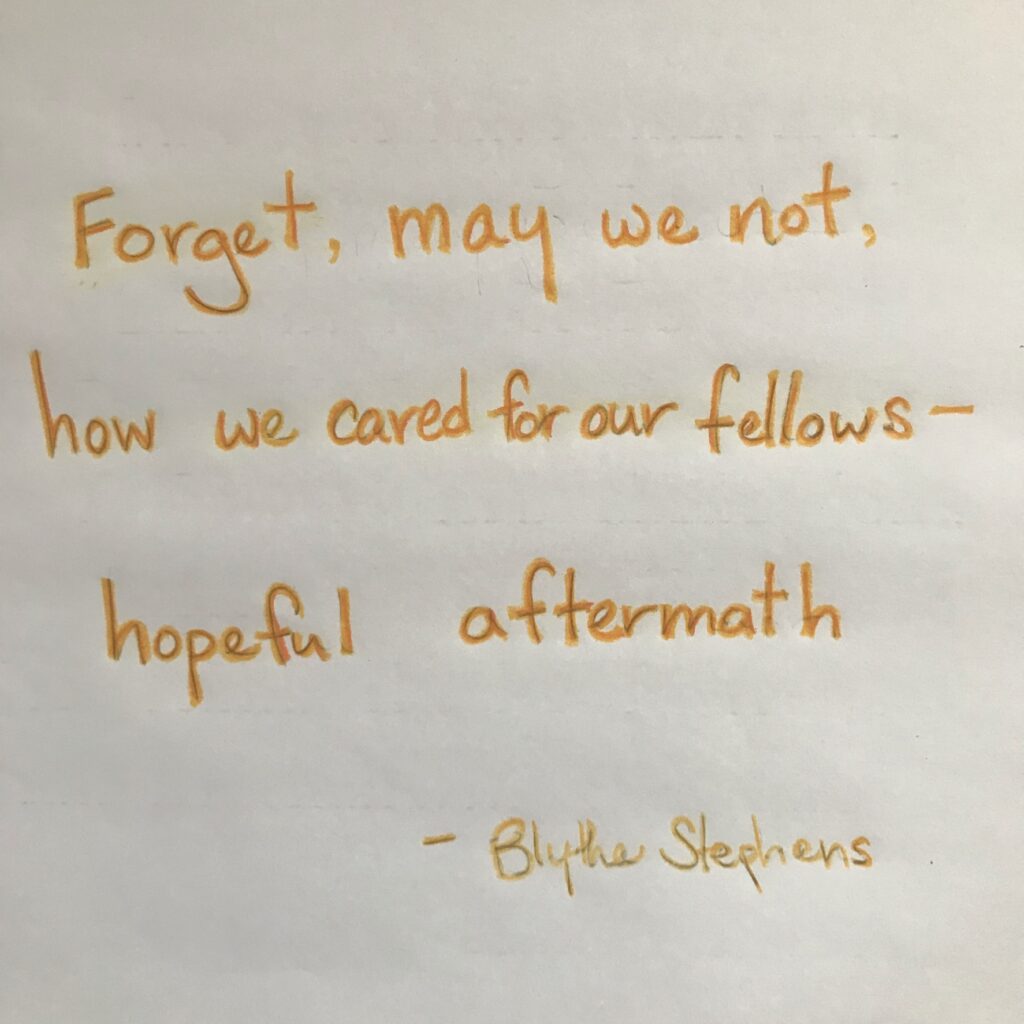
A Blythe Coach on Facebook & Instagram
Convertkit Commerce Unlimited Online Monthly Ballet & Yoga Classes 

DISCLAIMER: A Blythe Coach recommends that you consult your physician regarding the applicability of any recommendations and follow all safety instructions before beginning any exercise program. When participating in any exercise or exercise program, there is the possibility of physical injury. If you engage in this exercise or exercise program, you agree that you do so at your own risk, are voluntarily participating in these activities, assume all risk of injury to yourself.

WordPress Cookie Notice by Real Cookie Banner