Have you been dancing along with me through the Summer Dance Intensive? If so, are you a bit sore yet? 🙂 I hope you’re having fun and experiencing growth and transformation! Please remember that this program is meant to be taken in your own time, at your own pace.
Speaking for myself, I have definitely been feeling the effects of my personal “Adaptive Adult Summer Dance Intensive: since week one! I’ve got a rotation of tired and stiff muscles (which I love, because it means I’m getting stronger!) and am feeling noticeably more stable, secure, and fit to dance.
It’s amazing how minimal effort each day can yield noticeable gains in strength and stability, flexibility and range of motion, and general well-being.
This and the last three blogs (Adaptive Adult Summer Dance Intensive Weeks One, Two, & Three) have presented weekly suggested programs to develop body and mind, providing a complement or bridge to online or in-studio practice.
You can tailor the program to your needs, with anywhere from 5 minutes to 5 hours per day, choosing to participate in the recommended YouTube videos for specific exercises (great for cross-training and preventing injury alone or in combination with classes at your local studio), recorded classes and combinations, Live Online group classes and/or Live Online Private Lessons and Coaching or even join live in-person classes with me in Cologne, Germany!
Podcast episode 060 is the audio for this blog, scroll down for links to exercises
Week Four Overview
Week four is all about continuing the work we’ve started, finishing strong, and getting complete on our efforts so far. We are fostering a Creative State of Being and connecting with the Element of Air.
We are practicing exercises to continue to condition the body for dance, expand dancing movement vocabulary, compose dances, describe & critique choreography.
This final week, we are setting up to keep your practice going after the “Intensive” is complete. The idea is to have a well-rounded conditioning and cross-training routine that requires a very small commitment of time. You can continue to add different movements slowly as well as take full-length classes with me online or through other teachers and live studios.
Recommended Viewing: Paris Opera Ballet’s “Cendrillon,” with choreography by Rudolf Nureyev and a golden age of Hollywood twist on the classic “Cinderella” ballet (link is to a trailer, I sadly can’t find a full-length version currently- happened to catch it on television via Arte).
Criticism: Use the Be a Dance Critic tool, which is a framework for dance criticism with questions to help write reviews of choreography and performance. Through this you will describe, analyze, and interpret your viewing of “Cendrillon” (above) or another dance work you’ve been looking forward to seeing.
Repertory: we will continue to learn the “Queen of the Dryads” variation from “Don Quixote:” I will share variations on this short choreography, and you can also create your own translation as a composition exercise.
Improvisation: “Egg” exercise from Twyla Tharp (below), dance freely to “Pluma” or your other favorite music of the moment, or do a study of what movements you associate with the dreamy character of the “Queen of the Dryads” (above) experimenting with your new dance vocabulary, or whatever freestyle movement floats your boat.
Tharp’s “Egg” Improvisation Instructions:
“I sit on the floor, bring my knees to my chest, curl my head down to my knees, and try to make myself as small as I can. In this minimalized shrunken state, I have nowhere else to go; I cannot become smaller, I can only expand and grow. And so it becomes a ritual of discovery for me. If I lift my head and straighten my back I become Tall Egg. If I stretch out my legs and point my toes, forming an L-shape, I become Jackknife Egg. I stick with it as long as it remains interesting, sometimes going through as many as a hundred positions. I’ve been doing this daily for years and I usually find something new in the process… I like the Egg routine because it is so basic. You don’t need to know anything or be in particularly good shape to do it (although some stretching is a definite help). The only requirement is a commitment to the process. The starting Egg position is your home base and you are setting out to see see how far you can travel from home…Egg is an exercise that teaches you how to accomplish the most difficult task in any creative endeavor: begin.” (The Creative Habit p.112-3)
Composition: translations of “Queen of the Dryads” variation (i.e. simplification, modifying elements of dance such as use of time, space, or use of the body, music…), or other classical variation or other theme of your choosing.
Reflection: since it is the final week of the Adaptive Adult Summer Dance Intensive and I want to support you in moving powerfully forward, it will serve us to reflect on the learning of the last four weeks and determine how to proceed from here, to free us of any could have/would have/should have or disempowering energy. To that end, you are invited to respond to the following prompts:
What have you accomplished and what do you declare complete from this month-long intensive program?
For your daily program in Week Four and continuing, pick:
A foot/ankle conditioner to get Grounded (Ankle ABC’s, Towel Toes, or Plush Paralleleves) or do a full yoga practice, or do self-massage with a foam roller and/or lacrosse or tennis ball
An axial (leg and/or arm) movement or dance step** to get Orientedor have a stretching sessionor do a full ballet barre or dance class AND/OR
Learn Repertory/Improvise/Compose to get CreativeAND/OR
Watch/Describe/Analyze/Critique or Collaborate to get Related (might I suggest hopping on the A Blythe Coach Facebook Page and sharing your experiences?)
Days 22-26
Choose an foot/ankle conditioner + core activator + axial movement or step** and/or dance warmup/class, yoga practice, or stretching session and/or improv, composition, repertory, collaboration, or criticism
After the “official” 4-week program is done at the end of July, you are encouraged to keep practicing into week 5 and beyond, to work with others to generate a Related State of Being through Partnering, Collaborative Choreography, Repertory, sharing and critiquing Choreography, or ongoing Technique development, and connect to the Element of Ether.
Resources for Your Personal Dance “Intensive“
The Ballet Movement Vocabulary Hyperdoc is an interactive syllabus of ballet steps, techniques, and concepts. The Student Profile & Intended Results form can be a reflective tool for you to formulate your objectives, as well as help me tailor content to fit your needs. For more information on designing training to achieve your dancing dreams, check out the Goal Setting for Dancers blog as well.
You can follow some or all of the daily plan above, or sample à la carte steps and exercises from the playlists below:
Sunday morning hybrid Yoga class online and in-studio at Tanzschule Tanzraum Zentrum in Cologne Germany @11:00 CEST, Tuesday morning online Yoga class @6:15 CEST, and Tuesday morning online Ballet class @8:00 CEST on Zoom (Tuesday morning German time is Monday evening in HI, late night on the US mainland).
Further group classes or private lessons available by request, schedule a consultation to discuss. I am also continuing to go “Live” every weekday on social media to practice the day’s movements together, talk about improv, repertory, and choreography practices and answer your questions, so join me there for more fun and support!
Acknowledgment & Completion Celebration
I want to acknowledge you for taking the time to read my blog, and those who watch and move along with my YouTube videos, subscribe to my email newsletter, listen to my podcast, or are live students and clients for your efforts, growth, commitment to learning, increased knowledge, skill, and confidence.
I hope you celebrate your personal efforts and progress, too! Your participation, support, feedback, love, and community are so needed at this difficult time for us all! Live it up, and contact me if you’d like a personal acknowledgment for the glorious being you are in the world!
What’s Next Post-Intensive?
There’s lots more to come on the topics of completion, rest & recovery, dealing with mistakes and failure, elements of dance, specific ballet movements, yoga flows, and more! Come on over and subscribe to the YouTube Channel and join my email newsletter to receive my latest free offerings, favorite resources from myself and others, joy, and inspiration 🙂
DISCLAIMER: A Blythe Coach recommends that you consult your physician regarding the applicability of any recommendations and follow all safety instructions before beginning any exercise program. When participating in any exercise or exercise program, there is the possibility of physical injury. If you engage in this exercise or exercise program, you agree that you do so at your own risk, are voluntarily participating in these activities, assume all risk of injury to yourself.
During July, each week I am sharing a fully adaptable “Summer Dance Intensive” program to develop body and mind for those who would like to be immersed in dance or yoga and don’t have the chance to attend such a workshop in-person. The suggested free sequences can provide a complement or bridge to online or in-studio practice. You can tailor the program to your needs, with anywhere from 5 minutes to 5 hours per day and any level of experience!
Have fun customizing your program for your current condition, skills, and lifestyle, and please let me know what questions you have and how I can best serve you! I would be delighted to work with you individually to help design and execute your ideal training program- just email me at blythe@ablythecoach.com to book a consultation!
If you’re just joining me for the Summer Dance Intensive, be sure to get the scoop on Week One and Week Twofirst.
Week Three Overview
Week 3 expands on our foundation and centering from the first two weeks, building an Oriented State of Being and connecting with the Element of Water. We will flow into some improvisation which will later lead to composition, and continue to develop movement vocabulary and skill through dance exercises and appreciation.
This week you can choose to dive deeper into viewing and reflecting on choreographic works, yoga, breathing, and meditation practices, modern dance, or ballet. If jumping is appropriate for you, in ballet/dance we begin to practice becoming airborne as well as continuing work with the Elements of Dance of the Body, Shape, and Space.
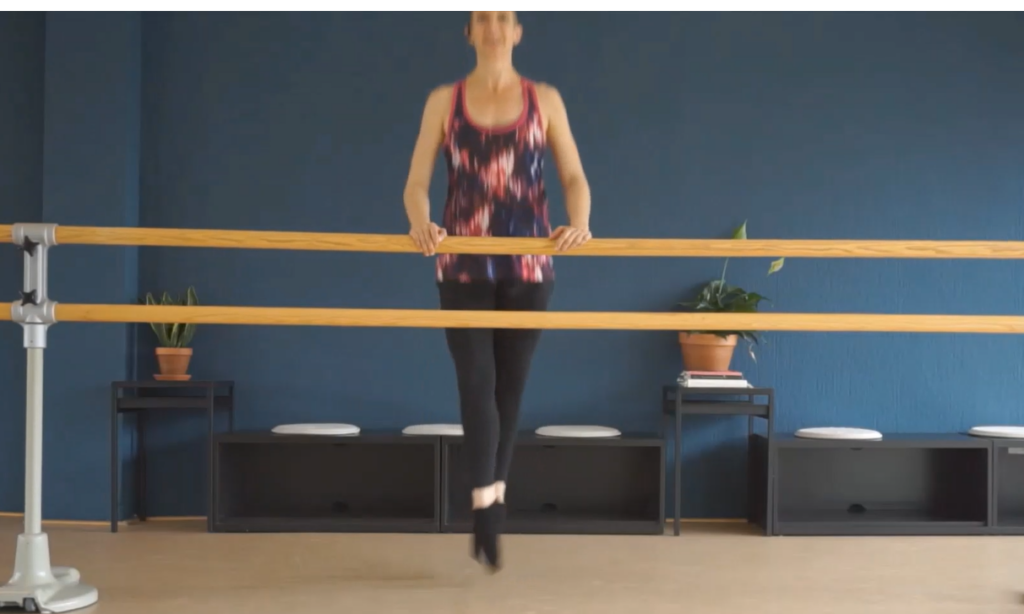
Having laid a solid foundation, if we’re up for it, this week we launch into the air (with stretched feet!) as in this photo of me performing royale at the barre
The Ballet Movement Vocabulary Hyperdoc is an interactive syllabus of ballet steps, techniques, and concepts. The Student Profile & Intended Results form can be a reflective tool for you to formulate your objectives, as well as help me tailor content to fit your needs. For more information on designing training to achieve your dancing dreams, check out the Goal Setting for Dancers blog as well.
You can follow some or all of the daily plan above, or sample à la carte steps and exercises from the playlists below:
I am teaching Sunday morning hybrid Yoga class (online and in-studio at Tanzschule Tanzraum Zentrum in Cologne Germany) @11:00 CEST, Tuesday morning online Yoga class @6:15 CEST, and Tuesday morning online Ballet class @8:00 CEST on Zoom (Tuesday morning German time is Monday evening in HI, late night on the US mainland).
Delighted to offer further group or private lessons by request, just schedule a consultation to discuss.
I am also continuing to go “Live” every weekday on social media to practice the day’s movements together and answer your questions, so join me there for more fun and support!
DISCLAIMER: A Blythe Coach recommends that you consult your physician regarding the applicability of any recommendations and follow all safety instructions before beginning any exercise program. When participating in any exercise or exercise program, there is the possibility of physical injury. If you engage in this exercise or exercise program, you agree that you do so at your own risk, are voluntarily participating in these activities, assume all risk of injury to yourself.
Welcome to week two of my first offering of the Adult Adaptive Summer Dance Intensive! If you have not yet read or participated in Week 1, please go back to this blog and podcast for the full scoop on the suggested program and ways to make it your own!
In week two, we are focused on finding a Centered State of Being and connecting with the element of Fire, with more stability and core work, exercises for integration, and expanded dance movements.
Podcast 059 is the audio version of this blog, but scroll down to the Week 2 Overview and Basic Schedule for links to videos for my recommended exercises for the week
It still requires only 15 minutes or so per day, and can be expanded with my ballet and dance exercises, full-length classes online or in-person, dance appreciation and criticism viewing, improvisation, learning dance repertory, composition/choreography…the sky’s the limit!
For the basic dance conditioning/injury prevention/cross-training program, we continue our Ankle ABC’s, Planking Pleasures, and calisthenic variations from last week (Jelly Jumping Jacks, Luscious Lunges, Scrumptious Squats, Tempting Tricep Dips, and Push it Up!), introducing new foot work (Towel Toes), cross-training (Caterpillar Walks), dance warmups (Kicky Leg Kicks, Sweet Leg Swings), and ballet movements (Powerful Plies, Tempting Tendus, Port de Bras Story).
I would be delighted to work with you individually to help design and execute your ideal training program- just email me at blythe@ablythecoach.com to book a consultation!
Week 1 Follow-Up
Recommended Viewing: “Strange Fruit” by Pearl Primus, for more on Pearl Primus (the choreographer of the week 1 recommended viewing) consider this history video and this article as well.
Recommended Writing: We used the Needs Assessment + Goal Setting tool (and if you missed it, you can do so now) to strategize the design of your personalized program & the Dance Appreciation Observation Tool to remember details of dance appreciation recommended viewing above for future reference, writing, and choreographic inspiration
Oh hello! Look forward to seeing you in the studio live this week or virtually 🙂
Week 2 Overview
Recommended Viewing: For dance appreciation, the full “Don Quixote” ballet (link to the version by Carlos Acosta at the Royal Ballet), and for learning performance repertory, the “Queen of the Dryads” variation from “Don Quixote” performed by Maria Khoreva at the Mariiksky Ballet (more info about the ballet also included in the description for the video). I will be teaching modifications of this well-loved dance this summer to adapt it to beginning through advanced dancers.
Also new this week is my 45-minute Floor-Based Yoga for Energy practice, great if you’re needing more pep in your step to get dancing!
I am going “Live” every weekday on social media to practice the day’s movements together and answer your questions, so join me there for more fun and support 🙂
Meanwhile, I would like to know:
How do you cultivate energy, wakefulness, and presence?
What physical skill and what mental skill are you developing this week?
DISCLAIMER: A Blythe Coach recommends that you consult your physician regarding the applicability of any recommendations and follow all safety instructions before beginning any exercise program. When participating in any exercise or exercise program, there is the possibility of physical injury. If you engage in this exercise or exercise program, you agree that you do so at your own risk, are voluntarily participating in these activities, assume all risk of injury to yourself.
Summer can be a fruitful time to advance our craft, with warm weather and time off from school or (sometimes) work to focus on developing dancing strength, flexibility, balance, endurance, skills, & repertory. Even famous ballet pedagogue Agrippina Vaganova remarked on the particular value of working on your ballet technique in the summer months.
My virtual studio is open to support your dancing and movement goals this summer
Back in the day, I enjoyed summer ballet “intensives” with the Nashville Ballet and my home studio, the West Hawaii Dance Academy. Until I departed for ballet conservatory study at North Carolina School of the Arts, these were unique opportunities to dive deeper and gain exposure in the profession. Later I would teach at summer dance camps and accelerated summer university ballet courses, and I’m always blown away by how much growth and improvement can occur in a short, concentrated timespan!
Courses in Ballet Technique, Pointe, Pas de Deux, Character Dance, Jazz, Tap, Body Conditioning, Pilates, Yoga, Dance History & Appreciation, Repertory, & Choreography were often included, whereas during the schoolyear, we mostly just technique, pointe, and rehearsals fit in with school. Of course there are also “summer intensive” opportunities for the study of other dance techniques, athletic pursuits, and yoga workshops as well.
And now there are such “intensive” opportunities for adults as well as youth, which is also exciting! But not everyone has the time or money to invest in extensive training…
Flexible & Adaptive Summer Dance Training
Tune in on Spotify for Podcast 058, the audio version of today’s blog, and scroll down for the weekly plan and other resource links
If you would like to immerse yourself in dance or yoga this summer and don’t have the chance to attend an intensive in-person, I’d like to offer an at-home online option that can flexibly meet your needs. Because of its (primarily) virtual nature, you don’t have to participate synchronously in real-time, so you can also start the program anytime!
During July, I will present weekly suggested programs to develop body and mind, providing a complement or bridge to online or in-studio practice. You can tailor the program to your needs, with anywhere from 5 minutes to 5 hours per day! I’ll also be following the program myself and going live on social media each (week) day to share about the week’s exercises, recommended viewing, listening, reading, and tools and also field any questions you may have.
Depending on how much time you can spend, you may choose to participate in the recommended YouTube videos for specific exercises (completely free and great for cross-training and preventing injury alone or in combination with classes at your local studio), recorded classes and combinations (also free), Live Online group classes and/or Live Online Private Lessons and Coaching or even join live in-person classes with me in Cologne, Germany (reasonably priced).
Perhaps you have an injury or other physical limitation. While you should seek appropriate treatment first, because your program is fully personalized, it can accommodate many special situations and needs.
Assess Your Needs & Plan Your Program
Have fun customizing your program for your experience, skills, and lifestyle, and please let me know what questions you have and how I can best serve you! I would also be happy to work with you individually to design and execute your ideal training program- just book a consultation HERE!
Please remember that participation is at your own risk, and I strongly recommend consulting with your MD or other medical professional before beginning a new exercise program of any kind. It is better to ease into new programs and movements for sustainable training, so take it at your own pace.
Dancing in Kailua-Kona, HI back in my early days
Choose to focus on ballet, modern, creative dance, yoga, or general cross-training
Being fully customizable, the cross-training applies to all movement disciplines, and beyond that you can focus on what interests you the most. You will find video and blog content on a variety of dance and yoga topics, from technical instruction to theoretical understanding to creative inspiration.
Focus on Ballet
If you wish to pursue an intensive centered on Ballet, my Ballet Movement Vocabulary Hyperdoc is another handy resource, forming a syllabus with links to videos defining, teaching, and practicing basic ballet vocabulary. I teach weekly adult ballet classes both online and offline, so you can avail yourself of those offerings if they fit your location and schedule, or you may opt to attend classes locally.
For a more conceptual introduction, The 7 Movements of Ballet Playlist provides theoretical groundwork. If you have significant ballet experience, I have started a Ballet Classes Playlist with recommended free full-length advanced classes, and will keep adding to it (which are your favorites?).
Focus on Modern, Jazz, or Creative Dance
Such syllabus/movement vocabulary documents for Jazz and Modern dance are still in-the-making for me (let me know if you’d like more videos and content on these topics!), but students of these styles will also find knowledge of the ballet vocabulary helpful. You can also jump right into sampling the Wonderful Dance Warmup or Elements of Dance Playlists on YouTube that include universal exercises and concepts for all dance styles.
You can combine physical practice and more academic learning, or even focus entirely on appreciation, theory, improvisation, choreography, or performance criticism. In the future, with demand, I will delight in providing more resources on these topics.
Focus on Yoga or Cross-Training
You may also focus on Yoga, Dance Conditioning, or Cross-Training for dance, ballet, and athletics. In this case you can go ahead and peruse the Yogalicious (mostly shorter introductory yoga practices with different themes), Full Yoga Practice Replays (50-minutes to 1 hour), Beautiful Breathing (Pranayama), Micro-Workout, or Sumptuous Stretching Playlists, or for more general inspiration, check out the Luscious Life Playlist.
You can also focus on training specific areas of the body to support your individual goals:
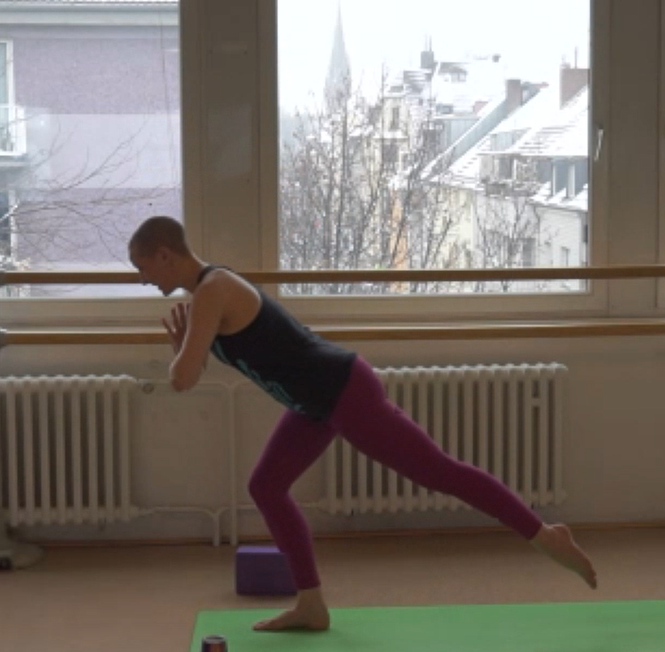
I do practice yoga all year (snowy rooftops pictured here), but it’s especially delightful in warm weather
Flexible Schedule & Timing
Your typical dance summer intensive is full-day training, every day for 2-6 weeks. This program will continue for a month, but of course is completely flexible, so you can join every day, every other day, for only one week, for the full month, spread it out over a longer period of time… anything is possible!
Start by following my recommended daily program, optionally adding full-length ballet, dance, and/or yoga classes live, online, or recorded. Then as desired, include learning choreographic repertory & rehearsals, aerobic cross-training (such as swimming, hiking, bicycling, or your favorite variations on my Micro-Workout), and/or personal physical therapy exercises.
Example Training Schedules
5-15 Minutes Per Day: follow the video plan below for dance conditioning to keep you in shape as a complement to light training in other areas, such as walking while traveling or on your lunch break. This is good for those who are strapped for time, but want to return to dance classes in the Fall or at some later time. Or maybe you want to start a dance class for the first time and show up with some foundational skills under your belt. This version does not include the elements of full classes online or live, or the dance repertory, appreciation, and criticism, but can be a beneficial first step in building your practice.
1.5+ Hours Per Day: follow the videos daily and also take a yoga or dance class (online or in-person) 2-6 times a week. You may choose to add the dance appreciation/criticism if you like.
3+ Hours Per Day: One dance and/or yoga class and the training videos daily, also watching recommended performance repertory, opportunity to learn to perform ballet variations or other dances, create choreography, and write dance criticism (reviews).
Live Classes with A Blythe Coach
Yoga
Sunday morning hybrid class online and in-studio at Tanzschule Tanzraum Zentrum in Cologne Germany @11:00 CEST
Tuesday morning online-only class @6:15 CEST: sign up through Convertkit Commerce linked here for monthly-recurring class savings or message me for drop-in rates.
Ballet
This week, adult online-only class @8:00 CEST will be Thursday morning (8 July) and then subsequent weeks it will fall on Tuesday (13 July+): sign up through Convertkit Commerce linked here for monthly-recurring class savings or message me for drop-in rates. Message me with any questions and I’ll be happy to help 🙂
Further group classes or private lessons available by request, schedule a consultation to discuss.
Week One Overview
Week One is about laying the Foundation, easing into dancing, establishing a Grounded State of Being, and connecting with the Element of Earth.
To start strong, outline your current state, goals, and challenges, and help me cater a program to meet your needs by completing the Needs Assessment.
Recommended Viewing: “Strange Fruit” by Pearl Primus. A classic, beautiful performance and also relevant given recent events in racial justice. If you would like to take notes, you can also use my free resource, Dance Appreciation Observation Log to help ensure that you remember what you saw for later reference.
Recommended Reading: Elements of Dance: review theory about the diverse uses of The Body, Action, Space, Time, & Energy in all dance forms.
Please note that once you have watched the instructional portions of each video and learned the exercises, you can skip ahead on subsequent days to the practice part of the video or just practice the movements with music. In this way, the basic program doesn’t require more than 15-20 minutes per day although new skills continue to be added.
Make it your own!
I hope you enjoy sharing in my very first “Adaptive Adult Summer Dance Intensive!”
Stay tuned for Week 2, where we will be building a solid scaffolding for dance, developing acentered state of being and igniting the Fire Element, utilizing the Elements of Dance (The Body, Space, Shape, Action), discussing Dance Criticism, practicing yoga for energy & building our dancing vocabulary.
Meanwhile, let me know what your dream “Summer Dance Intensive” looks like! Tell me about your dancing and movement needs, and how I can support you in adapting a training program to achieve your goals. Send me an email or contact me here on the website or social media.
DISCLAIMER: A Blythe Coach recommends that you consult your physician regarding the applicability of any recommendations and follow all safety instructions before beginning any exercise program. When participating in any exercise or exercise program, there is the possibility of physical injury. If you engage in this exercise or exercise program, you agree that you do so at your own risk, are voluntarily participating in these activities, assume all risk of injury to yourself.
It’s unbelievable, but we are already 6 months into 2021, and I relish reflecting on half a year of learning and growth around the same time that I celebrate my birthday in June. This year has had its share of challenges as well, and it’s also an opportunity to contemplate grief and growth. I personally have attended two funerals already in 2021, having lost a friend at the end of 2020 and my girlfriend’s grandma in January.
Mining the lessons and gems in it all.
I find it important to look back and celebrate wins in Quarter 1 & 2 and strategize what’s missing, what can go, and what to recommit to creating in terms of habits, action steps, plans and milestones.
Today in episode 57 of the podcast and the blog, I’m sharing an update on my results from the first half of the year and planning for success in the next 6 months.
I wanted to start by revisiting this year’s theme and my big-picture life Purpose, Essence, Mission, and Vision of what I am up to. In this context, I can evaluate whether each of my individual goals for the year still make sense along with looking at my results so far. Actually, it’s helpful for me to review these elements regularly to make sure my actions are in alignment and to help prioritize my time and energy.
Stand for 2021: Abundance & Contentment / Reichtum & Zufriedenheit; overall, my sense of satisfaction is high thanks to the strength of my mindfulness and gratitude practices, and I am so thankful that I have weathered the pandemic with my health and grown in the process. I feel happy and thankful and am at the same time always learning, growing, and improving.
Mission: to inspire and equip dancers and liberated citizens
Vision: supporting students/clients/colleagues/community to live extraordinary lives through dance and yoga education and coaching
Monthly Themes
Starting Strong in January
This month was about visioning, starting new goals & consistent habits which included a monthly increase in the daily duration of my meditation to reach 20 minutes this year, daily poetry, etc. Right away these goals were challenged, as I attended two funerals that month, having lost a friend at the end of 2020 and my girlfriend’s grandma in January.
Self-LoveFebruary
My focus in February was celebrating love in all it’s forms, Valentine’s Day, and especially self-love and care. This consisted of Artist’s Dates, Creativity, practicing childlike wonder, as well as at-home spa fare such as Face masks, Mani-Pedis, & Bath Bombs.
Minimalist March
In march I played the Minsgame with paper clutter, etc. and also worked on some other exciting projects that I hope to be able to share with you soon.
Move Your Body Minimal Fitness April (+Poetry +Letter-Writing)
In April I focused on Minimal Fitness, Cross-Training, Physical Therapy; also some Spring Cleaning (windows, fridge…), reading and writing poetry, and correspondence (April is National Poetry Month and National Letter-Writing Month in the US and I like to celebrate both).
Healthy EatingMay
May was a great time to revisit my eating habits and maximize fresh fruits and veggies and nutrients for energy and healing, including making Smoothies all the time and Jar Salads.
June: Open back up for my 40th Birthday!
Enjoyed a wonderful celebration of my life so far here in Cologne and in the Ahr Valley, did lots of reflecting, created a playlist, and partied down! Renewed German Work Visa (for 2 years!). I also got vaccinated for COVID-19 to protect myself and others.
Celebrating the fruits of our efforts (fresh cherries in this case!)
Results Q1 & 2 (What Happened with my Projects)
Wins/Glows
Renewed my US Passport from abroad (what a process!) in May, prior to its November expiration date, due to needing it to exceed my work visa
Granted a 2-Year Arbeitsvisum (Work Visa) in June
YouTube: 36 Videos, 68 subscribers (+37), 4,100 Views, 120 hours of Watch Time
Blog: published 24 blogs, got started on SEO tracking and metrics to optimize
Podcast: Hit one year as a podcaster, produced 52 podcasts in the year (57 total), 230 total plays
Teaching online, now resumed live & hybrid teaching
Social Media: producing “Monday Messages” consistently, enjoy creating an aesthetically attractive feed with photos and inspiring quotes, 317 Facebook page likes, 71 IG followers THANKS to those of you who have been following me on Facebook, Instagram, YouTube, the Blog and the Podcast: it means a lot!
GermanA2.2 Completed with Lingoda in May, now nearly complete with B1.1, finished Duolingo German Tree (working on “Legendary” to keep in practice)
Financial Plan – not yet meeting all targets, but I’ve been seeing slow growth and tracking income, seeing some increase in teaching this summer as we come out of quarantine, but will keep up social media marketing, pursuing opportunities as they present themselves
Reading Challenge – ahead, 22 books read out of 30 and I have so so many more that I want to read in the next 6 months! If you use Goodreads, I’d love to be connected there, and I’ve recently become addicted to Readwise (30-day free trial), which I’ve found to be a fantastic tool to review past reading, keep learning fresh and tag topics for future reference
Writing & Publishing – Blog writing consistently, Haiku Challenge & Blog on-track, still undecided what to publish first and when
Yoga Practice & Study, Ayurveda, Adaptive Yoga, Chakras, Alchemy & Elements
Fitness & Cross-Training – I’ve been pretty consistent PT & mini-workout (yay!), but no progress on Pull-Ups or Handstands
Meditation Challenge & Study – Participated in a Deepak Chopra 21-Day Program, July is 19 minutes per day, August 20 and then I will maintain that going forward
Poetry – I have written 177 Haiku Poems for my daily challenge this year and will keep going, as well as learning about other poetic forms and reading new selections
Music – taught myself “Hawaiian Lullabye,” started working on learning “Danny Boy” on Harmonica
Spirit & Magic – the yoga and meditation practices above, purposeful work, reading the Bible and Quran, prayer practice on track (behind if I want to finish the Quran this year, but I’m ok going consistently slowly), weekly Tarot card pull, started work on Magic Wand, Full Moon crystal charging, monthly altar decoration
Friendship & Love Letters – I’ve been pretty intentional lately about reaching out to loved ones (though it can always improve), but I’ve been letting my written correspondence slide
Fun, Festivity, Recipes & Food – strong in this area! Meals together, pick a new dish to try each month (salads, goulash, corn soup…), Artist’s Dates and treats, crafts, Feierabends together with my girlfriend, restaurants & cafes when open in June, epic birthday celebration (still want to celebrate with my family in-person and travel more soon)
What’s Missing/Grows & What’s Next
Therefore I have identified areas of growth as business/financial/savings, getting my German driver’s license, traveling and supporting my family (ok fair, it’s been pandemic and I’ve been trying to get established in a new country, but still an important goal), growing my audience so that more people can benefit from my offerings (it IS growing, but slower than I expected), increasing my know-how on book publishing (writing itself is progressing), writing more letters, and building in practice for Pull-Ups and Handstands.
Now that my work visa has been extended, it’s time to get serious about studying for my German Driver’s License. I’ve got an app to help with the theoretical part, and will schedule First Aid, the Eye Exam, Theoretical, and Practical portions, but not likely this summer. Goal of Fall.
My crochet hobby for Artist’s Dates/Creativity/ was great in the winter, but is definitely more fun in the cooler months, so will officially drop it now, possibly resuming in October.
Letter-Writing is something I love but procrastinate on anyhow. Something is missing in my system here, so I will work to make it a habit. I am also reading the book I Want to Thank You: How a Year of Gratitude Can Bring Joy and Meaning in a Disconnected World by Gina Hamadey as inspiration.
I haven’t been practicing my Pull-Ups, but still really want this skill! Will hang from my pull-up bar as I pass, and try out the variations in the video Your First Pull-Up from Lucy Lismore.
Like Pull-Ups, I have dropped the ball on Handstands, but I want to be able to perform this skill freestanding. Currently I have no problem holding a handstand against a wall, but will work on variations from the video Learn how to Handstand to improve.
Will revisit my targets to keep them SMART and Futurable, build out my project plans and accountability for the next 6 months, celebrate milestones along the way, and keep going creating content, value, and sharing my process!
Like an exhilarating ride on a rollercoaster, or if you prefer, a wave, dancers ascend and descend, sink, scoop, and rise, following or leaving a pathway in space. It can be quite a thrill even at a low level of risk!
Our clarity about the described pathway in space, whether it be an scooping undercurve or arcing overcurve, affects our accuracy in performing dance steps and the impression given by our choreographic expression.
“The elements of indirectness and directness are often confused with certain aspects of movement shape, namely directional and shaping movement. While the effort qualities are concerned with the kind of concentration or focus in space, the shape aspects of movement are more related to pathways and forms the body parts create in space.” (A Primer for Movement Description p.30, emphasis mine) In the “Shapeshifting Dancers: Forms & How We Get There” blog I discussed types of forms, and ways we move into and through them in ballet and dance. Here and in Episode 56 of the Podcast we’ll delve into two specific pathways that we often travel in space, so-called undercurves and overcurves.
The audio version of this blog is episode 56, scroll down the blog for more resources
“Undercurve” and “Overcurve” are terms mostly used in movement description (i.e. Laban Movement Analysis) and modern dance, but I also use them in teaching ballet technique because they clarify the path the steps travel through space and you will find the concepts are applicable to all movement forms.
Whether sliding, stepping, or jumping, every movement that transfers weight, travelling from one place to another, will either remain at the same level or change levels, often following an over-curving or under-curving pathway in space.
As modern dance innovators Alwin Nikolais and Murray Louis distinguish in The Nikolais/Louis Dance Technique: “Remember that in the undercurve, the transfer of weight is always in low level. In the overcurve, the transfer is always in high level.” (Location: 3,747) Let’s elaborate on the differences in action, timing, and pathway between the two types of travel.
Undercurves Described
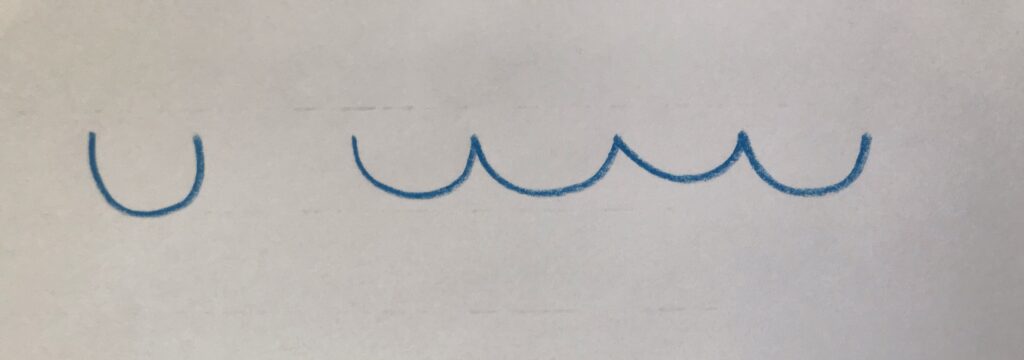
Illustration of a single undercurve and a string of undercurves, like drawing waves
Under-curves start at a high or mid-level, sink, travel (transferring the weight on the ground), and then rise again, forming a “U”-shaped pathway in space. Performed in succession, this creates a scalloping path, like the waves of the sea in a rudimentary drawing.
According to Nikolais/Louis, “The undercurve is conceived as the lower half of a sphere. It is a continuous half circle. The locomotion of an undercurve involves a triple action of the leg: plié—transfer of weight—lift.” (The Nikolais/Louis Dance Technique Location: 3,664) They emphasize skill in flexion and extension of the knee, “The fluidity of the flexing knee is the technical basis of both the undercurve and overcurve forms.” (The Nikolais/Louis Dance Technique Location: 3,665)
Try out some under-curves with me with the video that follows:
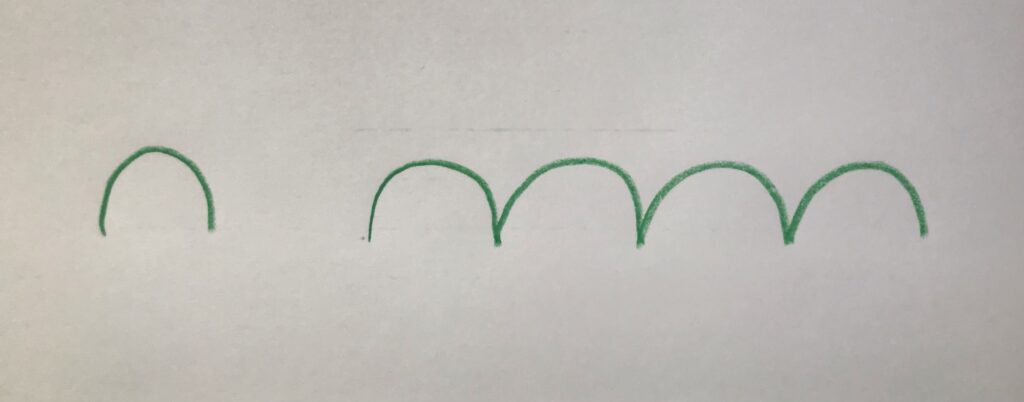
Illustration of a single overcurve and a string of overcurves, like rolling hills
Over-curves start at a low or mid-level, rise, travel (transferring weight in the air), and then sink again, forming an inverted “U” or “n”-shaped pathway in space, creating a scalloping pathway, like that of rolling hills in a rudimentary drawing.
Nikolais/Louis elaborate on movement possibilities from overcurves and undercurves: “The overcurve is the basis of the leap, just as the undercurve is the basis of the skip. Consideration is given to the upper curve of a circle. The action involves going up and stepping over.” (The Nikolais/Louis Dance Technique Location: 3,726) They break down the overcurve step by step: “overcurve leg action is also in three parts (not three counts): Standing leg rises to high level. The other leg lifts and steps over the curve of the circle. It lowers into pliée [sic] weight is transferred.” (The Nikolais/Louis Dance Technique Location: 3,739)
I particularly enjoy how Nikolais/Louis express the emotional requirements and impact of leaping overvurve movements: “‘Taking the air,’ being confident in the air and conscious of the space and leap action, is the motional fulfillment of the leap movement.” (The Nikolais/Louis Dance Technique Location: 3,762)
We can certainly practice over-curve and leaping motions in a controlled, small, incremental way at first, but it is wonderful to keep in mind the ultimate potential intent of soaring through the air as we develop skills and strength.
Timing of Under- and Over-curves
As well as taking different pathways in space, there are rhythmic and timing differences between the two actions as well, as Nikolais/Louis explain: “Undercurves are the basis for the quicker skip action, which has a three-eighth time value. However, the three-quarter undercurve waltz time needs to be carefully controlled so that the movement does not linger and become sentimental. […] dancer also should not confuse it with the step hop, duple time, which beginners will often substitute for the triple time undercurve skip.” (The Nikolais/Louis Dance Technique Location: 3,673-4, emphasis mine)
Nikolais/Louis also note the inherent challenge in lingering in the air and the impact that has on the rhythm of overcurves: “It is difficult to sustain the overcurve transfer of weight. The count becomes a duple so that a phrase of undercurve. undercurve, overcurve, overcurve, overcurve would count out as 1-2-3, 1-2-3, 1-2, 1-2, 1-2.” (The Nikolais/Louis Dance Technique Location: 3,729)
Technique notes for Under- and Over-curves
A clear change of level is necessary to describe undercurves and overcurves in space, and beginning dancers may need to exaggerate the level change to make the patterns clear. Nikolais/Louis stress the technical and physical requirements of controlling undercurve and overcurve actions:
“This triple action of the knee and leg must become automatic and smooth. The flexibility of the leg in the descent will help enormously in preparing for descending from air work.” (The Nikolais/Louis Dance Technique Location: 3,671)
Additional reminders for performing overcurves include that the “leading front leg lifts immediately to describe the overcurve form by stepping over, lengthening, and reaching downward and out of the hip for its next …” (The Nikolais/Louis Dance Technique Location: 3,731) and, “Lifting the straight back leg while in the air before the descent can sustain the air height longer.” (The Nikolais/Louis Dance Technique Location: 3,763) Try these ideas when you’re ready to go for more air time!
“Walking: transferring weight evenly from leg to leg on a level path.” “Hopping: locomotion on the same leg, transferring the weight in the air to the same leg. Transferring the weight through an undercurve or overcurve.” “Jumping: locomotion on two legs. Transferring weight to both legs. Full turns in the air, landing and pushing off from both legs.” “Leaping: transferring the weight from leg to leg in the air. Creating a long, horizontally level path as opposed to an overcurve. The different leaps vary in their character of traveling through the air.” “Skipping: as opposed to a ¾ undercurve, skipping can be a duple or a ⅜ rhythm with emphasis on the push off to upward instead of low transfer of weight.” (The Nikolais/Louis Dance Technique p.95, emphasis mine)
Chassé: “to chase,” as in a cat-and-mouse game between the two feet, one getting away and then the other coming after it. We practice two types in ballet technique, both demonstrated in the video above:
Chassé À Terre: slides along the floor in a “U” or scalloped pathway (down, across, up) to an open shape, then closes again; from a closed 3rd or 5th position, sinking into Plié, transferring the weight into an open 2nd (side) or 4th position (forward or backward), then stretching the legs in the new position or sliding to assemble them in a closed position again.
Chassé with a Sauté or jump: slides along the floor to an open shape, then closes again with a spring; from a closed 3rd or 5th position, sinking into Plié, transferring the weight into an open 2nd or 4th position, then stretching the legs into a jump and assembling them in a closed position in the air, and landing on both feet again.
Pas de Chat has a catlike leaping effect, jumping off from one foot and landing on the other, also like a cat-and-mouse game. As with all jumps, it begins with Plié (low level) and rolls through the feet on take-off and landing. Pas de Chat travels sideways, and can be practiced in parallel before moving on to turned-out or externally-rotated position.
Leading with the leg facing the direction of travel, which is typically in back in 3rd or 5th position when turned out, the foot pushes off to Passé / lift the thigh to Retiré, then springing with the following foot to create a brief diamond shape in the air, landing on other foot in Retiré and then closing to Plié on both feet again.
Further Ballet practice videos:
Powerful Pliés: the basic bending and stretching of the knees
Time Effort Blog introduces techniques for shifting our perception of time in dance and life
Space Effort Blog introduces techniques for manipulating focus
I hope you enjoyed exploring the concepts of undercurves and overcurves in ballet and dance today, as well as practicing the steps of Chassé, Pas de Chat, and more. Let me know whether you prefer an under- or over-curving pathway while dancing or observing dance in performance!
Blythe Stephens, MFA she/her or they/them A Blythe Coach: move through life with balance, grace, & power
DISCLAIMER: A Blythe Coach recommends that you consult your physician regarding the applicability of any recommendations and follow all safety instructions before beginning any exercise program. When participating in any exercise or exercise program, there is the possibility of physical injury. If you engage in this exercise or exercise program, you agree that you do so at your own risk, are voluntarily participating in these activities, assume all risk of injury to yourself.
As my birthday falls in June (this year is an especially notable one), I like to reflect at this time of year, considering the last year in my life as well as the 6 months since the official New Year. I relish celebrating my accomplishments and plotting my next steps to progress with my priorities.
We are enjoying the longest days of sunlight of the year here in Cologne, the harvest of the season, and for many, a time of rest, recovery, and recreation before the start of another school year. Maybe we have more space and time to reflect while taking a break from our usual responsibilities. Or perhaps we can take a moment to reflect even in hectic times, to appreciate our progress and plot our course.
Cologne and many places around the world are “opening up” again this summer following pandemic shut-down, and that’s something to reflect upon as well in order to make intentional choices going forward in our personal, professional, and creative lives. Writing and journal-keeping is one of my most trusty forms of reflection, processing, and awareness, and I am grateful the practice allows me to access my own wisdom over time.
The Podcast version of this week’s blog is 055: Journaling & Reflective Practice
In my blog on Artful Archiving, I shared: “I may not be a Beethoven-caliber genius, but I too work with a similar notebook system to anchor me in the midst of whatever chaos may come in life. No matter how much I digitize, I find for me much creative work must exist, at least at some stages of its development, in analog. So I have a daily diary, a bigger bullet journal of weekly, monthly, and longer-term planning, notes, and brainstorming, and yet another notebook of various ongoing professional projects and notes. At some point, the most important projects then are archived as Evernote notes, with photos, music, articles, and other relevant links attached.”
In addition to these journals, I also now keep daily morning pages, which I will discuss further below, but I have not always followed this system.
All of my personal journals, aside from morning pages and academic notes
My personal writing practice
My own journaling rituals reflect a lot of experimentation and evolution over time. I used to only write during difficult or dramatic times (aside from my academic work), whether it be journaling, creative writing, or poetry. I usually didn’t manage to write as often in happy or stable times.
In general I waited for the muse to strike and didn’t yet write daily or even weekly, which resulted in ended not writing often, resulting in epic hours-long catch-up sessions, some of which would end abruptly. During these early years, I struggled with inconsistency, though I aspired to be a regular writer.
My first attempts at becoming a diarist started in 1991, with my awesome early-90’s strawberry-print journal.
Funny story about that first diary: when I moved out from one apartment in Portland, apparently it had fallen into a nook by the built-in bookshelves, and was missing until it was returned to me by mail. I found out that a young girl had called my parents’ house (that’s why to always list “if found” contact info!) to track my address down and mail it back, including a letter and photos of herself, as her father, the maintenance man had found it, and she had read it! I was a mix of deeply grateful to get it back, embarrassed at what I had admitted in writing, and touched that she found things in common with my childhood self shared in it’s pages, such as a love for dance.
I am pleased that I have done quite a good job of keeping Travel Journals to record international and domestic (AT hiking, cross-country road-tripping…) tales of adventure. Outside of trips and vacations, I kept a journal, with gradually-increasing consistency through my school years, early professional life, and graduate school. Now I can finally say that I am a daily diarist, with anywhere from a few quickly-jotted lines to pages to show for each day.
In case I am so lucky to enjoy nostalgia in my old age, and if anyone else cares to know, I would like to record my intimate story of what transpired. My personal writings also inspire me to create other works, projects, personal, professional, and creative breakthroughs, and in order to leave a legacy.
Current Journal Ritual
I use my journals and notebooks for everything, from the mundane but important List-Making bullets necessary to keep track of the minutiae of life and for critical reference and tracking, Brain-Dumping to process an overload of experiences and ideas, Brainstorming to strategize and understand the big picture, Note-Taking to learn and prioritize. Through practice, I have experienced how Journaling helps provide clarity about what is (what happened, what’s missing, what’s next and other tools) and vision of what I want to create, experience, and share through my life.
I have used Reflective Practice as both a student and educator, with my own students, including simple tools such as daily wins or “Glows & Grows,” up to very sophisticated exercises and prompts. In daily life I now journal to record Gratitude, Abundance, Inquiry, Creativity, and for therapeutic applications, in my Relationships to self and others.
Reflection and journaling is always the first step for me when I am designing my Roadmap/Project Plans for the short-, medium-, and long-term. Keeping a journal and well-archived notes also allows for accountability through follow-up and checking in on milestones and related habit-building.
Types of Journal Practices
There are an infinite number of possible motivations and personal benefits to journaling and reflection. In fact, in the book Living a Beautiful Life, Alexandra Stoddard writes: “People who keep a daily journal do it for diverse and private reasons. Just as it is possible to gain more control over your life by developing meaningful rituals, so too, keeping a regular diary helps you know more clearly what your thoughts and feelings are, because you’ve written them down–have put them into words. You learn, by recording your thoughts and pleasures. A diary helps build up the muscles of your personality. For the modest amount of time and discipline it takes to keep a diary, the rewards are tremendous. In truth, those of us who keep diaries cannot stop. Once I’m in the flow I must keep up; like breathing out and breathing in, writing in my diary is a daily ritual. It helps me keep track of myself and my life, and thereby live more deeply and fully.” (p.33)
Clearing away superficial needs and tasks from our minds, such as making lists so that we don’t have to focus on keeping track mentally, reduces stress and frees the brain for higher-level decision making and creativity. Even simple, “entry-level” journaling practices can have a profound impact can include quick gratitude lists, task to-dos, shopping lists, daily or weekly, priorities, ideas that come in dreams or waking thoughts, and accountability trackers for habits we’re working on. Write it all down!
Expanding to the next level, so to speak, we can use journaling to flesh out our visions as they come to us, set long-term goals and conditions of satisfaction, process challenging situations, make distinctions and work with context, analyze, critique, navigate breakdowns, come up with creative solutions, and fuel our personal expression. Journaling is indispensable to therapy, be it physical or psychological, coaching, and educational contexts. Anywhere you want to grow, reflective practice is there to assist.
Therapeutic Journaling
Kathleen Adams’ article, “A Brief History of Journal Therapy,” which first appeared in The Illustrated Encyclopedia of Mind Body Medicine in 1999, indeed provides a concise summary of proven uses for journaling in therapy as well as in other educational contexts. Although I didn’t need more convincing of the powers of reflection for mental and psychological well-being, Adams reports physical affects that I found a bit surprising:
“Probably one of the most common reports from people who write journals is that the act of putting thought and feelings on paper helps give useful emotional and mental clarity. However, there is scientific evidence that the relief that comes from writing things down is more than just psychological. Dr. James Pennebaker, a researcher in Texas, has conducted studies that show that when people write about emotionally difficult events or feelings for just 20 minutes at a time over three or four days, their immune system functioning increases. Dr. Pennebaker’s studies indicate that the release offered by writing has a direct impact on the body’s capacity to withstand stress and fight off infection and disease.” (p.1)
Educational Reflective Practices
As an educator and coach, I have used different types of journaling and reflective practices with hundreds of students and clients over the years. This is in the tradition of responsive journaling practices which Kathleen Adams explains were becoming more widespread around the time of my birth:
“In the 1980s many public school systems began formally using journals in English classes and across the curricula as well. These journals, often called “dialogue” or “response” journals, offered a way for students to develop independent thinking skills and gave teachers a method for responding directly to students with individual feedback. Although the intention for classroom journals was educational rather than therapeutic, teachers noticed that a simple assignment to reflect on an academic question or problem often revealed important information about the student’s emotional life. Students often reported feeling a relief of pressure and tension when they could write down troubling events or confusing thoughts or feelings.” (p.1)
How wonderful to benefit from these educational innovations in academic life, as well as professional and personal applications. As an educator, I foster a student-centered, emancipatory approach to learning, so of course reflection and self-awareness are constant companions.
Dance & Reflection
Sometimes dance is approached from a purely technical or “practical” perspective, but I find it far more impactful on the life of the whole person when theoretical and reflective perspectives are included. In the Journal of Dance Education article “The Dancer as Reflective Practitioner: Is it possible?” Sherrie Barr agrees. Barr explains the pedagogical controversy: “The dichotomy between theory and practice within dance education is a reflection and expression of the same tension that has characterized the question of liberal education in the 20th century. Should liberal education encourage the development of a reflective and critical sensibility, or should it be subordinated to vocational and pre-professional training?” (p.60)
Barr goes on to argue for students to experience the fullness of what the subject of dance can offer: “Dance is as much a participatory and historical art as it is a living art form which dialectically engages, as it always has, the larger culture of which it is a part. As such the teaching of dance must provide challenges and opportunities, engaging students in the full discipline by connecting diverse theoretical ideas to their movement investigations. As students become aware of themselves as reflective practitioners within dance, they can become aware of dance as simultaneously a performance art, a cultural practice, and a venue for scholarly investigation.” (p.64)
This is incredibly empowering! To provide one example of regular engagement in reflective journaling in a dance technique context, I’d like to share the Evaluative Log I use for university-level classes, inspired by one shared by my colleague at Leeward Community College, Alex Durrant. Simplified versions of this type of log can be used with younger students as well. The Evaluative Log consists of four questions:
What did we do in session today? What vocabulary was used and what does it mean? What exercises did we cover? Did we create a choreographic sequence today? Can you remember it? If so, can you describe it with the correct vocabulary?
What were you confident with and what did you do well today? Give yourself full credit for your achievements, tell me about your personal triumphs and what that means to your progress! Does it mean you feel ready to challenge yourself further?
What were you less confident about today or would like to work on more? How can you improve your skills in this area? What exercises do you need to practice? What muscles need to get stronger? How will you keep trying to achieve your personal goals?
What are your targets for next session? What will you strive to achieve next time we are in the classroom? What do you need to do to get there? What do you need your teacher to do? — If you want me to work on something specific never be afraid to ask! Remember to keep your targets SMART (see also, “Futurablility for Objectives” Tool):
Specific Measurable Achievable Relevant Timely
Creative Growth through Reflection
Growth in Creativity can be another wonderful outcome from regular journaling, as it provides an outlet for the flow of expression and inspiration whether it be poetic, novel or short fiction-writing, nonfiction writing, choreographic, pedagogic…the tactic proves effective for the whole spectrum of topics and styles.
Daily writing is stressed as a component of the incredibly popular The Artist’s Way 12-week program by Julia Cameron, although countless artists and creative people of all types, not just writers, have found it effective.
An exercise Cameron describes in Week 1 goes like this: “Every morning, set your clock one-half hour early; get up and write three pages of longhand, stream-of-consciousness morning writing. do not reread these pages or allow anyone else to read them. Ideally, stick these pages in a large manila envelope, or hide them somewhere. Welcome to the morning pages. They will change you.” (The Artist’s Way p.96)
Keep in mind that Cameron doesn’t suggest that we look back at these sorts of preliminary brain-dump free-writes until Week 10, when she finally directs: “Read your morning pages! This process is best undertaken with two colored markers, one to highlight insights and another to highlight actions needed. Do not judge your pages or yourself. This is very important. Yes, they will be boring. Yes, they may be painful. Consider them a map. Take them as information, not an indictment.” (p.291)
Cameron further recommends a 3-step process for getting the most value from re-reading our morning pages, a good guideline for review of any personal writing, I find:
“Take Stock: Who have you consistently been complaining about? What have you procrastinated on? What blessedly have you allowed yourself to change or accept?
Take Heart: Many of us notice an alarming tendency toward black-and-white thinking: ‘He’s terrible. He’s wonderful. I love him. I hate him. It’s a great job. It’s a terrible job,’ and so forth. Don’t be thrown by this.
Acknowledge: The pages have allowed us to vent without self-destruction, to plan without interference, to complain without an audience, to dream without restriction, to know our own minds. Give yourself credit for undertaking them. Give them credit for the changes and growth they have fostered.” (p.291-2)
Spine of Creative Work with The Creative Habit by Twyla Tharp also talks about ways to identify or re-connect with what she calls the “spine” of our creative work:
“You can induce it with a ritual. I know a lawyer who has a useful gambit when questioning his clients: Whenever he hears a muddled explanation, he holds up his hands to silence the speaker and says, ‘Okay, explain it to me like I’m ten years old.’ That simple instruction, perhaps because it floods people with memories of a simpler time, gets them talking with clarity and purpose. That’s what the spine is to me: It’s my explanation to myself as if I’m ten years old again.”(The Creative Habit p.148)
Keep this in mind the next time you get lost in explanation or decision-making, explain it as if
“You can also discover the spine by recalling your original intentions and clarifying your goals. What was the first thing you dropped into your box for the project? Go back to it and remember how you started–that’s what it’s there for.” (The Creative Habit p.148)
Yoga & Compassionate Self-Study
Reflection is a natural component of yoga and meditation practices, and in the book Yoga Where You Are by Dianne Bondy and Kat Heagberg, they included a whole chapter to it, saying: “We’ve found regular journaling to be a powerful practice. We like to use questions or prompts, or you can also free-write.” (Location: 3,626)
Bondy and Heagberg provide helpful guidelines for starting a daily practice of journaling as compassionate self-study: “Journaling doesn’t need to take a long time to be powerful. Try writing what comes to mind—even for just two minutes or longer if you’re so inspired. There is no need to edit yourself or judge what you write. See what flows. As with meditation, we recommend setting an intention to choose a time of day and making a commitment.” (Yoga Where You Are Location: 3,627)
If you find writing from a chosen question or topic helpful, consider these prompts for compassionate self-study from Bondy and Heagberg:
“What am I grateful for? (This is a great one to try every day!)
What is my intention for today? What is my affirmation? (This is a great one to try every day!)
What am I feeling right now? Is it my breathing, my clothes, my emotions?
What are my core values? Do my core values align with my actions and feelings around the things I love to do?
How do my thoughts align with my actions and words?
What stories am I telling myself? Are they true?
How will I care for myself today?
What will I do today that makes me happy?
What feelings do I want to create in my life? Who will I share them with?
What do I celebrate about myself right now?
How is my yoga practice going? How is meditation going? Any reflections or realizations?
What inspires me?
What can I release?” (Yoga Where You Are Location: 3,631-3,649)
Meditation Journaling
Buddhist monk Nick Keomahavong, recommends “5 Transformational Journal Ideas” in his YouTube video by that name. The types of journaling he discusses are keeping a Gratitude Journal (a daily practice that has made also made a difference in my life and for countless others), The Good You See in Others which is a beautiful practice that can help improve our relationships, a Shadow Journal exploring all sides of our identity, a Venting Journal (one of my favorite uses for reflective writing over the years, so that I can sort out my emotions before I get them all over someone else), and a Meditation Journal.
For meditation journaling purposes, Keomahavong suggests we record the following information after each meditation session:
Date
Amount of Time
Experience in meditating
Draw inner experience
What steps did you take
My little daily journal notebook, teaching notebook, bullet journal, and current morning pages notebook
Choosing Journaling Tools & Timing
Here are a few more tips on getting your journaling practice started or reviving a dormant writing habit. I suggest that you use what you have and don’t let materials become a barrier to immediately starting or resuming a written reflective practice. But there is something to be said for having your preferred supplies on hand to facilitate your continuing the practice.
Personally, I have found that the size of the paper/notebook matters. I discovered that I’m most likely to maintain daily journaling using a very small book for daily thoughts. This way there is no pressure to go on and on and fill the page, instead each page gratifyingly fills, leading to the next. When my daily journal pages have been too large, or the book is too thick, it’s not portable enough as well as being psychologically daunting for me to get started, creating a barrier to daily practice.
Then I use a medium-sized journal for planning and tracking or bullet journaling longer-term, and an even larger book for brainstorming and art journaling and really big picture or long-term projects which yearn for space to spread out. Find the right entry-point that is inviting and encourages regular practice and you are bound to develop your own beautifully personal system.
Alexandra Stoddard too has ideas to help establish your personal reflective practice: “Two things help in keeping a journal. First, choose a type of notebook or blank book that pleases you; second, set aside a time each day when you can settle down and write in it.” (Living a Beautiful Life p.33-4)
Stoddard encourages each individual to consider a variety of factors in selecting a journal: “The size, cover, smell of the notebook, as well as the color of the paper and its smoothness–these details matter; the more pleasing they are to you, the more likely it is that you will stick to the journal ritual–and enjoy it. Each diarist has to feel his or her own way at first, and then a system will eventually establish itself. Once you find a type of notebook you feel comfortable with, stock up on them–choosing the right journal is the important first step.” (Living a Beautiful Life p.34)
When it comes to the timing of your entries, you can take Cameron’s advice to start first thing in the day as you jump out of bed, or take after Stoddard and find a time and place that works for you: “After you have your blank book, pick a good time of day to write in it. […] I can even write on a bus or plane now–once you have the habit, you can do it anywhere; at first, though, I needed a ritual place, and time to be alone, to write. Be alone if you can, because it will make you less inhibited and more able to relax totally, to daydream and fantasize–and to hear what your subconscious might have to say.” (Living a Beautiful Life p.35)
Drawing is great, too! Visual note-taking strategies for effective learning. There is support for physically writing out your journal as an analog practice, but if that absolutely doesn’t work for you for some reason, then try recording as voice-to-text, or typing, or whatever seems to work best for the way that you process information and learn. We are all individuals, and need to seek out our own best reflective practices.
The questions we ask ourselves are important to the answers we will come up with, so let me know which of the recommended prompts or ideas you try out and how they work for you. I am planning future blogs on further provocative, “Socratic-”type questions, coaching questions and tools, and wisdom-access questions for fruitful inquiry.
A few other blogs and videos on related topics of self-awareness, learning, and growth include:
Meanwhile, why not get out your journal of choice now and start by recording your responses to the questions below? Then take a picture and share with me for acknowledgement and celebration!
What issue are you currently facing that could use some written processing?
What important projects that you are up to deserve some reflection?
What will you commit to in terms of journaling or reflective practice this week?
Blythe Stephens, MFA she/her or they/them A Blythe Coach: Dance Education & Coaching move through life with balance, grace, & power
What do a carpenter swinging a hammer, an office worker closing a drawer, a police officer directing traffic, and a ballerina’s storytelling have in common?
All of their movements are traveling through space in relationship to other objects (concrete or abstract), taking specific pathways with particular attitudes. The hammer arcs up and then down to meet forcefully with the nail, the drawer is pressed directly forward in a direct “spoking” motion, the police officer’s gestures stab and swoop through space indicating when to stop and when to go, and the dancer intentionally prescribes patterns in space on their way to dynamic shapes.
Today we are exploring some of the basic forms we make with the body in space, how we arrive there, and what the point of all this is in terms of dance technique, expression, and performance.
“The elements of indirectness and directness are often confused with certain aspects of movement shape, namely directional and shaping movement. While the effort qualities are concerned with the kind of concentration or focus in space, the shape aspects of movement are more related to pathways and forms the body parts create in space.” (A Primer for Movement Description, emphasis mine p.30) Here we’ll look more closely at these sorts of pathways and forms.
In the book Making Connections, Peggy Hackney summarizes the key issues around shape with the following questions:“What forms does the body make? Is the shape changing in relation to self or in relation to the environment? How is the Shape changing–what is the major quality or element which is influencing its process of change?” (p.221)
Hackney also defines shape in terms of its intent as used in choreography: “An intent in Shape might include forming the body to reveal a particular ‘shape’ (for instance, a choreographer might choose an enclosed form, a ball shape, to depict someone who is turning inward); or changing the form of the body to bring about a specific type of relationship to other people or the environment (using spoke-like directional shape change when going toward a goal, for example); or reveal an investment in the process of shape change (rising when happy, retreating in fear, etc.).” (Making Connections p.43)
Basic Forms/Shapes
Speaking of the forms themselves, there are a few basic types of shapes listed below, as well as an infinite variety dependent on dance style and expressive intent. In ballet, there are clearly defined, named shapes that the body passes through and poses in, much too numerous to name here, such as the positions of the feet and arms and shapes with different orientations in space.
For more about use of space and the specific shapes we make in ballet dancing, I’m going to refer you to a few videos on my YouTube Channel:
The following categories are helpful when thinking of shapes in general. That is, most shapes, whether inside the context of dance or out, fall under one of these main concepts. According to Hackney, “The most basic forms the body makes when it is not moving. ‘Still forms,” are: Linear, Elongated (Pin) Flat (Wall) Round, Spherical (Ball) Twisted, Spiral (Screw) Tetrahedral (Pyramid)” (Making Connections p.221)
Modes of Shape Change: Shape Flow & Directional Movement
More than just striking poses, the way we arrive there, molding and shifting the body is important in dance. This is where various modes or types of changing from form-to-form come in.
Hackney captures this distinction: “Fundamentals and Laban Movement Analysis stress investing in the changing shape from within as an expressive process. For instance, Spreading is different from simply arriving in a wide shape. Awareness of this sort is particularly important for dancers who seem to get stuck in trying to ‘make the right shape,’ but are not connecting internally to enjoy the forming process itself. These shape qualities or elements are also laden with personal emotional meaning for each individual, as are the Effort Qualities.” (Making Connections p.223)
Hackney goes on to discuss various possible modes of shape change that are possible depending on the mover’s orientation: “Mode of Shape Change reveals an inner attitude about changing the form of the body–whether the shape change is self-oriented or environment-oriented. This inner attitude need not be conscious to be operative.” (Making Connections p.221)
According to Cecily Dell, in A Primer for Movement Description, these modes ultimately breaks down to three basic varieties: “We will distinguish three kinds of change in the form of movement: 1) shape flow – where the form results only from changes within the body parts; 2) directional movement – where the form results from a clear path going in a direction in space; 3) shaping movement – where the form results from the body clearly molding itself in relation to the shape of space, whether in relation to the shape of space, as in it creates the shape of the space, as in dance, or adapts to it, as in many work movements.” (p.44)
This sort of movement analysis is relevant both to choreographic expression as well as interpreting the everyday movement attitudes of people on the street and in work and leisure contexts. I will elaborate on each of these three types and where we see them next.
Shape Flow: Body-Oriented Movement
Over all, and in contrast to directional movement which we will get into next, the concept of shape flow “…applies to movement in which the form is dictated by a concern with the relationship within the parts of the body, i.e., it is body-oriented, and is not concerned primarily with the space around the body.” (A Primer for Movement Description p.46)
Not commonly seen in ballet or other classical dances, but rather more easily observed in everyday, pedestrian movement and in some modern dance techniques, is the body-oriented movements constituting shape flow: “The most basic model for shape flow, when it is seen as growing and shrinking, is the inflation and deflation of the trunk in breathing. A breathing pattern which is full and continuous, without holding, promotes the flow of shape changes in the body.” (A Primer for Movement Description p.45)
In fact, Hackney asserts that “Underlying all shape change is the basic change in the body’s form which happens in the process of breathing. This baseline process of Growing and Shrinking is called Shape Flow Support.” (Making Connections p.221) This is the level to which we are attuned during the meditation and pranayama (breathing) techniques of yoga. We notice the subtle shifts and sensations of the breath and bodily functions in silence, and foster awareness and presence from the “inside” out.
As Hackney goes on to explain, “The other perspective from which one can describe shape flow emphasizes the limbs. In this case, a change in the flow of shape can be described as folding or enclosing toward the center, or unfolding, opening out from the center. The terms in and out or toward and away may be substituted if they are more appropriate.” (A Primer for Movement Description p.46)
Finally with regard to shape flow, Hackney describes how “Shape Flow is shape change which is about the mover and the mover’s changing body part relationships self-to-self. It creates a sensation that the movement is not ‘about’ making something happen in the environment at all, but is about ‘Me sensing my own body as I am within myself or the world–my own responses change my shape.’ An example is adjusting to get comfortable. Shape Flow brings access to self, the ability to be in touch with the ‘inner’ world.” (Making Connections p.222)
Directional Movement
In contrast to the shape flow mode of shape change, according to Dell, “Directional movement appears as the most basic form in which movement establishes a relationship to the surrounding space.” (A Primer for Movement Description p.49) Dell clarifies how we establish directional shape change in relationship to the larger world: “We learn about space by encountering the objects which define it. Things appear at various distances from us; they occupy the space in different directions from the fronts of our bodies; they occupy more or less space than our bodies do.” (A Primer for Movement Description p.49)
Hackney describes the goal-orientation of directional movements: “Directional Movement is location, or goal-oriented shape change. It creates a bridge to the environment, ‘I can change my shape in order to go out to someone else or the world.’ Directional movement can be either spoke-like or arc-like. For example, I can spoke my hand out from my waist to reach to shake someone’s hand or I can let my arm swing from my side to reach in an arc. With Directional Mode of Shape Change I am able to contact the world outside myself and accomplish specific tasks such as picking up a pencil, hammering a nail, or shooting a basketball.” (Making Connections p.222)
But in dance, the “goal” may not be a concrete one, as Dell explains: “In dance, where the motivation for movement becomes even more abstract, directional movement may be seen in which not only is the object invisible, but the direction or goal in space is not so important as the form of the path itself, or the process of moving through a form. What this means for observers in the field of dance is that directional movement in dance often must be thought of much more in terms of a spoke-like, linear path, or an arc-like, flat form, rather than as going toward a place or thing or point in space. The latter is much closer to the everyday, functional appearances of directional movement.” (A Primer for Movement Description p.51)
These basic movements are how we access the space and objects around us as well as how we express ourselves physically, whether intentionally or not. The dancer and choreographer must learn how to use the various forms and modes of shape change, along with Efforts (including Time & Space, which I have written previous blogs about, and coming soon, Weight and Energy) to convey the mood and message of their work.
Directional Shape Change & Dance Technique
Just throwing ourselves into shape after shape does not a dance make, however, our transition and links or bridges are also enormously important. This was a major goal of my work with my gymnasts at Island Tumblers Gymnastics on the island of O’ahu, an elite group of athletes looking to improve their competitive edge. Having had years of intensive training, they gymnasts already had outstanding physical strength, flexibility, and control and were able to form themselves into a wide variety of shapes.
Through ballet technique, these gymnasts were able to fine-tune their lines and the appearance of assorted poses (earning them style points) and we strove to finesse HOW they got there, the smoothness and polish of their transitions. Furthermore, they broadened their expressive range and attention to the details of every moment of their routines, not just the flashy and fun tricks.
This is the difference between what a child or beginning dancer does, imitating the external shapes their teacher appears to make, but not yet able to understand the quality or mode of shape flow, and what an experienced or professional dancer does, having full control of every shape and transition. This all sounds really complex and technical, but it begins with simple exercises in the types of movements described below and slowly broadening awareness of all the possibilities, the menu if you will, of the Elements of Dance.
We are greatly aided in this work by observation and description of movement, both pedestrian and dance choreography, as well as personal exploration and experiential training. We all have automatic default patterns and preferences, but I seek to develop versatile dancers with a broad palette of expressive possibilities.
Reaching into Space with Directional Movement to Make Shapes: Spoking, Arcing, Carving
Let’s look at each of these categories, how to recognize them, and some examples from dance movement.
Spoking
According to Dell, “If you reach out from yourself toward something around you, or if you reach from one point to another, and you observe the path your body makes in moving, you will find that the path has one of two possible forms. First, the path may have the form of a straight line. Your reaching part may travel along a linear path to get to the point, the part itself may be moving in a spoke-like manner out from your body. Examples of this directional spoke-like movement might appear in someone pushing something forward away from his chest, or in a traffic cop who thrusts his arm out to stop a stream of traffic, or in a catcher who reaches up overhead to catch a ball.” (A Primer for Movement Description p.60)
In ballet, we see spoking movements mostly in the legs, such as in pas de cheval, frappé, and developpé. The arms mostly take an arcing or carving path, giving the upper-body movements fluidity.
Arcing
Whereas spoking forms the path of a straight line in space, “The second possible form the path may take is that of a flat arc through space. That is, if you want to reach something to the side of you, and instead of thrusting your arm out in a spoke-like way, you swing it out from its hanging position, you have described the flat arc in space, called directional arc-like movement. Examples of directional arc-like movement could be seen in the jumping jack exercise in calesthenics [sic], or the arm movement of the boxing referee counting for a knockout. Where spoke-like movement often involves the unfolding of many body parts into a direction, arc-like movement is more likely to be active in only one joint, as for instance the whole arm moving as a unit from the shoulder joint.” (A Primer for Movement Description p.50-1)
In ballet for example, we practice arcing movements in steps such as tendu, degagé, & grand battement, among others.
Carving
“Carving is shape change which is oriented to creating or experiencing volume in interaction with the environment. ‘I mold or contour or accommodate to the environment or other people.’ For example, as I describe a complex project with many parts that interact to create a rounded whole, I am probably molding the space in front of me with my hands. Or, when I hug someone, I contour and accommodate my body to theirs in a voluminous way. Carving provides a quality of movement that leads to integrating the self and the world; ‘I am involved in a co-creative relationship with others or the world.” (Making Connections p.222)
Ballet movements exhibiting this carving movement include Rond de jambe, coupé jeté, & renversé.
Shape Qualities
Now let’s take a look at the qualities with which we move into shapes, and how that impacts our dancing. According to Hackney: “Shape Qualities give information about the attitudinal process of changing the shape of the body. Every movement is an action of shape change from Closing to Opening, or Opening to Closing, even if the movement is very subtle. Opening/Closing is the most general statement of Shape change. This Opening/Closing can be felt or spoken about more specifically in terms which describe ‘toward where’ the shape is changing–the essential spatial pull which is coloring the expressive quality of the movement. These pulls are related to a Dimensional matrix in space. Rising Sinking Advancing Retreating Spreading Enclosing” (Making Connections p.222)
This language is helpful in learning dance technique and choreography, illuminating the corrections we receive in class and the intention of the dance movements we are asked to perform. Here are some examples in practice:
All the above shaping qualities are demonstrated in my latest video on Chassé:
What are your favorite dancing or yoga shapes? What are their key characteristics in terms of form?
How might a shift in the quality of your movement into and out of shapes affect your dancing?
Blythe Stephens, MFA she/her or they/them A Blythe Coach: move through life with balance, grace, & power
DISCLAIMER: A Blythe Coach recommends that you consult your physician regarding the applicability of any recommendations and follow all safety instructions before beginning any exercise program. When participating in any exercise or exercise program, there is the possibility of physical injury. If you engage in this exercise or exercise program, you agree that you do so at your own risk, are voluntarily participating in these activities, assume all risk of injury to yourself.
I’ve been listening to the Audiobook version of Eat, Pray, Love recently (I know, finally!) and Elizabeth Gilbert puts a fine point on the importance of sleep in our lives, divulging that during a particularly difficult part of her life following divorce she was treated for depression, including her last resort of taking medication: “I could finally sleep. This was the real gift, because when you cannot sleep, you cannot get yourself out of the ditch, there’s not a chance.” (Chapter 17)
What fosters good sleep in your life? What rituals help you wind down and relax in order to fall asleep and rest peacefully? That’s what I’m exploring today on the blog and in episode 53 of the A Blythe Coach Podcast:
Now, I am not a medical doctor or expert, just here to share what works for me and recommendations from friends and professionals. If you struggle with insomnia, definitely consult with a trusted doctor to treat the cause of your symptoms.
Overall, I have been really fortunate my whole life, generally being able to fall asleep easily and sleep deeply and for long periods. When I am awake, I am usually full of energy, but at the end of the day I can relatively quickly unwind and pass out soon after my head hits the pillow. However, there have been times when I haven’t gotten all the sleep that I want or need.
When I’m super-excited about something the following day such as a performance, interview, audition, test or professional evaluation, new class of students and so forth, I often find it difficult to fall asleep. I have had seasons in my life with poorer sleep than others, including periods of drastic change such as major breakups/divorce, while working in stressful jobs, at certain times in my educational journey, and while grieving loss. In these cases, I may not have as much time to sleep overall, I may not fall asleep as quickly as usual, my sleep can be fitful, and I also tend to wake up extra early when anxious and stressed.
I understand that many people I love live with mental or physical conditions that preclude good sleep on a regular basis and I feel deep compassion towards those who suffer from insomnia and lack of sleep regularly.
Some reasons we lose sleep are joyful: an exciting new job, move, new baby, or other wanted changes. But the body can’t tell the difference between “good” excitement or anxiety and “bad.” thus we need to cultivate practices that help relax both body and mind, regardless of the source of stress. I’m grateful that thus far, insomnia has not become a chronic condition for me, but I want to serve my students and clients who struggle in this area.
I am fortunate to be able to control to a great degree the conditions of my sleep: where, when, and how much. When they do come, my own anxious evenings are made easier with the knowledge that I CAN get by on little sleep for a while, especially since I am a good napper and am able to catch a few winks in between. This is a skill I highly recommend developing, the ability to somewhat catch up on rest through micro-naps or short periods of sleep (sometimes not complete sleep, but at least full-body relaxation, which can be very refreshing) during the day. I have been known to steal a lunchtime snooze under my desk or whatever relatively dark and peaceful location is available in professional and academic settings!
What I have discovered does NOT help me sleep better is continuing to lay in bed on a night when I am struggling to drift off, obsessing over what time I need to rise the next day, what I will need to accomplish then, or how difficult that will be unrested.
Adequate sleep is required for us to function on a basic level, let alone access our higher faculties to learn and grow. Of course it is especially critical for dancers and other athletes to get enough rest and recovery, as fatigue can lead to injury.
We all know that sleep is an essential life requirement, but we tend to forget the ingredients we require to set ourselves up to fulfill this basic need. This is a highly personal area, but some places to look if you’d like to make some tweaks to improve your sleep are environmental factors, yoga, relaxation, visualization and meditation, Ayurveda, the timing of yoga and exercise, and other soothing rituals like bathing, writing, reading, music, baths, warm drinks, & herbal remedies.
These are all practices I have employed and enjoyed at one point or another as gateways to sweet sleep.
Ayurveda to Promote Sleep
In this post, I am referencing The Woman’s Book of Yoga & Health by Linda Sparrowe and with yoga sequences by Patricia Walden, but their advice on insomnia and sleep is relevant for all, regardless of sex or gender. Sparrowe outlines some natural Ayurvedic insomnia solutions, “Of course, nothing will make your insomnia go away unless you change your lifestyle and decrease your stress level. Ayurvedic physicians remind us that we can make a few very simple changes to lessen our stress and promote a good night’s sleep:
Go to bed at the same time each night (preferably by 10:00 PM) and get up early (by 6:00 AM, if possible).
Avoid stimulating activities just before bed.
Unless it triggers night sweats, take a warm bath scented with sleep-inducing aromatherapy–try lavender essential oil–to promote sleep.
Exercise early in the day–aerobic activity like walking or jogging, energizing yoga sequences, and pranayama practice.
Set aside some ‘worry time’ so you can clear your mind before bedtime.
Drink warm milk/soymilk seasoned with honey and cardamom to calm and relax your nerves.” (p.243)
Relaxing Bedtime Yoga Poses
Linda Sparrowe explains how yoga can help us get better sleep: “A daily yoga practice that combines active standing poses and back-bends with more restorative poses first tires you out and then calms your nerves, quiets your mind, and relaxes your body.” (The Woman’s Book of Yoga and Health p.243) Specific yoga poses that Patricia Walden recommends to relieve insomnia include: Reclining Bound Angle, Downward Facing Dog, Standing Forward Bend, Headstand, Shoulderstand, Half-Plough Pose, Bridge Pose, Easy Seated Forward Bend, and Corpse Pose. (The Woman’s Book of Yoga & Health p.260-2)
Reclining Bound Angle Pose / Supta Baddha Konasana : “This pose improves circulation in your abdomen, helping to calm your nerves.” (p.260)
Downward Facing Dog / Adho Mukha Svanasana : “This pose relaxes your nervous system, relieving anxiety and tension.” (p.260)
Standing Forward Bend / Uttanasana : “By soothing your sympathetic nervous system and easing tension, this pose can help combat insomnia.” (p.260)
Headstand & Shoulderstand, Half-Plough / Sirasana, Sarvanasana, Ardha Halasana : Walden cautions, “Do [these poses] only if it is already part of your yoga practice. Do not do this pose if you have high blood pressure, have your period, or suffer from neck or back problems or migraines.” (p.261) The benefits of Headstand are to “help balance your endocrine system and relieve insomnia and nervous energy,” and Shoulder stands “soothe your nervous system and is especially useful in fighting insomnia, emotional distress, and irritability.” Walden says of Half-Plough Pose, “Try this pose to help bring a sense of calm and clarity to your mind and body, balance your energy, and relieve anxiety.” (p.261)
Bridge Pose / Setu Bandha Sarvangasana : “This pose can help calm nervousness and relieve anxiety to help you sleep.” (p.262)
Easy Seated Forward Bend / Adho Mukha Sukhasana : “This restful pose helps calm your nerves and prepare body and mind for sleep.” (p.262)
Corpse Pose / Savasana : “Relaxing, nourishing, and calming, this pose helps prepare your mind and body for restful sleep.” (The Woman’s Book of Yoga & Health p.262)
In general, gentle inversions, restorative forward folds, heart-openers, hip-openers, and twists are used in yoga practices for unwinding, relaxing, and preparing for bed. Keep in mind that if you are experiencing depression, extended time spent in inward-going forward folds is not recommended, choose other relaxing poses such as hip stretches and gentle back bends in this case.
I particularly enjoy easy neck and shoulder stretches, hip stretches like Half-Pigeon, and inversions like Downward Dog, Legs-Up-the-Wall, Candlestick, & Plough, and long unwinding twists to prepare to recline, release the day, and sleep, and have included some of these in this week’s new video below:
In her lifestyle primer Three Black Skirts, Anna Johnson recommends a simple before-bed relaxation ritual: “Do a ten-minute deep-relaxation exercise before sleep: Lie flat on the mattress, breathing slowly and deeply in and out of your nostrils. Starting with your feet, tighten then release each muscle in the body–the legs, torso, arms, shoulders, etc. Feel your body growing heavier and heavier, sinking deeper into the mattress.” (p.10)
This is a nice simple practice that anyone can try, and is related to other approaches to deep relaxation, including Yoga Nidra to follow.
Visualization is helps many people to find a relaxed state as well, and is an element of Yoga Nidra, or can be practiced separately. Along those lines, Johnson suggests: “Concoct a dream before sleep. Visualize the landscape, characters, and colors. Drifting deep into the imagination may open the door to real dreaming.” (Three Black Skirts p.10)
Yoga Nidra can be a great way to relax before bed or anytime. It is a wonderful extended deep relaxation process that includes breath awareness, body-scanning, and visualization techniques.
Pranayama Breathing to Unwind
Although The Women’s Book of Yoga and Health advises that pranayama practices are best performed earlier in the day, for myself personally, I can find slow and relaxed breathing exercises helpful to allow thoughts and worries to slip away. Only practice pranayama if it is appropriate for you, and listen to what your body wants in order to relax.
A few breath and mantra practices that I personally find decompressing are silently or out loud repeating the “Om” Mantra, Alternate Nostril Breathing, Humming Bee Breath, and Lion’s Breath.
OmMantra for articulation and relaxation
Om/Aum tutorial video
Nadi Shodhana /Alternate Nostril Breathing for balanced energy (00:00-8:35)
Alternate Nostril Breath (Anuloma Viloma or Nadi Shodhana)
According to The Yoga Deck, alternate-nostril breathing helps balance the energy of the nervous system and has “a profound stilling effect on the mind.” There are many approaches to alternate-nostril breathing, including hand positions, timing etc. I personally prefer to elongate, but not count the time spent inhaling and exhaling (known as a ration), and also to not necessarily retain the breath in-between, as shown in the video above.
“Sit comfortably. Place the index and middle fingers of the right hand on the forehead; thumb rests on right nostril, ring and baby fingers rest on left nostril.
Inhale and exhale. Close right nostril with the thumb; inhale through left nostril for a count of 5.
Close both nostrils; hold your breath for a count of 5.
Lift the thumb; exhale for a count of 5 through right nostril.
Inhale through right nostril; hold for a count of 5. Close right nostril, and exhale through left nostril. This ends 1 round.
Repeat 4 more rounds.” (The Yoga Deck)
You may choose to accompany the breathing practice with affirmations, such as: “I am balanced, calm, and serene,” or “I am wrapped in a warm blanket of serenity.” (The Yoga Deck)
“NOTE: We breathe in two-hour cycles: first one, then the other nostril is dominant. Prolonged breathing through one side saps our energy. Anuloma Viloma restores the proper balance.” (The Yoga Deck)
Brahmari / Humming Bee Breath for relaxation & contentment
Humming Bee Breath (Brahmari), according to The Yoga Deck, has “a calming influence on the mind. Grounds you in the present moment.”
“Sit comfortably with spine erect.
Close or lower your eyes. Inhale deeply for a count of 7.
With lips parted slightly, hum as you exhale for a count of 14. Get your lips to vibrate as you exhale.
Repeat 2 more times.”
I also received instructions during my yoga teacher training for Brahmari, which specified, “Inhale slowly and deeply through the nose. On exhalation make the sound of ‘m’ as in the third letter of ‘aum,’ like the humming sound of a bee. Exhale slowly and do not strain. The sound should be smooth, even, and controlled. The exhalation will naturally be longer than the inhalation. Continue. If that is comfortable, block the ears with the fingers to increase the vibrations through the body [you will see me do this in the video above].”
Simhasana / Lion’s Breath for letting it all go (7:17+)
“Autumn Release Lion’s Breath Yoga” on YouTube
Lion’s breath is a great way to howl, yowl, or hiss your tension away. It might feel silly to new practitioners, but can have a wonderfully relaxing effect as you get to physically blow off steam. After inhaling, just open your mouth wide, stick your tongue out and down toward your chin, allowing the eyes to roll up toward the third eye, widening and engaging the whole face as your exhale strongly and roar like a fierce lion. Repeat as desired.
Improve Your Environment
In Coach Yourself to Success, life coach Talane Miedaner emphasizes, “You want your home to rejuvenate you so that you have the energy to go to work again the next day. The first place to start is your bedroom. Make this room a haven, a place to retreat and relax. If you have a TV in the bedroom, move it out to another room; you’ll sleep better.” (p.200)
Anna Johnson warns to “Distance yourself from alarm clocks or other objects that glow in the dark, and make you fret about the lateness of the hour or the responsibilities of the next day.” (Three Black Skirts p.10)
I have used ear plugs and even a sleep mask to help me drift off in certain circumstances. Even if we sometimes can’t control our larger environment (housing, bedroom, roommates, mattress condition, and so forth), we can still take steps to prepare ourselves internally and in our immediate surroundings to help help us sleep better.
This may include adjustments to furnishings like our mattress, pillow, blankets, curtains (light), etc., but also things like aromatherapy and working with crystals. Ok, tools like crystals are not necessarily proven in double-blind scientific studies, but are nonetheless prized by many. I’ve been a crystal-lover since childhood and have a few especially soothing favorites, such as rose quartz and amethyst.
In The Crystal Handbook, Kevin Sullivan hints that “Good crystals to put by your bedside are those with which you have strong personal attachment, as well as clear crystals, Smoky Quartz, and Amethyst. If you have trouble sleeping due to nervous tension, shells, fossil, and Agate will help.” (p.182) Again, this is a personal preference, related to both color therapy and other theories of healing.
My friend Kate, of Yoga with Kumu Kate got me into spritzing rosewater when I need a lift, and another friend, Natasha Richards, deepened my appreciation for aromatherapy and essential oils. Lavender is always a relaxing favorite, but I also find that Cedar helps me feel grounded and supported, and various citrus oils can elevate my mood. Like the crystals, you can use your own preferences and intuition to guide such choices.
What I have eaten that day can contribute to my readiness for sleep, as can mental and psychological factors which can be alleviated by therapy and in some cases medication, and other practices which we’ll discuss next.
Clear Your Mind: Reflection, Venting & Completion
As The Woman’s Book of Yoga & Health mentioned, we should consider taking some “worry time” before bed to clear the mind. (p.243)
Anna Johnson prefers the following process to release stress and responsibilities: “Before going to bed, make a list of everything you need to achieve the next day as well as the other niggly pressures that are eating at you. Make the list very official looking, pin it above your desk, and doze off knowing your organized twin will sort it all out manana.” (Three Black Skirts p.10)
There are many ways to vent our emotions and stresses, reflect, contemplate, and complete our working day to make room for rest. Simple strategies are to journal or free-write, express gratitude, pray, or meditate. Just making a clear declaration, such as “My work today is done,” in writing or out loud, affirming that you are ready to wind down. More to come on reflective practices in the future!
Bedtime Rituals & Reading
In designer Alexandra Stoddard’s book Living a Beautiful Life, she describes a litany of rituals that help her prepare to enjoy her daily reading and then sleep:
“Because my daily schedule is packed full of appointments, it takes me my tidying-up ritual, my puttering ritual, my letter-writing ritual and usually a good hot bath and time to write in my diary before I can settle down, sit still and read for any length of time. During the week I read books in the evening. I have a menu of reading with enough variety to ensure there is always something new to work on. I’ve made it a habit never to let a day go by without reading a book for at least twenty minutes.” (p.36)
Johnson provides some inspiration for the kind of books that can help us drift off: “Read a fat little book–but not the kind that will keep you turning pages till dawn. Perhaps a Latin American saga or a meaty Russian classic–a novel whose characters’ names are impossible to pronounce and family trees are dense and require frequent cross-referencing.” (Three Black Skirts p.10)
Reading material is a personal choice, but for sleeping purposes, consider fanciful stories for children or adolescents, soothing rhymes, or even Dr. Seuss’s Sleep Book, which helped me drift off in college and even now. I start to yawn on page one!
Take a Bath
Particularly in colder climates and seasons, a nice bath can be a great way to take relaxing time fore ourselves to relax, and can lead to better rest. As Miedaner shares, “Another simple, inexpensive way to banish adrenaline burnout is to take a bath. Ours is a shower culture, so much so that you can easily go a year or two without taking a bath. You could even forget how wonderful a nice hot bath is. A bath has a number of advantages over a shower: It is more relaxing to give your body a real soak. A bath becomes a luxurious occasion if you add bubbles or use scented oils or soaps […] Pipe in your favorite music. Throw in a few handfuls of Epsom salts for a spa bath retreat. A bath is a wonderful thing. If you find you are so busy that you don’t have time for yourself, use the bath as an excuse to get away. When you shut the door, shut the world out and enter your private sanctuary. You deserve it. And when you step out, you will feel completely relaxed.” (Coach Yourself to Success p. 217)
A collection of herbal bath bombs (rose, lavender, and green tea, as it happens) has turned out to be one of my favorite pandemic self-care purchases, and I’m lucky to have a big bathtub in my apartment here in Cologne. I enjoyed more bathtub retreats last winter than usual, which was very helpful to warm and unwind. It’s true that to actually get clean, I prefer a shower, but there’s almost nothing so pampering as a nicely-scented bath.
Warm Drinks & Herbs
Soothing Beverages are another beloved way to help wind down. I personally like a lovely mug of hot cocoa on fall and winter evenings, but some people find the chocolate content too stimulating.
As we saw earlier, the Woman’s Book of Yoga & Health recommends the Ayurvedic practice of drinking “warm milk/soymilk seasoned with honey and cardamom,” (p.243) and Anna Johnson also likes to “Drink a cup of hot milk with wild honey, or an herbal infusion like St.John’s-wort, chamomile, or valerian. Valerian smells like a horse stable but it knocks you out cold.” (Three Black Skirts p.10)
Other Herbal Remedies recommended by The Woman’s Book of Yoga & Health include, “Herbal teas with valerian, hops, and chamomile soothe your mind and promote sleep. If you feel nervous or jittery, a tincture of motherwort should take the edge off. Balancing your adrenals and calming your sympathetic nervous system also can’t hurt. Rosemary Gladstar suggests herbs such as dong quai, St. John’s wort, Siberian ginseng, black cohosh, and sarsaparilla. Check with your herbalist or healthcare practitioner for doses that work for you.” (p.243)
I want to emphasize the importance of making sure to find a suitable herbs and avoid those contraindicated for your personal constitution and lifestyle. Back in the day when I was taking birth control, I couldn’t use St. John’s wort and some other herbal remedies due to possible interaction. Once I got off the hormones, I benefited from such herbs, but only very occasionally. Be extra careful and consult with your doctor about any medications or supplements you may be taking.
Relaxing Music, Stories, & White Noise
Sound therapy might take the form of the pranayama and mantra practices above where we create and observe sounds in our own body and environment, or simply playing sounds that put you in a mellow mood, whether they be music or white noise. Anna Johnson extolls the power of music to set the stage for sleep: “Music can get you into dreamland. I like nasal, growly baritones. Leonard Cohen does it for me every time (Recent Songs features dreamy violins), and when I’m really desperate I dip into James Taylor circa 1975.” (Three Black Skirts p.10)
An ex-partner of mine is a really light sleeper, so we always had recorded ocean sounds or a fan going to provide a relaxing backdrop for sleep especially in noisy urban settings. Others like to listen to relaxing tracks while engaging in their bedtime rituals. Try waves on the beach, sounds of rain, or even whale songs to accompany your trip to dreamland.
I have created a few especially soothing playlists for yoga or mellow moments and Spotify also has a range of suggestions of their own, depending on your musical tastes:
Perhaps you prefer audiobooks or podcasts by folks with particularly soothing voices or on topics of stress release and self-care. A sampling of my own podcast episodes with relevant themes are:
How and when we exercise is another factor to consider. We are warned not to engage in stimulating activities too late in the day, as that sends signals to our nervous system that we are ready to party! As The Woman’s Book of Yoga & Health advises: “Exercise early in the day–aerobic activity like walking or jogging, energizing yoga sequences, and pranayama practice.” (p.243)
We don’t need to avoid these practices altogether, just consider when we are performing them and schedule such activities nearer to the beginning than the end of our day. Perhaps more strenuous and energetic movement in the morning or start your day may help prepare the body for sleep. I find during less active, more sedentary times that I can have greater difficultly getting to sleep quickly.
Looking for ideas for energetic (and ultimately satisfyingly tiring) practices for your morning hours? Naturally, I’ve got some ideas…
Energetic Yoga & Dance Sequences for Early in the Day
Which of these practices have you tried before? Which would you like to experiment with or re-visit? What helps you relax and unwind in order to enjoy a good sleep?
I hope this has helped you discover or remember practices that support you in getting needed rest, and that you’ll let me know in a comment or email what you enjoyed or wish to try. I plan to share more techniques for relaxation, energy, and more going forward.
Sweet dreams!
Blythe Stephens, MFA she/her or they/them A Blythe Coach: Dance Education & Coaching move through life with balance, grace, & power
DISCLAIMER: A Blythe Coach recommends that you consult your physician regarding the applicability of any recommendations and follow all safety instructions before beginning any exercise program. When participating in any exercise or exercise program, there is the possibility of physical injury. If you engage in this exercise or exercise program, you agree that you do so at your own risk, are voluntarily participating in these activities, assume all risk of injury to yourself.
As I was taking a look at my results and learnings from my time as an online creator, I asked Ela, my girlfriend who is a graphic designer, owner of design firm Pixelchen und Karton and creator of my website, if we could take a look at my Google Analytics, which we set up a couple months ago for my website. I was pretty excited to see what the traffic looked like so far…
As it turns out, we had used the wrong one of a couple of long numerical codes, so no data had yet been gathered! But as of now it should be collecting data that will be helpful going forward.
It’s a learning curve, to say the least!
Luckily I do have some data about the various services I’ve been using, and I’ll be sharing that along with my key learnings and resources I have found helpful on the journey. I hope this will be useful for other aspiring creators, whether they be bloggers, vloggers, YouTubers, podcasters, or sharing through some other media, as well as provide insights for others who may be consumers or students of such resources.
More than anything, I am grateful to YOU who are here reading, witnessing, and engaging with my creations, whether it be on the blog, podcast, YouTube channel, in live online classes, over email and/or social media! It is wonderful to be on this journey with you and I hope you will find new ideas and opportunities through my content. Please let me know what you want to see more of in the future!
To make it as simple as possible to provide helpful feedback to help shape my creations going forward, I created a little Survey Google Form here, with just 5 short questions. Thanks for your presence and input 🙂
Podcast 052: Ten Things I Have Learned as an Online Creator
In many ways I have always been, and identified as, a creator or an artist. But in the sense of online content creation, as long as I have been reading blogs (at least since at least 2005 with Zen Habits), watching YouTube videos, and listening to podcasts, the educator in me has wanted to learn how to use these means to convey what I know and evoke inquiry in others.
Ever since I began building an international network of friends, students, and clients, I’ve understood the value of online communication and collaboration. My coaching credential, a mix of in-person and telephone meetings, and my teaching credential in particular, hybrid in nature and with many classes over Zoom, taught me more about online teaching.
I was introduced to UDL, or Universal Design for Learning, and the value of providing multiple means of engagement, action, expression, and representation in serving all learners. I have been working since then to integrate these methods into my own teaching practice, making it more inquiry-based, student-centered, diverse, and accessible.
My move to Germany naturally also developed further flexibility in communicating through language and other means, in-person and across distances.
Then, 18 months into my experience teaching dance in Europe, global pandemic hit in the form of COVID-19!
How terrifying that has been, on a very physical and existential level as a threat to our health, and also damaging to our social and financial well-being. Suddenly we were all wearing masks, rationing toilet paper, disinfecting everything, and events and classes were being cancelled. We worried for our well being and that of our friends and loved ones, and we wondered how to carry on, how to get by?
For a while, we were simply shut down. I used that time to plot possible next steps and the studios I work with were scrambling to problem-solve, to learn the skills and set up the equipment and systems to try to keep serving students, suddenly teaching and interacting as online businesses. I remember one yoga teacher training weekend when we had to cancel the second day, and I had suggested that we may be able to still continue the workshop on Zoom. Another student shot me down, insisting that wouldn’t work! Laughable to think of the early resistance now.
We were soon able to start providing online classes everywhere I was teaching and learning and everyone jumped on board to do their best to become effective online teachers, in live and synchronous classes on Zoom as well as on video through YouTube and other portals. I polled former students using Surveymonkey for feedback about what would best serve them at this point, and used this to help chart my path.
A version of my set-up for teaching on Zoom and recording for YouTube: PC, camera, tripod, connector, and microphone
YouTube & Me
You could say that it all started with YouTube. Just about as long as I have loved watching YouTube videos (so years now, I wonder how many?), I’ve toyed with the idea of starting my own channel. I started to casually put up a few choreography videos during my MFA and also used it in my teaching starting at that time, especially at The Movement Center and Kaiser High School, recording progress on choreography by and for students and helping improve the works.
In the fall of 2019 I met videographer Gustavo Mendoza Canales in an Expats in Cologne group on Facebook and he created a trailer for my teaching and coaching, then on March 10, 2020 I threw together and shared my first new tutorial video “Ankle ABC’s” to support my students who were now quarantined at home in keeping up their strength and stability. I was still learning my German ABC’s, using my built-in webcam and microphone, and it was all new.
Since then, I have posted 137 videos, having started off posting sporadically, ramping up to producing 2-3 videos per week, and then settling into consistently uploading one each week. None of my videos have yet gone viral, but a few have been gaining traction over time and I hope serving people along the way, including the “Port de Bras Story” video (809 views), “Ballet Second Port de Bras” (651 views) and “Seven Movements of Ballet” (472 views).
There are now 59 Subscribers to the A Blythe Coach YouTube Channel, almost 60! Then we’re aiming for 100, 500…because at 1,000 I’ll have access to even greater possibilities! This is your cue to subscribe now if you haven’t yet 🙂 There have been a combined total of 112 hours of public watch time on my channel, which is a fun metric to watch along with numbers of views and subscribers.
For context, in order to access YouTube Lives and certain other services as well as monetize a channel, a creator must collect 1,000 subscribers and 4,000 public watch hours. It’s so gratifying to get “likes” and comments along the way!
Equipment for Filming & Editing Video for YouTube
I started out recording videos using the built-in webcam in my ASUS VivoBook PC, which is not great, as well as some from my iPhone, but pretty soon Ela helped me research what what live-streamers use and make some modest investments that made a big difference in the quality of my videos.
I invested in a used Sony a5100 digital Cameraon eBay, Manfrotto PIXI Mini Tripod, CamLink 4kto connect the camera to my PC, and the Plantronics Voyager Legendcordless Microphone helps me get good sound in dance and yoga videos at a considerable savings comparted to the trendy iPods. A Toshiba external drive stores all of my video footage and a digital camera battery adapter thingie connected to the pc means I don’t have to worry about keeping camera batteries charged.
At some point soon, I’ll probably add some sort of compact ring light to the setup so that I’m better lit close-up (less shadowy). Eventually a computer upgrade, video and audio editing software and/or professional assistance with these technical areas will probably be in order, but for now, this pretty simple, compact and mobile setup is working well for me.
Other than my PC, everything fits in this little pouch in my backpack, great for bringing with me to the studios where I work, such as Tanzraum, pictured here
Processing through Podcasting
I published my first podcast episode, “Finding a Grounded State of Being for dance & life” on April 30, 2020. Trying to determine what my students and clients needed most (as well as what I myself longed for), I decided a sense of groundedness and stability was a good place to start.
Part of my motivation to start my Podcastwhen I did was my yoga teacher training (another thing it’s amazing I accomplished last year!) and the desire to grow that part of my life and teaching business. I wanted accountability in reading and digesting the required texts to get the most out of them and to share key learnings with my existing “audience” of students.
Using these insights for my own enrichment and for needed “credit” in the certification program was all well and good, but even better if others could benefit, too. Getting comfortable with recording myself speaking was another potential benefit.
The early podcasts were spoken drafts of the later essays on my key learnings about yoga and the teaching and learning process. I also wanted a free place to play with ideas that span the disciplines I love, to apply knowledge to dance, yoga, creativity, and life.
I love the freedom of the podcast format and have a couple regular listeners, but as it is not a search engine like YouTube and does not promote “organic” traffic, I have learned from my own experience and the wisdom of others that it can be a particularly slow audience to build. Still, the process of producing the podcast supports my other creations, such as the blog and videos, and as I enjoy podcasts so much myself, I want to keep on producing and expanding upon it.
Equipment for Podcasting
One of the cool things about starting the podcast was that it didn’t cost me anything, I simply began with what I had. My Microsoft Lifechat headset/microphone that I bought in 2019 in anticipation of teaching and coaching online during my move has been good enough for my podcast as well as coaching and courses on Zoom. The Voice Recorder program included on my trusty little Asus VivoBook PC captured my podcasts and Anchor.fm, which I think I originally heard about Anchor from the Optimal Living Daily podcast provided incredibly simple and free distribution so I could get started right away without any further investment.
Experimenting with Asynchronous Online Courses
Through participating in online webinar trainings, I got access to a free course on Teachable, and after that I created a free course of my own on the platform called “Five Ways to Find a Solid Foundation.” This mini-course resource serves as my freebie/lead magnet on my website. I will definitely continue to create online courses and curricula, either through the Teachable platform, as email sequences, or other formats. What’s your favorite way to engage in online courses?
Live Online Classes
In the last year, I have been teaching live classes on Zoom through my existing Cologne-based studios, as well as branched out to teach my own classes and have experimented with scheduling and payment using Livefitstream (drop-in group classes), Calendly (to book private consultations, classes, and coaching sessions), Paypal,Patreon, and most recently, Convertkit Commerce, and all have been a part of my learning this year.
While I have not yet found success in gaining patrons on Patreon, I do now have students enrolled in automatic monthly payment plans for unlimited online ballet and yoga classes through Convertkit and that is proving wonderfully convenient on both sides, so I’d like to expand in this area going forward.
Teaching and filmmaking at the same time is complex and there are a lot of moving parts, but it has also been so worthwhile to be able to continue to connect and support students and clients through pandemic lockdowns and across oceans. It’s so special to be able to teach folks here in Germany as well as in Hawai’i and everywhere in-between, and also to be able to attend classes taught worldwide online!
Ready to teach yoga with my mat and wireless microphone
10 Key Lessons Learned:
1. Just start!
Research alone will not make you a creator, and some things you must learn through trial and error. Learn as you go, and don’t worry about it being “too late” or having somehow missed the boat. Part of me wished I had started sooner, but the other part believes in divine timing, and I’m super glad I didn’t wait any longer to get going!
I believe that there are certain mistakes that you just have to make, and there is no time like the present to take a step towards your dream. If you’ve been there for said mistakes, I deeply appreciate your patience with my learning process! Better incremental progress than delayed perfection.
2. It quickly gets less awkward
Although it is very painful at first for most, taking and editing video or sound recordings soon becomes more comfortable and less horribly awkward. I was super-excited to share and have a lot of experience teaching and performing, but it was still scary and outside of my comfort zone to be regularly recording myself, and therefore having to experience my voice, image, mistakes and all, again and again in the editing process.
But I’ve gotten much more accustomed, comfortable, and at ease with practice! It will be exciting to see where increased confidence in this area can take me.
3. You can train for free
It was humbling to see how many new skills I would need to acquire in order to create online content. The good news is there’s lots of free training available to assist you in discovering the tools, equipment, and skills you need, whether you want to start a YouTube channel, a blog, a podcast, a course, a community, or even publish a book!
YouTube provided a great resource to learn how existing bloggers, YouTubers, and other creators do it. Some of my favorites have been:
I’m also glad I got turned on to Convertkit, especially their podcast “The Future Belongs to Creators,” free trainings, and free email marketing software for up to 1,000 subscribers & Teachable, with many courses and resources for course creators to help “Share what you know.”
4. Hire help strategically
It also helps to hire/get help from specific professionals with key pieces, such as a website and other technical requirements. As nonprofit founder and mentor of mine Virginia Holte advised in Podcast 50, a graphic designer/web developer and possibly a bookkeeper are important professionals to employ to provide a positive first impression whether you’re a solo entrepreneur, larger corporation, or nonprofit.
5. Be generous with your creations
Give, give, give! Is the motto of Amanda McKinney of Marketing Yoga with Confidence, and I couldn’t agree more. As teaching artists, we are motivated by being able to empower others, and making a living is secondary. It takes time to build consistency and grow an audience, but one of the most powerful ways to do that is to provide lots of value for free!
I’m committed to reaching the folks who need my content and message, but I understand that for most it’s not an overnight phenomenon. No matter how excellent and experienced we may be in our field, there are specific skills of marketing and so forth that take practice, and we can get that practice by offering our expertise lavishly and often.
6. Creating is a great outlet
As I had hoped, making videos, podcasts, and blogs has indeed been a great outlet for my anxiety in the last wild year! I’m incredibly grateful that I’ve managed to remain healthy and use this powerful impetus to take action on existing intentions to create and to share my process as a teaching artist and coach through writing and video and providing resources to my students. Through creating and sharing, I have realized that there is a huge well of ideas within just waiting to be expressed!
7. Creating provides accountability
Making my plans public ensures that I follow-through, and additionally may inspire others to take action, too! Working in public like this, sharing the process as well as products has provided a high level of accountability and inspiration to act on declared projects. While I often jump into new endeavors with energy and enthusiasm, that can wane with time, and I believe I have followed-through with what I have declared more powerfully than ever knowing that someone might be watching! What might you do if you knew it might inspire others?
8. Online connections are gold
A sense of connection to global community is indeed possible. Working with clients and students internationally has been such a blessing to me this year, both personally and professionally. Circumstances have made in-person contact extremely limited, so having these opportunities to be together online has been truly precious, whether catching up in a chat, breathing together in our yoga practice, or dancing!
In an effort to connect with more folks who resonate with my mission and offerings, I set up a professional Facebook page which now has 317 likes, and a businessInstagram that has reached 62 followers. I find it fascinating to weave current themes through the various media, and my social media accounts and YouTube Channel grow, I look forward to discovering how to most effectively reach my community, through membership, groups, or what makes sense to us.
9. Email is important
Along the lines of worldwide connection, I have learned that while social media is great, one thing that has become clear in studying online marketing is that email is super important, as it is the only platform for which you “own” your audience. I had become an unenthusiastic email-user in recent years (a hangover of corporate and graduate school burnout), but I now realize that if Facebook or IG were to one day disappear, I would sadly be left with nothing in terms of the connections I had made there.
So, I also started an Email Newsletter by personally inviting friends, family, colleagues, current and former students and clients to join. I currently have 81 subscribers, and will continue to focus on serving them, as they are my most engaged students and clients and in a sense, a board of directors for my baby business. It means so much to hear from you through email and all of the ways you reach out!
10. Creativity leads to more
The accountability and accessibility of online publishing has allowed a noticeable accumulation of my work to occur (52 podcasts, 37 blog posts, 130-something videos, 39 emails…) and is making bigger goals, such as publishing articles and books in the future, feel much more attainable.
Creating the blog naturally followed my YouTube Channel and Podcast, as Ela made me my gorgeous website and I knew that posting there regularly would help tie together all other media and provide a landing page for potential students and clients that represented the work I am currently making as well as my past projects.
Gratitude for One Year, next steps
I have enjoyed pursuing themes of interest through my teaching, speaking, and writing in all of these formats. I will continue to investigate how best to serve my students going forward.
It’s hard to believe that I already have a year of Podcasting, YouTubing, Newslettering, and Blogging (and maintaining business accounts on FB and IG) under my belt!!! I’ve learned so much about online teaching and content creation, as well as myself and my professional pathc, and am grateful that I “went for it” with all of those new projects, riding the energy of anxiety during pandemic. It was a very scary time, and I know we each coped in our own ways!
Here’s to learning, growth, and success in the coming year! I hope you enjoy as I share my subject-area knowledge and also transparency during the process of figuring it all out, and may it serve you in achieving your goals whatever they may be.
What will you create this week and in the coming year?
Blythe Stephens, MFA she/her or they/them A Blythe Coach: Dance Education & Coaching move through life with balance, grace, & power