
“In watching a collective dance–say, an artistically successful ballet–one does not see people running around; one sees the dance driving this way, drawn that way, gathering here, spreading there–fleeing, resting, rising, and so forth; and all the motion seems to spring from powers beyond the performers.”
(Langer ‘Virtual Powers’ 29)
Foreword
It’s been a hot minute (23 years) since I submitted “The Practice of Ballet, an Art of Living” for my Bachelor’s Thesis in Philosophy, but indeed I think of the concepts within it often. Reading it now, I see more than ever that the original product is imperfect, but the sources and ideas are still hold value for me, and may for you, too.
Therefore, I share it with you who might be interested in what ethics and performance have to do with one another. I have made some changes to the formatting for the online space, so it no longer conforms fully to the academic style in which it was originally written, but have tried not to change anything else about the original content and writing.
The Practice of Ballet, an Art of Living
by Blythe Stephens
Senior Thesis in Philosophy
Whitman College
April 7th, 2003
Prologue
In this piece I will explore the uniqueness of ballet technique as a practice that extends the virtue of dancers to their audience, using the philosophical framework of Aristotle, Alasdair MacIntyre, and Elaine Scarry as well as my own experience in dance. It seems to me that most dance literature is written from the viewpoint of the audience as regards history, biography, and criticism. These may be rich avenues of inquiry, but since ballet is not merely an observed art, but also a lived one, this literature does not capture the whole picture. Besides what has previously been written, there is also the experience and process of dancing ballet, in class and rehearsal as well as out on stage.
The traditional view of dance from the outside is limited, but dancers generally don’t have philosophical tools to speak about dance from the ‘inside.’ I would like to clarify what sort of pursuit ballet is, what kind of person is required to practice it, and what it does for both the ‘doer’ and the ‘viewer.’
I acknowledge that there is a magic and romance to ballet, but would like to explain what keeps people dancing once the initial romance has worn off, as well as what is so valuable about observing ballet. Ballet is an art form and a profession, but it is also a personal practice. It is, in point of fact, a brutal and consuming discipline that becomes a way of life for those who choose to pursue it seriously.
Strict discipline, a codified movement vocabulary or technique and strict rules of dress and demeanor all compose the dancer’s life; pursued to the extreme, these standards can cause dance to border on asceticism. Ballet’s transcendent beauty is not easily achieved. Dancers sometimes refer to ballet as an addiction they just can’t shake, or claim that they were indoctrinated into the discipline of ballet early and have been brainwashed (for one must begin to practice very young in order to ever gain mastery and become a professional), but there is more to ballet’s claim than that.
There is something inherently attractive about the practice of ballet itself, the deep concentration that it requires, the unending struggle for beauty and joy. The “internal” qualities of self-actualization, the development of virtue, extension of human potential, and happiness make it worthy of practicing in itself, as a good independent of material gain or fame.
Ballet rarely provides material or “external” goods, except perhaps the admission into an elite community of professionals. Many people practice ballet without ever having the expectation of making it big. Ballet dancing is deeply compelling; it gets into your mind and our body and the practice of it fills you with such joy that it is difficult ever to stop. Those who go into other professions after serious ballet study or a professional career, whether due to injury, rejection, or retirement, say that their ballet practice has helped them in every other area of life.
Ballet dancers submit themselves to their discipline for its own sake, despite the fact that the process of becoming a professional dancer is full of trials and sacrifice, such as virtually endless auditions, no free time (for dancers must take class and rehearse during the day and perform at night and often must tour the country or the world), the loss of a large part of their childhood and adolescence, the lack of material pleasures, no vacations, no higher education opportunity for a “normal” life.
A dancer’s profession is paid not with money but with a sort of personal fulfillment which she could find nowhere else. For most, there is nothing they would rather do. Ballet dancers feel that they live a very special kind of life dedicated to something that is very important to the world as well as for themselves. Ballet is a necessary and valuable contribution to society, for though the world of ballet is a small one, it has the potential to reach many. Its purpose is not merely to entertain, but to transform and enlighten, to bring beauty to life and to enlarge humans’ conceptions of their ability.
First I will discuss how ballet dancing fits Alasdair MacIntyre’s definition of a practice, incorporating how the activity develops Aristotelian virtues and finally showing how the ethical experience of the beauty of ballet transforms the dancers and is extended to the viewers and the community beyond. Finally, I will tackle some perceptual errors about beauty and refute some criticisms of ballet.
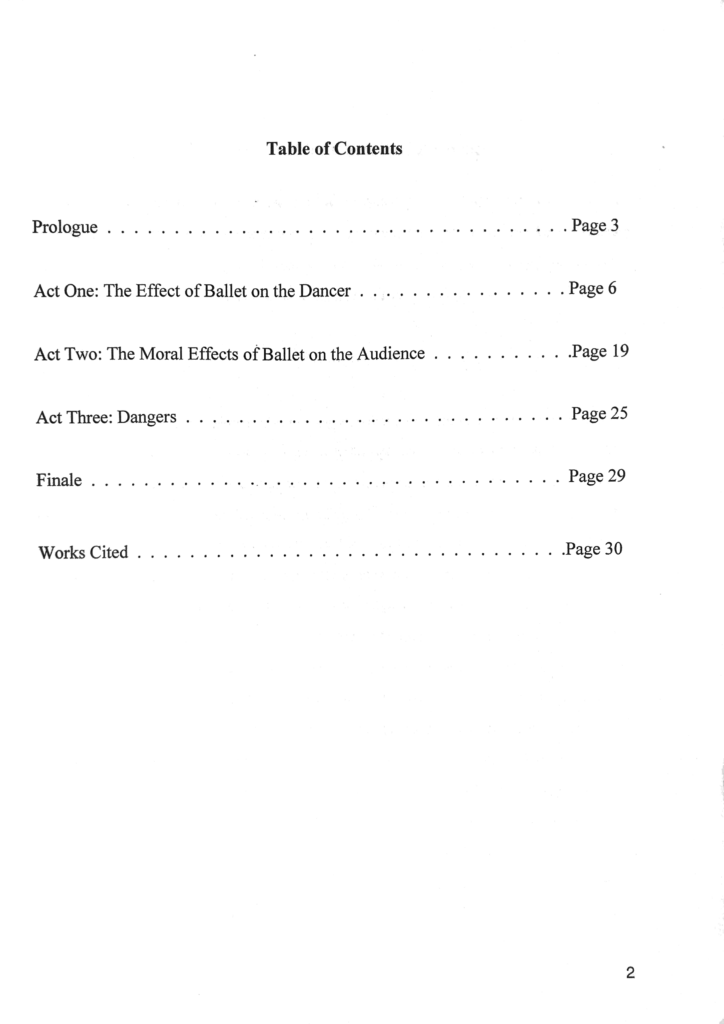
Act One: The Effect of Ballet on the Dancer
Scene One: Virtue from Practice
Ballet training focuses on the end result, a stunning performance, but the practice itself makes it an art form. I would say that ballet dancers do not simply dance for the sake of performance, but they also come to love the daily practice that classes and rehearsals provide. Performance is a culmination of technique learned through the years and practiced every day, and in it the practitioner realizes her transformation, but the daily repetition of class and rehearsal centers dancers and puts them in their true element. Ballet is a practice to which its followers are religiously devoted; they adhere to rules and techniques around which they build their lives for the sake of a greater purpose.
In his essay, “The Spirit of the Dance,” Myron Howard Nadel agrees that the practice of dance has profound spiritual effects on its practitioners, inducing a meditative state, for “there seems to be a genuine peace of mind (or at least search for it) among most clergymen and other religious people. Much time is spent in prayer and meditation in a search for inner peace. Through its intensity and discipline, dance training develops analogous powers of reflection and meditation” (15). While there is much self-reflection, dance should not become entirely self-centered, but rather submit to higher principles. In his book After Virtue, Alasdair MacIntyre outlines his definition of a practice in the context of his extension of a virtue-based Aristotelian ethics as:
Any coherent and complex form of socially established cooperative human activity through which goods internal to that form of activity are realized in the course of trying to achieve those standards of excellence which are appropriate to, and partially definitive of, that form of activity, with the result that human powers to achieve excellence, and human conceptions of the ends and goods involved, are systematically extended (187).
It is fascinating that MacIntyre chose to use the phrase “systematically extended” to describe what happens to the ends and goods of a practice, for extension is a word very frequently applied to ballet, and I don’t think that is a coincidence. Ballet instructors use the term to describe an outstretched leg and this is fitting, for in such a movement (and most movements in ballet), the energy is directed up and out. This is precisely what ballet dancers aim for — to extend themselves, to reach beyond themselves, the reaching of the body and the reaching of the soul so intimately connected that they happen simultaneously. Mind and body stretch at once. Every plie, every tendu, reaches beyond the one that came before. The pointed toe reaches, each muscle straining against the center support. Ballet is precisely an embodiment of the concept of extension. It travels, it suspends, flows, escapes, flies.
Ballet is sometimes criticized by modern dancers as being “afraid of the floor” for its dedication to creating such an extended line and using what are perceived as unnatural movements to push humans beyond the norm. In the era of their inception and also today, pointe shoes allowed dancers to appear to defy gravity, to supernaturally float and glide along the floor, to even further extend their lines.
Myron Nadel has a good response to the question of why it is important that dancers are challenged to extend themselves through the dance:
“Dance pushes the body to the utmost extremes. Such significant use of the most fundamental material thing we possess is as close to the essentials of the mind as use of any material thing can be. The opening of vistas for the body must necessarily expand the possibilities for the mind, and, it follows, for the spirit” (16).
I will elaborate on this close connection between the body and mind in my section on the moral effects of ballet on the dancer.
In his work Nicomachean Ethics, Aristotle discusses the value of what he calls crafts in aiming for different goods and actualizing the potential of the craftsmen. MacIntyre’s concept of a practice is built upon Aristotle’s crafts. The craft of ballet aims at excellence in dancing and of the dancer, which is then communicated to the audience. Every craft aims at some good, whether it is an activity or a product, argues Aristotle (1.1). The ends of the craft of ballet are the activity of fine dancing, its effect on the dancer, and beyond that, its effect on the audience.
According to Aristotle, the best good of all is our final end, which is happiness, and I believe that dancers can find this happiness in the practice of the virtues of their craft (1.2). True happiness through the action of dancing extends to the audience, who tap into the dancers’ self-actualization. The same type of active good is understood by the audience as by the dancer, but the greatest effect of all is felt in the larger community, so the best good of dancing is found there (Aristotle 1.2). The movement of ballet’s influence begins with the individual, spreads to her immediate community and through the strength of that community sways others.
The dancer’s life is devoted to the study of dancing, as a good in itself, rather than to investigation into what things are good in themselves, that is, philosophical study. All energies are put toward the activity of dancing, not the satisfaction of base desires, and the ballet dancer must be raised on the habits of ballet if she is going to succeed (Aristotle 1.4). Aristotle said that we must be grow up with fine habits if we are to be students of fine and just things (1.2).
Fine habits in ballet are the practice of its discipline and lead to the transformation of the dancer. The good of ballet, as with the good of each craft, is that for which it is done, it’s “end” (Aristotle 1.7). I cannot claim that ballet is the most complete good and will unfailingly lead to happiness, but it is certainly one way to cultivate virtues in individuals and groups.
Aristotle says that virtues are chosen for themselves (such as honor, pleasure, and understanding) and hence would be chosen even without a further result since they are self-sufficient, but that they are also chosen for happiness (1.7). Ballet is a self-sufficient activity that furnishes happiness and joy as well as virtue, and this is why dancers love their art.
Coming back to MacIntyre’s definition of a practice, ballet dancing has an extensive and coherent vocabulary which forms a complete system of complex movements that has developed and continued to evolve over time. Dancing is socially established and cooperative in that each practitioner works with, as well as against, herself and fellow dancers in aiming for the discipline’s standards of excellence. These standards inform the community of dancers and the larger world. I will more fully explain what these standards are in later sections. I will also explore what these ends and goods are in ballet and how they are “systematically extended.”
The end of ballet is simply to dance well, creating a beauty that you can feel and that others can see. You are constantly delving further into movement itself. If you asked me, or any dancer for that matter, why I dance, the answer is simply because I love the way it feels to be absorbed in its beauty. In the process of mastering the practice of ballet, a dancer develops virtues particular to dance and gains full possession of her body and mind.
Aristotle speaks of self-actualization through complete activities. Of the three types of good that Aristotle describes (external, body, soul) the goods of the soul, or internal goods, are good most fully. ballet is a good of the soul, as it is good in itself, though it also provides some of the fringe benefits to the body and limited external goods (Aristotle 1-7). These actions are called “complete activities,” since they are done for themselves and demand our full attention, removing an individual from outside considerations and creating a feeling of timelessness and devotion.
Aristotle claims that within complete activities we actualize our own potential for virtue, transforming ourselves and others. Merely the potential of virtuous activity (a state) is not complete without the activity of virtue (practice). The lives of people who are active in this way are pleasant in themselves. Aristotle calls virtuous activity good, fine, pleasant, divine and blessed (1-7). Dancers certainly know that potential for greatness is nothing without striving for it through disciplined practice, requiring a clear decision and determination. When ballet is practiced fully and correctly, it provides a deep sense of happiness.
Scene Two: Freedom Through Technique
There is a surrender that takes place, on a small scale in each ballet class, but also over time, when you begin by laying the foundation, the “dry” technique, and from there you can move to more expressive and free dancing. By technique, I mean the physical vocabulary of dancing, the steps and their correct performance. Hence dancers attend “technique class” each morning ot warm up and remind their bodies what they are up to.
It is very important to master a foundation of good technique so that it becomes a part of you before you give in completely to dancing, otherwise it cannot gain its full power: restraint must come first, freedom after. Once the foundation is in place, however, it is necessary to learn to let go in order to reach the fullest effect. To this end, ballet dancers strive to study at the best schools and get into the best companies, for there they will be taught properly and receive the best sort of focused, disciplined education that will in the end liberate them.
When I refer to the practice of dance, I mean the technique itself, plus everything else that goes along with it, the style, the relationship between practitioners which forms a lifestyle in itself. Ballet dancing requires so much of a person, she must be willing to make it the utmost priority in her life, at least until her career is through. Ballet becomes a comprehensive way of life.
MacIntyre further explains how practitioners submit themselves to the demands of a practice:
A practice involves standards of excellence and obedience to rules as well as the achievement of goods. To enter into a practice is to accept the authority of those standards and the inadequacy of my own performance as judged by them. It is to subject my own attitudes, choices, preferences and tastes to the standards which currently and partially define the practice (190).
Learning the rules of ballet is like learning a new language in which the only vocabulary is movement and, at least at first, this vocabulary can seem extremely restrictive. Ballet is criticized for its supposed limitation of movement, but I argue that this carefully ordered type of dancing ultimately becomes the most freeing by allowing us to go beyond the ordinary to represent human goods. The reason dancers, myself included, submit themselves to rigorous standards of excellence is that once they have practiced long enough, these same standards free them to do things they would otherwise never be capable of, extending their natural ability. Where once you were making a stab at seemingly awkward movements, now you can embody the movement and the spirit of dance. You are transformed by the performance of ballet, losing contact with time, your ordinary relationship with space, and your ordinary, limited self. The careful practice of ballet technique changes everything.
Technique in ballet is what MacIntyre calls “technical skills” and has developed over the years. Historically, ballet dancing originated in social court-dancing, which followed certain steps but required no great sacrifices to practice it, simply noble birth and an inclination. It then developed into a performing art, increasingly inclined toward virtuosity. Not just anyone could emulate the grace of the ballerina, rising up onto her toes, fluttering mesmerizingly and virtually flying across the stage. Nor could they emulate the strong and able presence of the premiere danseur, or leading male dancer, soaring through the air.
Eventually traveling dance companies formed. These companies performed in many different locales — ever refining their technique — enabling dancers to become professional practitioners of their art. Thus, ballet technique developed to enhance specific qualities of the art, such as strength, swiftness and balance which lend an almost supernatural quality. Ballet soon became quite complex and was carefully mapped out for instruction in an almost uniform syllabus. Those dancers who mastered these techniques formed a small elite population of skilled artists.
The development of fine ballet technique is a slow process and results are found at varying speeds. The practitioner must continually push her limits in order to develop. Though the movements become more comfortable and natural with repetition, it is important never to get fully comfortable where you are with your technique, because there is always more to be developed, always higher standards to reach for.
There is no limit to the heights that ballet can reach, and all of the breathtaking dancers in history have shown us that we can always do more than we at first think we can. Ballet is an endless process of habituation and assimilation (both Aristotelian concepts) involving positioning of the body that allows for maximum ease in transferring the weight, extending the legs, moving quickly in any direction and exercising utmost control. It opens the body to the audience and orients it to the stage and the other dancers. In their book Understanding Ballet, Mary Clarke and Clement Crisp explain the system of ballet dancing:
“Ballet training itself is a system of movement that has been developed over a period of three hundred years, but it is important to insist that the classical technique that students learn is an entirely logical and sensible method of movement. Its aim is to achieve maximum control and maximum mobility. ‘Turn out’ is the first basic principle of ballet training. The leg is taught to turn out from the hip socket to an angle of ninety degrees to gain freedom of movement and pleasing line. By giving the legs the greatest possible flexibility it enormously increases the range of movement of a dancer’s body (14).”
The framework of ballet dancing has a specific rationale and the dancer must possess a special sort of self-awareness, not just of her body, but of the state of her mind, in order to personally assess those areas which need improvement and which she needs to focus on. Complete focus and concentration on the task of dancing is required of each participant, as Nadel notes:
The dancer gets his technique in class, but he must review the purpose of technique constantly. We must never forget that the struggle against imperfections in the body leads finally to freedom of expression. A virtuoso’s trick may be regarded as a circus stunt unless it is vital to the expression of the artistic structure. . . The idea of discipline should not give illusions of rigidity or externally enforced rules. Instead, self-direction, understanding, and control are what an artist must develop to create his wares (Dance Experience 366).
The context of the ballet class opens up the possibility for development: it is quiet, plain, and designed specifically for the pursuit of one aim, to create beauty through dance. Regulations regarding dress, behavior, interaction and traffic flow, along with those regarding the method of movement, combine to set the stage, so to speak, for concentration on the activity of dancing. The space is literally opened up, the air cleared, to be devoted to dance. Nadel goes so far as to liken the practice of dancing to religious practice:
“Most dance forms, except some of the contemporary schools, have also adopted a ritual, which is designed to produce a good dancer. Ballet has very clear and formalized rituals, slightly altered from school to school but essentially the same. Ballet began in Europe and is practiced all over the world. When the dancer stands at the practice barre, he can be certain that the ritual he is about to perform is observed at the same time in many places. . . when a dancer puts on his “hat,” he is ready for the ritual of self-contemplation, hard physical labor, and the celebration of life (“Spirit of the Dance” 16).“
This is a significant analogy because it gets at what all practices have in common, from art to sports to spiritual practices. Each practice is submitted to overarching rules and rituals which shape the good for which it aims.
So what distinguishes a practice from simple technical skills? MacIntyre indicates that the goods involved are somehow extended:
“What is distinctive in a practice is in part the way in which conceptions of the relevant goods and ends which the technical skills serve — and every practice does require the exercise of technical skills — are transformed and enriched by these extensions of human powers and by that regard for its own internal goods which are partially definitive of each particular practice (193).“
According to MacIntyre, there are two sorts of internal goods produced by fine artists: the excellence of their products and the excellence of their lives lived as creators of those products.
Every practice is an art of living, and I will elaborate how dance is an example. MacIntyre uses the practice of portrait painting to illustrate: “what the artist discovers within the pursuit of portrait painting — and what is true of portrait painting is true of the practice of the fine arts in general — is the good of a certain kind of life… the painter’s living out a greater or lesser part of his or her life as a painter, that is the second kind of good internal to painting” (190).
He contrasts these internal goods with the external goods found in a practice such as recognition and monetary gain, but as I noted earlier, for dancers and much of the arts world, there is little in the way of external goods to be found.
The virtues of a practice are developed through working for the internal goods of that practice. MacIntyre defines a virtue as, “an acquired human quality the possession and exercise of which tends to enable us to achieve those goods which are internal to practices and the lack of which effectively prevents us from achieving any such goods” (191). This definition is an extension of Aristotle and other virtue-based ethicists’ conception of a virtue, since it involves activity within the context of a practice. Certain virtues are required of every practice (justice,
courage and honesty) since they are necessary for the unique kind of relationship between those who participate (past and present) in a practice (MacIntyre 191).
MacIntyre states that,
“virtues then stand in a different relationship to external and internal goods. The possession of the virtues — and not only their semblance and simulacra — is necessary to achieve the latter; yet the possession of the virtues may perfectly well hinder us in achieving external goods,”
and this certainly seems to be true of ballet (196). If you seek external goods as a ballet dancer, you most likely have come to the wrong place.
Aristotle makes a distinction between the virtues of thought and the virtues of character. He states that the virtues of thought (wisdom, good comprehension, prudence) arise from teaching, whereas the virtues of character (generosity, temperance) result from habit. Virtues are not natural, but we are by nature able to acquire them (Aristotle 1.13). In this sense, the virtuous person undergoes a transformation and goes beyond what she naturally is and become what she can be.
Aristotle explains that this is how we got the word “ethical,” which is derived from the word ethos which means custom or habit. Both thought and character virtues should be habituated in connection with one another, but this does not always happen. There are two ways, as I see it, to be inadequate in the virtues of dancing, the first is to not possess the preconditions for such virtue, and the second is to possess the potential, but never habituate yourself to actualize it.
As I mentioned with the actualization of potential for virtue in dancing, Aristotle asserts that if something arises in us by nature, we first have the capacity for it then later can perform the activity, therefore there is some underlying ability that must be brought out through the exercise of virtues of character (2.1). We activate these virtues in just the same way as we activate crafts, by realizing our already-present potential for them, thus actualizing our purpose (2.1).
Aristotle contends that virtues are not feelings or capacities, but instead states that are actualized by our activity (2.5). This is important to note, since it can be at odds with how we ordinarily conceive of virtue. Rather than the common, surface notion of virtue, Aristotle’s virtue expresses a deeper possibility within us and requires habituation and activity that can, if we let it, shape the entirety of our lives. Our virtue is ruined by excess and deficiency, but is preserved by the mean between these, which can be difficult to gauge (Aristotle 2.2). This is where dance and other practices can be tempted toward asceticism, when they are pursued to excess or in the wrong ways. While it is dangerous to go to either extreme, we must undergo through habituation in order to develop our virtue. Following a practice in the right way involves the avoidance of base pleasures and instead seeking higher activities for their own sake.
Selma Cohen speaks of actions for their own sake:
“Of all the arts to which dance has been likened that of lyric poetry offers the most significant analogies. Like dance, it is both rhythmic and expressive. It makes its statement in a manner that has an important sensuous appeal. In the words of Gerard Manley Hopkins, poetry is ‘speech framed to be heard for its own sake and interest above its interest of meaning.’ Dancing may be thought of as movement framed to be seen for its own sake and interest even above its interest of meaning (‘Prolegomenon to an Aesthetics of Dance’ 4).”
There are certain necessary conditions that must be in place in order for virtue to be developed: virtue must be voluntary (not by force or ignorance) and motivated internally rather than externally (Aristotle 3.1). This means that an individual cannot approach ballet for the sake
of vain concerns of developing her body or being thought graceful, but instead must recognize the value of the virtues of dancing and wish to dance for its own sake. All virtuous acts are chosen freely and for themselves and are thus judged by these tests. Dancing is a vehicle for the kind of self-actualization that Aristotle calls for that can extend into a life, indeed many lives.
Scene Three: Necessary Conditions
In ballet, building sound technique is of foremost importance, but in order to properly execute the steps, one must possess a body and mind with the potential to move in the style of ballet. This requires flexibility and strength in the back, hips, legs, and feet, a degree of slenderness that allows the lines to be seen and speed and a light appearance to be accomplished, as well as a mind that can pick up steps quickly, understand rhythms, and locate the dancer spatially and be dedicated to the years of concentrated technique honing. Obviously, each of these is further developed upon the serious practice of ballet. For example: dancers become
more supple and strong during their training and dancing tends to mold the body and mind to its requirements, but there must be some underlying ability to begin with.
There is some controversy about these necessary traits among those critical of ballet’s conventions. However, most people may gain improved grace, posture, musicality and other such skills by practicing ballet, and I would recommend it to almost anyone as an avocation, but only those with natural potential and the right physical structure can avoid injury under constant exercise and best practice the technique to become professionals.
Even when an individual possesses all of these favorable characteristics, there are still unteachable elements of performance that ballet, at its best, includes such as subtleties of expression and relationship to other dancers on stage that properly convey the mood and poignancy of a piece and take it from being a merely acrobatic feat to a riveting performance.
Dramatic ability, nuance, and stage presence all rely on the dancer’s own traits and cannot be imposed from without; they are innate abilities that can only plumbed from within and further enhanced through practice.
Dance is like music in this sense. It involves working toward an mpossible ideal of perfection through the practice of fine technique. And yet with dance, as with music, greatness cannot be achieved through technique alone. Technique becomes the support for your own (and the choreographer’s) expression and style. These can only be freed
with a mastery of the practice of ballet. And only a combination of natural talent, physical and mental potential, and sheer determination will get you there.
Further, claims MacIntyre, internal goods are advanced through competitive practice among dancers or practitioners since they “are indeed the outcome of competition to excel, but it is characteristic of them that their achievement is a good for the whole community who participate in the practice” (190). Just as MacIntyre emphasizes the importance of a community of practitioners and their admirers, so Aristotle before him told of friendship as an extremely important factor in establishing a strong community in which the virtues can be developed. In this way, ballet and the other arts are developed and extended to their audience. Every person, in Aristotle’s view, requires friendship in order to be virtuous, and dancers are no exception, since “the young need friends to keep them from error, the old to care for them and support actions that fail due to weakness, and those in their prime need friends to do fine actions” (8.1).
Friendship is necessary to the development and practice of all of the virtues, as well as being fine in itself, holding cities together and perpetuating justice (Aristotle 8.1). The essence of friendship is reciprocated goodwill (Aristotle 8.2) and this reciprocal nature is what promotes justice. Friendship creates a community of people who are seeking justice and whose life together allows the cultivation of virtue Aristotle 9.9). Without friendship, the project of all the practices and thus of the good, would surely fail!
Scene Four: Getting Beyond the Technique
Freedom at last! After many years of practicing the virtues of ballet, repeating the steps thousands of times over, one is able to put them together in such a fluid way that they are no longer individual movements or isolated moments, rather a seamless whole. Utter self-control is mastered, allowing the dancer to go beyond her previous limitations. Self-consciousness and even consciousness of the audience and of the other performers-as-such all disappear. One is left with the simple joy of dancing. When this transformation is enacted, the world is a different sort of world entirely, for without our ordinary self-consciousness, our everyday perceptions of time and space are changed.
Good dance is self-realizing, complete, and in-the-moment. It certainly fulfills Aristotle’s criteria for a complete activity, one in which the end is the activity itself, much like philosophizing. It subsumes all other desires and thoughts and, in a sense, the dancer is “danced” by the dance, becoming the instrument of a something beyond herself.
Dancing uses the body and the mind to transcend what was formerly “just” the body and “just” the mind. The ballerina is transformed, expanded, extended. Further, this transformation of the dancer is recognizable by not only the dancer, but anyone standing by, and the realization of the practice of ballet can bring about responses like Paul Valery’s, in his essay “Philosophy of the Dance,”
“It seems to him that this person who is dancing encloses herself as it were in a time that she engenders, a time consisting entirely of immediate energy, of nothing that can last. She is the unstable element, she squanders instability, she goes beyond the impossible and overdoes the improbable; and by denying the ordinary state of things, she creates in men’s minds the idea of another, exceptional state–a state that is all action, a permanence built up and consolidated by an incessant effort, comparable to the vibrant pose of a bumblebee or moth exploring the calyx of a flower, charged with motor energy, sustained in virtual immobility by the incredibly swift beat of its wings (59 emphasis mine).”
This passage perfectly describes ballet’s effect. In performance, time really does seem to stand still and the dancers are fully immersed in the act of dancing, passionate and all-consuming, suspended. Afterwards, however, it seems as if only moments have passed and both the dancers
and the audience are left wondering what, exactly, just happened to them.
Act Two: The Moral Effects of Ballet on the Audience
Scene One: The Demands of Beauty
Ballet, through its practice of various virtues and profound effect on its audience, ultimately has a positive impact on the community as a whole. This might seem like a stretch, but ultimately this is what ballet, and much of art, is about — aiming for an unattainable perfection — and I think that the audience can somehow see this.
The audience sees and feels the beauty of the practice. Dancers know that they are aiming for beauty, to recreate the wonder that they experience when watching accomplished dancers perform and the beauty that they observe in everyday experiences. Sometimes a ballet will tell a classic story, sometimes there will be no plot at all, but it always appeals to the beauty of the dance and the interaction of the dancers. Beauty fills the mind, yet invites the search for something beyond itself, causes us to gape, yet also prompts the mind to move chronologically back in the search of precedents and parallels, forward into new acts of creation, and over to bring things into relation (Scarry 29).
In her book, On Beauty and Being Just, Elaine Scarry writes of her conception of the moral content of beauty. An encounter with beauty involves a “felt experience of cognition at the moment one stands in the presence of a beautiful boy or flower or bird,” (Scarry 3) or other site of beauty, and causes the observer to automatically behave in certain ways due to the influence exerted. The simplest manifestation of this felt experience is the act of staring, much in the way that people behave while bird watching or other activities that seek out beauty (Scarry 5).
Scarry argues that there is a certain structure of perception at the moment one stands in the presence of beauty and that we find the beautiful thing incomparable and unprecedented and thus respond to it in specific ways (Scarry 22). She outlines three key features of beauty: it is sacred, unprecedented (makes the world new), and lifesaving (quickens, adrenalizes, makes the heart beat faster, makes life worth living!) (Scarry, 23-25). Scarry further argues that when we experience beauty we find that it greets or welcomes us, as if we have the wishes or consent of the beautiful object, and our arrival is contractual in that it is something both we, and the world we’re joining, want (Scarry 25). Beauty also has the uncanny ability to incite deliberation and a built-in liability to self-correction (Scarry 28). Due to all of these traits, we may conclude that beauty is, in fact, ethical.
The demands that beauty makes upon us go beyond the act of gazing in its presence. Thus we see that the thing beyond the dancers that, in effect “dances” them, is beauty. Beauty requires an act of replication, according to Scarry, bringing copies of itself into being, whether exact or unrecognizable.
Some examples of the copies that beauty incites are drawings, photos, descriptions and, most applicable in this case, dances. Beauty is the inspiration for further beauty (Scarry 3). All artists respond to this requirement in their own way. The practice of ballet is one very powerful way in which we can pass on the joy of experiencing beauty, and a particularly effective one, since we watch the beauty unfold before us through the actions of the dancers.
Upon witnessing beauty, we feel compelled to make the beauty of the thing we experience more evident, ever more “clearly discernible” (Scarry 5) to others. We want others to behold the beauty that we have discovered in the world, and to this end we tell others of our experiences or recreate the moment in other ways. Beauty communicates the idea of eternity
through the continual passing-on of the experience of beauty, the perpetual duplication and distribution of a moment that never stops (Scarry 5).
According to Scarry, beauty also causes a phenomenon called “radical decentering” (109) which requires us to give up our imaginary position at the center of the world in favor of a transformation that takes place at the very roots of our sensibility (111). Beauty is unique in that we willingly cede our ground to the thing that stands before us (Scarry 112). Once we give up our ego-centeredness, our entire world opens up and we are present to the experience of beauty and those around us.
Beauty greatly aids the project of ethics, as anything which alters consciousness in the direction of unselfishness, objectivity and realism is to be connected with virtue, and beauty enacts a sort of “unselfing” on us, making some greater mental act possible (Scarry 113).
“Aesthetic fairness” assists the project of “ethical fairness,” both of which require a symmetry of people’s relation to one another (Scarry 114). Fairness refers to both loveliness in countenance and an ethical requirement or pact (Scarry 91). It can be found in our relationship to beautiful things as well as just political involvements or good relations with one another. Scarry believes that equality is at the heart of beauty; that it is pleasure-bearing, the morally highest and best feature of the world (98).
The remarkable thing about the symmetry, equality, and self-sameness of physically beautiful things (such as the sky) is that they are present to the senses, whereas the symmetry, equality and self-sameness of just social arrangements are not (Scarry 101). This, we shall see, is part of what makes ballet so effective at conveying virtue, goodness, and justice, since it is embodied and hence its influence is literally felt in the body of the viewer. Beauty is a call which exerts pressure toward ethical equality (Scarry 109).
Scarry claims that there exist three sites of beauty: the suspended state of beholding, the active state of creating, and the site of stewardship in which one acts to protect or extend a fragment of beauty already in the world or supplement it by bringing a new object into being (Scarry 114). This last, creation, is important to the continual distribution of beauty to others and the process of fairness and virtue. It is the impetus for creating through one’s practice.
We must keep in mind, however, that though human beings have created much of the beauty of the world, we are only collaborators (with beauty) in a much vaster project (Scarry 108). Beauty, such as the transformation enacted by dancers, is a magnificent aid to justice, since inspiring awe and the desire to act is a wonderful manner in which to inspire people to goodness. Justice is assisted by any perceptual event that so effortlessly incites in us the wish to create (Scarry 115).
Scarry claims that beautiful things, like dancing, have forward momentum and that the perception of the audience can be expanded by experiencing its requirement of plenitude and distribution (46; 48). Dance is the ideal medium for expressing forward momentum. Finally, our desire for beauty is likely to outlast its object, as beauty we create will likely outlast us, because the pleasure we take in beauty is inexhaustible (Scarry 50).
Beauty and justice both require a certain type of community in order to thrive, as I discussed earlier regarding Aristotle’s Nicomachean Ethics. The work that beautiful persons and things accomplish is collectively accomplished, with different persons and things contributing to the work for different lengths of time (Scarry 51). Also, groups of people with the common aim of undertaking beauty and justice tend to perpetuate such goals for the benefit of all.
Scarry asserts that the same sort of perceptual acuity is required to recognize injustice and maintain an openness to beauty; that a deep concern with beauty goes hand in hand with a concern for good and it in fact sharpens our perceptual acuity for the work of addressing injustice (60; 62). The structure of perceiving something has a two part scaffolding: one’s attention is involuntarily given to the beautiful person or thing; this quality of heightened attention is voluntarily extended out to other persons and things (Scarry 81). Scarry writes of the advantages beauty confers: “The benefit of the extraordinary is twofold: first, in the demands it (without our invitation) places on us in its own behalf; second, in the pressure it exerts toward extending the same standard laterally” (67).
When a beautiful object and an admirer come together, they become one, at least for a little while. There is an innate continuity between beauty and its beholder: the beholder, in response to beauty, seeks to bring new beauty into the world and hence beholders of beautiful things themselves become beautiful in their interior lives (Scarry 88-89).
Scene Two: How the Practice of Ballet is Unique
The amazing thing about ballet specifically, as a transformative practice, is that it is not only a beautiful physical manifestation of virtue and justice, it is actually in motion. The transformation is being played out before your eyes; the dancers and audience can physically experience the feeling as it conveys them into the future, spreading its potency among them, inspiring them ever onward and upward.
Scarry herself argues that the experience of beauty is kinesthetic and somatic — that what happens, happens to our bodies, and we are brought into a different relation to the world (111). This is so clear in the experience of dancing! Watching dance makes people want to dance as well, has a real effect on their bodies, and makes them want to make it a part of themselves and explain and translate it in any way they can!
The dancing of inexperienced amateurs and that of masterful professionals are worlds apart, but the first is a step along the way to the second. In the case of the beginner, there is a strained sense of concentration, a struggle to gain control, to coordinate musicality with the individual steps and patterns onstage and with other dancers. There is a self-consciousness before the audience and a feeling that the movement is unnatural or contrived. This leaves the dancing disjointed and incomplete — as a result, both the performers and the audience are unable to suspend their disbelief, their ordinary preoccupations, their attachment to the everyday. The continued practice remains important, for virtue is attained through action — the amateur is just not yet at the point of being able to pass the call of beauty on to an audience.
With a ballerina or danseur who is as close to ideal as can be, however, the dancing appears effortless, seamless and utterly coordinated. Tension and release in the dance are utterly within the dancer’s control. The audience grasps each nuance of expression and is effectively carried away from their normal life and perceptions of limitation, allowing them to seem to transcend limitations like time and space.
One of the interesting things about dancing, as a work of art, is that since it is performed, it is constantly becoming and never just “being”. Also, the dancer is the dance — they are an inseparable whole. The art takes place embodied, over time, and cannot last as a physical artifact, only as a living tradition. After years of training and hours and months of rehearsal, a performance seems to go by in a moment. Ballet is a constant process and does not neatly sit in a corner. It tells a story and expresses emotion, but rarely explicitly.
More important is the communication of beauty. Performance alters the experience of dancing — the dancer finally learns to trust her foundation in technique and become consumed by the dance. She embodies dancing and is filled with joy. Time and space no longer behave in the same way — there is only dancing. Pain goes away, as do the everyday thoughts that crowd your mind, your awareness of others and yourself as such. In her essay, “Phenomenology: An Approach to Dance,” Maxine Sheets explains:
“The dance, as it is formed and performed by the dancers, is a unity of succession, a cohesive moving form, and so it is to the audience. What appears before us is not an externally related series of spatial-temporal befores, nows, and afters, but a form which is ekstactic, in flight, in the process of becoming the dance which it is, yet never fully the dance at any moment (46).“
Dancers practice to a point where they no longer experience the stage in the same way, from mirrored rehearsal space to open auditorium. There is effortless interaction with many other dancers, synchronization of all movements and breathing.
In many ways, ballet with a partner is the most exciting of all. Intense rehearsal is required, for it is much more complicated than dancing alone and requires total trust in one another. Once it is learned, however, it changes the whole experience of dancing, perhaps because the ethical influence of ballet, in its symmetry of relations, is precisely what is happening on stage between the dancers. Partnering is a good example of embodied symmetry of relations, as Susanne Langer explains:
In a pas de deux the two dancers appear to magnetize each other; the relation between them is more than a spatial one, it is a relation of forces; but the forces they exercise, that seem to be as physical as those which orient the compass needle toward its pole, really do not exist physically at all. They are dance forces, virtual powers (“Virtual Powers” 30).
The give and take between two dancers and their absolute trust are symbolic of equal interactions in “real” life.
Act Three: Dangers
As we have seen, ballet creates a tremendous momentum for good. Still, the practice of ballet has come under attack from the outside. These attacks, however, are grounded in perceptual misunderstandings about the nature of ballet.
Scene One: Mistaken Good
The terms that Aristotle, MacIntyre and Scarry use obviously do not only describe the art of ballet dancers, for many other fine and performing artists and musicians live similar lifestyles and have similar aims, but I simply wish to speak for the dancers and their role as living, breathing art.
I also do not intend to suggest that all ballet dancers are saints, but their lives do possess the potential to develop certain virtues in the context of dance and to embody them so that others are moved and effected. MacIntyre acknowledges the imperfections of practitioners but asserts that the spirit of the practice remains through its true adherents:
“It is no part of my thesis that great violinists cannot be vicious or great chess-players mean-spirited. Where the virtues are required, the vices also may flourish. It is just that the vicious and mean-spirited necessarily rely on the virtues of others for the practices in which they engage to flourish and also deny themselves the experience of achieving those internal goods which may reward even not very good chess-players and violinists (193).”
There are two ways to err while seeking the good in ballet: one is committed by the dancers themselves and involves an excess of striving or striving toward the wrong goal; the other is committed by the audience in mistaking what the good of ballet is.
At its best, ballet is a wondrous and engaging art that audiences of all ages and walks of life can learn from and enjoy. The danger lies in the possibility for the practice to reach unhealthy extremes. Aristotle rightly emphasized the importance of seeking the mean between extremes when aiming at the good, not seeking to be ‘extremely good,’ but to be precisely in accord with virtue. Ballet possesses wonderful potential, but can also verge on the ascetic. With too much emphasis on technique, speed and lightness, ego and physical perfection, the practice can be lost, the beauty subsumed.
There is a fine line between the ordinary struggle that makes good ballet dancing and fosters virtue and the sort of struggle that only creates disorder. In the worst cases, ballet can become isolating and controlling, bringing on a variety of disorders. These distorted behaviors are not what I have in mind when I describe ballet at its best, but due to the demanding nature of the practice and the fragility of people, the pressure involved with ballet dancing can become too much in some cases. The same is true of many other practices, such as music and sports.
Such phenomena of disorder can stem from one choreographer or other person in a position of power exerting a negative influence and encouraging ascetic tendencies. In his work, The Saints of Modern Art, Charles A. Riley shows how the famed choreographer of the New York City Ballet, George Balanchine, often verged on the ascetic ideal:
“The body is always the starting point in dance, but some choreographers take an ascetic approach to achieve gravity-defying, pure effects that the normal body cannot attain. Balanchine, after the publication of his ex-dancers’ memoirs, is the bete noire for the speed, elongation, thinness, and stamina that he ‘sadistically’ demanded of his dancers, some of whom turned to drugs, plastic surgery, anorexia, and other extreme measures to give him that perfection (4).”
I would argue that such “gravity-defying, pure effects” can be reached without resort to illness, but that, again, it can be difficult to balance. Riley elaborates on the possibility for asceticism in
contemporary ballet, stating:
“The asceticism of twentieth-century dance can be explored through its classicism, use of repetition, and emphasis on rhythm. As in the work of Philip Glass, the accumulated repetition of some dance induces a static sense of time. In the simplest terms, looking in a circle, movement with precision but without progress, becomes an ascetic emptying out. The classicism of Balanchine, which also performs this emptying, adds a level of anachronism. For some, it is a timeless quality that, like the silence of the dancers, offers a canvas on which their own dreams can be painted (Riley 237).“
Dancers follow the directions of one teacher during a class, and several instructors usually make up their daily class and rehearsal schedule, but they do not and should not submit themselves to the direction and scrutiny of one person only, but to the broader study of ballet as a tradition and an ever-evolving discipline.
As I noted earlier, dance is in large part a reflective exercise in which dancers assess their own progress with the help of their immediate dance community. This is important, because good ballet happens among the ballet community, not just where one person imposes her idea of what ballet should be upon the others.
There are choreographers and great dancers in history who have had a large role in the progress of ballet, but its genius is in community and not shaped by individuals alone. Although ballet may seem a somewhat ancient and established practice, it is always advancing and dancers continually test their personal limits and raise the bar for excellence and responding to the society they live in. Nadel points out the mistake of focusing too much on oneself in dancing, rather that advancing the beauty of the practice:
“Concentration on oneself can become a narcissistic exercise, but this is merely another imperfection to overcome. When the body can be looked at as an object or vehicle for the will of the mind, the narcissistic inclination can be controlled. Meditative thought directed toward the self is vital to the dance. (Nadel 15)“
Scene Two: Errors in Judgment
Another danger in the practice of ballet is error on the part of observers, which can include dancers themselves, while watching others. I will use this concept of Elaine Scarry’s to more fully explain how a ballet audience may be mistaken about beauty.
As Scarry notes, beauty is accused of many things unjustly. This applies especially well to ballet. Beauty is sometimes disparaged for the “contagion of imitation” that it inspires, such as the temptation to dress like movie stars or try to be thin and graceful like dancers, but these are just imperfect versions of its deeply good movement toward replication (Scarry 6).
People correctly recognize beauty, but at times mistake what is begging to be replicated and how they should go about answering the call. Beauty is additionally disparaged for stimulating a sort of material cupidity and possessiveness, but this, Scarry argues, is just yet another imperfect instance of an otherwise positive outcome (7).
Scarry goes on to assert that beauty has a self-correcting quality, in that when we make mistakes in judging an object or performance not to be beautiful, if we are continually in its presence, we will tend to experience a very sudden change of heart. We may rule out something as an object of beauty then all of a sudden, in a “revisionary moment” realize our mistake. Such revisionary moments take place as an abrasive crash, a kinesthetic correction of perception in response to our formerly failed perceptual generosity (Scarry, 11-12; 14). In other words, “one lets things into one’s midst without accurately calculating the degree of consciousness required by them,” writes Scarry (15). When we miscalculate, beauty presents itself with the most force, showing us our error.
She concludes that we cannot reject beautiful things for giving rise to false outcomes as well as true ones, as this would result in what she terms “deteriorated vision,” (Scarry 10) a truly un-fair
treatment of beauty.
One might think that giving attention to a beautiful thing would detract from other sites of beauty, but this is not so, for it normally seems to heighten, rather than diminish, the acuity with which one sees the next beautiful instance (Scarry 18). The more beauty we are privy to experience, the better we become at recognizing beauty when we stumble
across it unawares.
Finally, the idea that “natural” beauty does not deserve attention is not very strong, since many things we unembarrassedly admire, and rightly so — great math skill, a capacity for musical composition, the physical agility of a dancer or speed of an athlete — entail luck at birth (Scarry 78). While dance does require some innate ability and potential, so does every other practice, so this does not disqualify it as a valid site of beauty to be appreciated, only categorizes it as one particularly specific site.
Finale
I have argued that the practice of ballet allows the attainment of otherwise unrealizable potential within the practitioner. Dancing is a self-actualizing activity, wherein dancers submit themselves to a structured technique in order to extend themselves and transcend their limitations. Through this activity they may become happy and virtuous. In performance they extend this good to the audience, who in turn sees and feels the beauty of the dance and the realization enacted by the dancers and wishes to participate in it.
Those who have experienced beautiful dancing greatly desire to do something; to replicate their experience and create their own beauty and virtue, thereby extending themselves. A mutually beneficial cycle has thus begun that spreads the contagion of both beauty and justice or “fairness” to the community at large. Ballet is unique due to its embodiment of a discipline and its virtues and is literally moving to watch. Mistakes in understanding and communicating the beauty of ballet are mistakes about the internal goods, not the practice itself.
While investigating this topic, I have learned about the relationship of practices to a life in pursuit of virtue and how submitting to the call of beauty and of an initially constraining practice can ultimately free your inner potential. I have put words to my experience in dance and the deep benefit and inspiration I feel that people can receive from experiencing it. I have discovered arguments that align with my experience regarding criticism and defense of ballet and have identified what has gone wrong when dancers exhibit disorder.
Now I understand why dance, of all arts in practice moves me most, philosophically as well as physically, and I hope to share the value of ballet with others. Ballet truly is a living art, an art of living.
Works Cited
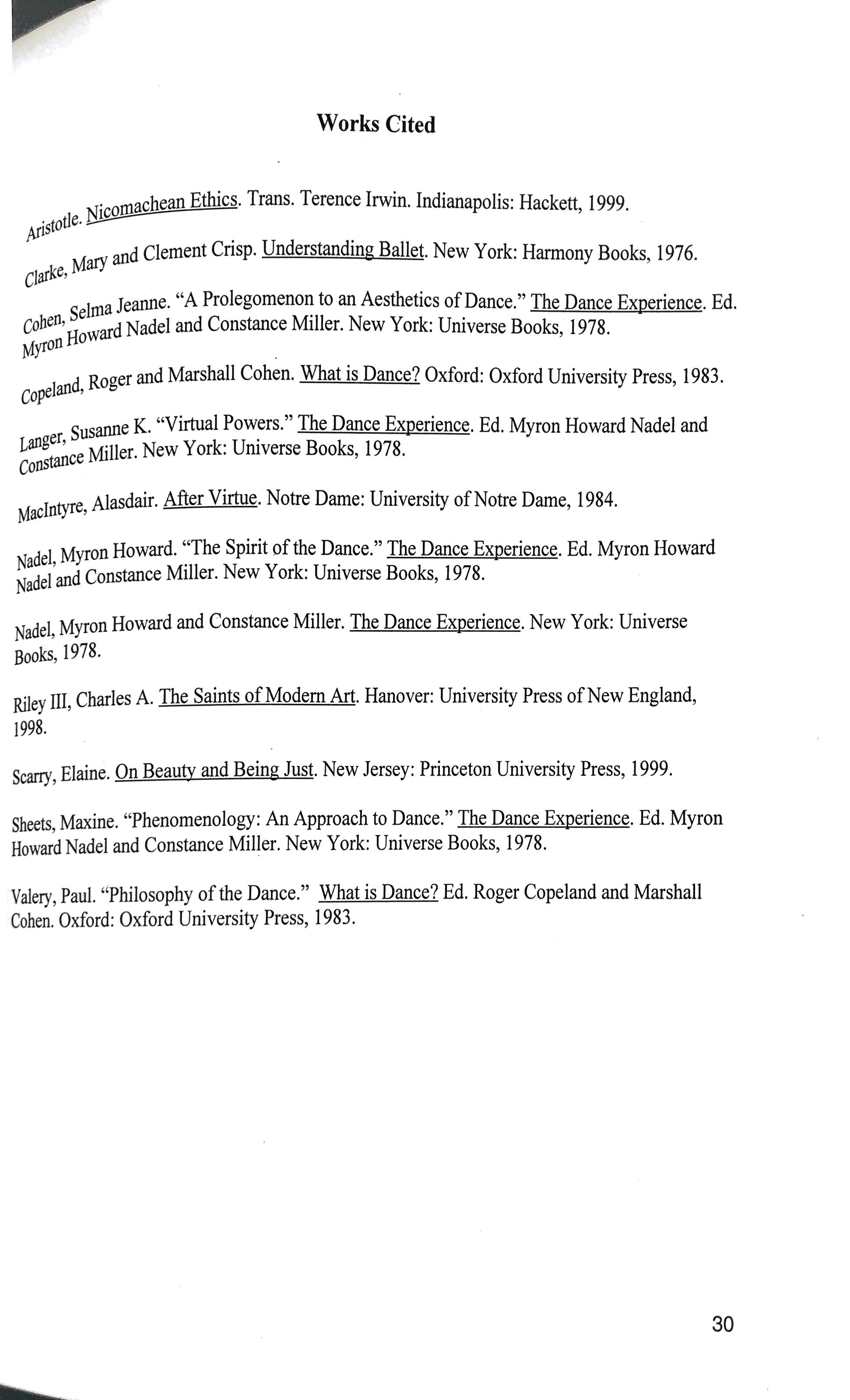
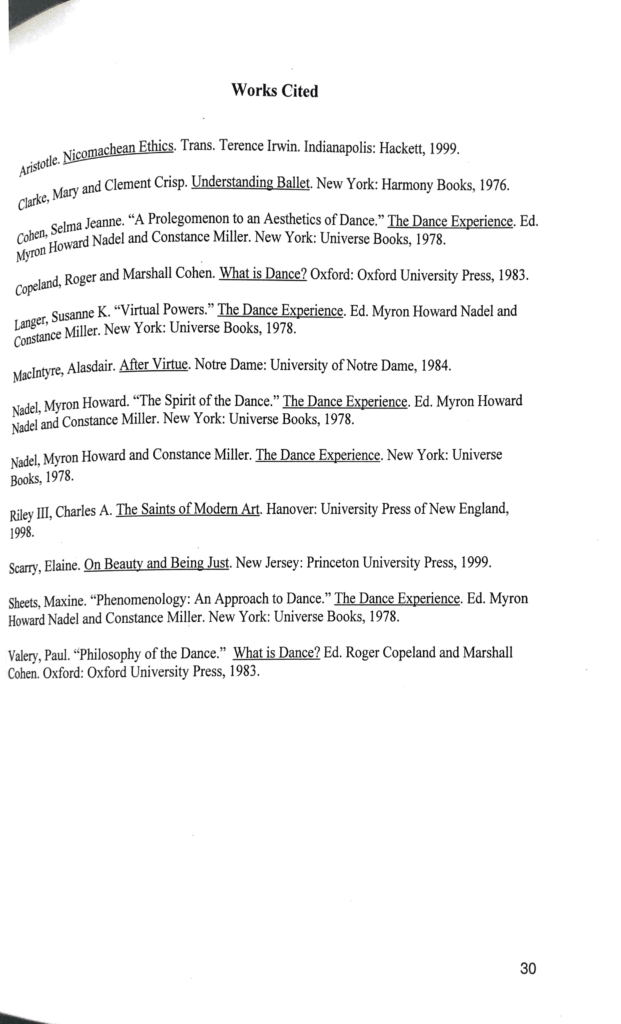
- Aristotle. Nicomachean Ethics. Trans. Terence Irwin. Indianapolis: Hackett, 1999.
- Clarke, Mary and Clement Crisp. Understanding Ballet. New York: Harmony Books, 1976.
- Cohen, Selma Jeanne. “A Prolegomenon to an Aesthetics of Dance.” The Dance Experience. Ed. Myron Howard Nadel and Constance Miller. New York: Universe Books, 1978.
- Copeland, Roger and Marshall Cohen. What is Dance? Oxford: Oxford University Press, 1983.
- Langer, Susanne K. “Virtual Powers.” The Dance Experience. Ed. Myron Howard Nadel and Constance Miller. New York: Universe Books, 1978.
- MacIntyre, Alasdair. After Virtue. Notre Dame: University of Notre Dame, 1984.
- Nadel, Myron Howard. “The Spirit of the Dance.” The Dance Experience. Ed. Myron Howard Nadel and Constance Miller. New York: Universe Books, 1978.
- Nadel, Myron Howard and Constance Miller. The Dance Experience. New York: Universe Books, 1978.
- Riley III, Charles A. The Saints of Modern Art. Hanover: University Press of New England, 1998.
- Scarry, Elaine. On Beauty and Being Just. New Jersey: Princeton University Press, 1999.
- Sheets, Maxine. “Phenomenology: An Approach to Dance.” The Dance Experience. Ed. Myron Howard Nadel and Constance Miller. New York: Universe Books, 1978.
- Valery, Paul. “Philosophy of the Dance.” What is Dance? Ed. Roger Copeland and Marshall Cohen. Oxford: Oxford University Press, 1983.

Questions for Reflection
- What goods do you create through artistic practice?
- How do you express meaning and value?
- What does inquiry bring to the creative and educational context?
- Which sources inspire you to live a purposeful life?
- What does dance provide to you?
- What do you want to know about dance & art?
Resources for Further Exploration
- Sourcing Ballet Somatically – Pedagogical Approaches to Integrating Movement Techniques Article
- Emancipatory Dance – Dancing Intersectional Feminism Article
- How (and Why) to Take Dance Notes – Class, Rehearsal, Performance Writing to Grow & Create Article
- Real Criticism – Fraught to Fabulous, Fine to Fugly Feedback Examples Article
- Current Notebook Lineup – Analog Journals for Creativity Article
- Goal-Setting for Dancers Article
- Dance Teaching Portfolio from my secondary teaching credential program at UH Manoa College of Education including my Teaching Philosophy
Further topical explorations, special workshops and collaborations in dance, coaching, creative living and more coming soon.
Thank you for reading, for being, and for dancing with me, in spirit or in fact!
Take care of yourself and keep moving mindfully, let me know how if I can be of service, would love to see you in my email newsletter or on social media as well.
Blythe Stephens, MFA & Bliss Catalyst
they/them or she/her
Creator of A Blythe Coach @ablythecoach
helping multi-passionate creatives dance through their difficulties,
taking leaps of faith into fulfillment through coaching, yoga & dance education