
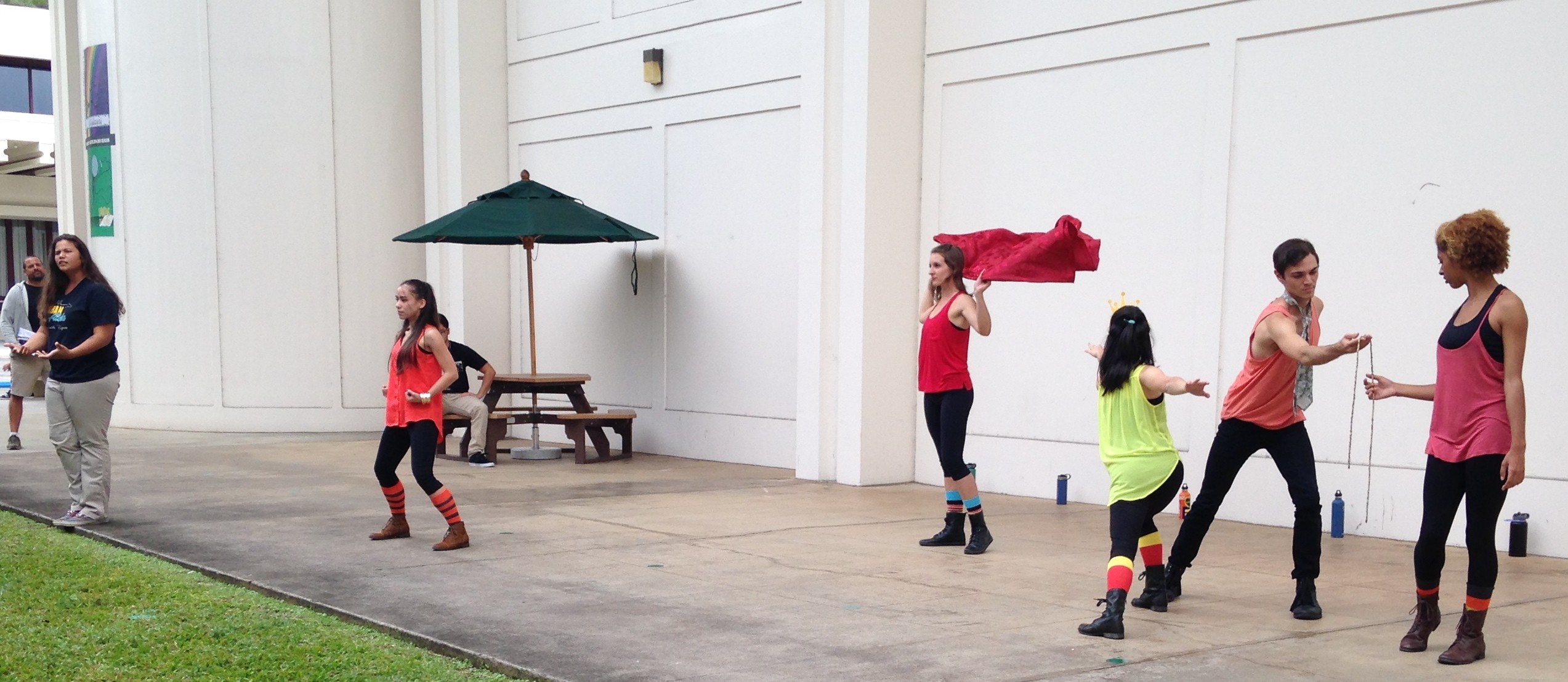
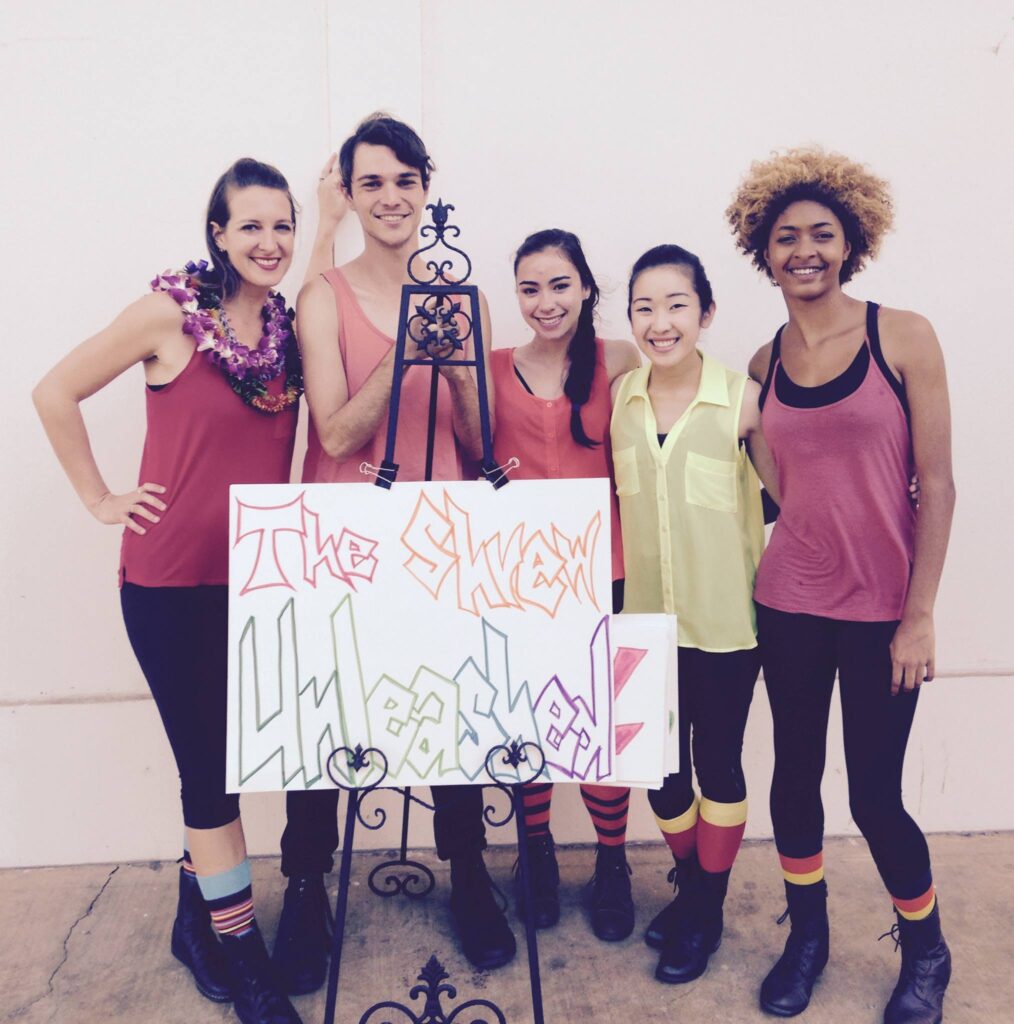
It’s been a hot minute (11 years at the time of this article) since I submitted “THE SHREW UNLEASHED: A DANCE AND POETRY EVENT IN CONJUNCTION WITH THE TAMING OF THE SHREW” for my Master’s Thesis in Choreography and Performance, but the issues raised are still relevant to my current movement research projects and broader societal conditions.
Therefore, I share it with you who might be interested in what such a collaborative, text-informed, and site-specific dance work can look like.
The Shrew Unleashed: a Dance and Poetry Event in Conjunction with The Taming of the Shrew
“The Shrew Unleashed” is a creative feminist response, in poetry and dance, to the misogynistic messages in Shakespeare’s play “The Taming of the Shrew.” It is a green show performed by five dancers and a poet in three parts: selected Shakespearean sonnets, an Audience-Participation “Spontaneous Dance Poem,” and “Wonder Woman,” a spoken-word poem. Performances for school and public audiences took place March 11-15, 2015 inside and outside the Kennedy Theatre at the University of Hawai‘i at Mānoa. Themes in the work include the power of words, empowerment, and social justice.
The full text is available to read as a PDF document with supporting documents and images below and is also published on Academia.edu:
Shakespeare’s Sonnets
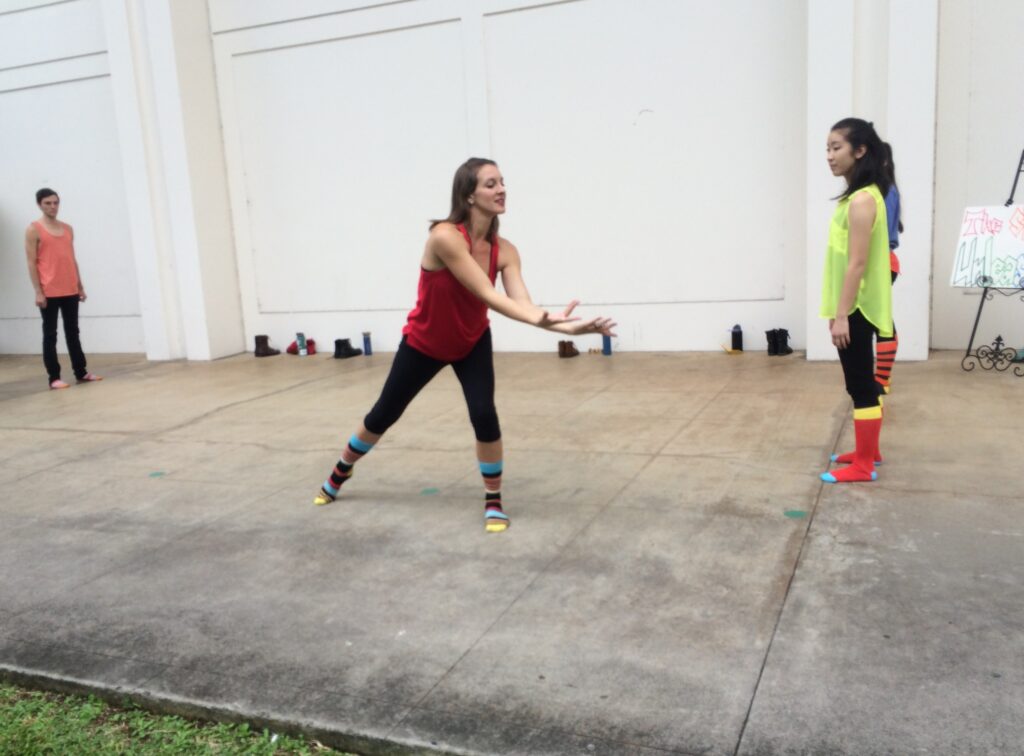
Since the work was text-based, an integral part of my choreographic process was selecting which texts to use as a starting point. As a discussion of and response to “The Taming of the Shrew,” I wanted to include a section consisting of Shakespeare’s works, in order to illuminate the difficult but beautiful heightened language with movement.
Since the work was designed for a young audience (middle school, high school, and above), I wanted to include a social media element and conducted an informal survey via Facebook about Shakespearean works friends would recommend for such a project. Among the recommendations I received were selections from Shakespeare’s plays, such as A Midsummer Night’s Dream, and Henry V as well as sonnets.
I wasn’t sure that dialogue would make sense out of context, and wanted to provide a variety of perspectives while maintaining brevity, so decided to use a selection of sonnets, which would prove to be nuggets of text on which to build dance.
Selection of the poetic text served as the jumping-off point for the choreography and I worked with colleagues, friends, and the cast to select which sonnets we would use and decide who among the cast members would dance for each. I read and researched the sonnets, taking recommendations, reading academic research about the sonnets, and taking into account the
themes I wanted to carry over from The Taming of the Shrew, such as love, friendship, identity, power, and the passage of time.
In all, we presented seven Sonnets choreographies, and here are two video examples:
60: Like Waves
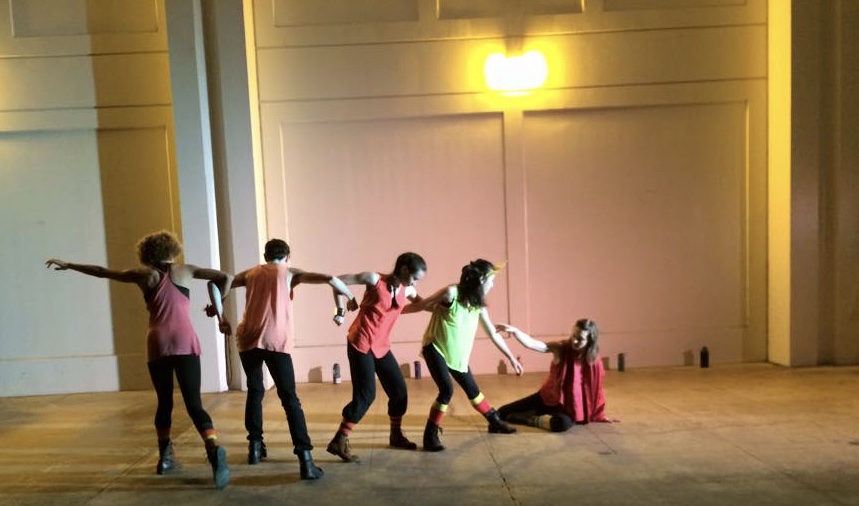
“Sonnet LX (60),” “Like Waves,” incorporates many themes from throughout the Sonnet Section and ultimately was chosen to conclude the section, bringing it full-circle by speaking of time, death, beauty, maturity, praise, and the ocean. This sonnet gives me the feeling of being resigned to an inevitable fate, in awe and powerless. For this final sonnet, we moved away from a narrative interpretation and chose to depict how “the waves make toward the pebbled shore,” rising, falling, turbulent, sustained, strong, bound and at times free, wringing and pressing with the tides (Figure 8.9 shows the turbulence, ebb, and flow of the dancing). I was able to draw on my studies of water for my piece, “Undertow,” to inform the choreography for this sonnet. In order to dance the movements of the waves, this last sonnet was performed as an ensemble, descending and ascending diagonals from upstage right to downstage left. Structurally
it worked well to have five dancers, as we rotated through the lines of poetry, first dancing as we advanced, and then speaking as we retreated, until the last two lines of text, the first of which was spoken two words at a time, the second in unison for a strong final statement.
52: Treasure
“Sonnet LII (52),” “Treasure,” speaks of how perhaps absence, or limited contact, can make the heart grow fonder, and shares the themes of time, love, longing, sweetness and richness with other selected sonnets. It can be found in Figure 2.5. “Sonnet 52” has a luscious sumptuousness that immediately attracted me, with imagery of jewels, feasts, and special robes. I was excited to share a Shakespearean Sonnet that sensuously alluded to pleasure and desire, with sensuous but appropriate language, so I chose it to be a solo for myself, with movements that were direct (either towards or away from the object of my desire), and alternately strong and quick (in resistance to the pull of pleasure) or light and sustained (savoring). The “regal” gesture motif appears at the beginning during the first line, “So am I as the rich,” and the movement follows a somewhat narrative line as I explored an imaginary landscape of chests of fine clothes and jewels, shelves and tables of delicious food, and a lover that infrequently visits.
Wonder Woman Slam Poem
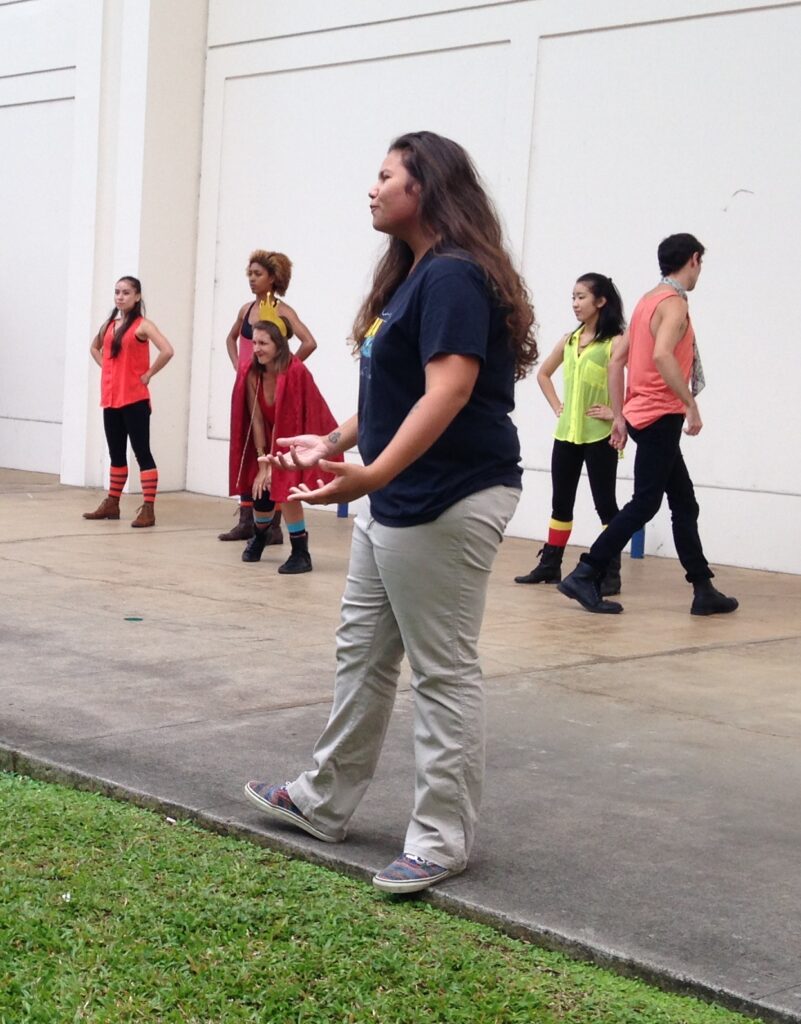
The dancers and I collaborated with Jenna Robinson to select subject matter and themes for an original poem that would respond to the misogyny in The Taming of the Shrew in an empowering way, providing entertainment as well as a call to action for our audiences.
Originally I referred to this poem as a “slam,” since this is the style of competitive performance poetry I have seen Robinson and others perform at poetry slams here in Hawai‘i and in the continental U.S., and it is a term that may appeal to general audiences. However, as we worked together I realized that outside of a competition context, the poetry may appear in print or be performed in other contexts and Robinson considers herself a “performance poet” more broadly than a “slam poet.” I kept the language the same in our marketing materials to grab attention, but in this work will simply refer to “Wonder Woman” as a poem rather than a slam poem. Robinson, who earned a BA in History from the University of Hawai‘i, has competed on the Hawai‘i National Slam Poetry Team, and co-founded the local nonprofit Urban Aloha to benefit youth programs, and I have wanted to collaborate on a dance and poetry project ever since we became familiar with one another’s work several years ago, and the thesis project created a good platform.
Robinson and I discussed the major themes and goals of The Shrew Unleashed and she provided drafts of the “Wonder Woman” poem, which the dancers and I would read and improvise to, considering possible movements and our audience. Robinson then edited the drafts in response to our feedback.
Spontaneous Dance Poem
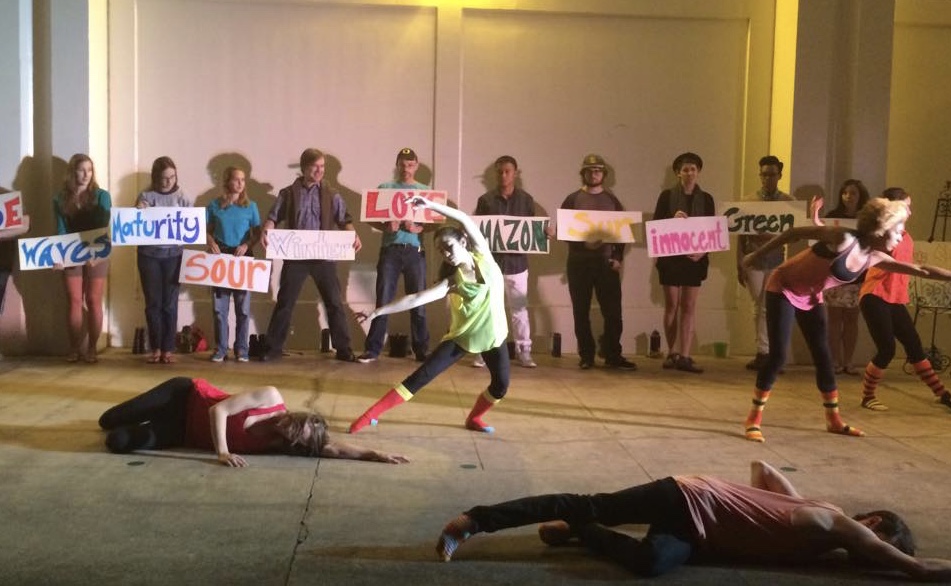
Once the sonnets were chosen and “Wonder Woman” developed, I chose keywords from those existing texts to use in the creation of the Audience-Participation “Spontaneous Dance Poem.” Jenna Robinson created poetic lines for each keyword, and the dancers and I chose key movements and movement sequences to correspond. The last portion of the poetry development for this section was creating the “chance procedures” process to facilitate the “Spontaneous Dance Poem” section. The process of selecting which keywords and corresponding movements would be performed is detailed in Figure 3 of the full text.
Works Cited
- SparkNotes. SparkNotes. Web. 25 Mar. 2015. http://nfs.sparknotes.com/sonnets/.
- Barton, John. Playing Shakespeare: An Actor’s Guide. New York: Anchor, 2001. Print.
- Blom, Lynne Anne, and L. Tarin. Chaplin. The Intimate Act of Choreography. Pittsburgh, PA: U of Pittsburgh, 1982. Print.
- Brandstetter, Gabriele, and Gabriele Klein. Dance (and) Theory. Bielefeld: Transcript, 2013. Print.
- Chang, Jeff. Can’t Stop, Won’t Stop: A History of the Hip-hop Generation. New York: St. Martin’s, 2005. Print.
- Clark, Noelene. “Wonder Woman Cast: Gal Gadot to Star in Batman-Superman film.” Web. 15 Apr. 2015.
- “The Complete Works of William Shakespeare.” The Complete Works of William Shakespeare. Web. 21 Mar. 2015. http://shakespeare.mit.edu/.
- Culler, Jonathan D. Literary Theory: A Very Short Introduction. Oxford: Oxford UP, 1997. Print.
- “Discoveries.” Discoveries. Web. 14 Apr. 2015. http://www.scrc.us.com/discoveries/feministstruggle-in-shakespeares-the-taming-of-the-shrew/.
- Hackney, Peggy. Making Connections Total Body Integration through Bartenieff Fundamentals. Amsterdam: Gordon and Breach Pub., 1998. Print.
- “Shakespeare’s Sonnets.” Shakespeare’s Sonnets. Web. 23 Mar. 2015. http://www.shakespeares-sonnets.com/.
- Sternberg, Robert J., and Wendy M. Williams. Educational Psychology. Boston: Allyn and Bacon, 2002. Print.
- “Teaching Tools.”: Movement Has Meaning. Web. 02 Apr. 2015. http://movementhasmeaning.com/teaching-tools/.
Questions for Reflection
- What texts inspire your artistic practice?
- How do you express meaning and value?
- What does inquiry bring to the creative and educational context?
- Which movement research and dance choreography practices do you employ?
- What does dance provide to you?
- What do you want to know about dance & art?
Resources for Further Exploration
- The Practice of Ballet, an Art if Living – BA in Philosophy Thesis Article
- Sourcing Ballet Somatically – Pedagogical Approaches to Integrating Movement Techniques Article
- Emancipatory Dance – Dancing Intersectional Feminism Article
- How (and Why) to Take Dance Notes – Class, Rehearsal, Performance Writing to Grow & Create Article
- Real Criticism – Fraught to Fabulous, Fine to Fugly Feedback Examples Article
- Goal-Setting for Dancers Article
- Dance Teaching Portfolio from my secondary teaching credential program at UH Manoa College of Education including my Teaching Philosophy
Further topical explorations, special workshops and collaborations in dance, coaching, creative living and more coming soon.
Thank you for reading, for being, and for dancing with me, in spirit or in fact!
Take care of yourself and keep moving mindfully, let me know how if I can be of service, would love to see you in my email newsletter or on social media as well.
Blythe Stephens, MFA & Bliss Catalyst
they/them or she/her
Creator of A Blythe Coach @ablythecoach
helping multi-passionate creatives dance through their difficulties,
taking leaps of faith into fulfillment through coaching, yoga & dance education